Spécialiste des outils coupants certifié ISO 9001 depuis 2009, nous fournissons des fraises en bout HSS de précision à 30+ pays du monde entier.
Fraises en bout HSS (Fraises en acier rapide)
Conçu pour les centres d'usinage CNC et les fraiseuses manuelles, nos fraises en acier rapide offrent des performances optimales sur les métaux ferreux et non ferreux. Par rapport aux fraises en carbure, Les outils HSS offrent une meilleure rentabilité pour la production de volumes moyens.
Spécifications techniques:
Qualités des matériaux:
- M2/M35 (Certifié DIN/ANSII)
- HSS-Co8 (8% teneur en cobalt)
- HSS-E (Vannéadium amélioré)
Gamme de tailles:
- Diamètre: 0.5-25mm (tailles personnalisées disponibles)
- Longueur de la flûte: 2xD à 10xD
Revêtements:
- Étain (or): 600Indice °C
- TiAlN (violet): 800Indice °C
- TiCN (gris): Idéal pour l'acier inoxydable
Avantages de base en matière de performances:
1 Durée de vie prolongée de l'outil
Le HSS allié au cobalt démontre 50% durée de vie plus longue que l'acier rapide standard lors de nos tests d'abrasion ASTM G65.
2 Configurations multi-flûtes
Choisissez parmi:
- 2-flûte: Idéal pour le fraisage de l'aluminium
- 4-flûte: Idéal pour la finition de l'acier
- 6-flûte: Finitions miroir sur alliages
3 Revêtements résistants à la chaleur
Notre technologie de revêtement exclusive réduit la température de coupe de 15-20% par rapport aux revêtements standards.
Applications industrielles:
- Automobile: Usinage du bloc moteur (Étude de cas: Temps de cycle réduit de 22% pour le fournisseur BMW)
- Aérospatial: Composants d'avion en titane
- Moule & Mourir: Fraisage de cavité en acier P20
- Électronique: 5Fabrication du dissipateur thermique G
Guide de sélection:
Pour l'aluminium:
- Recommandé: 3-flûte, 45° hélice
- Éviter: Revêtement TiN (provoque un bord accumulé)
Pour l'acier inoxydable:
- Doit utiliser: Revêtement TiCN/TiAlN
- Optimal: 4-conception de flûte
Section FAQ:
Q: Fraises en HSS ou en carbure?
UN: HSS offre une meilleure ténacité pour les coupes interrompues, tandis que le carbure offre une résistance à l'usure plus longue.
Q: Comment identifier les fraises usées?
UN: Rechercher:
- Formation de bavures
- Dégradation de l'état de surface
- Bruit inhabituel lors de la coupe
Conseils d'entretien:
- Utiliser du liquide de refroidissement pour l'acier inoxydable
- Réduire la vitesse d'avance lors de l'usinage de matériaux durcis
- Conserver dans son emballage d'origine pour éviter d'endommager les bords
Obtenez votre devis personnalisé dans 24 heures. Contactez nos experts en outillage à sales@cutterbest.com
Notre entreprise est spécialisée dans la fabrication et la personnalisation d'une large gamme d'outils de coupe, dédié à l'amélioration de l'efficacité de la production des clients et à la réduction des coûts de fabrication. Nous proposons des solutions d'outils complètes adaptées à divers matériaux de coupe, englobant l'acier au carbone (environ. Dureté HB225), acier allié (Dureté HB225 ~ 325), acier pré-trempé (jusqu'à dureté HRC45), acier trempé (Dureté HRC40 ~ 61), et en fonte. Ces solutions répondent à divers besoins de coupe, y compris les coupes droites, coupes courbes, Coupes en L, coupes de rainures, coupes à l'arc interne, coupures d'arc externe, Coupes en forme de T, forage, et filetage.
Nos outils de coupe en carbure excellent dans le traitement des types d'acier susmentionnés, offrant des performances exceptionnelles avec une tolérance de précision de seulement ± 0,02 mm. Cela garantit que nos clients peuvent obtenir sans effort une qualité de coupe de qualité professionnelle., ce qui fait de nous votre partenaire idéal pour les solutions d'outils de fraisage.
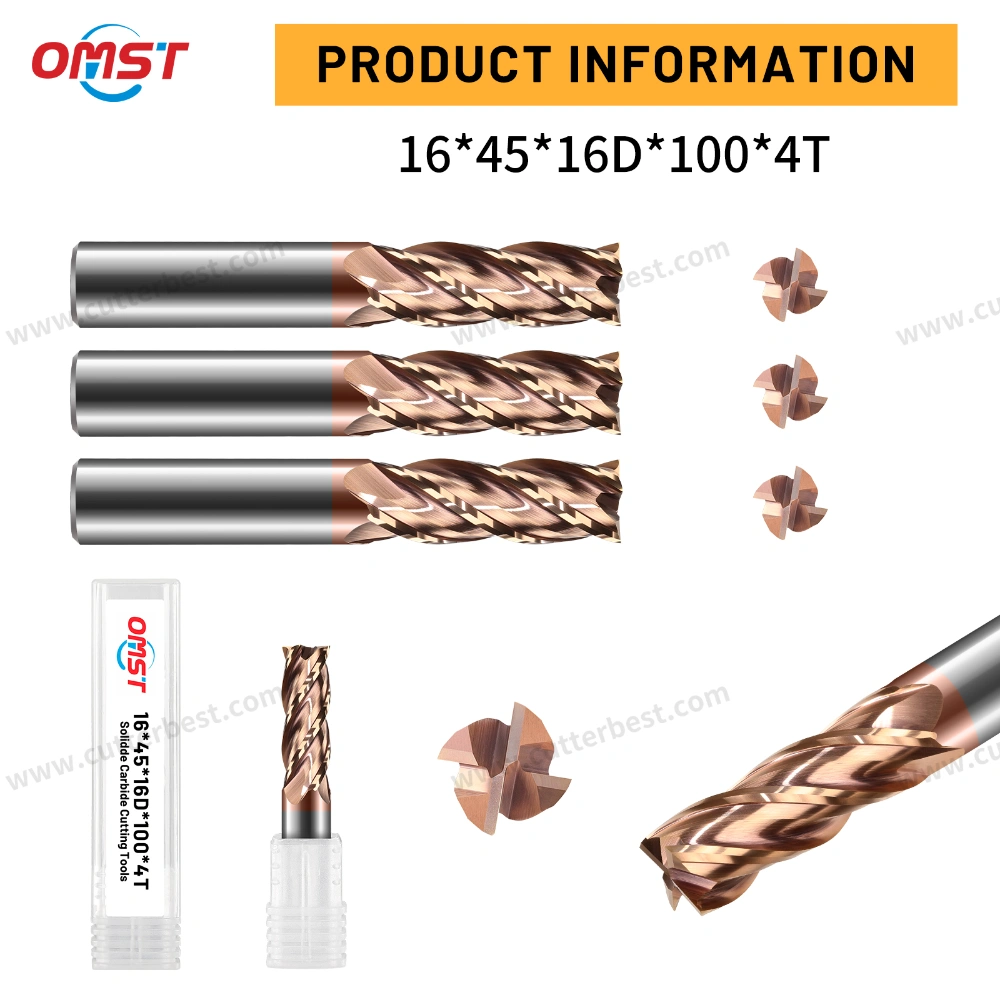
Nous pouvons fournir des services de production OEM personnalisés. Si nos fraises en carbure standard ne répondent pas à vos exigences, vous pouvez personnaliser le diamètre entre 0,2 mm et 25 mm, la longueur totale de 50mm à 200mm, et choisissez des flûtes de 4F, 5F, 6F, ou 8F. Vous pouvez également ajouter votre propre logo. N'hésitez pas à nous contacter pour tout besoin.
| Spécification | Jarret
Diamètres(D) | Flûte
Longueur(LC) | Complet
Longueur (L) | Diamètres
(D) | Flûtes
(F) |
| 1/2"1"3"1/2"4F | 1/2" | 1" | 3" | 1/2" | 4F |
| 1/4"3/4"2-1/2"1/4"4F | 1/4" | 1/4" | 2-1/2" | 1/4" | 4F |
| 1/8"3/8"1-1/2"1/8"2F | 1/8" | 3/8" | 1-1/2" | 1/8" | 2F |
| 1/16"3/16"1-1/2"1/8"2F | 1/16" | 3/16" | 1-1/2" | 1/8" | 2F |
| 3/8"1"2-1/2"3/8"4F | 3/8" | 1" | 2-1/2" | 3/8" | 4F |
| 3/16"5/8"2"3/16"2F | 3/16" | 3/16" | 3/16" | 3/16" | 2F |
| 3/32"9/32"1-1/2"1/8"2F | 3/32" | 9/32" | 9/32" | 1/8" | 2F |
| 5/8"1-1/4"3-1/2"5/8"4F | 5/8" | 1-1/4" | 3-1/2" | 5/8" | 4F |
| 5/16"13/16"2-1/2"5/16"4F | 5/16" | 13/16" | 2-1/2" | 5/16" | 4F |
| 5/64"3/16"1-1/2"1/8"2F | 5/64" | 3/16" | 1-1/2" | 1/8" | 2F |
| 7/64"3/8"1-1/2"1/8"2F | 7/64" | 3/8" | 1-1/2" | 1/8" | 2F |
T1: Êtes-vous une société commerciale ou un fabricant?
UN: Nous sommes un fabricant, spécialisé dans ce domaine des outils de coupe depuis plus de 15 années.
T2: Quels types de produits proposez-vous?
UN: Nous fabriquons des fraises en carbure, forets pour le forage, alésoirs, fraises, former des forets, outils de tournage, moulins à fileter, inserts, et nous couvrons également divers outils de coupe non standard.
T3: Fournissez-vous des services OEM ou ODM?
UN: Oui, en effet. Nous proposons des services OEM et ODM pour répondre aux besoins spécifiques de nos clients..
T4: Avez-vous des échantillons gratuits ou des réductions?
UN: Des échantillons gratuits peuvent être fournis si les clients acceptent de payer les frais d'expédition. Pour la première commande, les nouveaux clients reçoivent un coupon de 50 USD pour les commandes supérieures à 500 USD, et profitez d'un 5% réduction pour les commandes supérieures à 5 000 USD.
Q5: Comment garantir la qualité des outils de coupe?
UN:Nous garantissons les matériaux & fabrication, utiliser du carbure de première qualité, et effectuer des inspections rigoureuses conformes aux normes ISO, de la matière première au produit final, avec 100% vérifications des dimensions clés avant l'expédition.
Q6: Puis-je spécifier mon propre transitaire?
Bien sûr, nous pouvons livrer la marchandise à l'agent maritime désigné par le client.
Juste 4 étapes pour traiter votre commande:
1.Dessin:Vous pouvez envoyer des images de produits régulières existantes ou des dessins 3D du produit à notre responsable commercial.
2.Citation:Basé sur les spécifications du produit, exigences, et technologie de traitement, nous vous fournirons un devis. Veuillez confirmer les exigences finales avec notre directeur commercial.
3.Produire:Après avoir confirmé le contrat et le calendrier de livraison sans aucun problème, nous organiserons la production dès réception du paiement pour assurer une livraison dans les délais.
4.Livraison:Une fois que les marchandises ont passé l'inspection de qualité, ils seront expédiés conformément au calendrier convenu et aux modalités logistiques spécifiées dans le contrat.
Paiement:
Pour les principes de sécurité des transactions et de coopération à long terme, nous adoptons généralement les virements bancaires et Western Union comme méthodes de paiement, ou nous négocions davantage en fonction de la commande spécifique.
Livraison:
Compte tenu du poids du produit, volume, chronologie du transport, et les frais de transport, nous proposons plusieurs solutions d'expédition pour répondre à vos besoins de transport.
Expédition express:
EMS et DHL international express sont couramment utilisés, et les livraisons arrivent généralement dans 3 à 10 jours,Si votre logement est éloigné , il faut payer plus pour un endroit éloigné , ou changer pour expédier par EMS
Fret aérien:
Le fret aérien est sûr et rapide, adapté aux envois urgents et aux gros articles dépassant 100 kg. Il faut généralement 3-10 jours ouvrables, avec des délais de transit variables selon les pays.
Fret maritime:
Le fret maritime convient aux grosses commandes en raison de son faible coût, mais avec des délais de livraison plus lents, allant généralement de 30 à 50 jours
 Fraise de précision,Outils de coupe pour l’usinage CNC de chaque matériau