 Präzisions-Fräser,Schneidwerkzeuge für die CNC-Bearbeitung jedes Materials

Einführung
An end mill cutter is one of the most common cutting tools used in CNC machining and milling operations. It is designed to remove material from a workpiece with cutting edges on both the end and the sides, which makes it more versatile than many other tools.
Unlike a standard drill bit, an end mill cutter can perform several machining tasks, including slotting, Seitenfräsen, Profilierung, Konturierung, and surface finishing. Because of this flexibility, it is widely used in machining aluminum, Stahl, Edelstahl, and other materials.
If you are new to this tool, this guide will help you understand what an end mill cutter is, how it works, what types are commonly used, and how to choose a basic cutter for different CNC applications.
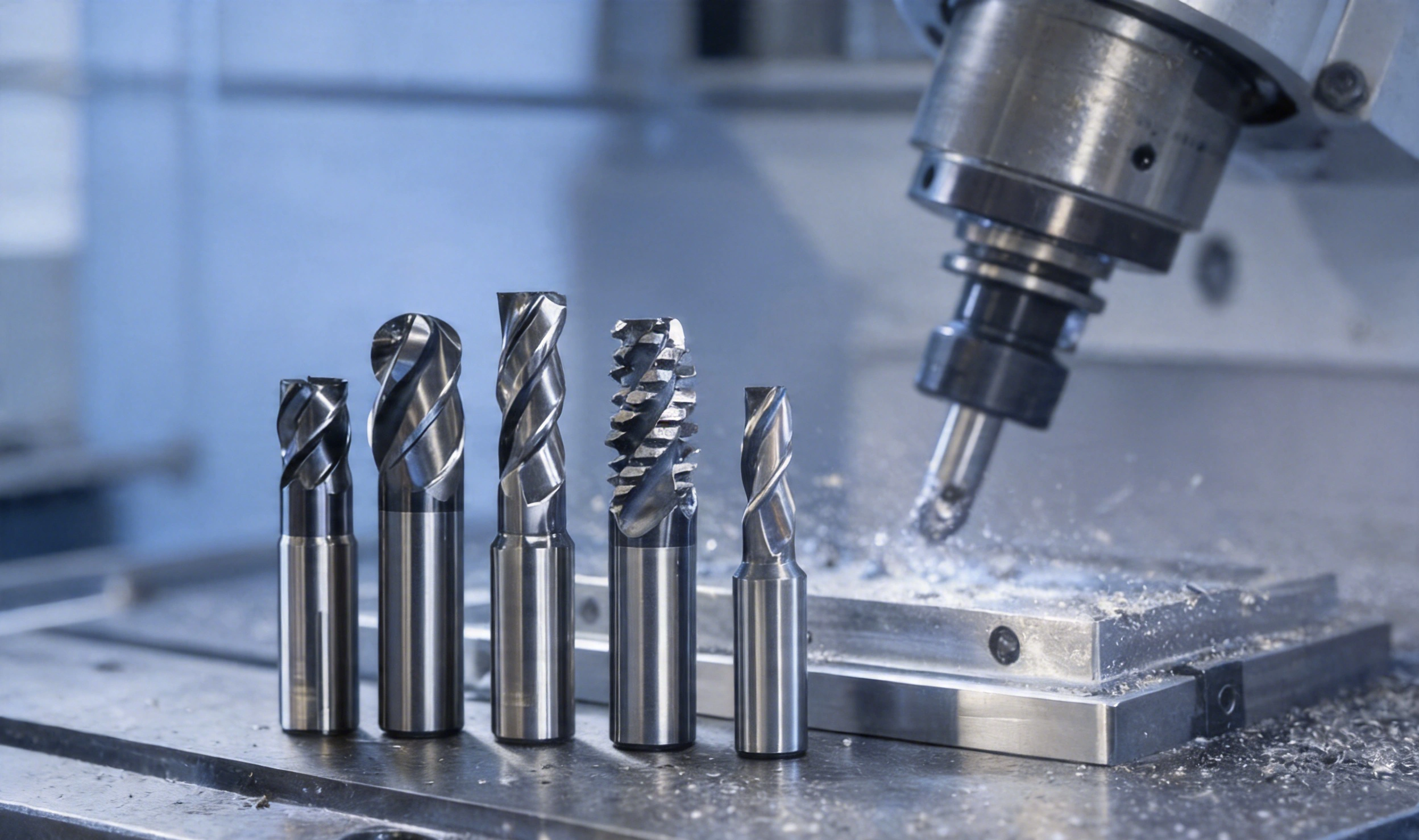
Was ist ein Schaftfräser??
An end mill cutter is a rotary cutting tool used on CNC machines and milling machines. It rotates at high speed while the tool or workpiece moves in a controlled direction to remove material.
What makes an end mill cutter different from many other tools is its cutting geometry. It usually has cutting edges on the tip and along the sides, so it can cut vertically and laterally. Infolge, it is suitable for a wide range of machining operations, from simple slotting to more complex contouring work.
End mill cutters are commonly made from high-speed steel or solid carbide. In modern CNC machining, solid carbide tools are often preferred because they offer better rigidity, higher wear resistance, and more stable cutting performance.
If you want to learn more about practical applications, you can also read our guide on what is an end mill cutter used for.
Main Parts of an End Mill Cutter
Although end mill cutters come in different shapes and designs, most of them include several basic parts.
Schneidende Kanten
The cutting edges are the working part of the tool. They remove material during milling and directly affect cutting efficiency and surface finish.
Flöten
Flutes are the grooves along the body of the cutter. They help remove chips during machining and influence chip evacuation, Steifigkeit, and cutting performance.
Tool Tip
The tool tip design varies depending on the cutter type. Some cutters have flat ends, while others have ball nose or corner radius geometry.
Schaft
The shank is the part held by the tool holder or spindle. Its diameter must match the holder correctly to ensure stable clamping and machining accuracy.
Beschichtung
Many end mill cutters use coatings such as TiAlN, Altin, or DLC to improve wear resistance, Hitzebeständigkeit, und Standzeit.
These parts work together to determine how the cutter performs in different materials and machining conditions.
End Mill Cutter vs Drill Bit
Many beginners confuse an end mill cutter with a drill bit. Jedoch, they are designed for different purposes.
A drill bit is mainly used for making round holes. By contrast, an end mill cutter can perform side cutting, Schlitzen, Konturierung, pocketing, and finishing operations in addition to plunge cutting in some cases.
Quick Comparison Table
| Besonderheit | Schaftfräser-Fräser | Bohrer |
|---|---|---|
| Main Function | Milling, Schlitzen, Profilierung, seitliches Schneiden | Drilling holes |
| Cutting Direction | Axial and lateral | Mainly axial |
| Typische Verwendung | Slots, pockets, Konturen, side walls | Round holes |
| Tool Flexibility | Higher | Lower |
| Common CNC Use | General milling operations | Hole-making operations |
daher, although both tools remove material, they are not interchangeable in most machining situations.
Common Types of End Mill Cutters
There are many types of end mill cutters, and each design is intended for specific machining tasks.
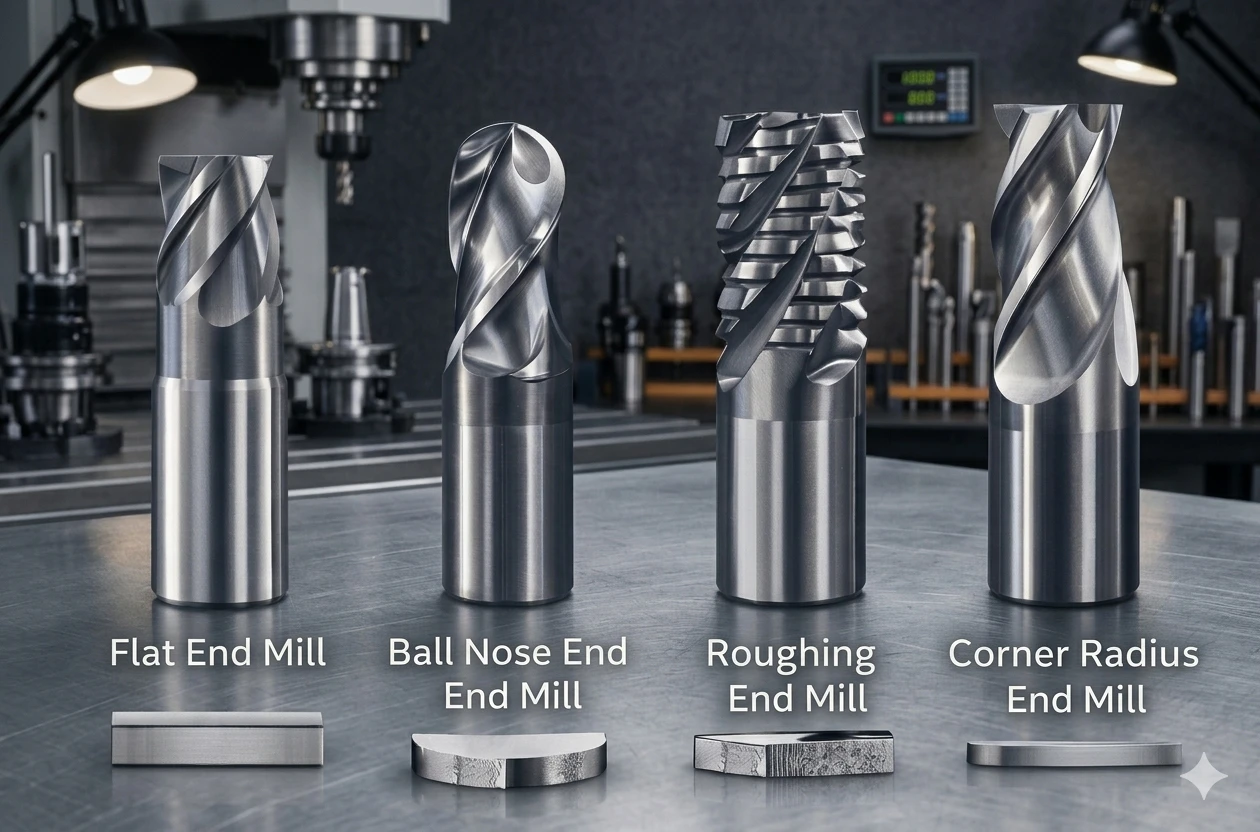
Flacher Schaftfräser
A flat end mill is one of the most common types. It is widely used for slotting, Seitenfräsen, and general-purpose machining.
Kugelfräser
Ball nose end mills are commonly used for contouring, 3D machining, und gekrümmte Oberflächen. They are especially useful in mold and die work.
Corner Radius End Mill
A corner radius end mill combines a flat bottom with rounded corners. It can improve edge strength and help achieve smoother transitions.
Schruppfräser
Roughing end mills are designed for aggressive material removal. They are often used when machining large amounts of stock before finishing.
Konischer Schaftfräser
Tapered end mills are used for angled walls, deep cavities, and some special machining applications.
If you want to explore more geometry options, you can also read our guide on types of end mill cutters.
What Is an End Mill Cutter Used For?
End mill cutters are used in many common CNC machining operations.
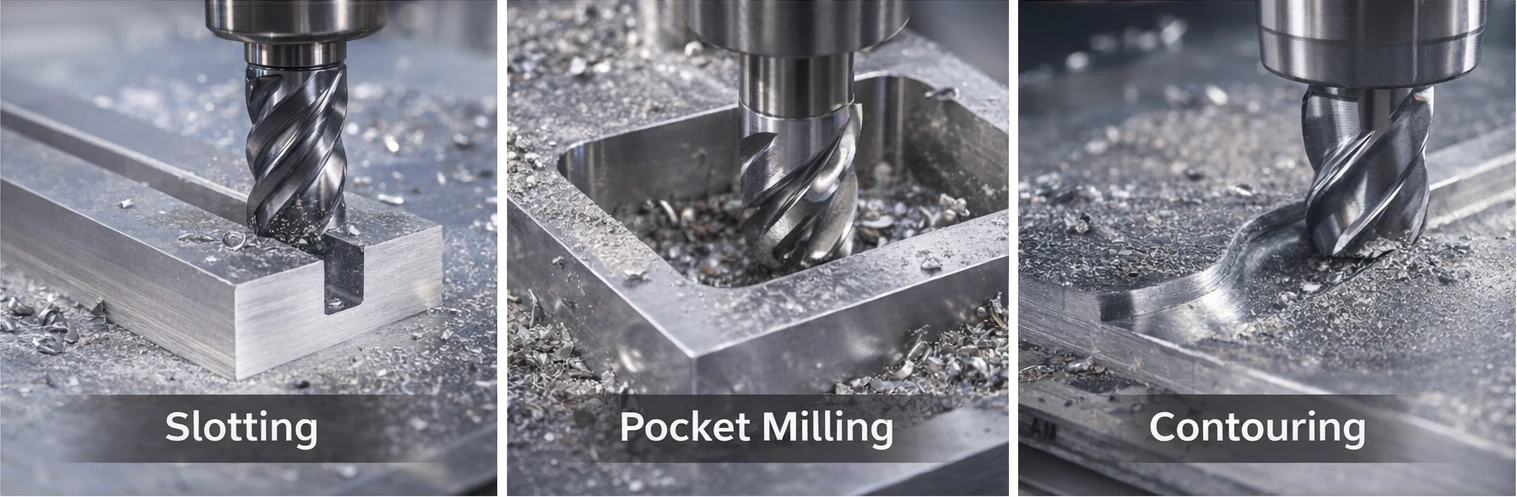
Schlitzen
They are often used to cut straight slots and grooves in metal parts.
Side Milling
They can machine vertical surfaces and side walls with good dimensional control.
Profiling and Contouring
They are suitable for machining complex shapes, curved paths, and 3D surfaces.
Pocket Milling
They are widely used to remove material from closed areas or cavities inside a workpiece.
Surface Finishing
With the correct geometry and cutting parameters, they can produce a smoother finished surface.
Because of this wide range of uses, end mill cutters are commonly applied in mold making, Maschinenteile, automotive components, Teile für die Luft- und Raumfahrt, and general metalworking.
For more practical examples, read our guide on end mill cutter uses in CNC machining.
How to Choose a Basic End Mill Cutter
Choosing a basic end mill cutter does not need to be complicated, but several factors should be checked before ordering.
Werkstückmaterial
The material being machined is one of the most important factors. Aluminium, Stahl, and stainless steel usually require different flute designs, Beschichtungen, and cutting strategies.
Flötenzählung
In vielen Fällen, 2 flute tools are suitable for aluminum because they provide better chip evacuation. In der Zwischenzeit, 4 flute tools are often used for steel and general-purpose machining because they offer better rigidity.
If you want a deeper comparison, read our guide on 2 Flöte vs 4 Nutfräser.
Werkzeugmaterial
Solid carbide end mill cutters are often preferred for CNC machining because they provide higher rigidity, better wear resistance, and more stable performance.
Beschichtung
The coating should match the material and machining condition. The right coating can improve heat resistance and tool life.
Required Finish
For roughing operations, the focus may be higher material removal. For finishing work, surface quality and dimensional accuracy become more important.
Basic Specifications to Check Before Buying
Even if you are only selecting a basic end mill cutter, it is still important to confirm several key specifications.
Fräserdurchmesser
This affects the width of the cut, Steifigkeit, and the size of the feature being machined.
Flötenzählung
This influences chip evacuation, Steifigkeit, and cutting efficiency.
Flötenlänge
Flute length determines how deep the cutter can machine while still maintaining stability.
Overall Length
Overall length affects tool reach and vibration control.
Schaftdurchmesser
Shank diameter must match the holder correctly to ensure stable clamping.
Beschichtungstyp
The coating should be selected according to the workpiece material and machining condition.
These are the most basic specification points that buyers should check before placing an order. If you need standard or custom solutions, you can also explore our end mill cutter product page.
Why Carbide End Mill Cutters Are Popular
Carbide end mill cutters are widely used in CNC machining because they generally offer better rigidity and wear resistance than high-speed steel tools.
They are especially common in steel, Edelstahl, and high-speed machining applications where cutting stability and tool life are important. Zusätzlich, carbide cutters can maintain stronger cutting performance under demanding conditions.
If you need a tool for steel, Aluminium, or stainless steel machining, you can also explore our Hartmetall-Schaftfräser solutions
Häufig gestellte Fragen
What is an end mill cutter?
An end mill cutter is a rotary cutting tool used for CNC milling operations such as slotting, Seitenfräsen, Profilierung, Konturierung, and finishing.
What is the difference between an end mill cutter and a drill bit?
A drill bit is mainly used for making holes, while an end mill cutter can cut both vertically and laterally for a wider range of machining operations.
What are end mill cutters used for?
They are used for slotting, Seitenfräsen, Taschenfräsen, Profilierung, Konturierung, and surface finishing in CNC machining.
What are the common types of end mill cutters?
Common types include flat end mills, Kugelkopffräser, Eckradiusfräser, Schruppfräser, and tapered end mills.
How do I choose a basic end mill cutter?
You should check the workpiece material, flute count, Fräserdurchmesser, Flötenlänge, Gesamtlänge, tool material, and coating before selecting a cutter.
Abschluss
An end mill cutter is a versatile cutting tool widely used in CNC machining and milling operations. Because it can cut on both the end and the sides, it is suitable for many tasks, including slotting, Profilierung, Taschenfräsen, and finishing.
To choose the right tool, buyers should understand the basic structure, common cutter types, key applications, and important specifications such as flute count, Durchmesser, Flötenlänge, and coating. Once these factors are matched correctly, the tool can deliver better cutting performance, längere Standzeit des Werkzeugs, and more stable machining results.
CTA
Looking for a reliable end mill cutter manufacturer for aluminum, Stahl, or stainless steel?
Explore our end mill cutter product page for standard and OEM solutions, or contact us with your drawing and application requirements.