 Präzisions-Fräser,Schneidwerkzeuge für die CNC-Bearbeitung jedes Materials

Ein Schaftfräser ist ein rotierendes Schneidwerkzeug, das beim CNC-Fräsen verwendet wird, um Material vom Ende und von der Seite eines Werkstücks zu entfernen. Es kann Slots bearbeiten, Taschen, Profile, Seitenwände, gekrümmte Oberflächen, and finishing features in materials such as aluminum, Stahl, Edelstahl, Kupfer, und Kunststoffe.
In diesem Ratgeber, you will learn what an end mill cutter is, how it differs from a drill bit, what it does in CNC milling, common cutter types, basic specifications, and how to choose the right tool for different machining applications.
Was ist ein Schaftfräser??
Ein Schaftfräser ist ein rotierendes Schneidwerkzeug, das auf CNC-Maschinen und Fräsmaschinen verwendet wird. It rotates at high speed while the tool or workpiece moves along a controlled path to remove material.
The main difference between an end mill cutter and many other tools is its cutting geometry. Most end mills have cutting edges on the end and along the sides. daher, they can cut vertically and laterally. This makes them suitable for slotting, Seitenfräsen, Profilierung, Taschenfräsen, Konturierung, und Abschluss.
Manufacturers commonly make end mill cutters from high-speed steel or solid carbide. Jedoch, many CNC machine shops choose solid carbide tools because they offer better rigidity, higher wear resistance, and more stable cutting performance.
If you need standard or custom tools for production machining, Sie können auch unsere besuchen Produktseite für Schaftfräser.
Main Parts of an End Mill Cutter
Although end mill cutters come in different shapes and designs, most tools include several basic parts. Understanding these parts helps buyers choose the right cutter for their material, Maschine, und Bearbeitungsziel.
| Part | Function | Warum es wichtig ist |
| Schnittkanten | Remove material from the workpiece | Affect cutting efficiency and surface finish |
| Flöten | Help evacuate chips during machining | Influence chip removal, Steifigkeit, und Schnittstabilität |
| Tool tip | Defines the end geometry of the cutter | Affects slotting, Konturierung, Abschluss, and corner strength |
| Schaft | Held by the tool holder or spindle | Must match the holder for stable clamping |
| Beschichtung | Protects the cutting edge during machining | Verbessert die Verschleißfestigkeit, Hitzebeständigkeit, und Standzeit |
Schneidende Kanten
The cutting edges are the working part of the tool. They remove material during milling and directly affect cutting performance, accuracy, und Oberflächenbeschaffenheit.
Flöten
Flutes are the grooves along the body of the cutter. They help remove chips from the cutting area. Zusätzlich, flute design affects rigidity, Wärmekontrolle, und Schnittstabilität.
Tool Tip
The tool tip design depends on the cutter type. Some end mills have flat ends, while others have ball nose, Eckradius, or tapered geometry. Infolge, different tip designs are used for different machining tasks.
Schaft
The shank is the part held by the tool holder or spindle. Its diameter must match the holder correctly. Otherwise, Vibration, poor accuracy, or tool runout may occur.
Beschichtung
Many end mill cutters use coatings such as TiAlN, Altin, TiSiN, Zinn, DLC, or Nano blue coating. The right coating can improve heat resistance, Verschleiß reduzieren, und verlängern die Standzeit des Werkzeugs.
End Mill Cutter vs Drill Bit
Many beginners confuse an end mill cutter with a drill bit. Jedoch, they are designed for different machining purposes.
A drill bit mainly cuts in the axial direction to create round holes. Im Gegensatz dazu, an end mill cutter can cut both axially and laterally. daher, it can machine slots, Taschen, Konturen, Profile, Seitenwände, and finished surfaces.
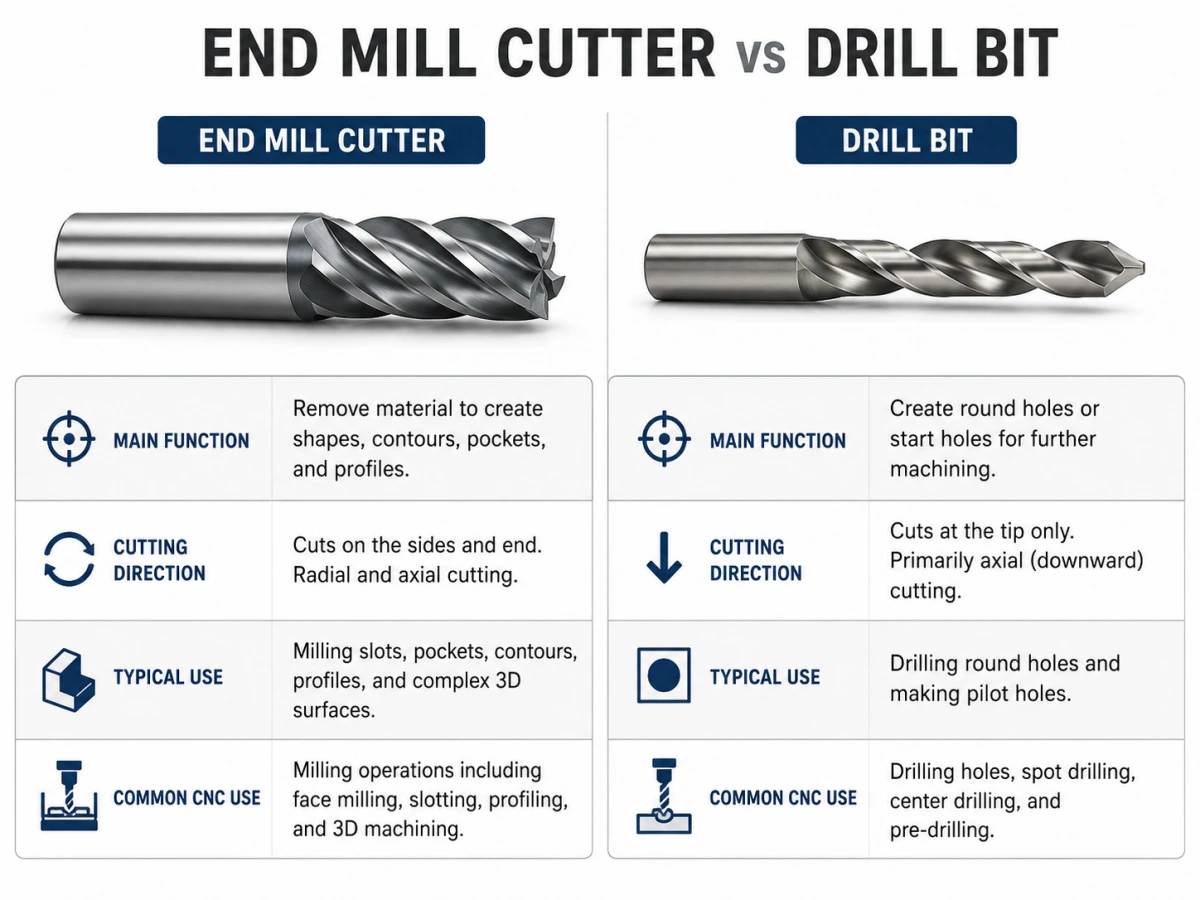
| Besonderheit | Schaftfräser-Fräser | Bohrer |
| Main function | Mahlen, Schlitzen, Profilierung, seitliches Schneiden | Drilling holes |
| Schnittrichtung | Axial and lateral | Mainly axial |
| Typische Verwendung | Spielautomaten, Taschen, Konturen, Seitenwände | Round holes |
| Tool flexibility | Höher | Untere |
| Common CNC use | General milling operations | Hole-making operations |
Zusamenfassend, both tools remove material, but they are not interchangeable in most machining situations. A center-cutting end mill can plunge in some applications, but it is still not the same as a standard drill bit.
Common Types of End Mill Cutters
There are many types of end mill cutters, and each design has a specific purpose. Choosing the right type helps improve cutting efficiency, Oberflächenqualität, und Standzeit.
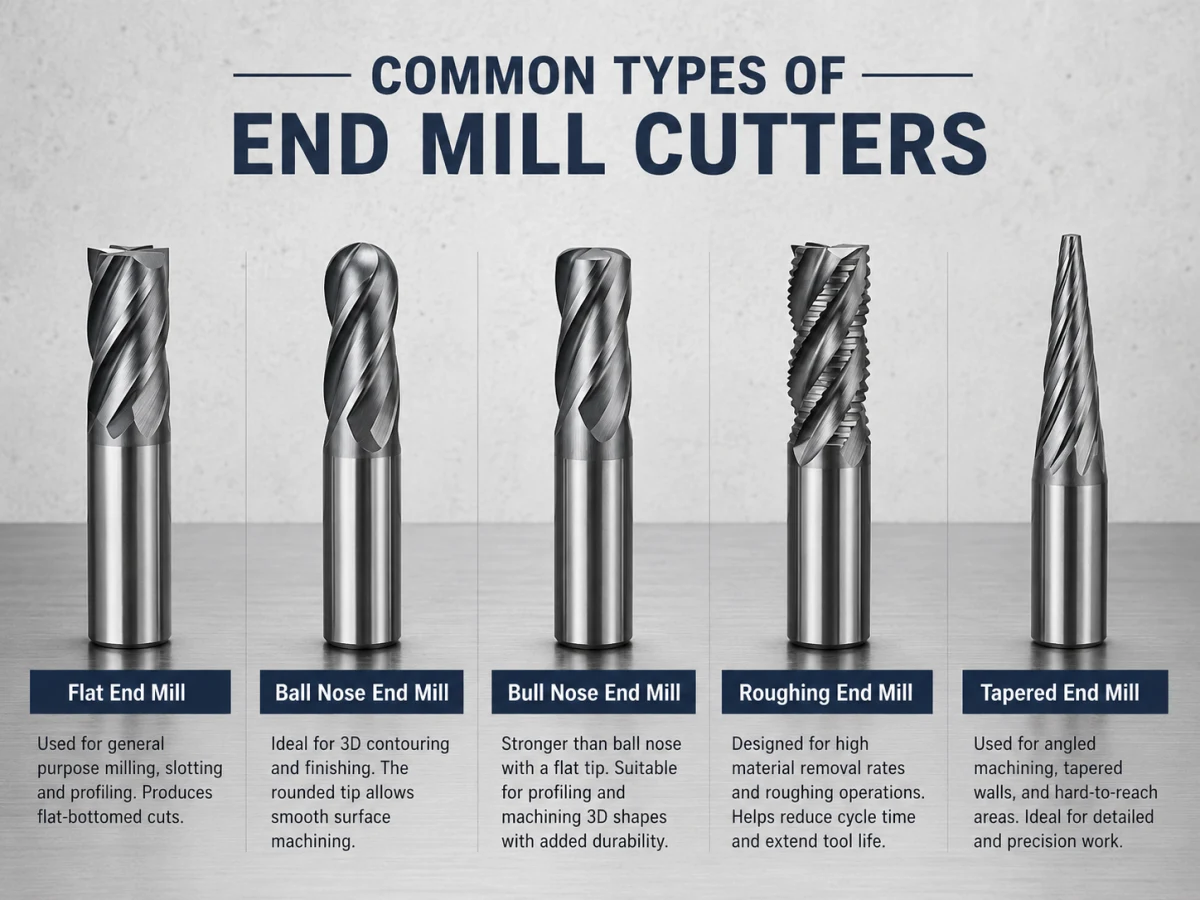
Flacher Schaftfräser
A flat end mill has a flat cutting end. Es wird häufig zum Schlitzen verwendet, Seitenfräsen, Schulterfräsen, und allgemeine Bearbeitung.
Kugelfräser
A ball nose end mill has a rounded cutting end. It is commonly used for 3D contouring, Formenbearbeitung, gekrümmte Oberflächen, und Endbearbeitungsarbeiten.
For curved surface machining and mold work, Sie können sich auch unsere ansehen Kugelkopffräser.
Bull-Nase-Schaftfräser
Ein Bull-Nose-Schaftfräser, also called a corner radius end mill, combines a flat bottom with rounded corners. It improves edge strength and helps create smoother transitions.
For stronger corner geometry, siehe unsere Bull-Nase-Schaftfräser.
Schruppfräser
A roughing end mill is designed for aggressive material removal. It is often used before finishing to remove large amounts of stock quickly.
For heavy stock removal, Sie können unsere überprüfen Schruppfräser.
Konischer Schaftfräser
A tapered end mill has a gradually changing diameter. It is used for angled walls, tiefe Hohlräume, Formenbearbeitung, und Sonderprofile.
For mold cavities and angled machining, Besuchen Sie uns konischer Fräser.
For a more detailed comparison of tool geometries, Lesen Sie unsere end mill cutter types guide.
Wofür wird ein Schaftfräser verwendet??
End mill cutters are used in many CNC milling operations. Because they can cut from the end and the side, they are suitable for both simple and complex machining tasks.
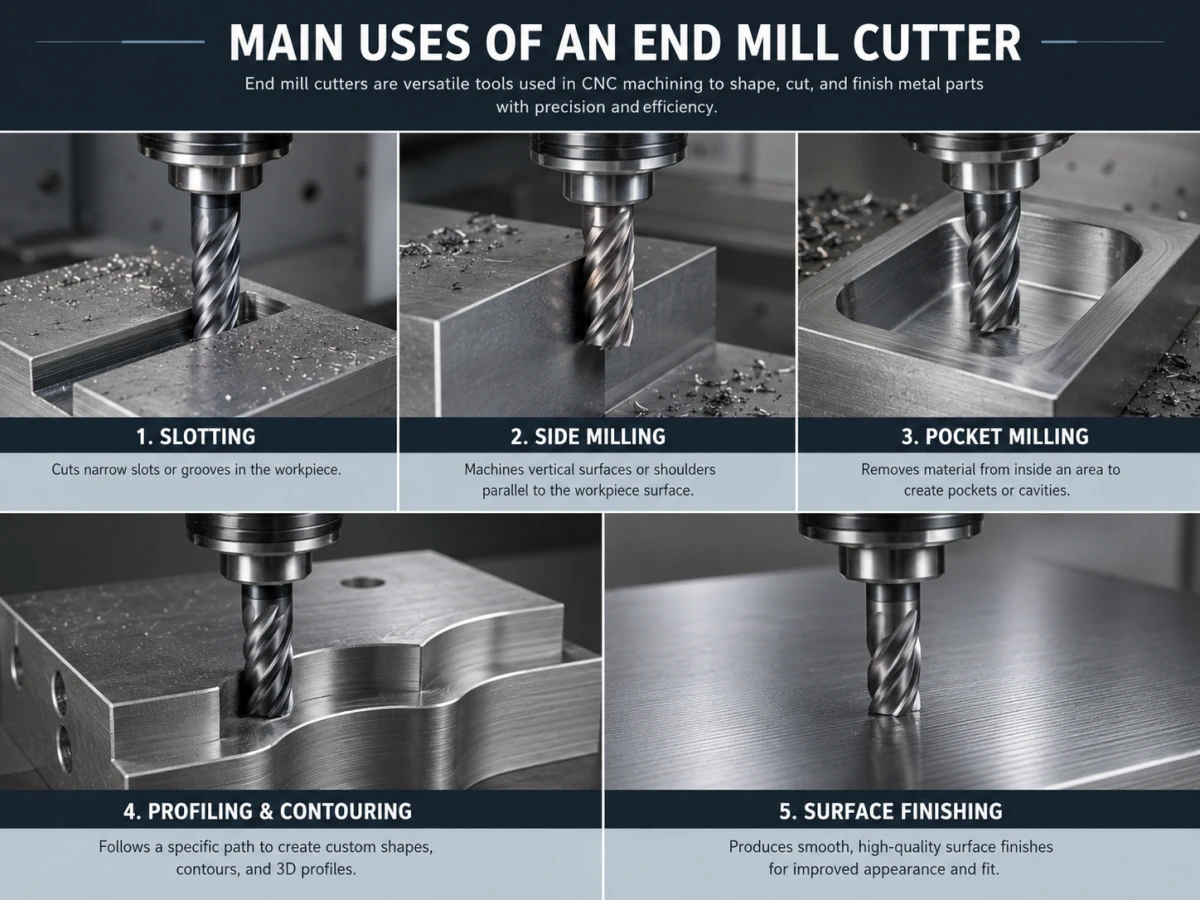
Schlitzen
Slotting is one of the most common applications. An end mill cutter can cut straight or curved slots into a workpiece with good accuracy. These slots can create keyways, Rillen, Führungsschienen, and assembly features.
For softer materials such as aluminum, chip evacuation is important. daher, machinists often select 2 flute tools when the workpiece needs better chip removal.
Seitenfräsen
Side milling uses the side cutting edges of the tool to remove material from the vertical surface of a workpiece. This operation is useful for machining shoulders, Schritte, und Seitenwände.
Machine shops commonly use side milling for precision parts, Formkomponenten, Werkzeugteile, and general CNC production.
Profilieren und Konturieren
Machinists also use end mill cutters for profiling and contouring. These operations create complex shapes, curved paths, and external or internal profiles.
Machinists often select ball nose and corner radius tools for this kind of work because these tools can improve surface transitions and finishing quality.
Taschenfräsen
Pocket milling removes material from a closed or recessed area inside a workpiece. This operation is common in parts that need internal cavities, weight reduction, oder präziser Materialabtrag innerhalb eines begrenzten Bereichs.
Good chip control, stable tool paths, and the correct cutter geometry are important for this process.
Oberflächenveredelung
After rough machining, an end mill cutter can also be used for finishing. The goal is to improve dimensional accuracy and surface smoothness.
Finishing tools are selected according to tolerance, Werkstückmaterial, Maschinenstabilität, and required surface quality.
Stufenfräsen und Schulterbearbeitung
End mill cutters can machine stepped surfaces, Schultern, und mehrstufige Funktionen. These features often require sharp transitions, stabiler Schnitt, and accurate dimensions.
Infolge, Werkzeugsteifigkeit, Flötendesign, and coating selection are important.
End Mill Cutter Uses for Aluminum, Stahl, und Edelstahl
Different workpiece materials require different cutter designs. daher, buyers should match the end mill cutter to the material and machining condition.
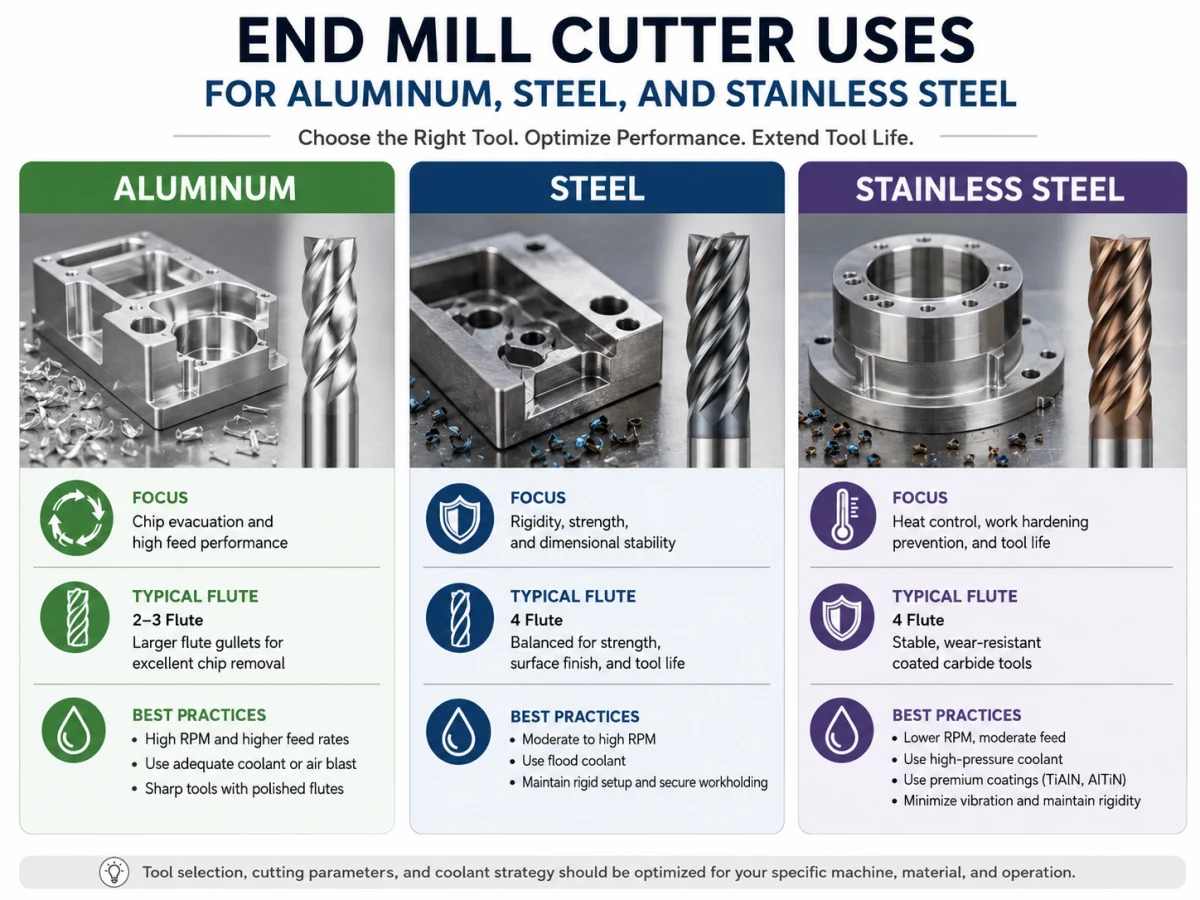
| Werkstückmaterial | Common Cutter Choice | Hauptgrund |
| Aluminium | 2 Flöte bzw 3 Nutfräser aus Hartmetall | Better chip evacuation and smooth cutting |
| Stahl | 4 flute carbide end mill with suitable coating | Bessere Steifigkeit und Verschleißfestigkeit |
| Edelstahl | Coated carbide end mill with stable geometry | Better heat control and edge protection |
| Kupfer und Messing | Sharp edge carbide end mill | Clean cutting and reduced burrs |
| Kunststoffe | Sharp, polished flute cutter | Smooth chip removal and lower melting risk |
Schaftfräser für Aluminium
Bei der Bearbeitung von Aluminium, end mill cutters are used for slotting, Taschenfräsen, Seitenfräsen, und Abschluss. Aluminium erzeugt größere Späne, Daher werden oft Werkzeuge mit weniger Spannuten und guter Spanabfuhr bevorzugt.
High-helix carbide end mills are also common for aluminum because they help improve cutting smoothness and reduce chip buildup.
Für Aluminium und NE-Werkstoffe, you can compare flute options on our 2 Nutfräser Und 3 Nutfräser Seiten.
Schaftfräser für Stahl
Für Kohlenstoffstahl und legierten Stahl, Schaftfräser werden häufig zum Seitenfräsen verwendet, Konturierung, Schulterbearbeitung, und Halbfertigbearbeitung. Stahl erfordert normalerweise eine bessere Steifigkeit und eine höhere Verschleißfestigkeit.
In vielen Fällen, 4 flute carbide end mills are selected for steel and general-purpose metal machining.
Für die Stahlbearbeitung, Sie können unsere ansehen 4 Nutfräser.
Schaftfräser für Edelstahl
Edelstahl ist schwieriger zu bearbeiten, da er Hitze erzeugt und zu Werkzeugverschleiß neigt. In Edelstahlanwendungen, Schaftfräser werden üblicherweise zum Profilieren verwendet, Abschluss, und kontrolliertes Seitenfräsen.
Die richtige Beschichtung, Flötengeometrie, and cutting parameters help maintain cutting stability and reduce edge wear.
How to Choose a Basic End Mill Cutter
Choosing an end mill cutter does not need to be complicated. Jedoch, buyers should check several factors before ordering.
Werkstückmaterial
The workpiece material is one of the most important factors. Aluminium, Stahl, Edelstahl, Kupfer, Messing, Kunststoffe, and cast iron may require different flute designs, Beschichtungen, and cutting strategies.
Flötenzählung
Flute count affects chip evacuation, Steifigkeit, and cutting efficiency. Zum Beispiel, machinists often use 2 Nutenwerkzeuge für Aluminium, while they commonly choose 4 flute tools for steel and general-purpose machining.
Für einen tieferen Vergleich, Lesen Sie unsere 2 Flöte vs 4 Führung für Nutfräser.
Werkzeugmaterial
Many CNC machine shops choose solid carbide end mill cutters because they provide higher rigidity, bessere Verschleißfestigkeit, and stable performance. Some workshops still use HSS tools for lower-speed or general machining applications.
Beschichtung
The coating should match the material and machining condition. Zum Beispiel, machinists often choose TiAlN and AlTiN coatings for steel, while DLC coating may suit aluminum and non-ferrous materials.
Required Finish
For roughing operations, the main goal is higher material removal. Jedoch, for finishing work, surface quality and dimensional accuracy become more important.
Basic Specifications to Check Before Buying
Bevor Sie eine Bestellung aufgeben, buyers should confirm several key specifications. This helps avoid tool mismatch and improves machining stability.
Fräserdurchmesser
Cutter diameter affects cutting width, Steifigkeit, and the size of the machined feature.
Flötenlänge
Flute length determines how deep the cutter can machine. Jedoch, a longer flute may reduce rigidity, so it should match the actual cutting depth.
Gesamtlänge
Overall length affects tool reach and vibration control. A longer tool may be needed for deep cavities, but it should be used carefully to reduce chatter.
Schaftdurchmesser
Shank diameter must match the holder correctly. Stable clamping helps improve accuracy and tool life.
Corner Geometry
Wohnung, Kugelnase, Eckradius, and tapered geometries are used for different machining goals. daher, corner geometry should match the part shape and required finish.
Beschichtungstyp
Die Beschichtung sollte entsprechend dem Werkstückmaterial ausgewählt werden, Schnittgeschwindigkeit, Kühlmittelzustand, and tool life requirement.
Why Solid Carbide End Mill Cutters Are Common in CNC Milling
Solid carbide end mill cutters are popular because they offer strong rigidity, high hardness, and good wear resistance. They can support higher cutting speeds and provide more stable performance than many standard tool materials.
In production machining, many shops use carbide tools for steel, Edelstahl, Gusseisen, Aluminium, und andere anspruchsvolle Materialien. Zusätzlich, the right geometry and coating can improve machining consistency.
Industrial buyers, Händler, and machine shops often prefer carbide tools because they help reduce tool changes and support more stable production.
For standard and custom carbide tools, you can visit our carbide end mill cutter pape.
When Do You Need a Custom End Mill Cutter?
A standard cutter can solve many common machining tasks.
Jedoch, you may need custom tooling when the part has a special profile, deep cavity, unusual material, strict tolerance, or non-standard size requirement.
Manufacturers can design custom end mill cutters with special diameter, Flötenlänge, Gesamtlänge, Eckradius, Beschichtung, Schaftgröße, and tool geometry.
For drawing-based or OEM tooling, Besuchen Sie uns custom end mills pape.
Häufig gestellte Fragen
What is an end mill cutter?
An end mill cutter is a rotary cutting tool used for CNC milling operations such as slotting, Seitenfräsen, Profilierung, Konturierung, Taschenfräsen, und Abschluss.
What is an end mill cutter used for?
It is used to remove material from the end and side of a workpiece. Common applications include slots, Taschen, Seitenwände, Profile, Schultern, gekrümmte Oberflächen, and finished surfaces.
What is the difference between an end mill cutter and a drill bit?
A drill bit mainly cuts holes in the axial direction. An end mill cutter can cut axially and laterally, so it can perform more milling operations such as slotting, Profilierung, und Seitenfräsen.
What are the common types of end mill cutters?
Common types include flat end mills, Kugelkopffräser, Bull-Nose-Schaftfräser, Schruppfräser, tapered end mills, 2 Schaftfräser mit Nut, 3 Schaftfräser mit Nut, 4 Schaftfräser mit Nut, Und 6 Schaftfräser mit Nut.
How do I choose a basic end mill cutter?
You should check the workpiece material, Flötenzahl, Fräserdurchmesser, Flötenlänge, Gesamtlänge, Schaftdurchmesser, Werkzeugmaterial, Beschichtung, und erforderliche Oberflächenbeschaffenheit.
Are carbide end mill cutters better than HSS end mills?
Carbide end mill cutters usually provide better rigidity, Verschleißfestigkeit, und Schnittstabilität. Jedoch, the best choice depends on the machine, Werkstückmaterial, Schnittgeschwindigkeit, and budget.
Abschluss
An end mill cutter is a versatile CNC milling tool used for slotting, Seitenfräsen, Taschenfräsen, Profilierung, Konturierung, Schulterbearbeitung, und Abschluss. Because it can cut from both the end and the side, it is more flexible than many basic cutting tools.
To choose the right cutter, buyers should understand the tool structure, Fräsertyp, Flötenzahl, Material, Beschichtung, Durchmesser, Flötenlänge, und Bearbeitungsanwendung. Once these factors are matched correctly, the cutter can provide better cutting efficiency, längere Standzeit des Werkzeugs, and more stable machining results.
Looking for a reliable end mill cutter manufacturer for aluminum, Stahl, Edelstahl, or custom CNC machining?
Entdecken Sie unsere Produktseite für Schaftfräser for standard and OEM solutions, oder kontaktieren Sie uns mit Ihren Zeichnungs- und Anwendungsanforderungen.