 Präzisions-Fräser,Schneidwerkzeuge für die CNC-Bearbeitung jedes Materials

Einführung
How does an end mill cutter work in CNC milling? It removes material with rotating cutting edges while feed motion moves the tool through the workpiece. Flutes carry chips away from the cutting zone, so cutting stability, Oberflächenbeschaffenheit, and tool life depend on rotation speed, Vorschubgeschwindigkeit, Fräsergeometrie, und Spanabfuhr.
This guide explains how the end milling process works, how the cutter removes material, how chips leave the cutting zone, and what affects cutting stability, Oberflächenbeschaffenheit, und Standzeit.
Wenn Sie mit diesem Tool noch nicht vertraut sind, Sie können zuerst unsere lesen Grundlegender Leitfaden für Fräswerkzeuge.
What Is an End Mill Cutter in CNC Milling?
Ein Schaftfräser ist ein rotierendes Schneidwerkzeug, das auf CNC-Maschinen und Fräsmaschinen verwendet wird. Im Gegensatz zu einem Standardbohrer, it can cut vertically and laterally. daher, it can create slots, Taschen, Konturen, Seitenwände, and finished surfaces.
Most tools have cutting edges on the end and along the sides. Infolge, they can remove material in different directions depending on the toolpath and machining operation.
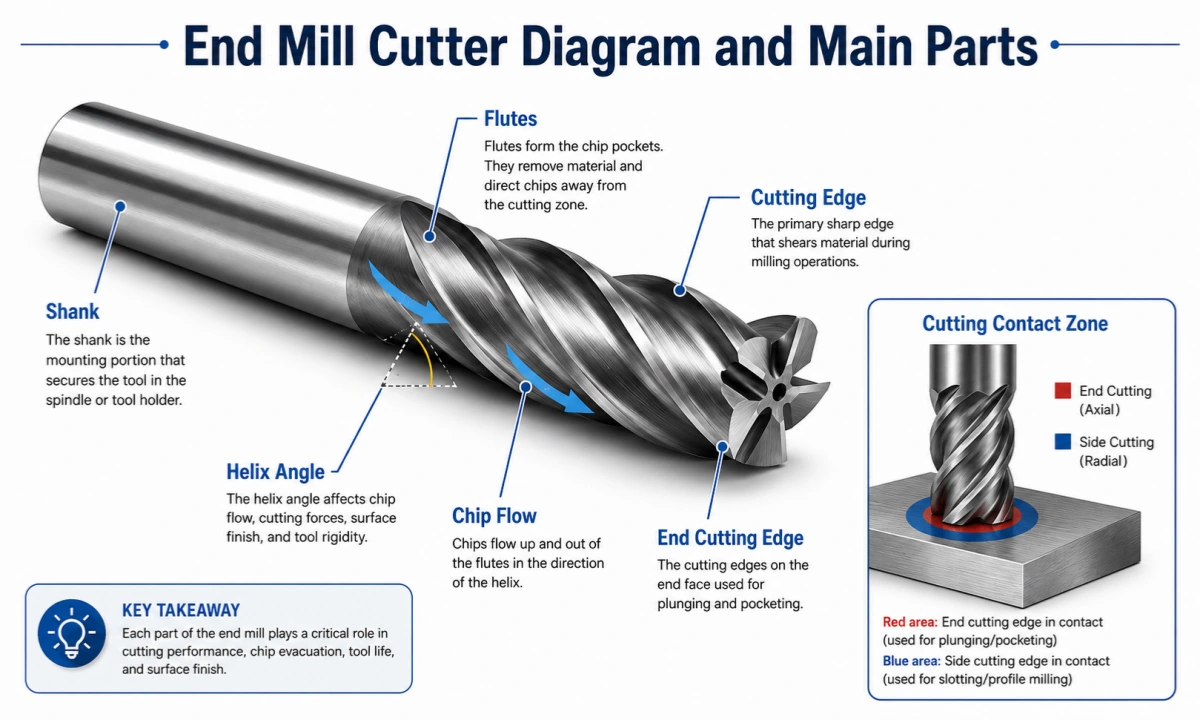
End Mill Cutter Diagram and Main Parts
| Part | Function | Warum es wichtig ist |
| Schaft | Holds the cutter in the spindle or tool holder | Affects clamping stability and runout control |
| Flöten | Guide chips away from the cutting zone | Beeinflusst die Spanabfuhr, Wärmekontrolle, und Schnittstabilität |
| Schneidende Kanten | Shear material from the workpiece | Affect cutting efficiency, Oberflächenbeschaffenheit, und Standzeit |
| End Cutting Edge | Cuts from the tool tip | Helps with slotting, pocket entry, and bottom cutting |
| Side Cutting Edge | Cuts along the side of the tool | Helps with profiling, Seitenfräsen, and shoulder machining |
| Helixwinkel | Controls the spiral angle of the flute | Affects chip flow, cutting smoothness, und Vibration |
| Beschichtung | Protects the cutting edge | Improves wear resistance and heat resistance |
Flöten
Flutes are the grooves along the cutter body. They help remove chips during cutting and directly affect chip evacuation, Steifigkeit, und Schneidleistung.
Schneidende Kanten
The cutting edges shear material from the workpiece. Their sharpness and geometry affect cutting efficiency, Oberflächenbeschaffenheit, und Standzeit.
Schaft
The shank is the part clamped into the spindle or holder. A stable shank setup is important for machining accuracy and vibration control.
Helixwinkel
The helix angle influences chip flow and cutting smoothness. In vielen Fällen, it also affects heat control and machining stability.
Tool Tip Geometry
Different tip shapes support different machining tasks. Flat end mills work well for slotting and side milling, while ball nose tools are suitable for contouring and 3D surfaces.
If you want to compare different tool shapes, Lesen Sie unsere tool type comparison guide.
How Does an End Mill Cutter Work in CNC Milling?
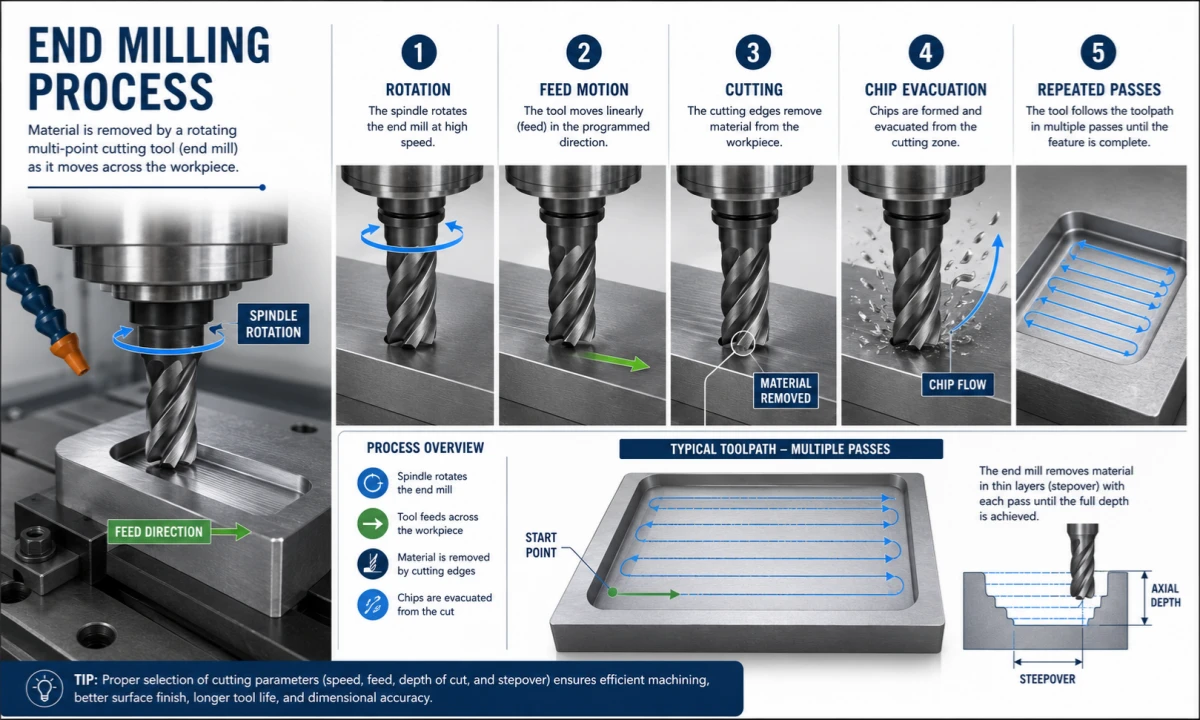
1. Rotation Creates the Cutting Action
Erste, the cutter rotates at high speed in the spindle. This rotation brings the cutting edges into contact with the workpiece and creates the cutting action.
2. Feed Motion Moves the Tool Through the Material
Gleichzeitig, the tool or the workpiece moves in a controlled direction. This movement is called feed motion. It determines how the cutter travels through the material and how much material is removed in each pass.
3. Cutting Edges Shear Off Material
As the rotating cutter enters the material, the cutting edges shear off small sections of the workpiece. These removed sections become chips.
4. Flutes Carry the Chips Away
Nächste, the flutes help carry chips away from the cutting zone. Good chip evacuation is important because trapped chips can increase heat, damage the cutter, and reduce surface quality.
5. Repeated Passes Create the Final Shape
Endlich, the CNC machine creates the final shape by controlling the toolpath, Schnitttiefe, Vorschubgeschwindigkeit, and spindle speed. With repeated passes, the cutter can produce slots, Taschen, Konturen, Seitenwände, and finished surfaces.
For readers asking “how does an end mill cutter work,” the table below explains the basic cutting steps in a simple CNC milling operation.
End Milling Process Table
| Process Step | What Happens | Warum es wichtig ist |
|---|---|---|
| Rotation | The cutter spins at high speed | Creates cutting action |
| Feed Motion | The tool or workpiece moves in a controlled path | Determines material removal |
| Schneiden | The edges shear material into chips | Forms the machined feature |
| Spanabfuhr | Flutes guide chips away | Reduces heat and improves stability |
| Repeated Passes | The machine follows programmed toolpaths | Produces the final shape |
This table explains the basic logic behind the end milling process in a simple way.
End Cutting vs Side Cutting
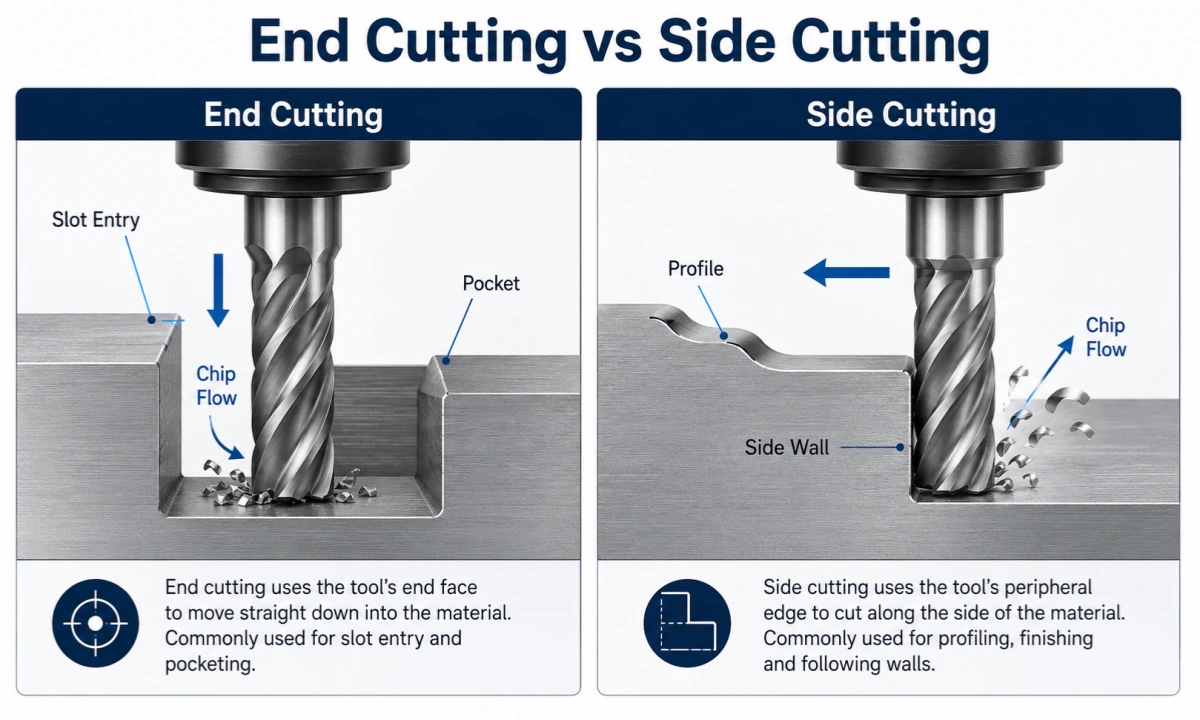
An end mill cutter can remove material from the end and side of the tool. This is one reason it is more flexible than a standard drill bit.
End Cutting
End cutting happens when the tool tip removes material from the bottom of a slot, Tasche, or shallow entry area. Center-cutting end mills can handle some plunging or pocket entry operations, but they are still different from drill bits.
Side Cutting
Side cutting happens when the side cutting edges remove material from the wall or profile of a workpiece. This cutting action is common in side milling, Schulterfräsen, Profilierung, und Konturfräsen.
Aus diesem Grund, Werkzeuggeometrie, Flötenzahl, Vorschubgeschwindigkeit, and clamping stability all affect how well the cutter performs in different operations.
Common End Milling Operations
Schlitzen
The cutter removes material in a straight path to create grooves or narrow slots.
Seitenfräsen
The side cutting edges machine vertical walls or side surfaces.
Taschenfräsen
The cutter removes material from a closed internal area inside the workpiece.
Konturierung
The tool follows curved or shaped paths to create profiles and complex surfaces.
Oberflächenveredelung
A finishing pass improves surface quality and dimensional accuracy.
These operations explain why machine shops use these tools in mold making, Maschinenteile, Automobilkomponenten, Teile für die Luft- und Raumfahrt, und allgemeine Metallbearbeitung.
What Affects How Well an End Mill Cutter Works?
Werkzeugmaterial
Solid carbide tools usually provide better rigidity, Verschleißfestigkeit, und stabilere Schnittleistung bei der CNC-Bearbeitung.
Für spezielle Hartmetallwerkzeuge, Sie können auch unsere besuchen Vollhartmetall-Fräswerkzeuge Seite.
Flötenzählung
Die Anzahl der Spanflöten beeinflusst die Spanabfuhr und die Steifigkeit. In vielen Fällen, machinists choose fewer flutes for aluminum and more flutes for steel or harder materials.
Für einen tieferen Vergleich, Lesen Sie unsere Vergleichsanleitung für die Anzahl der Flöten.
Beschichtung
The right coating can improve wear resistance, Hitzebeständigkeit, und Standzeit, especially in demanding cutting conditions.
Feed Rate and Speed
Feed rate and spindle speed must match the workpiece material and tool design. Otherwise, the cutter may overheat, wear too quickly, or leave a poor surface finish.
Werkstückmaterial
Aluminium, Stahl, and stainless steel behave differently during machining. daher, machinists should adjust cutter geometry, Beschichtung, Vorschubgeschwindigkeit, and spindle speed according to the material.
How to Use an End Mill Cutter More Effectively
Match the Tool to the Material
Choose the tool geometry, Flötenzahl, and coating according to the workpiece material.
Use Stable Clamping
A stable holder and proper setup help reduce vibration and improve cutting accuracy.
Keep Chip Evacuation Clear
Good chip evacuation helps prevent heat buildup and unstable cutting.
Use Suitable Cutting Parameters
Geschwindigkeit, füttern, axiale Tiefe, and radial engagement should match the cutter and the machining task.
Monitor Tool Wear
A worn cutter can reduce accuracy, Oberflächenqualität, und Bearbeitungseffizienz. daher, regular tool inspection is important.
If you need standard or OEM tooling solutions, Sie können auch unsere besuchen Produktseite für CNC-Fräswerkzeuge.
End Milling Operation Diagram and Chip Flow
A clear end milling operation diagram should show spindle rotation, feed direction, Schneiden, Spanfluss, and the workpiece contact area. These points help readers understand how the cutter removes material and why cutting stability depends on both tool movement and chip evacuation.
In a typical operation, the spindle rotates the tool, the feed motion moves the cutter through the material, and the flutes carry chips away from the cutting zone. If chips stay near the cutting edge, heat and vibration may increase, which can reduce surface quality and tool life.
This visual explanation is useful for readers who search for end milling cutter diagrams, end milling operation diagrams, or end milling process examples.
Common Mistakes When Using an End Mill Cutter
Using the Wrong Flute Count
Poor flute selection can reduce chip evacuation or cutting stability.
Ignoring Feed and Speed Settings
Incorrect cutting parameters can lead to overheating, Kantenschäden, and short tool life.
Choosing the Wrong Tool Type
Ein flacher Schaftfräser, Kugelkopffräser, and roughing end mill work for different operations, so one tool should not replace every cutter type.
Poor Chip Evacuation
When chips stay in the cutting zone, surface finish and tool life may both suffer.
Using One Setup for Every Material
The same cutting conditions do not work equally well for aluminum, Stahl, und Edelstahl.
Häufig gestellte Fragen
How does an end mill cutter work?
An end mill cutter works by combining spindle rotation and feed motion. The cutting edges shear material from the workpiece, and the flutes remove chips from the cutting zone.
What is end milling?
End milling is a machining process in which a rotating end mill cutter removes material to create slots, Taschen, Seitenwände, Konturen, and finished surfaces.
What is the difference between an end mill and a drill bit?
A drill bit mainly makes holes, while an end mill can cut vertically and laterally for a wider range of milling operations.
What are end mills used for?
End mills are used for slotting, Seitenfräsen, Profilierung, Taschenfräsen, Konturierung, und Oberflächenveredelung.
Can one end mill cutter be used for both aluminum and steel?
Nicht immer. Werkzeuggeometrie, Flötenzahl, Beschichtung, and cutting parameters often need to change depending on the material.
Why is chip evacuation important in end milling?
Chip evacuation helps control heat, reduce tool damage, and improve cutting stability and surface quality.
Abschluss
Understanding how an end mill cutter works helps improve machining efficiency and tool performance. The end milling process depends on spindle rotation, Vorschubbewegung, cutting edge geometry, und Spanabfuhr.
When machinists match cutter type, Flötenzahl, Beschichtung, and cutting parameters correctly, end milling can produce accurate parts, bessere Oberflächenbeschaffenheit, and more stable machining results. That is why proper tool selection and machining setup are both essential.
CTA
Looking for standard or custom tools for aluminum, Stahl, oder Edelstahlbearbeitung?
Besuchen Sie unsere Produktseite für CNC-Fräswerkzeuge oder senden Sie uns Ihre Zeichnung, Größenliste, Material, und Beschichtungsanforderungen. OMIST can recommend suitable tools for CNC milling applications.