 Precision Milling Cutters,Cutting Tools for CNC Machining Every Material

Long Reach End Mill Specifications
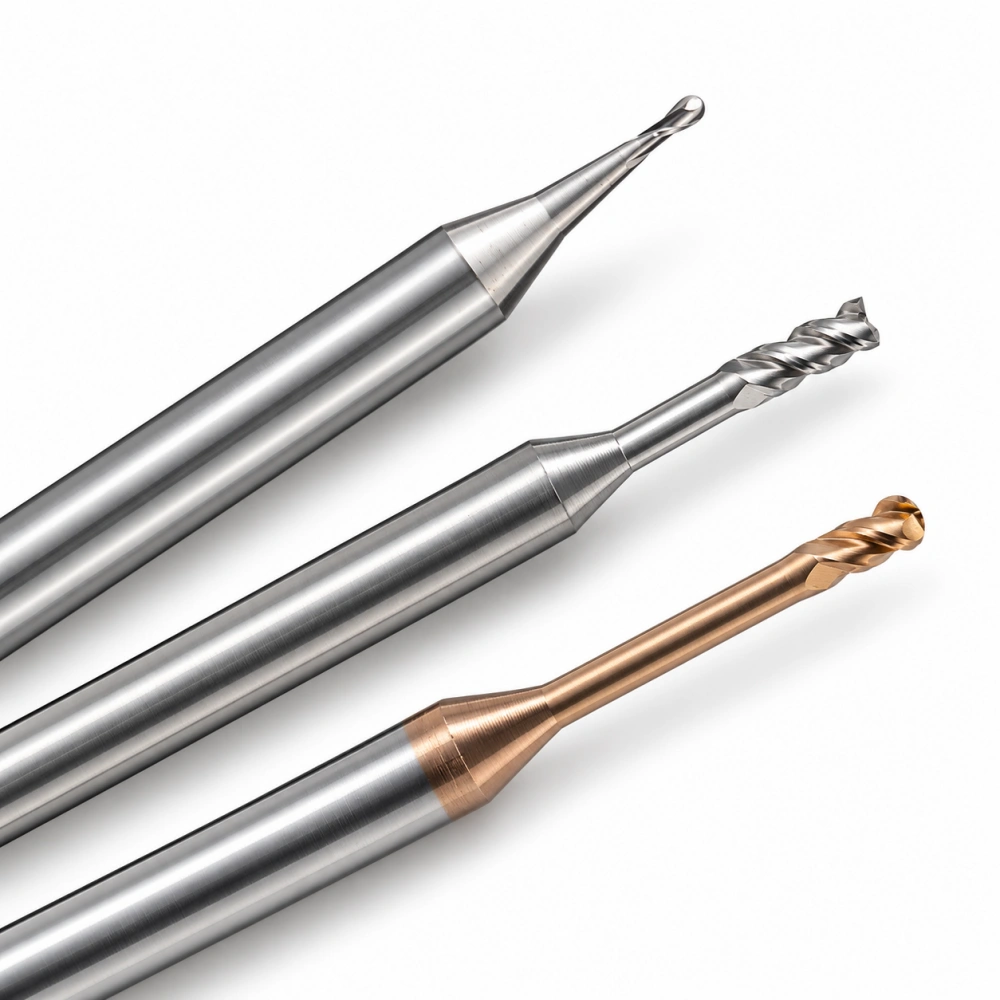
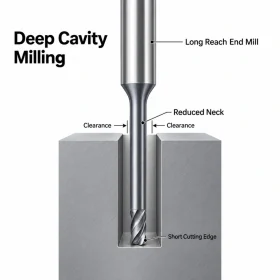
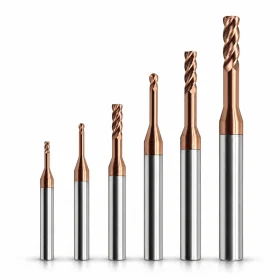
Long reach end mills combine a short cutting section with a reduced neck to provide clearance where a standard end mill body may interfere with a deep or restricted feature.
Dimensions vary between square, ball nose and corner radius geometries. Therefore, use the ranges below for initial selection rather than treating them as freely interchangeable size combinations.
| Tool Geometry | Cutting Size | Length Range | Neck / Shank / OAL |
|---|---|---|---|
| Square / Flat | Cutting Diameter: Ø0.2–4.0 mm | Flute Length (L1): 0.3–3.8 mm; Effective Length (L2): 1–30 mm | Neck Diameter: Ø0.16–3.9 mm; Shank: Ø4 / Ø6 mm; OAL: 50 / 60 / 75 mm |
| Ball Nose | Ball Radius: R0.1–R2.0 mm; Ball Diameter: Ø0.2–4.0 mm | Flute Length (L1): 0.2–4.0 mm; Effective Length (L2): 1–30 mm | Neck Diameter: Ø0.16–3.9 mm; Shank: Ø4 / Ø6 mm; OAL: 50 / 60 / 75 mm |
| Corner Radius | Cutting Diameter: Ø1.0–4.0 mm; Radius: R0.1 / R0.2 / R0.5 mm | Flute Length (L1): 1.5–6.0 mm; Effective Length (L2): 4–30 mm | Neck Diameter: Ø0.95–3.9 mm; Shank: Ø4 / Ø6 mm; OAL: 50 / 60 / 75 mm |
Note: For ball nose tools, the ball diameter corresponds to D = 2R. Available size combinations vary by tool geometry and catalog series.
For smaller-diameter options and related micro-machining tools, see Micro End Mills.
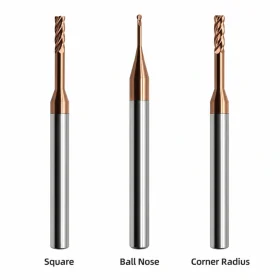
Square, Ball Nose and Corner Radius Options
The required end geometry depends on the feature being machined. The long reach structure provides neck clearance, while the cutting-end geometry determines how the tool contacts the workpiece.
Square Long Reach End Mills
Square long reach end mills provide a flat cutting end for pockets, bottom surfaces, straight-wall features and other areas that require flat-bottom geometry.
The catalog covers cutting diameters from Ø0.2 to Ø4.0 mm. Depending on the size, effective length can reach 30 mm.
For applications that do not require a reduced-neck structure, compare the standard Flat End Mill range.
Ball Nose Long Reach End Mills
Ball nose versions use a fully rounded cutting end for curved surfaces, 3D contours and deep-cavity profiling. In addition, the long neck helps the cutting end reach past surrounding walls or other restricted features.
The standard catalog includes ball radii from R0.1 to R2.0 mm. Listed examples include R0.1, R0.15, R0.2, R0.25, R0.3, R0.4, R0.5, R0.75, R1.0, R1.5 and R2.0.
For general ball nose applications without a long-neck requirement, see Ball Nose End Mills.
Corner Radius Long Reach End Mills
Corner radius versions combine a flat end with a defined corner radius. As a result, they suit parts that need a flat-bottom geometry together with a specified corner radius.
The current catalog lists Ø1.0–4.0 mm cutting diameters with R0.1, R0.2 and R0.5 mm corner radius options. These are discrete catalog options, not a continuous R0.1–R0.5 mm range.
For standard-reach corner radius geometry, see Bull Nose End Mill.
Long Reach vs Long Length End Mills
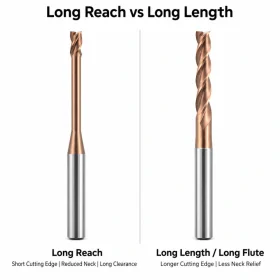
Overall tool length alone does not define a long reach end mill.
Long reach, long neck and reduced neck tools use a relieved neck behind a relatively short cutting edge. This structure provides clearance when the cutting area sits inside a deep cavity or behind a surrounding wall.
By contrast, a long length or long flute end mill has a longer cutting edge. It suits applications that require cutting engagement over a greater axial length.
Therefore, choose between them according to the main machining requirement: clearance and access or a longer cutting edge.
Applications and Tool Selection
Long reach end mills help when a standard tool body cannot access the required feature without interference.
Typical applications include deep cavities, narrow pockets, recessed features, mold components and other restricted-access CNC milling operations.
Choose the cutting geometry according to the feature:
- Choose a square end for flat bottoms and straight-wall features.
- Choose a ball nose for curved surfaces and 3D contours.
- Choose a corner radius when the feature requires a flat end with a defined corner radius.
Next, match the cutting diameter, flute length, effective length, neck diameter and shank size to the required feature and access conditions.
For a broader comparison of common cutter geometries, see End Mill Cutter Types.
Custom Long Reach End Mills
Standard catalog sizes cover multiple combinations of cutting diameter, radius, flute length, effective length, neck diameter, shank diameter and overall length.
For non-standard dimensions or geometry combinations, send a drawing or sketch for review before quotation.
We review the drawing and assess manufacturing feasibility for custom sizes and configurations. This process helps confirm the required dimensions before the custom tool specification is finalized.
FAQ
Are long reach end mills the same as long neck end mills?
The terms often describe closely related reduced-neck tool structures. In practice, purchasing decisions depend more on cutting diameter, cutting length, neck diameter, effective length and overall dimensions than on the name alone.
Are reduced neck end mills different from long reach end mills?
Reduced neck describes the tool structure, while long reach describes the access requirement. A reduced neck creates clearance behind the cutting section, so the two terms often overlap in commercial product descriptions.
Which geometry should I choose for deep cavity machining?
Choose the geometry according to the feature. Square ends suit flat-bottom and straight-wall features, ball nose tools suit curved or 3D surfaces, while corner radius tools provide a flat end with a defined corner radius.
Is a long reach end mill the same as a long flute end mill?
No. A long reach tool typically uses a reduced neck behind a relatively short cutting section. In contrast, a long flute tool uses a longer cutting edge when the application requires greater axial cutting engagement.
Can all diameter, radius and length combinations in the table be supplied?
No. The table shows family-level catalog ranges, and available combinations vary by tool geometry and catalog series. For non-standard combinations, we review the drawing and manufacturing feasibility before confirming the specification.
Can you manufacture custom long reach end mills?
Yes, we can review custom dimensions and configurations based on your drawing and machining requirements. We confirm manufacturing feasibility before finalizing the custom specification.
Send Your Long Reach End Mill Inquiry
Send your long reach end mill inquiry by email, or contact us on WhatsApp.