 Fresas de precisión,Herramientas de corte para el mecanizado CNC de todos los materiales

Una fresa de extremo es una herramienta de corte giratoria que se utiliza en el fresado CNC para eliminar material del extremo y el costado de una pieza de trabajo.. Puede mecanizar tragamonedas, bolsillos, perfiles, paredes laterales, superficies curvas, y acabados en materiales como el aluminio, acero, acero inoxidable, cobre, y plasticos.
En esta guía, aprenderá qué es una fresa de extremo, en qué se diferencia de una broca, qué hace en el fresado CNC, tipos de cortadores comunes, especificaciones basicas, y cómo elegir la herramienta adecuada para diferentes aplicaciones de mecanizado.
¿Qué es una fresa de extremo??
Una fresa de extremo es una herramienta de corte rotativa que se utiliza en máquinas CNC y fresadoras.. Gira a alta velocidad mientras la herramienta o pieza de trabajo se mueve a lo largo de una trayectoria controlada para eliminar material..
La principal diferencia entre una fresa y muchas otras herramientas es su geometría de corte.. La mayoría de las fresas tienen bordes cortantes en el extremo y a lo largo de los lados.. Por lo tanto, Pueden cortar vertical y lateralmente.. Esto los hace adecuados para ranurar., fresado lateral, Perfiles, fresado de bolsillo, contornear, y terminando.
Los fabricantes suelen fabricar fresas de acero de alta velocidad o carburo sólido.. Sin embargo, Muchos talleres de mecanizado CNC eligen herramientas de carburo sólido porque ofrecen una mejor rigidez., mayor resistencia al desgaste, y un rendimiento de corte más estable.
Si necesita herramientas estándar o personalizadas para el mecanizado de producción, también puedes visitar nuestro página de producto del cortador de fresado.
Partes principales de una fresa de extremo
Aunque las fresas vienen en diferentes formas y diseños, la mayoría de las herramientas incluyen varias partes básicas. Comprender estas piezas ayuda a los compradores a elegir la cortadora adecuada para su material, máquina, y meta de mecanizado.
| Parte | Función | Por qué es importante |
| Bordes cortantes | Retire el material de la pieza de trabajo. | Afecta la eficiencia de corte y el acabado de la superficie. |
| Flautas | Ayuda a evacuar las virutas durante el mecanizado. | Influir en la eliminación de virutas, rigidez, y estabilidad de corte |
| Información sobre herramientas | Define la geometría final del cortador. | Afecta el ranurado, contornear, refinamiento, y fuerza de las esquinas |
| Pierna | Sostenido por el portaherramientas o el husillo. | Debe coincidir con el soporte para una sujeción estable |
| Capa | Protege el filo durante el mecanizado. | Mejora la resistencia al desgaste, resistencia al calor, y vida útil de la herramienta |
Bordes cortantes
Los filos de corte son la parte de trabajo de la herramienta.. Eliminan material durante el fresado y afectan directamente el rendimiento de corte., exactitud, y acabado superficial.
Flautas
Las flautas son las ranuras a lo largo del cuerpo del cortador.. Ayudan a eliminar las virutas de la zona de corte.. Además, El diseño de la flauta afecta la rigidez., control de calor, y estabilidad de corte.
Consejo sobre herramientas
El diseño de la punta de la herramienta depende del tipo de cortador.. Algunas fresas tienen extremos planos., mientras que otros tienen nariz esférica, radio de esquina, o geometría cónica. Como resultado, Se utilizan diferentes diseños de puntas para diferentes tareas de mecanizado..
Pierna
El vástago es la pieza sujeta por el portaherramientas o husillo.. Su diámetro debe coincidir correctamente con el soporte.. De lo contrario, vibración, poca precisión, o puede ocurrir que la herramienta se descentre.
Capa
Muchas fresas utilizan recubrimientos como TiAlN., Altin, TiSiN, Estaño, contenido descargable, o revestimiento nano azul. El recubrimiento adecuado puede mejorar la resistencia al calor, reducir el desgaste, y prolongar la vida útil de la herramienta.
Cortador de fresado versus broca
Muchos principiantes confunden una fresa con una broca.. Sin embargo, Están diseñados para diferentes propósitos de mecanizado..
Una broca corta principalmente en dirección axial para crear agujeros redondos.. Por el contrario, una fresa de extremo puede cortar tanto axial como lateralmente. Por lo tanto, puede mecanizar ranuras, bolsillos, contornos, perfiles, paredes laterales, y superficies acabadas.
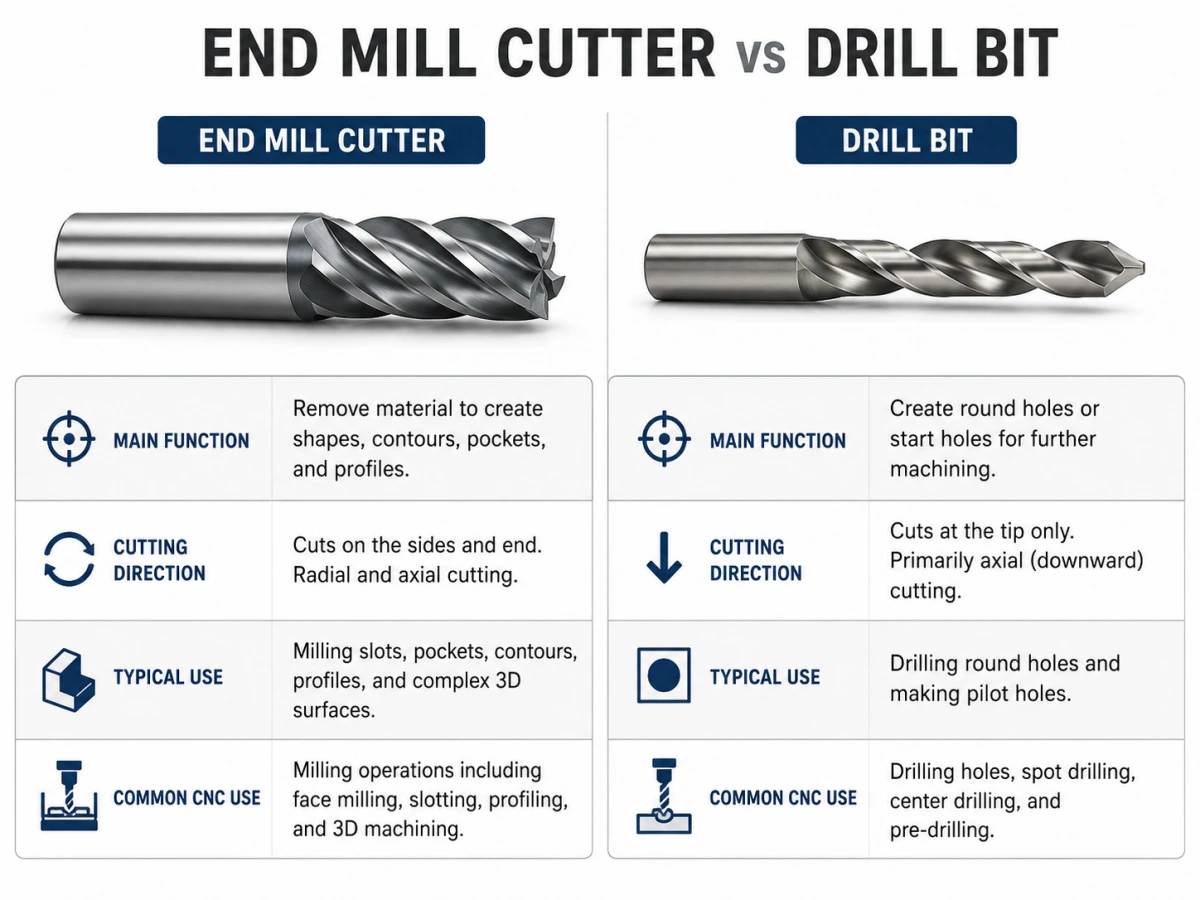
| Característica | Fresa de extremo | Broca |
| Función principal | Molienda, ranurado, Perfiles, corte lateral | Perforación de agujeros |
| Dirección de corte | axiales y laterales | Principalmente axial |
| Uso típico | Tragamonedas, bolsillos, contornos, paredes laterales | Agujeros redondos |
| Flexibilidad de herramientas | Más alto | Más bajo |
| Uso común de CNC | Operaciones generales de fresado. | Operaciones de perforación |
En breve, ambas herramientas eliminan material, pero no son intercambiables en la mayoría de situaciones de mecanizado. Una fresa de corte central puede hundirse en algunas aplicaciones, pero todavía no es lo mismo que una broca estándar.
Tipos comunes de fresas de extremo
Hay muchos tipos de fresas de extremo., y cada diseño tiene un propósito específico. Elegir el tipo correcto ayuda a mejorar la eficiencia de corte, calidad de la superficie, y vida útil de la herramienta.
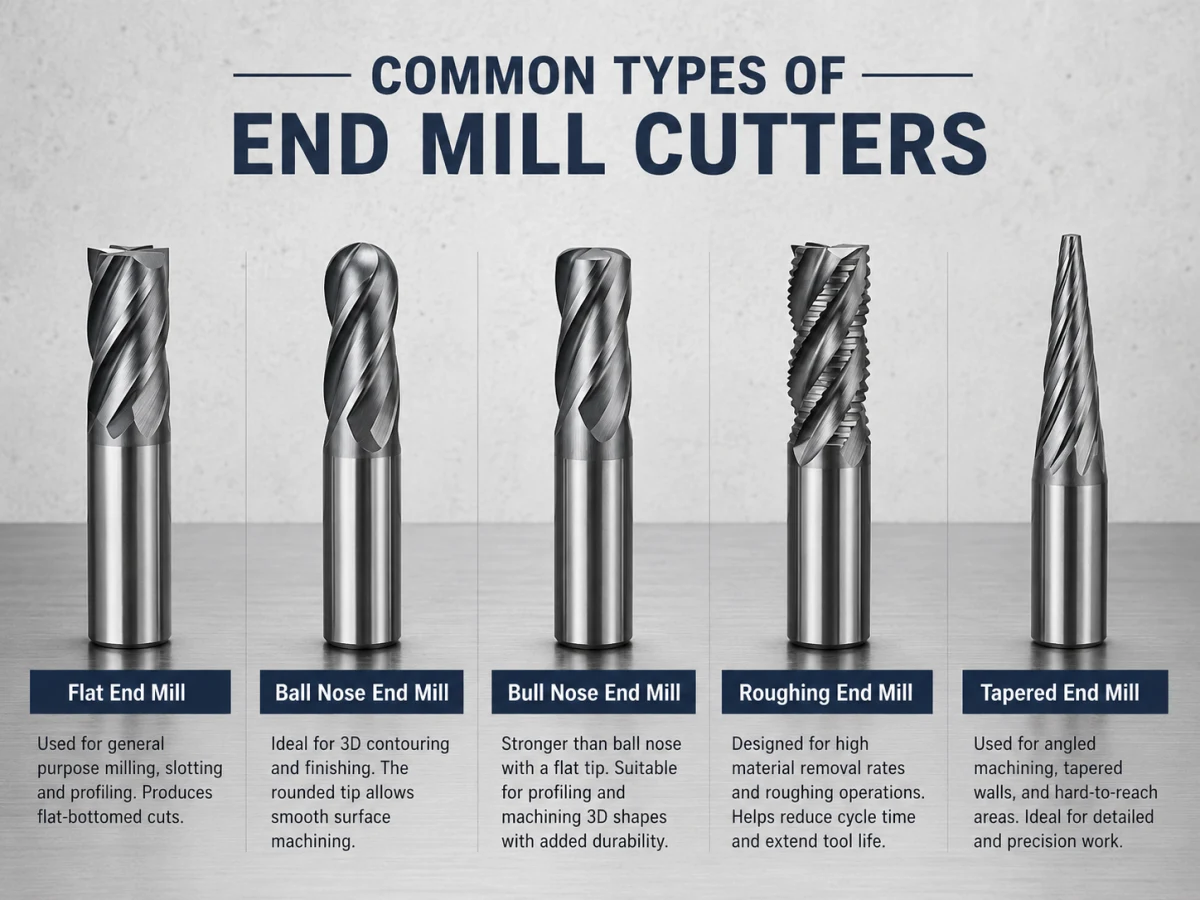
Fresa de extremo plano
Una fresa de extremo plano tiene un extremo de corte plano.. Es ampliamente utilizado para ranurar., fresado lateral, fresado en hombro, y mecanizado de uso general.
Molino de extremo de punta esférica
Una fresa de punta esférica tiene un extremo de corte redondeado.. Se utiliza comúnmente para contorneado 3D., mecanizado de moldes, superficies curvas, y operaciones de acabado.
Para mecanizado de superficies curvas y trabajo con moldes, también puedes ver nuestro Fresas de punta esférica.
Molino de punta de toro
Una fresa de punta redondeada, También llamado fresa de extremo de radio de esquina., combina un fondo plano con esquinas redondeadas. Mejora la resistencia de los bordes y ayuda a crear transiciones más suaves..
Para una geometría de esquina más fuerte, ver nuestro fresa de punta de toro.
Fresa de desbaste
Una fresa de desbaste está diseñada para la eliminación agresiva de material.. A menudo se utiliza antes de terminar para eliminar rápidamente grandes cantidades de material..
Para eliminación de material pesado, puedes consultar nuestro fresas de desbaste.
Fresa cónica
Una fresa de extremo cónico tiene un diámetro que cambia gradualmente. Se utiliza para paredes en ángulo., caries profundas, mecanizado de moldes, y perfiles especiales.
Para cavidades de molde y mecanizado en ángulo, visita nuestro Cortador cónico.
Para una comparación más detallada de las geometrías de las herramientas, lee nuestro Guía de tipos de fresas de extremo.
¿Para qué se utiliza una fresa de extremo??
Las fresas de extremo se utilizan en muchas operaciones de fresado CNC.. Porque pueden cortar desde el final y el costado., Son adecuados para tareas de mecanizado tanto simples como complejas..
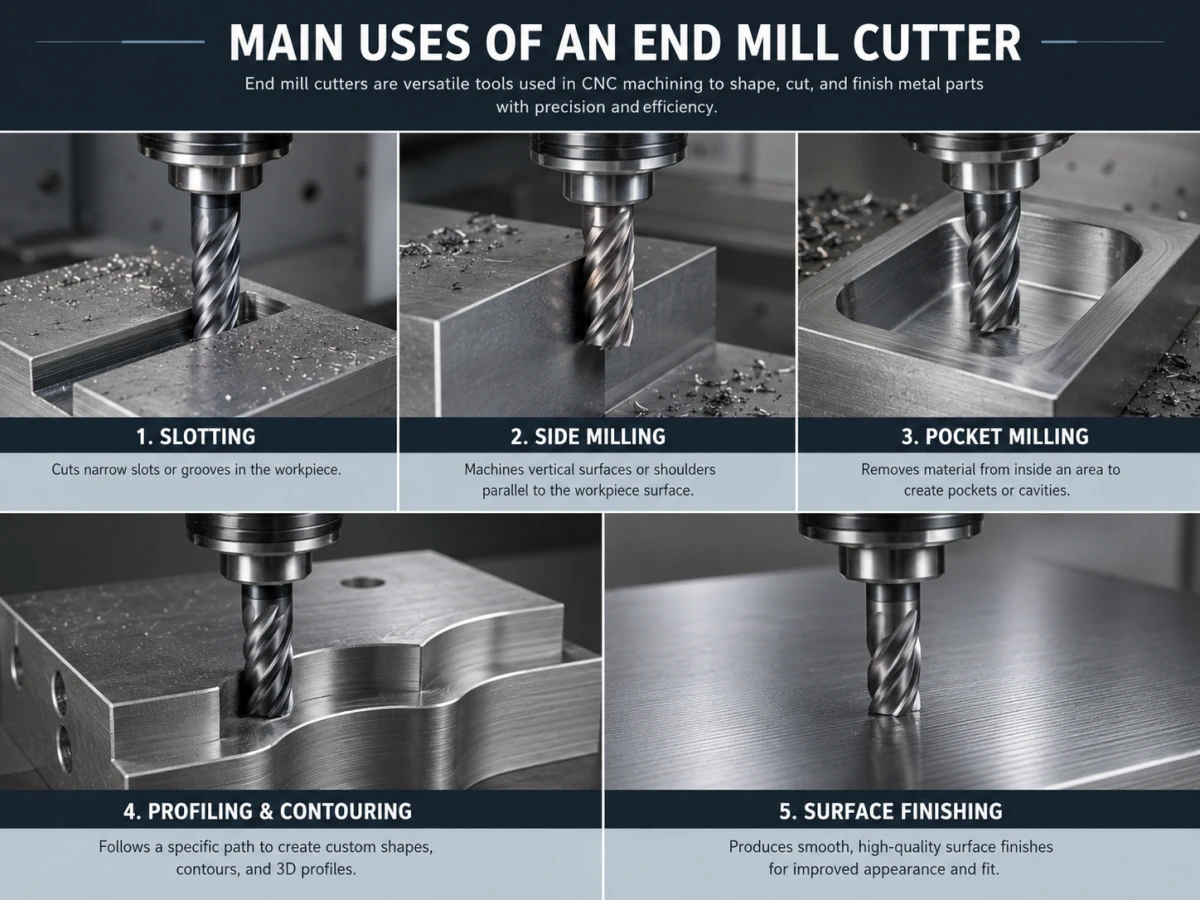
Ranurar
El slotting es una de las aplicaciones más comunes. Una fresa de extremo puede cortar ranuras rectas o curvas en una pieza de trabajo con buena precisión. Estas ranuras pueden crear chaveteros., surcos, pistas guía, y características de montaje.
Para materiales más blandos como el aluminio., La evacuación de virutas es importante.. Por lo tanto, Los maquinistas a menudo seleccionan 2 herramientas de flauta cuando la pieza de trabajo necesita una mejor eliminación de virutas.
Fresado lateral
El fresado lateral utiliza los bordes cortantes laterales de la herramienta para eliminar material de la superficie vertical de una pieza de trabajo.. Esta operación es útil para mecanizar hombros., pasos, y paredes laterales.
Los talleres mecánicos suelen utilizar fresado lateral para piezas de precisión., componentes del molde, piezas de herramientas, y producción CNC en general.
Perfilado y Contorneado
Los maquinistas también utilizan fresas para perfilar y contornear.. Estas operaciones crean formas complejas., caminos curvos, y perfiles externos o internos.
Los maquinistas suelen seleccionar herramientas de punta esférica y de radio de esquina para este tipo de trabajo porque estas herramientas pueden mejorar las transiciones de superficies y la calidad del acabado..
Fresado de bolsillo
El fresado de cavidades elimina material de un área cerrada o empotrada dentro de una pieza de trabajo.. Esta operación es común en piezas que necesitan cavidades internas., reducción de peso, o eliminación precisa de material dentro de un área limitada.
Buen control de virutas, trayectorias de herramientas estables, y la geometría correcta del cortador son importantes para este proceso.
Acabado de superficies
Después del mecanizado en desbaste, También se puede utilizar una fresa para acabado. El objetivo es mejorar la precisión dimensional y la suavidad de la superficie..
Las herramientas de acabado se seleccionan según la tolerancia., material de la pieza de trabajo, estabilidad de la máquina, y calidad superficial requerida.
Fresado escalonado y mecanizado en escuadra
Las fresas de extremo pueden mecanizar superficies escalonadas, espalda, y funciones multinivel. Estas características a menudo requieren transiciones bruscas, corte estable, y dimensiones precisas.
Como resultado, rigidez de la herramienta, diseño de flauta, y la selección del recubrimiento son importantes.
Usos del cortador de fresado para aluminio, Acero, y acero inoxidable
Diferentes materiales de piezas de trabajo requieren diferentes diseños de cortador. Por lo tanto, Los compradores deben hacer coincidir la fresa final con el material y las condiciones de mecanizado..
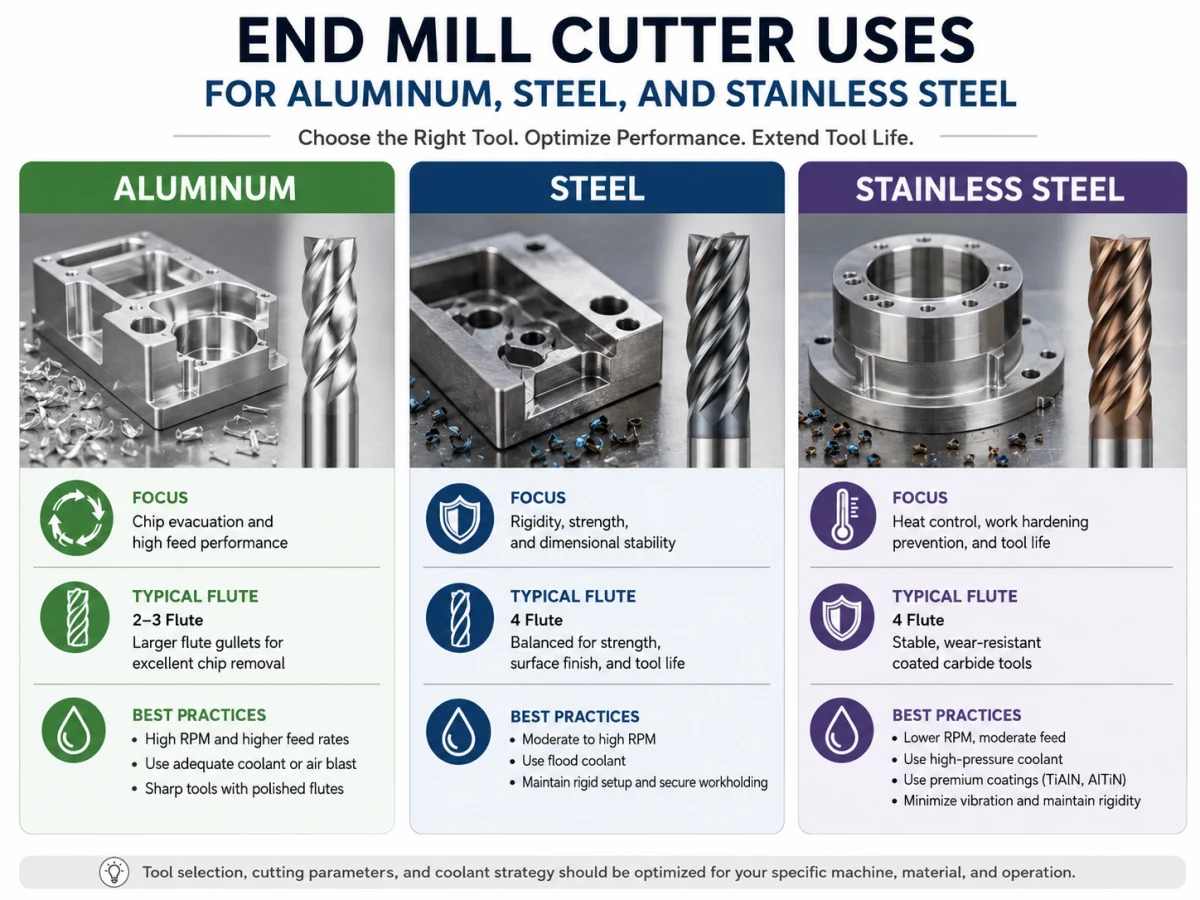
| Material de la pieza de trabajo | Elección de cortador común | Razón principal |
| Aluminio | 2 flauta o 3 fresa de carburo de flauta | Mejor evacuación de virutas y corte suave |
| Acero | 4 Fresa de carburo de flauta con revestimiento adecuado | Mejor rigidez y resistencia al desgaste. |
| Acero inoxidable | Fresa de metal duro recubierta con geometría estable | Mejor control del calor y protección de los bordes |
| Cobre y latón | Fresa de carburo de borde afilado | Corte limpio y reducción de rebabas. |
| Plástica | Afilado, cortador de flauta pulido | Eliminación suave de virutas y menor riesgo de fusión |
Cortador de fresado para aluminio
Al mecanizar aluminio, Las fresas de extremo se utilizan para ranurar., fresado de bolsillo, fresado lateral, y terminando. El aluminio produce virutas más grandes, por lo que a menudo se prefieren herramientas con menos ranuras y buena evacuación de virutas..
Las fresas de carburo de alta hélice también son comunes para el aluminio porque ayudan a mejorar la suavidad del corte y reducen la acumulación de viruta..
Para aluminio y materiales no ferrosos, Puedes comparar opciones de flauta en nuestro 2 fresa de ranura y 3 fresa de ranura paginas.
Cortador de fresado para acero
Para acero al carbono y acero aleado, Las fresas de extremo se utilizan a menudo para fresado lateral., contornear, mecanizado de hombro, y semiacabado. El acero suele requerir una mayor rigidez y una mayor resistencia al desgaste..
En muchos casos, 4 Las fresas de extremo de carburo de flauta se seleccionan para el mecanizado de acero y metales de uso general..
Para mecanizado de acero, puedes ver nuestro 4 fresa de ranura.
Cortador de fresado para acero inoxidable
El acero inoxidable es más difícil de mecanizar porque genera calor y tiende a provocar desgaste de la herramienta.. En aplicaciones de acero inoxidable, Las fresas de extremo se utilizan comúnmente para perfilar., refinamiento, y fresado lateral controlado.
El revestimiento adecuado, geometría de la flauta, y los parámetros de corte ayudan a mantener la estabilidad del corte y reducir el desgaste del borde.
Cómo elegir una fresa de extremo básica
Elegir una fresa cortadora no tiene por qué ser complicado. Sin embargo, Los compradores deben comprobar varios factores antes de realizar el pedido..
Material de la pieza de trabajo
El material de la pieza de trabajo es uno de los factores más importantes.. Aluminio, acero, acero inoxidable, cobre, latón, plástica, y el hierro fundido puede requerir diferentes diseños de flauta, revestimientos, y estrategias de corte.
Conteo de flauta
El número de canales afecta la evacuación de virutas, rigidez, y eficiencia de corte. Por ejemplo, Los maquinistas suelen utilizar 2 herramientas de flauta para aluminio, mientras que comúnmente eligen 4 Herramientas de flauta para mecanizado de acero y de uso general..
Para una comparación más profunda, lee nuestro 2 flauta vs. 4 guía de fresado de flauta.
Material de la herramienta
Muchos talleres de mecanizado CNC eligen fresas de carburo sólido porque proporcionan mayor rigidez., mejor resistencia al desgaste, y rendimiento estable. Algunos talleres todavía utilizan herramientas HSS para aplicaciones de mecanizado general o de baja velocidad..
Capa
El recubrimiento debe coincidir con el material y las condiciones de mecanizado.. Por ejemplo, Los maquinistas suelen elegir recubrimientos TiAlN y AlTiN para acero., mientras que el recubrimiento DLC puede ser adecuado para aluminio y materiales no ferrosos.
Acabado requerido
Para operaciones de desbaste, el objetivo principal es una mayor eliminación de material. Sin embargo, para terminar el trabajo, La calidad de la superficie y la precisión dimensional se vuelven más importantes..
Especificaciones básicas para comprobar antes de comprar
Antes de realizar un pedido, Los compradores deben confirmar varias especificaciones clave.. Esto ayuda a evitar desajustes de herramientas y mejora la estabilidad del mecanizado..
Diámetro del cortador
El diámetro del cortador afecta el ancho de corte, rigidez, y el tamaño de la característica mecanizada.
Longitud de la flauta
La longitud de la flauta determina la profundidad a la que puede mecanizarse el cortador.. Sin embargo, una flauta más larga puede reducir la rigidez, por lo que debe coincidir con la profundidad de corte real.
Longitud total
La longitud total afecta el alcance de la herramienta y el control de la vibración.. Es posible que se necesite una herramienta más larga para caries profundas., pero debe usarse con cuidado para reducir la charla..
Diámetro del vástago
El diámetro del vástago debe coincidir correctamente con el soporte.. La sujeción estable ayuda a mejorar la precisión y la vida útil de la herramienta.
Geometría de esquina
Departamento, nariz de bola, radio de esquina, y las geometrías cónicas se utilizan para diferentes objetivos de mecanizado. Por lo tanto, La geometría de las esquinas debe coincidir con la forma de la pieza y el acabado requerido..
Tipo de revestimiento
El recubrimiento debe seleccionarse según el material de la pieza de trabajo., velocidad de corte, condición del refrigerante, y requisito de vida útil de la herramienta.
Por qué las fresas de carburo sólido son comunes en el fresado CNC
Las fresas de carburo macizo son populares porque ofrecen una gran rigidez., Alta dureza, y buena resistencia al desgaste. Pueden soportar velocidades de corte más altas y proporcionar un rendimiento más estable que muchos materiales de herramientas estándar..
En mecanizado de producción, Muchos talleres utilizan herramientas de carburo para acero., acero inoxidable, hierro fundido, aluminio, y otros materiales exigentes. Además, la geometría y el recubrimiento correctos pueden mejorar la consistencia del mecanizado.
Compradores industriales, distribuidores, y los talleres mecánicos a menudo prefieren herramientas de carburo porque ayudan a reducir los cambios de herramientas y respaldan una producción más estable..
Para herramientas de carburo estándar y personalizadas, puedes visitar nuestro papel cortador de fresa de carburo.
¿Cuándo necesita una fresa de extremo personalizada??
Una cortadora estándar puede resolver muchas tareas de mecanizado comunes.
Sin embargo, Es posible que necesite herramientas personalizadas cuando la pieza tenga un perfil especial., cavidad profunda, material inusual, tolerancia estricta, o requisito de tamaño no estándar.
Los fabricantes pueden diseñar fresas de extremo personalizadas con un diámetro especial, longitud de la flauta, longitud total, radio de esquina, revestimiento, tamaño del mango, y geometría de la herramienta.
Para herramientas basadas en planos o OEM, visita nuestro papel de molinos de extremo personalizados.
Preguntas más frecuentes
¿Qué es una fresa de extremo??
Una fresa de extremo es una herramienta de corte rotativa que se utiliza para operaciones de fresado CNC, como el ranurado., fresado lateral, Perfiles, contornear, fresado de bolsillo, y terminando.
¿Para qué se utiliza una fresa de extremo??
Se utiliza para eliminar material del extremo y el costado de una pieza de trabajo.. Las aplicaciones comunes incluyen tragamonedas, bolsillos, paredes laterales, perfiles, espalda, superficies curvas, y superficies acabadas.
¿Cuál es la diferencia entre una fresa y una broca??
Una broca corta agujeros principalmente en dirección axial.. Una fresa de extremo puede cortar axial y lateralmente, para que pueda realizar más operaciones de fresado como ranurado, Perfiles, y fresado lateral.
¿Cuáles son los tipos comunes de fresas de extremo??
Los tipos comunes incluyen fresas de extremo plano, Fresas de punta esférica, fresas de punta de toro, fresas de desbaste, fresas cónicas, 2 Fresas de ranurar, 3 Fresas de ranurar, 4 Fresas de ranurar, y 6 Fresas de ranurar.
¿Cómo elijo una fresa de extremo básica??
Debes comprobar el material de la pieza de trabajo., recuento de flauta, diámetro del cortador, longitud de la flauta, longitud total, diámetro del vástago, material de la herramienta, revestimiento, y acabado superficial requerido.
¿Son las fresas de carburo mejores que las fresas de HSS??
Las fresas de carburo suelen proporcionar una mejor rigidez., resistencia al desgaste, y estabilidad de corte. Sin embargo, La mejor elección depende de la máquina., material de la pieza de trabajo, velocidad de corte, y presupuesto.
Conclusión
Una fresa de extremo es una herramienta de fresado CNC versátil que se utiliza para ranurar, fresado lateral, fresado de bolsillo, Perfiles, contornear, mecanizado de hombro, y terminando. Porque puede cortar tanto por el extremo como por el lateral., Es más flexible que muchas herramientas de corte básicas..
Para elegir el cortador adecuado, Los compradores deben entender la estructura de la herramienta., tipo de cortador, recuento de flauta, material, revestimiento, diámetro, longitud de la flauta, y aplicación de mecanizado. Una vez que estos factores coincidan correctamente, el cortador puede proporcionar una mejor eficiencia de corte, mayor vida útil de la herramienta, y resultados de mecanizado más estables.
Buscando un fabricante confiable de fresas para aluminio, acero, acero inoxidable, o mecanizado CNC personalizado?
Explora nuestro página de producto del cortador de fresado para soluciones estándar y OEM, o contáctenos con sus requisitos de dibujo y aplicación.