 Fresas de precisión,Herramientas de corte para el mecanizado CNC de todos los materiales

¿Puedes sumergirte con una fresa?? Sí, but the cutter must have center-cutting geometry, and the material, entry depth, evacuación de viruta, and machine setup must be suitable.
A 2-flute design usually provides more space for chips than a higher-flute cutter. Por lo tanto, it can support controlled plunge entry in aluminum, latón, cobre, plásticos seleccionados, and other applications where chip evacuation is important.
Sin embargo, two flutes do not automatically make an end mill suitable for vertical entry. For deep pockets, materiales difíciles, o configuraciones inestables, rampa, entrada helicoidal, or pre-drilling often provides better control.
What Does Plunging Mean in CNC Milling?
Plunging means feeding an end mill in the axial direction, directly toward the workpiece. During this movement, the cutter must remove material near its center while chips leave through the flutes.
This differs from side milling, where the cutting edges mainly remove material from the side of the tool. Straight plunging creates a higher axial load and provides less space for chips to escape from the bottom of the cut.
Como resultado, the cutter geometry and entry method become especially important.
Typical axial-entry methods include:
- Straight plunging
- rampa
- Entrada helicoidal
- Pre-drilling followed by milling
Each method creates different cutting loads and chip-flow conditions.
Can You Plunge With an End Mill Safely?
An end mill can plunge safely when the following conditions are met:
- The tool has center-cutting geometry
- The entry is shallow and controlled
- Las virutas pueden salir de la zona de corte.
- El voladizo de la herramienta es limitado
- The machine and workpiece setup are stable
- The axial feed matches the specific cutter
- The material suits the tool geometry and coating
The most important question is not simply whether the cutter has two or four flutes.
En cambio, confirmar:
Can the end cutting edges remove material at the center of the tool?
If the answer is no, the cutter should not be fed straight down into solid material.
Center-Cutting vs Non-Center-Cutting End Mills
What Is a Center-Cutting End Mill?
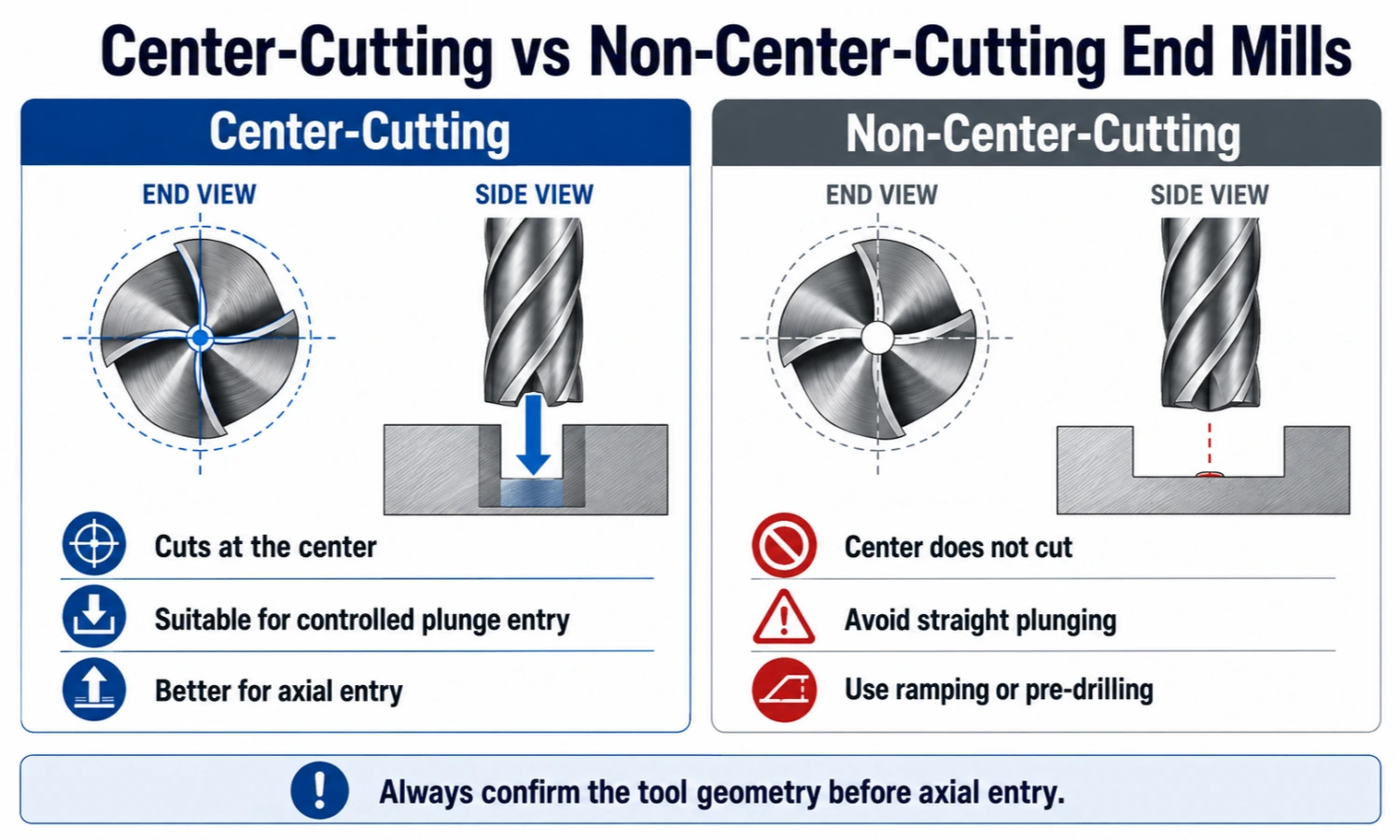
A center-cutting end mill has end cutting edges that reach or cross the center area of the tool.
This geometry allows the cutter to remove material near its rotational center. Por lo tanto, it can support certain axial-entry operations, including controlled straight plunging, rampa, o entrada helicoidal.
A center-cutting end mill must still be used within the limits of its specific design. It does not mean that the tool can be used like a drill for any depth, material, or feed rate.
Why a Non-Center-Cutting End Mill Cannot Plunge Straight Down
A non-center-cutting end mill does not have an effective cutting edge at the tool center.
If this tool is fed vertically into solid material, the center may rub instead of cutting. This can cause:
- Excessive heat
- High axial load
- Charla
- Edge chipping
- Deflexión de la herramienta
- Poor entry accuracy
- Premature tool failure
A non-center-cutting tool can still perform side milling or enter an existing hole. Sin embargo, it should not be used for straight plunging into solid material.
How to Confirm Center-Cutting Geometry
Do not identify center-cutting capability only from the flute count.
En cambio, controlar:
- The product specification
- The tool drawing
- A clear photograph of the end geometry
- Whether the end cutting edges reach the center
- The manufacturer’s application instructions
- Confirmation from the tool supplier
Some two-flute and four-flute end mills have center-cutting geometry, while others do not.
Why a 2-Flute Design Can Help With Plunge Entry
More Chip Space
A 2-flute end mill normally has wider flute grooves than a cutter with more flutes.
The additional space can help chips move away from the center of the cut. This is important because chips have fewer exit paths during axial entry than during open side milling.
If chips remain below the tool, pueden volver a cortarse o comprimirse contra la pieza de trabajo. Heat and cutting pressure can then rise quickly.
Chip Evacuation in Soft Materials
Aluminio, latón, cobre, and some plastics may produce relatively large or continuous chips.
A sharp 2-flute cutter with adequate flute space can help reduce:
- Embalaje de chips
- Borde construido
- Re-cutting
- Acumulación de calor
- Daños de vanguardia
Aire, neblina, or suitable coolant can also help move chips away from the cutting area.
Lo que el conde de flauta no puede decirte
Flute count alone does not confirm:
- Center-cutting capability
- A safe plunge feed
- Maximum entry depth
- Suitability for hard materials
- Required coolant method
- Rigidez de la herramienta
- Maximum tool overhang
The complete cutter design must be reviewed.
For more information about flute space, diámetro del núcleo, longitud de la flauta, y evacuación de virutas, lee nuestro guía de selección de flautas de fresado final.
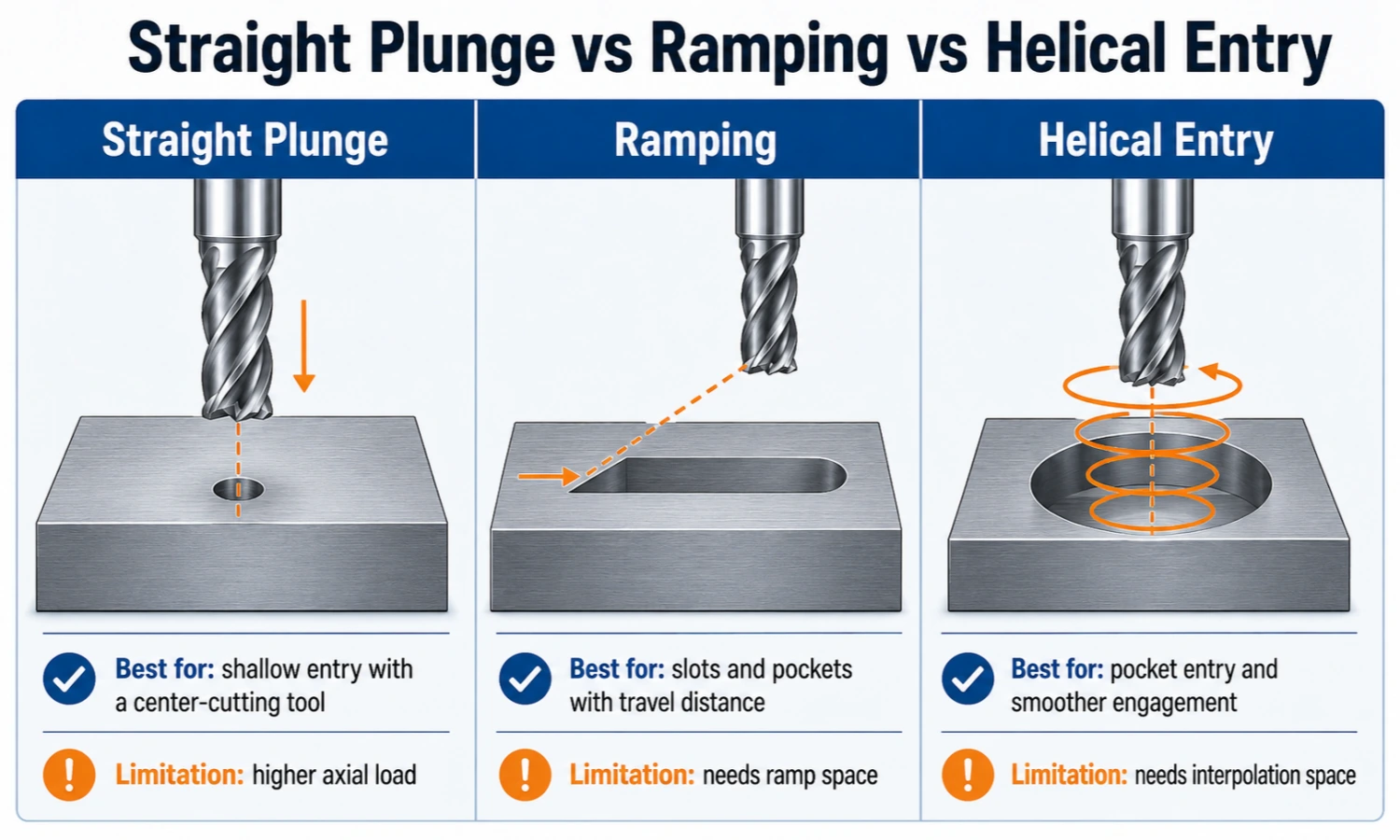
Straight Plunge vs Ramping vs Helical Entry
The safest entry method depends on the feature, available toolpath space, material, and cutter design.
| Entry Method | Suitable Situation | Ventaja principal | Limitación principal |
|---|---|---|---|
| Straight Plunge | Shallow entry with a center-cutting tool | Short and direct toolpath | Higher axial load and limited chip evacuation |
| rampa | Slots and pockets with available travel distance | Reduces direct axial loading | Requires enough ramping distance |
| Entrada helicoidal | Pocket entry and larger openings | Smooth engagement and improved chip flow | Requires interpolation space |
| Pre-Drilling | Deep or difficult axial entry | Removes center material before milling | Adds another machining operation |
When Straight Plunging Is Acceptable
Straight plunging may be suitable when:
- The cutter is center cutting
- The entry is shallow
- The material is easy to machine
- The tool overhang is short
- La evacuación de viruta se mantiene estable
- The tool supplier allows axial entry
Straight entry should be controlled rather than aggressive.
When Ramping Is the Better Choice
Ramping combines axial and horizontal movement.
Because the cutter moves sideways while entering the material, the cutting load is distributed more gradually than during a straight plunge.
Ramping is often useful for:
- Slot starts
- Pocket entry
- Longer entry paths
- Applications where straight plunging creates excessive load
The ramp angle and feed must match the specific cutter and material.
When to Use Helical Entry
Helical entry moves the cutter in a circular path while gradually feeding downward.
This method can improve engagement and chip evacuation because the cutter does not remain concentrated at one center point.
Helical entry is often suitable for:
- Fresado de cajeras
- Larger openings
- Deeper entry
- Materials that generate heat during straight plunging
- Applications that require smoother entry
The pocket must provide enough room for the helical toolpath.
When Pre-Drilling Is Safer
Pre-drilling removes the center material before the end mill enters.
It can be useful when:
- The required entry is deep
- The material is difficult to machine
- The selected end mill is not suitable for direct plunging
- Chip evacuation is restricted
- A conventional hole is already part of the machining process
Pre-drilling adds another tool and operation, but it can reduce the risk of damaging the end mill.
When Can a 2-Flute End Mill Plunge?
Use this checklist before machining:
- Confirm that the cutter is center cutting
- Check that the material matches the tool
- Keep the first entry shallow and controlled
- Use an axial feed suitable for the specific cutter
- Make sure chips can leave the bottom of the cut
- Keep tool overhang as short as practical
- Check holder condition and runout
- Clamp the workpiece securely
- Direct air, neblina, or coolant toward the entry area
- Stop if the tool rubs instead of cutting
Soft materials and shallow pocket starts are usually easier than deep axial entry in heat-resistant materials.
Sin embargo, the actual result still depends on cutter diameter, geometría del borde, grado de carburo, revestimiento, rigidez de la máquina, y trayectoria.
When Should Straight Plunging Be Avoided?
Non-Center-Cutting Tool
Do not feed a non-center-cutting end mill vertically into solid material.
Use an existing hole, pre-drilling, rampa, entrada helicoidal, or another suitable cutter instead.
Deep Axial Entry
Deep plunging makes chip evacuation more difficult. Chips may remain below the tool and increase heat or cutting pressure.
rampa, entrada helicoidal, or step-by-step entry may provide better control.
Hard or Heat-Resistant Materials
Harder or heat-resistant materials can increase axial load, calor, and cutting-edge stress.
Do not assume that changing from two flutes to four flutes will automatically solve the problem. Review the cutter series, grado de carburo, revestimiento, método de entrada, y condición del refrigerante.
Long Tool Overhang
Long overhang increases deflection and chatter risk.
Use the shortest practical tool and flute length. Además, improve holder and workpiece rigidity before increasing the axial load.
Mala evacuación de virutas
Straight plunging should be stopped when chips remain inside the pocket or begin wrapping around the tool.
Improve air or coolant delivery, reduce the entry depth, or change to a different entry method.
Unstable Machine or Workpiece Setup
An unstable holder, worn collet, weak fixture, or low-rigidity machine can cause vibration during entry.
Correct the setup before changing the flute count or increasing the feed.
Safe Starting Practices for Plunge Entry
The correct RPM, axial feed, and entry depth depend on the exact cutter and machining conditions. Por lo tanto, one fixed parameter cannot be applied to every 2-flute end mill.
Use the following starting practices:
- Confirm center-cutting geometry before machining.
- Begin with a lower axial feed than the side-milling feed.
- Keep the initial entry shallow.
- Use air, neblina, or suitable coolant to clear chips.
- Keep the cutter extension short.
- Listen for rubbing, knocking, or unstable cutting sounds.
- Watch chip shape and spindle load.
- Inspect the cutting edge after the first trial cut.
- Change to ramping or helical entry when straight plunging is unstable.
Test cuts should be made in a controlled condition before full production.
Common Plunge-Cutting Problems and Solutions
| Problem | Posible causa | Adjustment Direction |
|---|---|---|
| Tool rubs at the center | Non-center-cutting geometry | Use a center-cutting tool or another entry method |
| Chips pack inside the pocket | Entry is too deep or chip evacuation is weak | Reduce entry depth and improve air or coolant delivery |
| Chatter during entry | Largo voladizo, sin, or unstable clamping | Shorten overhang and improve holder or fixture rigidity |
| Built-up edge in aluminum | Poor chip flow, dull edges, or unsuitable surface condition | Use sharp geometry and improve chip evacuation |
| Early edge damage | Excessive axial feed or unsuitable material | Reduce the axial feed or use ramping |
| Excessive heat | Long contact time or poor coolant access | Use helical entry, rampa, o preperforación |
| Tool enters unevenly | Incorrect end geometry or unstable setup | Confirm center cutting and inspect runout |
| Poor bottom accuracy | Tool deflection or unsuitable entry method | Improve rigidity and review the cutter geometry |
A problem may have more than one cause. Por lo tanto, inspect the complete setup before replacing the cutter.
2 Flauta vs. 4 Flute for Plunge Entry
For plunge entry, center-cutting geometry and entry method are more important than flute count alone.
A 2-flute cutter usually provides more chip space. This can help during shallow entry in aluminum and other materials that generate larger chips.
Some 4-flute tools provide more cutting edges and a larger core. Sin embargo, the smaller flute grooves may make chip evacuation more difficult during straight axial entry.
Both 2-flute and 4-flute end mills may be manufactured with either center-cutting or non-center-cutting geometry. Always confirm the specific product before plunging.
Para una comparación más amplia, leer 2 fresa de extremo de flauta vs. 4 flauta.
Preguntas más frecuentes
Can All 2-Flute End Mills Plunge?
No. A 2-flute end mill must have suitable center-cutting geometry before it can remove material at the tool center.
Flute count alone does not confirm plunge capability.
How Do I Know Whether an End Mill Is Center Cutting?
Check the product specification, dibujo de herramienta, or end-view photograph. The end cutting edges should reach or cross the center area.
When the geometry is unclear, ask the manufacturer or supplier to confirm it.
Is Ramping Safer Than Straight Plunging?
Ramping often reduces direct axial loading because the tool moves horizontally while feeding downward.
Sin embargo, the ramp angle, alimentar, geometría del cortador, and available travel distance must still be suitable.
Can a 2-Flute End Mill Plunge Into Aluminum?
Sí, a center-cutting 2-flute end mill can perform controlled plunge entry in aluminum under suitable conditions.
Bordes cortantes afilados, adequate flute space, voladizo corto, and reliable chip evacuation are especially important.
Can an End Mill Plunge Into Stainless Steel?
Some application-specific center-cutting end mills can enter stainless steel axially. Sin embargo, calor, endurecimiento por trabajo, control de chips, and cutting-edge stress make straight plunging more demanding.
rampa, entrada helicoidal, or pre-drilling may provide a safer approach.
Can a 4-Flute End Mill Plunge?
Sí, some 4-flute end mills are center cutting and can support certain axial-entry operations.
The product specification and recommended entry method must be confirmed first.
Can I Use an End Mill Instead of a Drill Bit?
A center-cutting end mill can make certain shallow entries, características de fondo plano, and pocket starts.
Sin embargo, a drill bit is designed specifically for axial holemaking and usually evacuates chips more efficiently in deeper conventional holes.
Use an end mill when the operation requires milling after entry or a flat-bottom feature. Use a suitable drill for normal deep holemaking.
What Is the Difference Between Plunging and Helical Entry?
Straight plunging feeds the cutter directly downward along its axis.
Helical entry combines circular movement with gradual axial feed. This reduces concentrated center loading and normally provides more space for chips to leave the cut.
Guías relacionadas
For more information about 2-flute tools and flute-count selection, leer:
¿Qué es un 2 fresa de extremo de flauta utilizada para?
2 fresa de extremo de flauta vs. 4 flauta
2 flauta vs. 4 flauta vs. 6 fresa de ranura
Guía de selección de flautas para fresas de extremo
Need Help Choosing a Center-Cutting End Mill?
Envíanos el material de tu pieza, tamaño de cortador requerido, operación de mecanizado, dibujo, tool photograph, or current cutting problem. We can review the available information and help confirm a suitable standard or custom tool direction.
Vea nuestros estándares y personalizados 2 página de producto del molino de extremo de flauta.
Para discutir su solicitud, envíenos un correo electrónico a sales@cutterbest.com.