 Fresas de precisión,Herramientas de corte para el mecanizado CNC de todos los materiales

Introducción
Un 4 flute end mill is mainly used for steel, acero inoxidable, acero aleado, refinamiento, semiacabado, fresado lateral, and profile milling in CNC machining. With four cutting edges and a stronger core structure, proporciona mayor rigidez, corte más estable, and a smoother surface finish than lower-flute tools in many harder-material applications.
Sin embargo, it is not the best choice for every material or operation. For aluminum roughing, ranurado profundo, or heavy chip removal, a 2 flute tool may clear chips more efficiently. Por lo tanto, la elección correcta depende del material, profundidad de corte, requisito de evacuación de viruta, y meta de mecanizado.
If you need a carbide 4 fresa de ranura para mecanizado de acero o acero inoxidable, también puedes ver nuestro 4 fresa de ranura product page here.
¿Qué es un 4 Molino de extremo de flauta?
Un 4 flute end mill is a rotary milling cutter with four helical cutting edges. The four-flute design gives the tool a stronger core structure, so it can improve rigidity during CNC machining.
Machinists often use this tool for side milling, fresado de contorno, mecanizado de perfiles, refinamiento, y semiacabado. It works especially well when surface quality, estabilidad de corte, and tool life matter more than maximum chip space. Sin embargo, for deep slotting in aluminum or other soft materials, a 2 flute tool may be a better choice.
When Should You Use a 4 Molino de extremo de flauta?
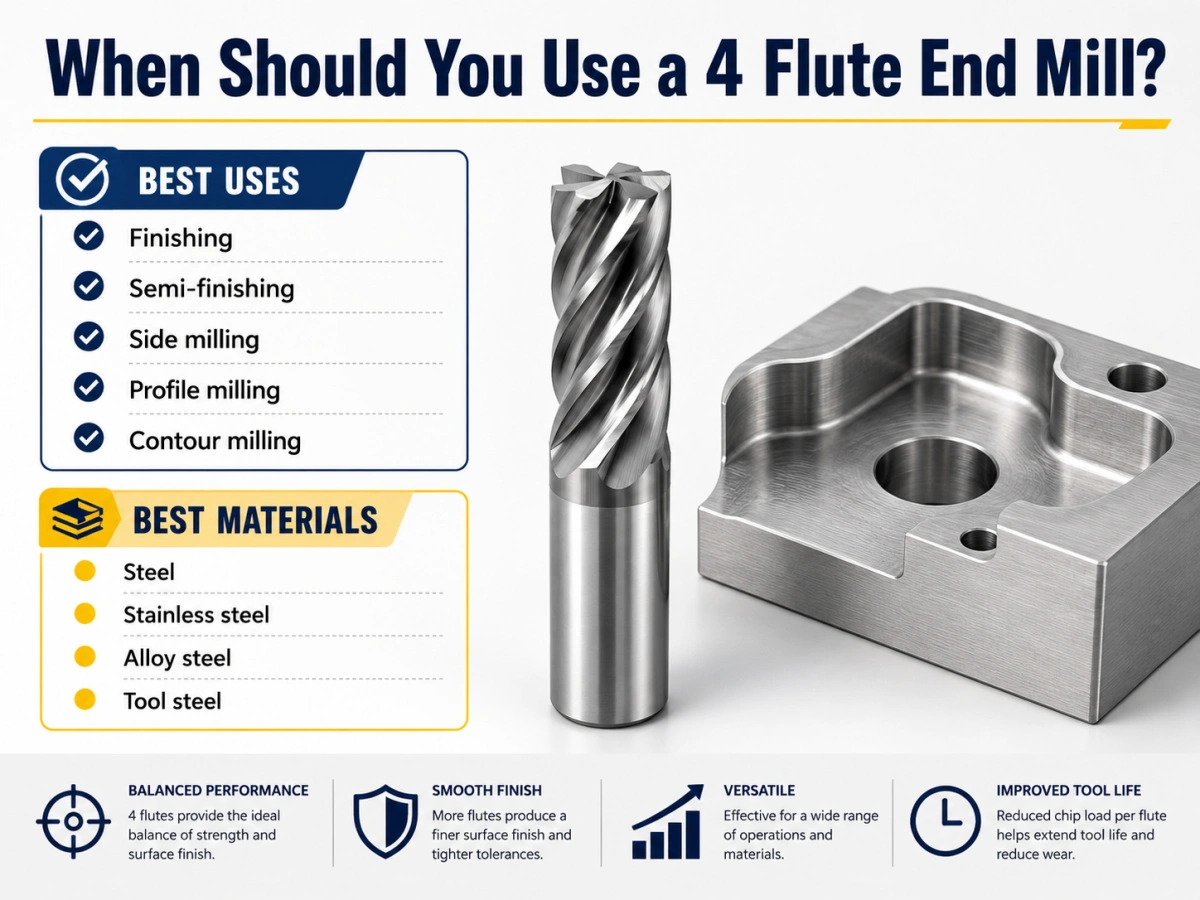
Un 4 flute end mill works best when the operation requires higher rigidity, corte estable, and a cleaner surface finish. Por esta razón, many CNC users choose it for finishing and semi-finishing in steel, acero inoxidable, acero aleado, y otros materiales más duros.
En general, you should consider a 4 fresa de extremo de flauta cuando:
- the workpiece material is steel, acero inoxidable, acero aleado, or tool steel
- the operation requires stable cutting with less vibration
- the goal is better surface finish
- the process involves side milling, fresado de contorno, o mecanizado de perfiles
- the setup needs higher rigidity than a 2 flute tool can provide
- chip evacuation is not the main limitation
Por el contrario, for deep slots, heavy aluminum roughing, or very soft materials, a lower flute count tool may remove chips more efficiently.
Best Materials for a 4 Molino de extremo de flauta
Steel and Alloy Steel
Un 4 flute end mill works well for steel and alloy steel because it provides good rigidity and stable cutting performance. Como resultado, machinists often choose it for finishing and semi-finishing operations where dimensional accuracy and surface quality matter.
Acero inoxidable
Stainless steel machining usually requires heat resistance, estabilidad de corte, and careful chip control. Por esta razón, a coated carbide 4 flute end mill can work well in controlled CNC machining when the speed, alimentar, and coolant match the material.
Aluminum for Light Finishing
Un 4 flute end mill can cut aluminum in some cases, especially for light finishing, contour work, and shallow profiling. Sin embargo, it is usually not the first choice for deep slotting or heavy roughing because aluminum produces larger chips and needs more chip space.
For a full aluminum-focused explanation, lee nuestro are 4 fresas de extremo de flauta buenas para aluminio guía.
4 Flauta vs. 2 Molino de extremo de flauta
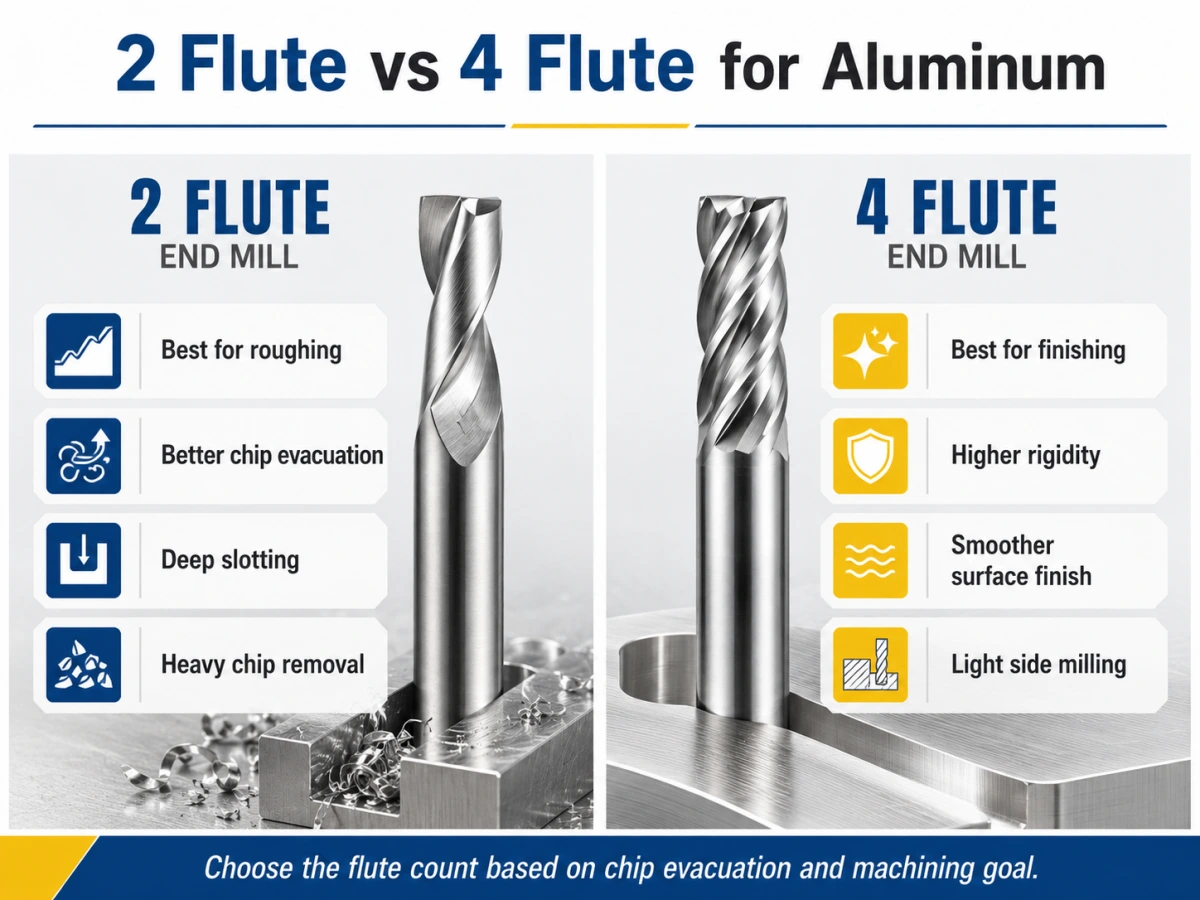
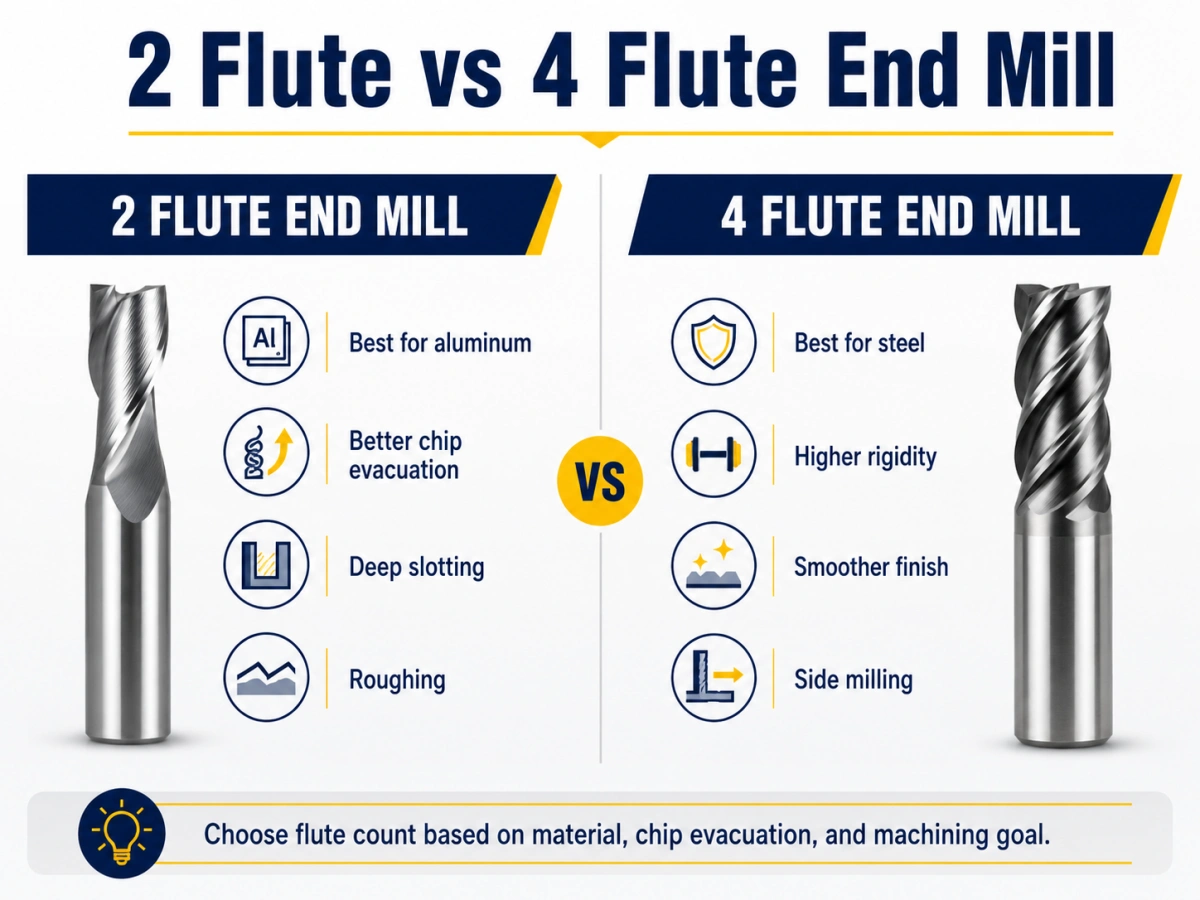
Elegir entre un 2 flauta y un 4 flute end mill depends on the material, profundidad de corte, requisito de evacuación de viruta, y meta de mecanizado.
Un 4 flute end mill is usually better for:
- acero y acero inoxidable
- alloy steel and tool steel
- acabado y semiacabado
- side milling and profile milling
- mayor rigidez
- smoother surface finish
Un 2 flute end mill is usually better for:
- mecanizado de aluminio
- latón, cobre, plástica, and soft materials
- deeper slotting
- roughing in soft materials
- evacuación de virutas más rápida
En otras palabras, a 4 flute end mill is usually the better choice when stability and finish quality matter more than chip space. Por el contrario, a 2 flute tool may work better when the material produces larger chips or when the operation needs deeper chip clearance.
Para una comparación detallada, lee nuestro 2 flauta vs. 4 fresa de ranura guía.
Para una comparación más amplia por material y operación, También puedes leer nuestro 2 flauta vs. 4 flauta vs. 6 fresa de ranura guía.
¿Puede un 4 Flute End Mill Cut Aluminum?
Sí, a 4 flute end mill can cut aluminum, but it usually works better for light finishing, fresado de contorno, and shallow profiling rather than heavy roughing. Because aluminum produces larger chips, tools with fewer flutes often provide more chip space and better chip evacuation.
Por lo tanto, if the job involves deep slots or aggressive material removal in aluminum, a 2 flute end mill may be the safer option. Mientras tanto, if the operation is light profiling or finishing, a 4 flute design can still work well with proper parameters, suitable coolant, and stable chip control.
For more details, lee nuestro 4 flute end mills for aluminum guía.
How to Optimize 4 Flute End Mill Performance
Choose the Right Coating
Different materials require different coating strategies. para acero, acero inoxidable, y acero aleado, coatings such as AlTiN, TiAlN, or TiSiN can improve wear resistance, resistencia al calor, y vida útil de la herramienta.
Control Tool Overhang
Shorter tool overhang usually improves stability and reduces chatter. Como resultado, a rigid setup can improve surface finish, machining accuracy, and cutting consistency.
Match Speeds and Feeds to the Material
Velocidad de corte, tasa de alimentación, radial engagement, and coolant should match the workpiece material and tool geometry. Además, following the tool manufacturer’s recommendations can reduce unnecessary wear, improve surface finish, y prolongar la vida útil de la herramienta.
Common Applications in CNC Machining
Because a 4 flute end mill provides a good balance of rigidity and finish quality, CNC users often choose it for many metalworking applications.
Common examples include:
- mold and die machining
- fabricación de piezas de automóviles
- general machinery components
- precision steel parts
- componentes de acero inoxidable
- tool steel machining
- profile and contour milling work
- finishing and semi-finishing of metal parts
En estas aplicaciones, the tool works well when surface quality, estabilidad, and reliable performance matter more than maximum chip space.
Preguntas más frecuentes
¿Qué es un 4 fresa de extremo de flauta utilizada para?
Un 4 flute end mill is mainly used for steel, acero inoxidable, acero aleado, refinamiento, semiacabado, fresado lateral, fresado de perfiles, and CNC metal machining.
es un 4 Molino de extremo de flauta bueno para acero.?
Sí. Un 4 flute end mill works well for steel because it provides higher rigidity, stable cutting performance, and smoother surface finish than lower-flute tools in many finishing operations.
¿Puede un 4 flute end mill cut stainless steel?
Sí, a coated carbide 4 flute end mill can cut stainless steel when the coating, velocidad, alimentar, refrigerante, and cutting conditions match the material.
es un 4 flute end mill good for aluminum?
Un 4 flute end mill can work for aluminum finishing and light profiling. Sin embargo, for deep slotting or heavy roughing, a 2 el molino de extremo de flauta suele ser mejor. For more details, lee nuestro 4 flute end mills for aluminum guía.
¿Cuál es la diferencia entre 2 flauta y 4 Fresas de ranurar?
Un 2 flute end mill provides more chip space and is often better for aluminum, materiales blandos, and deeper slotting. Un 4 flute end mill provides higher rigidity and is often better for steel, acero inoxidable, refinamiento, y fresado lateral.
Conclusión
Un 4 flute end mill works well for steel, acero inoxidable, acero aleado, refinamiento, semiacabado, fresado lateral, and profile milling. Its main advantages are higher rigidity, smoother surface finish, y un rendimiento de corte más estable en el mecanizado CNC.
Sin embargo, it is not the best choice for every job. For aluminum roughing, ranurado profundo, or heavy chip removal, a lower flute count tool may perform better. Por lo tanto, you should choose the flute count based on material type, profundidad de corte, requisito de evacuación de viruta, y propósito de mecanizado.
Necesito un 4 Fresa de extremo de flauta para acero o acero inoxidable?
Si necesitas un 4 fresa de flauta para acero, acero inoxidable, acero aleado, acero para herramientas, refinamiento, semiacabado, fresado lateral, or profile milling, we can help you choose a suitable carbide tool design.
Envíanos tu material, diámetro de corte, longitud de la flauta, requisito de recubrimiento, dibujo, o aplicación de mecanizado. Our team can recommend standard or custom carbide end mills for your CNC machining project.
Check our 4 fresa de ranura product page here.
Guías relacionadas:
Son 4 fresas de extremo de flauta buenas para aluminio?