 Precision Milling Cutters,Cutting Tools for CNC Machining Every Material

Key Features
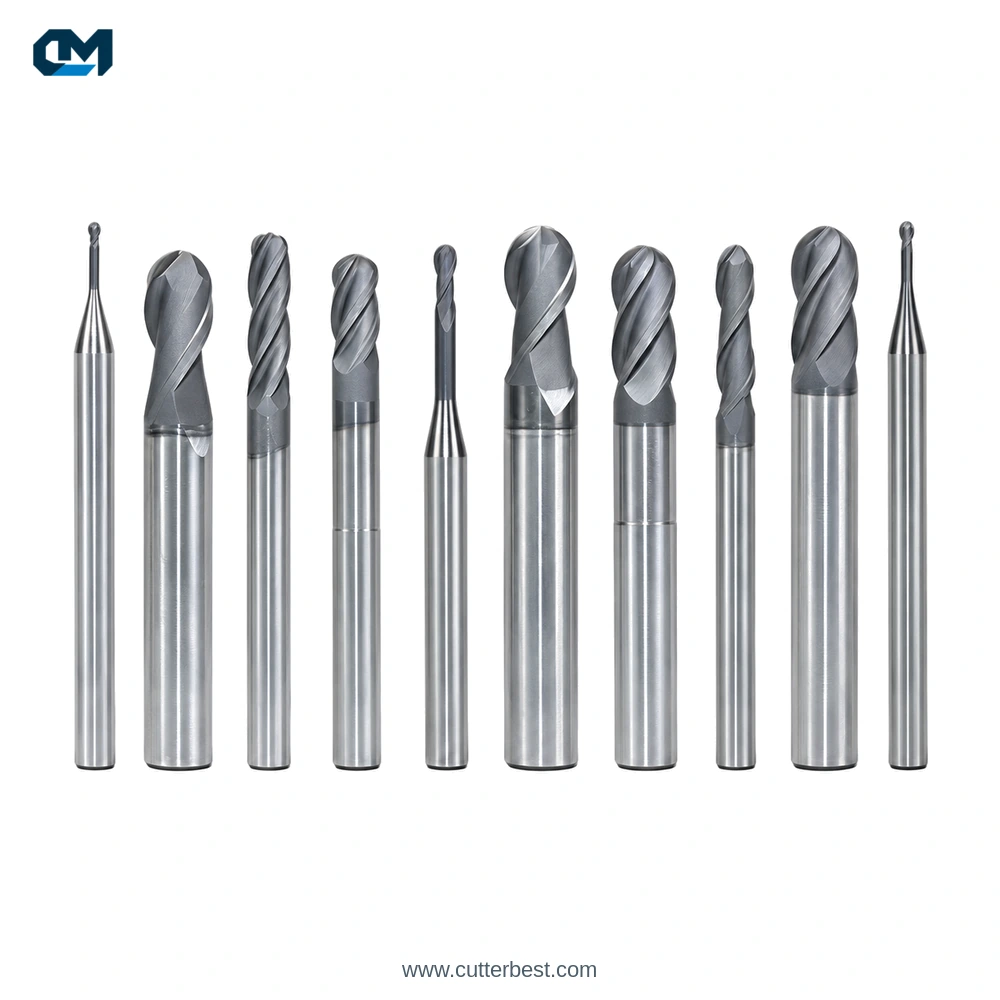
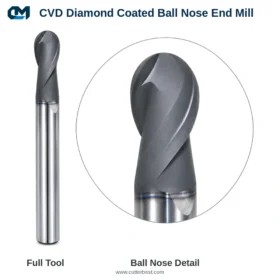
- These CVD diamond-coated ball nose end mills are designed for graphite machining, where the coating helps resist abrasive wear.
- Selected sizes offer multiple effective lengths for features with different access requirements.
- Selected cutting diameters are available with more than one shank diameter or flute count.
Diamond-Coated Ball Nose End Mill Sizes
Representative Metric Configurations
Each row shows one catalog configuration. All dimensions are in millimeters.
| Ball Radius R | Nominal Cutting Diameter d | Length of Cut L1 | Effective Length L2 | Overall Length L | Shank Diameter D | Flutes |
|---|---|---|---|---|---|---|
| 0.1 | 0.2 | 0.4 | 2 | 50 | 4 | 2 |
| 0.3 | 0.6 | 1.2 | 6 | 50 | 4 | 2 |
| 0.3 | 0.6 | 1.2 | 10 | 50 | 4 | 2 |
| 0.5 | 1 | 2 | 6 | 50 | 3 | 2 |
| 0.5 | 1 | 2 | 6 | 50 | 4 | 2 |
| 1.5 | 3 | 8 | 25 | 60 | 6 | 2 |
| 1.5 | 3 | 8 | 30 | 60 | 6 | 2 |
| 5 | 10 | 20 | – | 100 | 10 | 2 |
| 5 | 10 | 20 | – | 100 | 10 | 4 |
| 6 | 12 | 30 | – | 100 | 12 | 4 |
A dash (–) indicates that the catalog gives no separate L2 value for that configuration.
How to Read the Ball Nose End Mill Drawing
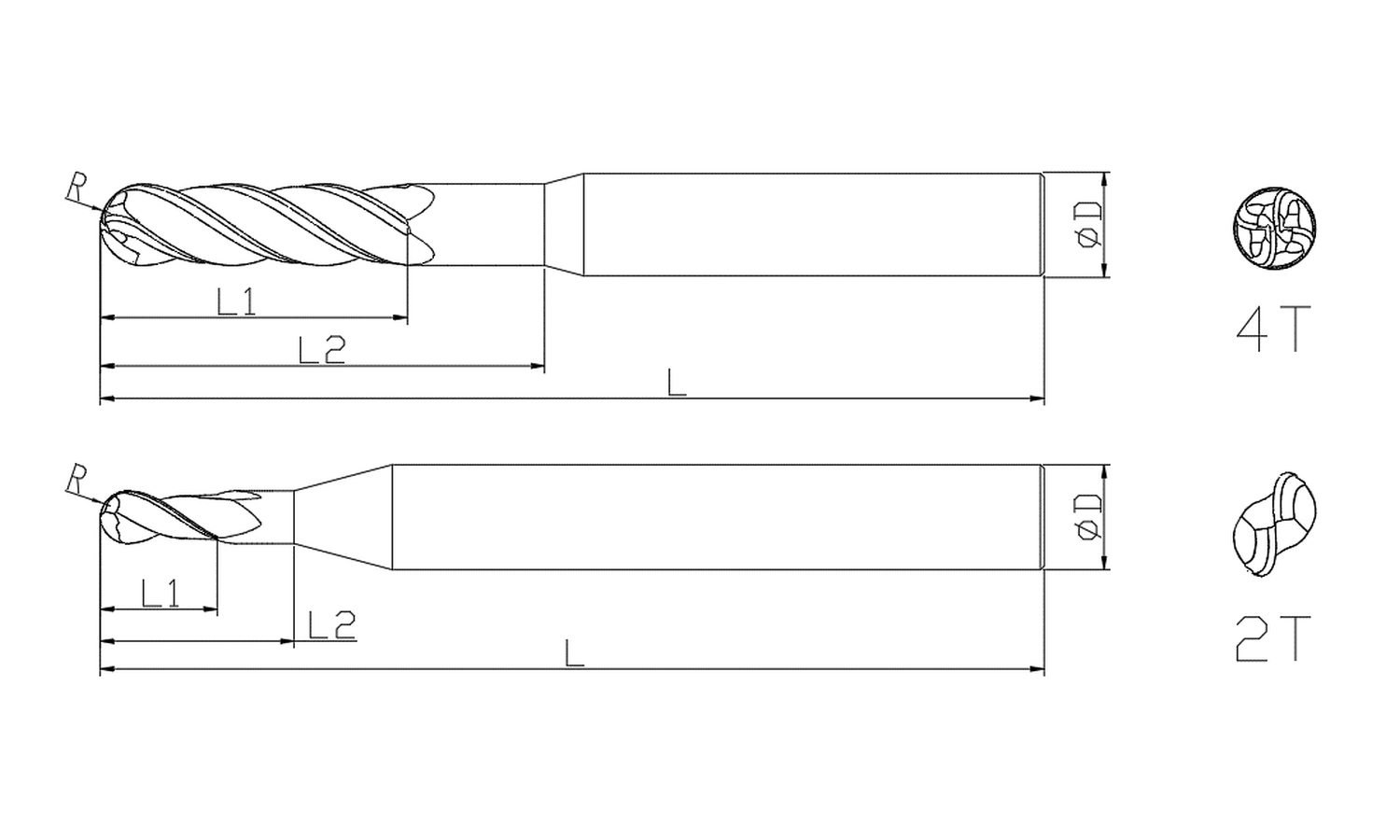
| Symbol | Definition |
|---|---|
| R / d | R is the ball radius. For the full-radius tips in this series, the nominal cutting diameter is d = 2R. |
| L1 | Length of cut. Measured along the tool axis from the front of the ball tip to the length-of-cut reference line, including the ball tip. |
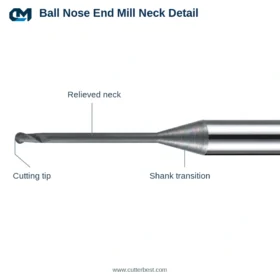
| L2 | Effective length. For tools with a relieved neck, L2 is measured along the tool axis from the front of the ball tip to the start of the transition from the neck to the shank. |
| L | Overall length, measured from the front of the ball tip to the end of the shank. |
| D | Shank diameter at the cylindrical clamping section. |
Use L2 as a reference dimension when checking reach. Usable machining depth depends on the part geometry, neck and shank clearance, tool stickout, and holder clearance.
Applications in Graphite Machining
Use these ball end mills to finish contoured faces, fillets, and fine details on graphite EDM electrodes. They also suit curved floors and profile transitions in graphite mold cavities. For guidance on choosing tools for each machining stage, see our graphite roughing and finishing guide.
Comparing the Ø3 mm Ball Nose Configurations
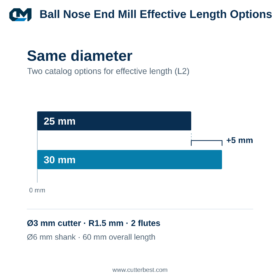
The two Ø3 mm tools shown above have the same R1.5 ball radius, 8 mm length of cut, Ø6 mm shank, 60 mm overall length, and two flutes. Their listed effective lengths are 25 mm and 30 mm. Compare the tool drawings against your part geometry and holder setup when choosing between them.
Selection & Usage Guide
Choose the Ball Radius and Cutting Diameter
Check the smallest concave radius on the part and the narrowest opening the tool must pass through. Use the part drawing to confirm that the tip can reach the intended surface.
Check Cutting Length and Clearance
Check that the cutting edges cover the portion of the tool that will engage the workpiece. For recessed features, ask for the selected tool drawing if you need the neck diameter or transition dimensions.
Confirm Shank Diameter and Flute Count
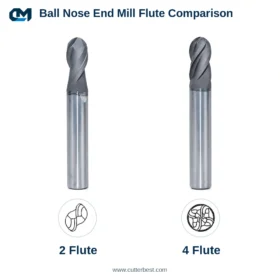
Match the shank diameter to your holder. The table shows Ø1 mm cutters with either a Ø3 mm or a Ø4 mm shank. The Ø10 mm examples show separate two-flute and four-flute options with the same listed cutting length, overall length, and shank diameter.
Why Choose CutterBest
When preparing your quote, we confirm the selected catalog configuration and flag any critical dimensions that need drawing review.
Frequently Asked Questions
Can I Request a Size That Is Not Shown in the Table?
Yes. Send your required ball radius or cutting diameter, the other dimensions you know, and the quantity. We can check the wider catalog for a match.
Can I Request a Quote Before Choosing the Flute Count?
Yes. Tell us what feature you are machining and which tool dimensions are fixed. We can check the flute counts listed for the matching configurations.
Related Products
- CVD diamond-coated end mill series for an overview of the available end geometries.
- Diamond-coated square end mills for flat-bottom slots and pockets in graphite.
- Diamond-coated corner radius end mills for features with a radius between the floor and sidewall.
- Carbide ball nose end mills for other workpiece materials.
Request a Quote
- Catalog configuration. Send the catalog model or required dimensions, quantity, and delivery country. We’ll check availability and lead time for your order.
- Drawing review. Send a dimensioned tool or part drawing and the required quantity. Highlight the dimensions that must match.
- Tool selection help. Share the graphite grade if known, the feature you need to machine, the target depth, the narrowest opening, and your holder setup.