 หัวกัดที่มีความแม่นยํา,เครื่องมือตัดสําหรับเครื่องจักรกลซีเอ็นซีทุกวัสดุ

ในก 2 ขลุ่ยกับ 4 flute end mill comparison, the main decision is how to balance chip evacuation, cutting-edge count, tool support, and the required machining result.
A two-flute cutter is often preferred when chip removal is the main challenge. Typical examples include full-width slotting, enclosed pockets, and high-chip-volume machining in aluminum or other non-ferrous materials.
A four-flute cutter is often selected when chips can leave the cutting zone reliably and the operation benefits from more cutting contacts, greater core support, or stable side milling and finishing.
อย่างไรก็ตาม, flute count is not the only selection factor. เส้นผ่านศูนย์กลางคัตเตอร์, ความลึกของขลุ่ย, การเข้าถึงเครื่องมือ, วัสดุชิ้นงาน, การเคลือบ, การว่าจ้าง, ความแข็งแกร่งของเครื่องจักร, and coolant delivery also affect the result.
ตอบด่วน
Use a 2-ดอกเอ็นมิลล์ขลุ่ย when the operation creates a high chip volume or restricts chip evacuation. It is a common starting direction for full-width slotting, กระเป๋าลึก, aluminum machining, and other chip-heavy cuts.
Use a 4-ดอกเอ็นมิลล์ขลุ่ย when chip space is sufficient and the process benefits from more cutting edges. It is commonly considered for side milling, การทําโปรไฟล์, กึ่งสำเร็จ, ตกแต่ง, and many steel applications.
Neither design is automatically better for every job. The correct choice depends on where the cutter is engaged, how chips leave the cut, and whether chip space, ความแข็งแกร่ง, productivity, or finish is the main priority.
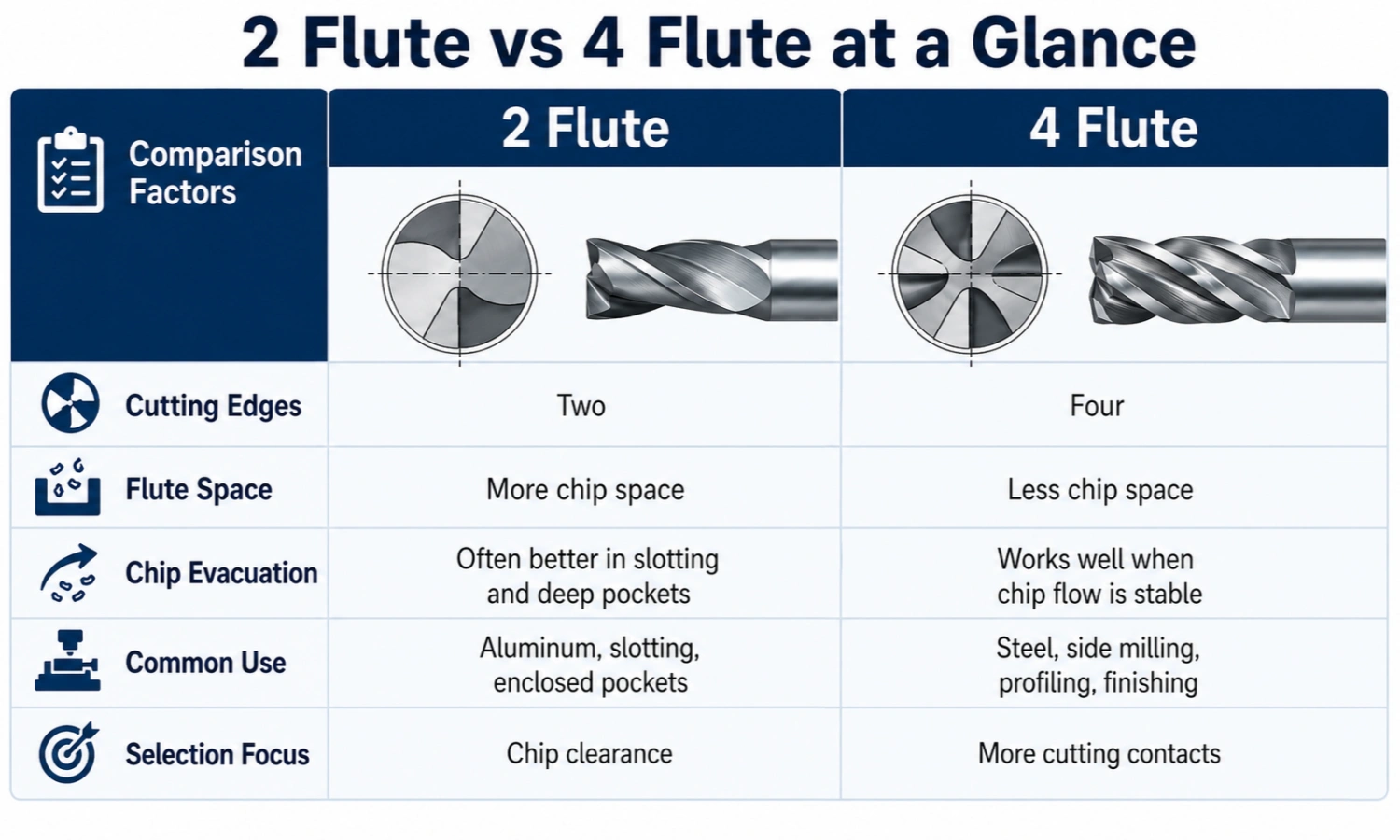
2 ฟลุตกับ 4 Flute End Mill at a Glance
| ปัจจัย | 2-Flute Direction | 4-Flute Direction |
|---|---|---|
| ขอบตัด | Two cutting edges | Four cutting edges |
| Flute Space | More space for chips | Less space between cutting edges |
| การอพยพชิป | Often useful in closed or chip-heavy cuts | Suitable when chips can leave the cut reliably |
| Core Support | Depends on flute depth and geometry | Often allows more core support |
| ช่องแคบเต็มความกว้าง | Common when chip volume is high | Requires adequate chip clearance |
| การกัดข้าง | Suitable when chip evacuation remains important | Often useful with lighter radial engagement |
| พื้นผิวเสร็จสิ้น | Can produce a good finish under stable conditions | More cutting contacts may support finishing |
| Material Direction | Common in aluminum and non-ferrous cuts | Common in many steel and finishing applications |
| Main Selection Focus | Chip space and evacuation | Cutting-edge count and tool support |
 How Flute Count Changes Cutting Performance
Flute Space and Chip Evacuation
หัวกัดมีช่องว่างระหว่างคมตัดและแกนที่จำกัด.
มีสองขลุ่ย, more of the cutter diameter can normally be allocated to the flute grooves. ดังนั้น, chips have more space to form and move away from the cutting zone.
This can be useful during:
- ช่องแคบเต็มความกว้าง
- Deep or enclosed pocket milling
- เครื่องจักรกลอลูมิเนียม
- Plastic machining
- การดำเนินการอื่นๆ ที่มีชิปสูง
A four-flute cutter has more cutting edges within the same diameter. ส่งผลให้, the individual flute grooves are often smaller.
This does not mean that a four-flute tool cannot evacuate chips. แทน, it means that the application must provide enough space, สารหล่อเย็น, air, or toolpath movement for chips to leave the cut.
Cutting Edges and Feed Capacity
A two-flute cutter has two cutting contacts per revolution, while a four-flute cutter has four.
At the same spindle speed and chip load per tooth, the four-flute tool would require a higher programmed feed because more cutting edges enter the material during each revolution.
อย่างไรก็ตาม, this higher feed is only practical when:
- Chip evacuation remains stable
- Machine power is sufficient
- Tool engagement is suitable
- Cutting heat is controlled
- The workpiece and holder are rigid
- The cutter geometry matches the material
ดังนั้น, four flutes do not automatically mean faster machining. เช่นเดียวกัน, two flutes do not automatically mean lower productivity.
The usable feed depends on the overall machining conditions.
Core Support and Tool Rigidity
A four-flute design often allows more material to remain near the tool core. This can provide greater core support in some cutter designs.
อย่างไรก็ตาม, actual rigidity also depends on:
- เส้นผ่านศูนย์กลางคัตเตอร์
- Flute depth
- ความยาวขลุ่ย
- Overall tool length
- ส่วนยื่นของเครื่องมือ
- มุมเกลียว
- เกรดคาร์ไบด์
- Holder condition
A short two-flute cutter may be more stable than a long four-flute cutter of the same diameter. ด้วยเหตุนี้, flute count should not be used as the only measure of tool rigidity.
Surface Finish and Cutting Stability
More cutting edges can provide more frequent cutting contacts. ดังนั้น, a four-flute cutter may support a consistent finish during suitable side milling and finishing operations.
แต่ถึงอย่างไร, surface finish also depends on:
- เครื่องมือหมด
- Cutting-edge quality
- ฟีดต่อฟัน
- การหมั้นในแนวรัศมี
- การโก่งตัวของเครื่องมือ
- Machine stability
- การหนีบชิ้นงาน
- กลยุทธ์เส้นทางเครื่องมือ
A well-selected two-flute cutter can still produce a good finished surface, โดยเฉพาะในอะลูมิเนียมและวัสดุที่ไม่ใช่เหล็กอื่นๆ.
For a broader explanation of flute space, เส้นผ่านศูนย์กลางหลัก, มุมเกลียว, and flute-count selection, อ่านของเรา คู่มือการออกแบบและการเลือกขลุ่ยดอกเอ็นมิลล์.
When to Use a 2-Flute End Mill
ช่องแคบเต็มความกว้าง
Full-width slotting engages the cutter across its full diameter. เพราะเหตุนี้, the operation produces a high chip volume while the slot walls restrict the available chip-exit paths.
A two-flute end mill is often considered because its wider flute grooves provide more chip space.
Stable slotting also depends on:
- ความลึกของช่อง
- เส้นผ่านศูนย์กลางคัตเตอร์
- ความยาวขลุ่ย
- ส่วนยื่นของเครื่องมือ
- Air or coolant delivery
- ความแข็งแกร่งของเครื่องจักร
- พารามิเตอร์การตัด
A shallow slot and a deep slot do not create the same cutting conditions. ดังนั้น, the tool and cutting strategy should match the actual feature.
Deep or Enclosed Pockets
Chips may remain inside a deep or enclosed pocket instead of leaving the cutting zone.
When chips are re-cut, cutting heat and tool load can increase. เครื่องหมายพื้นผิว, ขอบที่สร้างขึ้น, and early edge damage may also develop.
A two-flute cutter can provide useful chip clearance in these applications. อย่างไรก็ตาม, pocket depth, entry method, side engagement, การเข้าถึงเครื่องมือ, and coolant access must still be reviewed.
Aluminum and Non-Ferrous Machining
อะลูมิเนียมอัลลอยด์หลายชนิดผลิตเศษที่ค่อนข้างใหญ่หรือต่อเนื่องกัน. ทองแดง, ทองเหลือง, and selected plastics can also require reliable chip clearance.
สำหรับวัสดุเหล่านี้, a two-flute tool may use:
- คมตัดที่คมชัด
- พื้นผิวร่องเรียบหรือขัดเงา
- Suitable flute space
- Application-specific edge preparation
- อากาศที่เชื่อถือได้, หมอก, หรือการส่งสารหล่อเย็น
A two-flute design is not the only option for aluminum. Three-flute and application-specific four-flute cutters may also work well in certain side-milling or finishing conditions.
The selection should be based on the operation rather than the material name alone.
Other Chip-Heavy Operations
Two-flute tools can also support light roughing and selected steel slotting applications when chip evacuation is difficult.
The key question is:
Does the operation create more chips than the available flute space can remove reliably?
If the answer is yes, a lower flute count may provide a useful starting direction.
For detailed examples of two-flute applications, อ่าน what a 2 flute end mill is used for.
ดูมาตรฐานและกำหนดเองของเรา คาร์ไบด์ที่เป็นของแข็ง 2 ดอกเอ็นมิลล์ขลุ่ย ตัวเลือก.
When to Use a 4-Flute End Mill
การกัดข้างและการกลึงโปรไฟล์
ระหว่างการกัดข้าง, only part of the cutter diameter may engage the workpiece. Chips usually have more open space to leave than during full-width slotting.
ในสถานการณ์เช่นนี้, a four-flute tool may provide:
- More cutting contacts
- Greater core support in many designs
- Stable radial cutting
- Consistent profiling
- Improved productivity under suitable conditions
อย่างไรก็ตาม, radial engagement must remain appropriate. Heavy side engagement can still create heat, การโก่งตัว, and chip-control problems.
กึ่งสำเร็จรูปและการตกแต่ง
Four-flute cutters are commonly used for semi-finishing and finishing because the operation often creates a lower chip volume than full-width roughing.
More cutting contacts may support:
- Consistent wall finishing
- Stable contour milling
- Smoother profiling
- Higher programmed feed under suitable conditions
นิ่ง, a four-flute tool does not guarantee a better surface.
วิ่งหนี, ฟีดต่อฟัน, คุณภาพขอบ, เส้นทางเครื่องมือ, การสู้รบในแนวรัศมี, and machine rigidity remain important.
Steel and Stainless Steel Applications
Four-flute end mills are widely used for many steel and stainless steel machining operations.
In these materials, the tool may benefit from:
- Greater core support
- More cutting edges
- Suitable coating
- Controlled radial engagement
- Stable machine and fixture conditions
อย่างไรก็ตาม, the material category alone does not determine the flute count.
ตัวอย่างเช่น, full-width slotting in steel may still require two or three flutes when chip evacuation is limited. Stainless steel also requires careful control of cutting heat, งานแข็งตัว, การเคลือบ, และความแข็งแกร่งของขอบ.
Operations With Stable Chip Evacuation
A four-flute cutter becomes more practical when chips can leave the cutting zone without packing around the tool.
This may occur during:
- การกัดข้าง
- การทำโปรไฟล์แบบตื้น
- Open-pocket finishing
- กึ่งสำเร็จ
- Light radial cuts
- Operations with effective coolant or air delivery
When chip space is no longer the main limitation, cutting-edge count and tool support can receive greater priority.
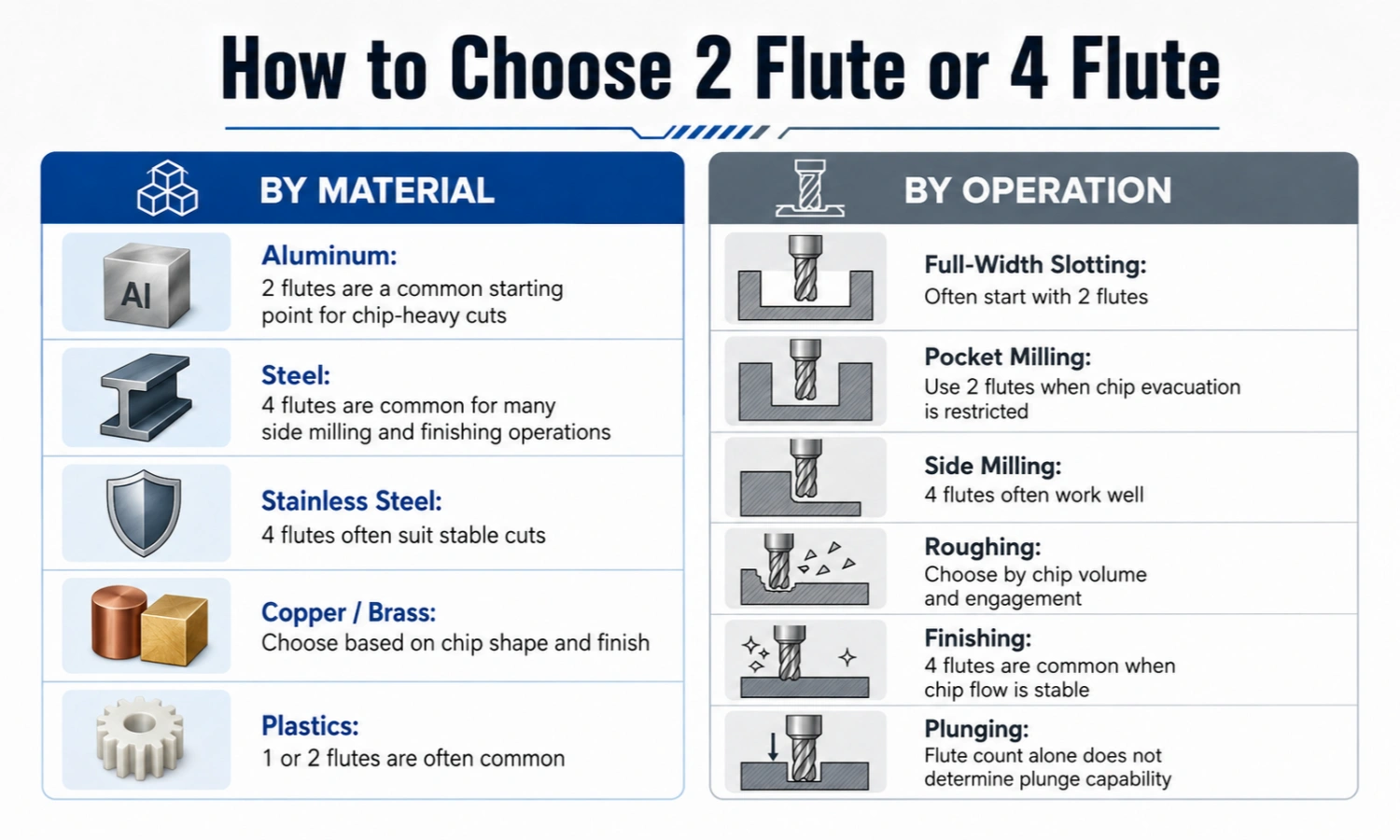
2 ฟลุตกับ 4 Flute by Workpiece Material
The following table shows common starting directions rather than fixed rules.
| วัสดุ | Common Starting Direction | What May Change the Choice |
|---|---|---|
| อลูมิเนียม | Two or three flutes for chip-heavy cuts | การกัดข้าง, ตกแต่ง, alloy grade and coolant |
| ทองแดง | Two flutes for chip clearance | Copper grade, burr control and finish |
| Brass | Two or more flutes may work | Brass grade, chip form and machining operation |
| พลาสติก | One or two flutes are common | ประเภทพลาสติก, cutting heat and edge requirements |
| เหล็กกล้า | Four flutes are common | Full slotting, เส้นผ่านศูนย์กลางของเครื่องมือ, coating and depth |
| สแตนเลส | Four flutes suit many operations | Work hardening, การว่าจ้าง, coolant and edge strength |
| เหล็กหล่อ | Several flute counts may work | Abrasiveness, dry cutting, dust and operation |
| Selected Composites | Application-specific cutter required | Material structure, abrasiveness and edge quality |
This table should be used as an initial guide. The final decision should also reflect tool diameter, ความลึกของการตัด, สภาพเครื่อง, และจำเป็นต้องทำให้เสร็จ.
2 ฟลุตกับ 4 Flute by CNC Operation
สล็อต
For full-width slotting, two flutes are often a practical starting point because the operation produces a high chip volume and restricts chip movement.
A four-flute cutter may still perform shallow or controlled slotting when:
- The slot is not deep
- Chip evacuation is reliable
- The material produces manageable chips
- Cutting parameters are adjusted correctly
The deeper and more enclosed the slot becomes, the more important flute space usually becomes.
การกัดกระเป๋า
Pocket milling includes both the entry move and the subsequent material-removal path.
A two-flute cutter may suit deep or enclosed pockets where chip packing is a concern. A four-flute cutter may suit side engagement or finishing after the main pocket has been opened.
ดังนั้น, one pocket can involve different flute-count requirements during different stages of the operation.
การกัดข้างและการกลึงโปรไฟล์
For side milling, chip evacuation is often less restricted than in full-width slotting.
Four flutes may support more cutting contacts and stable profiling. อย่างไรก็ตาม, two flutes can still work well when machining aluminum, พลาสติก, or other materials that benefit from additional chip space.
The selection should reflect radial engagement, เสร็จสิ้นที่จำเป็น, and tool rigidity.
การกัดหยาบ
Roughing does not automatically mean that two flutes are required.
Full-width or high-chip-volume roughing may benefit from fewer flutes. ในทางตรงกันข้าม, side roughing with controlled radial engagement may use three, สี่, or more cutting edges.
Dedicated roughing end mills may also use chipbreaker or serrated geometry. ดังนั้น, they should not be selected by flute count alone.
ตกแต่ง
Four-flute cutters are common in finishing because chip volume is often lower and more cutting contacts may improve machining continuity.
อย่างไรก็ตาม, flute count cannot compensate for:
- Excessive runout
- Unstable clamping
- Incorrect feed per tooth
- ระยะยื่นของเครื่องมือยาว
- Poor toolpath
- Worn cutting edges
A two-flute cutter can also produce a good surface finish when it matches the material and cutting conditions.
Plunging and Ramping
Flute count does not determine whether an end mill can plunge.
Both two-flute and four-flute cutters may be manufactured with center-cutting or non-center-cutting geometry. Before programming straight plunging, ลาด, หรือทางเข้าแบบเกลียว, confirm that the end cutting edges and tool design support the required movement.
สำหรับคำแนะนำโดยละเอียด, อ่าน can you plunge with an end mill.
Quick Selection Checklist
Before choosing between two and four flutes, ยืนยัน:
- What material are you machining?
- Is the operation full-width slotting or side milling?
- How much chip volume will be produced?
- Is chip evacuation restricted?
- กระเป๋าเป็นแบบลึกหรือแบบปิด?
- Is surface finish more important than flute space?
- How long is the tool overhang?
- การตั้งค่าเครื่องจักรและฟิกซ์เจอร์มีความแข็งแกร่งหรือไม่?
- Can coolant or air reach the cutting zone?
- การทำงานจำเป็นต้องมีรูปทรงการตัดตรงกลางหรือไม่?
- หัวกัดมีไว้สำหรับการกัดหยาบหรือไม่, กึ่งสำเร็จ, หรือการตกแต่ง?
เลือกสองฟันเมื่อพื้นที่ชิปเป็นข้อจำกัดหลัก.
เลือกสี่ฟันเมื่อการคายเศษมีเสถียรภาพ และกระบวนการได้ประโยชน์จากหน้าสัมผัสการตัดที่มากขึ้นหรือการรองรับแกนที่มากขึ้น.
เพื่อการเปรียบเทียบจำนวนขลุ่ยที่กว้างขึ้น, อ่าน เปรียบเทียบ 2, 4, และ 6 ดอกเอ็นมิลล์ขลุ่ย.
คำถามที่พบบ่อยเกี่ยวกับ 2 ฟลุตกับ 4 ดอกกัดเอ็นมิลฟลุต
ความแตกต่างหลักระหว่างคืออะไร 2 และ 4 ดอกกัดเอ็นมิลฟลุต?
ความแตกต่างที่สำคัญคือความสมดุลระหว่างพื้นที่ร่องฟันและการนับจำนวนคมตัด.
โดยปกติแล้ว หัวกัดแบบสองฟันจะให้พื้นที่สำหรับเศษมากขึ้น. หัวกัดสี่ฟันให้คมตัดมากขึ้นและมักจะให้การรองรับแกนที่มากขึ้น.
ประสิทธิภาพที่แท้จริงยังคงขึ้นอยู่กับรูปทรงเครื่องมือที่สมบูรณ์และสภาพการตัดเฉือน.
เป็น 2 ฟลุตหรือ 4 ฟลุตดีกว่าสำหรับอะลูมิเนียม?
สองฟันเป็นทางเลือกทั่วไปสำหรับการกัดร่องอะลูมิเนียม, การแทง, และการตัดปริมาณชิปสูงอื่นๆ.
อย่างไรก็ตาม, หัวกัดอะลูมิเนียมแบบสี่ร่องอาจทำงานได้ดีในระหว่างการกัดข้างหรือการเก็บผิวละเอียด เมื่อรูปทรงมีระยะหลบเศษเพียงพอ.
การดำเนินการมีความสำคัญเท่ากับวัสดุ.
เป็นดอกเอ็นมิลล์ 4 ร่อง ที่ดีสำหรับ เหล็กกล้า?
ใช่. ดอกเอ็นมิลล์สี่ฟันมักใช้สำหรับการกัดข้าง, กึ่งสำเร็จ, และปิดท้ายด้วยเหล็ก.
อย่างไรก็ตาม, การกัดร่องเต็มความกว้างหรือการตัดลึกอาจต้องใช้ร่องฟันน้อยลง เมื่อการคายเศษกลายเป็นเรื่องยาก.
การเคลือบ, เรขาคณิตของเครื่องตัด, ความแข็งแกร่ง, และสภาพการตัดต้องตรงกับเกรดเหล็กด้วย.
ดอกเอ็นมิลล์ 4 ร่อง สามารถตัดอะลูมิเนียมได้?
ใช่. คัตเตอร์สี่ฟันสามารถตัดเฉือนอะลูมิเนียมได้เมื่อมีรูปทรงร่องฟัน, การเตรียมขอบ, และสภาพการตัดให้เหมาะสมกับวัสดุ.
อาจมีประโยชน์สำหรับการกัดข้างหรือการเก็บผิวละเอียดที่เบากว่า. สำหรับการกัดร่องลึกหรือการกำจัดเศษหนัก, ขลุ่ยน้อยลงมักจะจัดการได้ง่ายกว่า.
จำนวนขลุ่ยใดดีกว่าสำหรับการกัดช่องเต็มความกว้าง?
มักใช้สองร่องฟันเนื่องจากการกัดร่องเต็มความกว้างทำให้ได้ปริมาณเศษสูงและจำกัดเส้นทางออกของเศษ.
แต่ถึงอย่างไร, หัวกัดสี่ฟันอาจทำงานในช่องตื้นได้ เมื่อการคายเศษยังคงมีเสถียรภาพและพารามิเตอร์การตัดมีความเหมาะสม.
ซึ่งดีกว่าสำหรับการกัดข้าง?
ร่องสี่ร่องมักมีประโยชน์สำหรับการกัดข้าง เนื่องจากเศษมีพื้นที่เปิดโล่งมากขึ้น, ในขณะที่คมตัดเพิ่มเติมสามารถรองรับประสิทธิภาพการผลิตและการเก็บผิวละเอียดได้.
อย่างไรก็ตาม, อาจเลือกใช้ขลุ่ยสองขลุ่ยในอะลูมิเนียม, พลาสติก, หรือการใช้งานอื่นๆ ที่ระยะห่างของเศษยังคงมีความสำคัญ.
ดอกเอ็นมิลล์ 4 ร่อง ให้ผลลัพธ์ที่ดีกว่าเสมอหรือไม่?
เลขที่. คมตัดที่มากขึ้นอาจช่วยในการเก็บผิวละเอียดบางอย่างได้, แต่ไม่รับประกันว่าพื้นผิวจะดีขึ้น.
วิ่งหนี, คุณภาพขอบ, ฟีดต่อฟัน, การสู้รบในแนวรัศมี, การโก่งตัวของเครื่องมือ, ความเสถียรของเครื่องจักร, และเส้นทางเครื่องมือก็ส่งผลต่อผลลัพธ์เช่นกัน.
เครื่องกัดเอ็นมิล 2 ร่อง สเตนเลสได้?
Some two-flute cutters can machine stainless steel, particularly during slotting or operations where chip evacuation is restricted.
อย่างไรก็ตาม, stainless steel also requires a suitable carbide grade, การเคลือบ, ความแข็งแรงของขอบ, coolant strategy, and control of work hardening.
The exact application must be reviewed.
Does Flute Count Determine Plunge Capability?
เลขที่. Plunge capability depends on the end geometry, especially whether the cutter has center-cutting edges.
A two-flute or four-flute tool may be either center cutting or non-center cutting.
Always confirm the tool specification before axial entry.
คำแนะนำที่เกี่ยวข้อง
หากต้องการข้อมูลเพิ่มเติม, อ่าน:
คาร์ไบด์ที่เป็นของแข็ง 2 ดอกเอ็นมิลล์ขลุ่ย
ก.คืออะไร 2 ดอกเอ็นมิลล์ขลุ่ยใช้สำหรับ?
Can you plunge with an end mill?
เปรียบเทียบ 2, 4, และ 6 ดอกเอ็นมิลล์ขลุ่ย
การออกแบบและการเลือกขลุ่ยดอกเอ็นมิลล์
Need Help Choosing 2 หรือ 4 ฟัน?
ส่งวัสดุชิ้นงานของคุณมาให้เรา, การทำงานของเครื่องจักร, ขนาดเครื่องตัด, ความลึกของการตัด, การเข้าถึงเครื่องมือ, การวาดภาพ, โมเดลอ้างอิง, และปริมาณที่ต้องการเมื่อมี.
We will review the information and help identify whether chip space, cutting-edge count, tool support, or surface requirements should receive greater priority.
อีเมล: sales@cutterbest.com