 หัวกัดที่มีความแม่นยํา,เครื่องมือตัดสําหรับเครื่องจักรกลซีเอ็นซีทุกวัสดุ

เมื่อเปรียบเทียบก 2 ขลุ่ยกับ 3 ดอกเอ็นมิลล์ขลุ่ยสำหรับอะลูมิเนียม, start with the machining operation.
Choose a 2-flute end mill when deep slotting, การหยาบหนัก, or high chip volume makes chip evacuation the main concern. Its larger flute spaces give aluminum chips more room to leave the cutting area.
Choose a 3-flute end mill when side-wall quality, profile stability, กึ่งสำเร็จ, or finishing matters more. The additional cutting edge can provide more consistent engagement and better rigidity in a comparable cutter design.
Neither flute count suits every aluminum job. ความลึกของช่อง, การสู้รบในแนวรัศมี, การเข้าถึงเครื่องมือ, สภาพผู้ถือ, สารหล่อเย็นหรือการระเบิดของอากาศ, เส้นทางเครื่องมือ, and surface requirements can change the final choice.
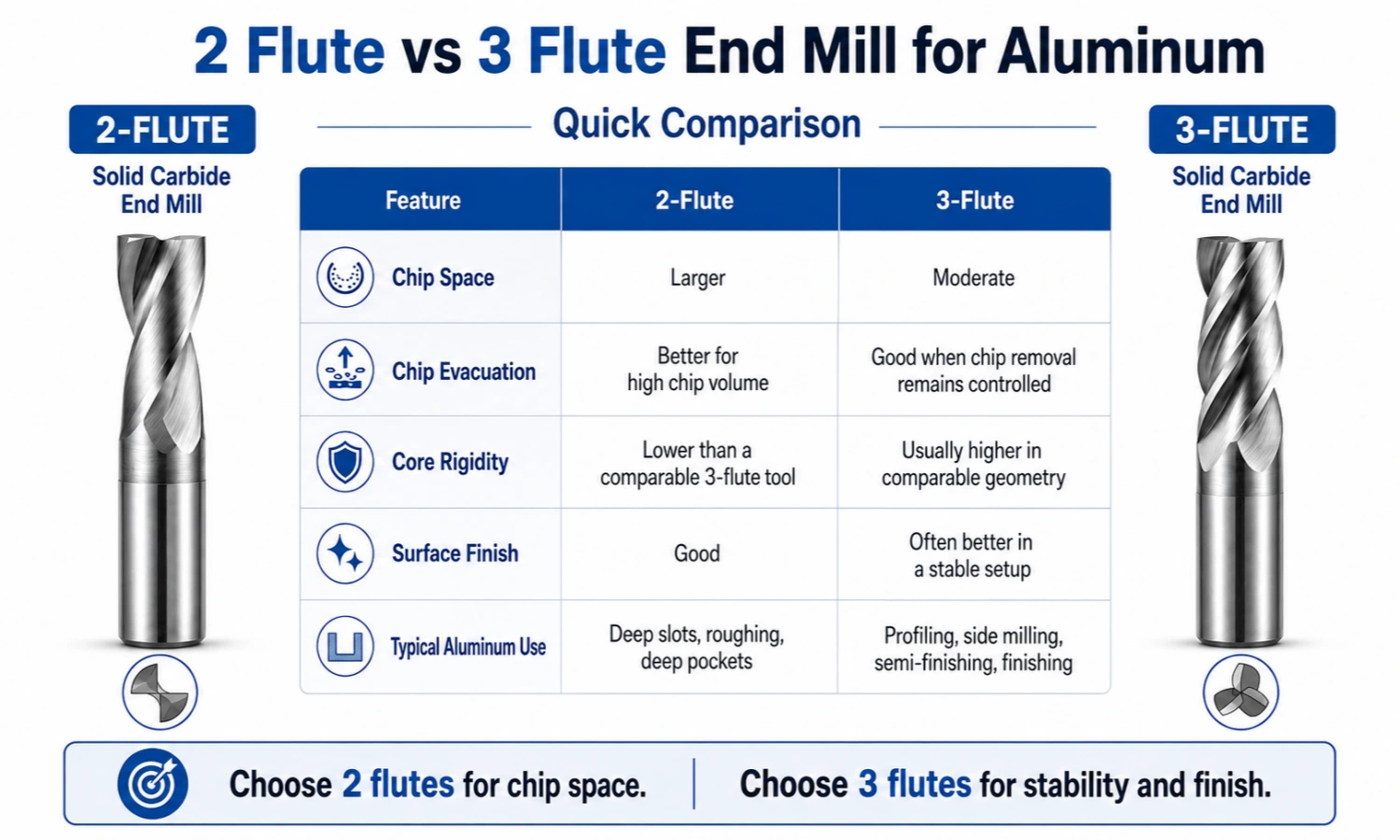
การเปรียบเทียบอย่างรวดเร็ว: 2 ฟลุตกับ 3 ดอกเอ็นมิลล์ฟลุตสำหรับอะลูมิเนียม
| ปัจจัยการคัดเลือก | 2-ดอกเอ็นมิลล์ขลุ่ย | 3-ดอกเอ็นมิลล์ขลุ่ย |
|---|---|---|
| ชิปสเปซ | Larger | Moderate |
| การอพยพชิป | Better for high chip volume | Good when chip removal remains controlled |
| ความแข็งแกร่งของแกนกลาง | Lower than a comparable 3-flute tool | Usually higher in comparable geometry |
| การเซาะร่องลึกเต็มความกว้าง | Usually preferred | Suitable under controlled conditions |
| การหยาบหนัก | Usually preferred | Better for moderate removal |
| การกัดข้าง | เหมาะสม | Often preferred |
| พื้นผิวเสร็จสิ้น | ดี | Often better in a stable setup |
| Typical Aluminum Use | สล็อตลึก, การหยาบ, กระเป๋าลึก | การทําโปรไฟล์, การกัดข้าง, กึ่งสำเร็จ, ตกแต่ง |
เลือก 2 flutes when chip space and safe chip removal are the priorities. เลือก 3 flutes when cutting stability, คุณภาพผนังด้านข้าง, and finishing potential matter more.
These are starting recommendations, not fixed rules. The complete machining setup still affects the result.
Why Flute Count Matters in Aluminum Machining
Chip Space and Chip Evacuation
Aluminum often produces large, อ่อนนุ่ม, or continuous chips. When these chips remain inside a slot or pocket, the cutter may recut them. Chips may also stick to the cutting edge or scratch the machined surface.
A 2-flute end mill provides larger flute spaces. It normally handles high chip volume more easily than a comparable 3-flute cutter.
This advantage becomes important in deep full-width slots and enclosed pockets, where chips have limited room to escape.
A 3-flute tool still provides useful chip space. อย่างไรก็ตาม, the toolpath, สารหล่อเย็น, ระเบิดทางอากาศ, and cutting engagement must help chips leave the cutting zone.
Core Rigidity and Tool Deflection
In comparable designs, a 3-flute cutter often has more core material than a 2-flute cutter. The stronger core can reduce tool deflection during side milling and profiling.
Lower deflection helps the cutter maintain a more consistent wall position. It may also improve profile accuracy and reduce visible wall variation.
Flute count cannot correct a weak setup. Excessive tool reach, ผู้ถือหมดแรง, poor clamping, or unstable machine conditions can still cause chatter and dimensional changes.
Use the shortest practical tool length and stable tool holding before relying on flute count to improve the result.
Cutting-Edge Engagement and Surface Finish
A 3-flute end mill creates three cutting engagements per revolution instead of two.
Under stable conditions, the additional engagement can support smoother side walls and a more consistent finish. This is one reason three-flute cutters are often selected for profiling, กึ่งสำเร็จ, และการตกแต่ง.
The final surface also depends on:
- ฟีดต่อฟัน
- เครื่องมือหมด
- เรขาคณิตของขอบ
- การสึกหรอของเครื่องมือ
- Holder condition
- ความแข็งแกร่งของเครื่องจักร
- การหมั้นในแนวรัศมี
- Coolant or air delivery
A higher flute count may improve finishing potential, but it does not guarantee a specific surface result.
When to Choose a 2-Flute End Mill for Aluminum
การเซาะร่องลึกเต็มความกว้าง
Choose a 2-flute end mill when the slot is deep, full-width engagement is required, and chips have limited room to escape.
ระหว่างการเซาะช่องเต็มความกว้าง, both sides of the cutter remain engaged with the material. Chips must travel through the flutes before leaving the slot.
A two-flute design provides more room for chip flow. It is usually the safer starting choice when chip packing presents a higher risk.
Coolant or air blast remains important. A 2-flute cutter cannot compensate for excessive engagement or poor chip removal.
Heavy Roughing and High Chip Volume
เลือก 2 flutes when high chip volume and safe chip evacuation matter more than final wall finish.
Heavy roughing removes more material and produces more chips. Larger flute spaces can reduce the risk of chip recutting and flute blockage.
The cutter must still match the machine, เจ้าของ, ความยาวเครื่องมือ, และตัดภาระ. Excessive engagement can overload any cutter.
การกัดพ็อกเก็ตลึก
Deep and enclosed pockets can trap chips around the tool. A 2-flute end mill is often a practical starting choice for these conditions.
รายการทางลาด, รายการลาน, or adaptive toolpath can reduce cutting engagement. การระเบิดของอากาศหรือน้ำหล่อเย็นที่รุนแรงอาจทำให้เศษหลุดออกจากด้านล่างของช่องได้เช่นกัน.
สำหรับการเซาะร่องลึก, การหยาบ, และการตัดเฉือนอะลูมิเนียมปริมาณเศษสูง, ดูของเรา 2 ดอกเอ็นมิลล์ขลุ่ย.
เมื่อใดควรเลือกดอกเอ็นมิลล์ 3 ร่องสำหรับอะลูมิเนียม
การกัดข้างและการกลึงโปรไฟล์
เลือกดอกเอ็นมิลล์ 3 ฟันเมื่อการตัดด้านข้างที่มั่นคงและคุณภาพของผนังสม่ำเสมอมีความสำคัญมากกว่าพื้นที่ร่องสูงสุด.
ระหว่างการกัดข้าง, เส้นผ่านศูนย์กลางของหัวกัดเพียงบางส่วนเท่านั้นที่อาจสัมผัสกับชิ้นงานได้. การคายเศษมักจะทำได้ง่ายกว่าในระหว่างการกัดร่องเต็มความกว้าง.
คมตัดที่สามช่วยให้หน้าสัมผัสสม่ำเสมอมากขึ้นในระหว่างการกัดผนังตรง, การทำโปรไฟล์ภายนอก, รูปร่างภายใน, และการตกแต่งขอบ.
กึ่งสำเร็จรูปและการตกแต่ง
เลือก 3 ร่องเมื่อพื้นผิวสม่ำเสมอและการตกแต่งผนังด้านข้างเป็นเป้าหมายหลัก.
เครื่องมือแบบ 3 ร่องฟันสามารถให้การยึดเกาะที่นุ่มนวลกว่าหัวกัด 2 ร่องบางรุ่น. โดยจะทำงานได้ดีที่สุดเมื่อการตั้งค่าเครื่องจักรยังคงมีเสถียรภาพและระยะยื่นของเครื่องมืออยู่ภายใต้การควบคุม.
A 3-flute cutter will not automatically correct:
- Excessive runout
- Worn cutting edges
- Poor clamping
- Unstable feed
- Excessive tool reach
- Incorrect radial engagement
Check these conditions before changing the flute count.
Controlled Slotting and Pocketing
A 3-flute end mill can handle shallow or controlled slotting when the toolpath and chip evacuation are suitable.
Lighter engagement, staged cutting, a ramping entry, a helical entry, or an adaptive toolpath can reduce the amount of material engaged at one time.
For deeper full-width slots or heavy roughing, start with a 2-flute tool. The larger flute spaces provide a wider margin for chip removal.
For side milling, การทําโปรไฟล์, กึ่งสำเร็จ, และการตกแต่ง, ดูของเรา 3 ดอกเอ็นมิลล์ปลายแบนคาร์ไบด์ฟลุตสำหรับอะลูมิเนียม.
For more details about three-flute applications, อ่านของเรา คู่มือการใช้เครื่องตัดสามฟัน.
Decision Rules: 2 ฟลุตหรือ 3 Flute for Aluminum?
Rule 1: Start with Chip Volume and Slot Access
Start with a 2-flute cutter when:
- The slot is deep
- Full-width engagement is required
- The pocket is enclosed
- Chips have limited space to escape
- High chip volume is expected
A 3-flute cutter becomes more practical when the cutting area is open and the toolpath allows chips to leave freely.
Rule 2: Define the Main Machining Goal
เลือก 2 flutes when material removal and chip evacuation are the priorities.
เลือก 3 flutes when the operation focuses on:
- Side-wall quality
- Profile consistency
- กึ่งสำเร็จ
- ตกแต่ง
- Stable side cutting
The primary machining goal should guide the starting choice.
Rule 3: Review Tool Reach and Setup Rigidity
Long tool reach increases deflection risk. Use the shortest practical tool and improve clamping before changing the flute count.
Do not use additional flutes as a substitute for stable tool holding.
If the setup remains weak, a 3-flute cutter may still vibrate or produce inconsistent dimensions. Review holder runout, การเข้าถึงเครื่องมือ, การสู้รบในแนวรัศมี, and machine rigidity together.
Rule 4: Check Coolant, Air Blast, and Toolpath
Flute count is only one part of chip control.
Strong air blast, suitable coolant delivery, and a toolpath that avoids excessive engagement can improve chip evacuation. These conditions may allow a 3-flute cutter to complete controlled slotting successfully.
If chips continue to collect, reduce engagement, improve chip removal, or move to a 2-flute tool.
Rule 5: Match Edge Geometry and Surface Treatment
Aluminum machining generally benefits from sharp cutting edges and smooth chip flow.
The cutter geometry and surface treatment should match:
- Aluminum grade
- การทำงานของเครื่องจักร
- Coolant method
- Chip-adhesion risk
- Required tool life
- ความต้องการพื้นผิว
Do not choose a cutter only by flute count or coating name. The complete tool design must match the application.
Recommended Flute Count by Aluminum Operation
| Aluminum Operation | Recommended Starting Choice | เหตุผลหลัก |
|---|---|---|
| ช่องร่องลึกเต็มความกว้าง | 2 ฟัน | พื้นที่ชิปมากขึ้น |
| การกลึงหยาบหนัก | 2 ฟัน | การอพยพของเศษดีขึ้น |
| Deep pocket milling | 2 ฟัน | Easier chip removal |
| Shallow controlled slotting | 2 หรือ 3 ฟัน | Depends on depth and chip control |
| การกัดข้าง | 3 ฟัน | Better stability and wall quality |
| การกัดโปรไฟล์และคอนทัวร์ | 3 ฟัน | More consistent engagement |
| กึ่งสำเร็จ | 3 ฟัน | Balanced chip space and rigidity |
| ตกแต่ง | 3 ฟัน | Better finishing potential |
These are starting choices rather than absolute rules. เส้นผ่านศูนย์กลางเครื่องมือ, ความยาวขลุ่ย, การเข้าถึงโดยรวม, ความแข็งแกร่งของเครื่องจักร, สารหล่อเย็น, and cutting strategy can change the final decision.

Signs Your Flute Count or Setup May Be Wrong
| Observable Problem | สาเหตุที่เป็นไปได้ | Practical Response |
|---|---|---|
| Chips pack inside the slot | Insufficient flute space or weak chip removal | Improve air or coolant, reduce engagement, or consider 2 ฟัน |
| Chips are recut and scratch the surface | Chips remain in the cutting zone | Adjust the toolpath and improve chip evacuation |
| Aluminum sticks to the cutting edge | Poor chip removal, worn edge, or unsuitable surface treatment | Check lubrication, สภาพขอบ, and flute surface |
| Side walls show chatter marks | Excessive reach, การหนีบที่อ่อนแอ, หรือการมีส่วนร่วมที่ไม่มั่นคง | Shorten overhang and improve rigidity |
| Dimensions vary during profiling | Tool deflection or runout | Check the holder, วิ่งหมด, ตัดภาระ, and tool reach |
| Finish remains inconsistent | The setup or parameters are unstable | Review the complete cutting system before changing flute count |
These problems do not always mean that the flute count is wrong.
Changing from 2 flutes to 3 flutes will not correct excessive runout. เช่นเดียวกัน, moving to 2 flutes will not solve weak coolant delivery if chips remain trapped inside a pocket.
Start with the visible problem. Check chip flow, การเข้าถึงเครื่องมือ, หนีบ, ตัดภาระ, and tool condition before selecting another cutter.
Common Mistakes When Selecting an Aluminum End Mill
Choosing by Flute Count Alone
Flute count does not fully describe a cutter.
Two tools with the same number of flutes may use different core sizes, flute depths, edge geometries, ความยาว, and surface treatments.
Compare the complete tool design and machining conditions.
Using More Flutes to Compensate for a Weak Setup
More flutes may improve rigidity in comparable cutter designs. อย่างไรก็ตาม, they cannot repair a weak holder, การวิ่งหนีมากเกินไป, poor clamping, or excessive tool overhang.
Fix the setup first. Then select the flute count according to chip volume and surface requirements.
Treating Recommendations as Absolute Rules
A 3-flute cutter can machine slots, and a 2-flute cutter can finish aluminum.
The recommendations in this guide describe practical starting choices:
- 2 flutes for more chip space
- 3 ร่องฟันเพื่อการยึดที่มั่นคงยิ่งขึ้นและศักยภาพในการตกแต่งที่ดีขึ้น
ผลลัพธ์สุดท้ายจะขึ้นอยู่กับการตั้งค่าการตัดเฉือนที่สมบูรณ์.
คำถามที่พบบ่อย
เป็น 2 ฟลุตหรือ 3 ฟลุตดีกว่าสำหรับอะลูมิเนียม?
ดอกเอ็นมิลล์ 2 ร่องมักจะดีกว่าสำหรับการกัดร่องลึก, การหยาบหนัก, และการทำงานที่ต้องการพื้นที่ชิปสูงสุด.
ดอกเอ็นมิลล์ 3 ร่องมักจะดีกว่าสำหรับการกัดข้าง, การทําโปรไฟล์, กึ่งสำเร็จ, และการตกแต่งขั้นสุดท้ายเมื่อความเสถียรในการตัดและคุณภาพของผนังมีความสำคัญมากกว่า.
เป็นดอกเอ็นมิลล์ 3 ร่อง เหมาะสำหรับการกัดร่องอะลูมิเนียม?
ใช่. หัวกัด 3 ร่องสามารถใช้งานได้กับการกัดร่องอะลูมิเนียมแบบตื้นหรือแบบควบคุม เมื่อการคายเศษยังคงมีประสิทธิภาพ.
For deeper full-width slots or heavy roughing, โดยทั่วไปแล้วคัตเตอร์แบบ 2 ฟันจะเป็นตัวเลือกการเริ่มต้นที่ปลอดภัยกว่า.
ดอกเอ็นมิลล์ชนิดใดที่ให้งานอะลูมิเนียมได้ดีกว่า?
ดอกเอ็นมิลล์ 3 ร่องมักให้โอกาสในการเก็บผิวละเอียดที่ดีกว่า เนื่องจากสร้างหน้าสัมผัสในการตัดต่อการปฏิวัติได้มากขึ้น และอาจให้ความแข็งแกร่งที่ดีกว่า.
วิ่งหนี, ให้อาหาร, การสึกหรอของเครื่องมือ, หนีบ, ความเสถียรของเครื่องจักร, และการมีส่วนร่วมในแนวรัศมีก็ส่งผลต่อพื้นผิวสุดท้ายด้วย.
ดอกเอ็นมิลล์ 2 ร่อง สามารถใช้กับการตกแต่งอะลูมิเนียมได้หรือไม่?
ใช่. มีคม, คัตเตอร์ 2 ฟันที่มั่นคงสามารถเก็บผิวอะลูมิเนียมได้.
เมื่อความสม่ำเสมอของผนังด้านข้างและพื้นผิวเป็นสิ่งสำคัญ, หัวกัด 3 ฟันมักเป็นตัวเลือกการเริ่มต้นที่ดีกว่า.
ต้องการความช่วยเหลือในการเลือกระหว่าง 2 และ 3 ฟัน?
การเลือกระหว่าง 2 และ 3 ขลุ่ยขึ้นอยู่กับเกรดอลูมิเนียม, การทำงานของเครื่องจักร, ความลึกของช่อง, การเข้าถึงเครื่องมือ, วิธีการควบคุมชิป, และพื้นผิวที่ต้องการ.
ส่งวัสดุชิ้นงานมาให้เรา, ขนาดที่ต้องการ, ช่องหรือความลึกของกระเป๋า, ปริมาณ, และข้อมูลรูปวาดหรือเครื่องตัดปัจจุบันที่มีอยู่.
ไม่แน่ใจว่าจะเลือกนับขลุ่ยตัวไหน? ส่งอีเมลความต้องการของคุณมาที่ sales@cutterbest.com, และเราจะตรวจสอบว่าเครื่องมือ 2 ร่องหรือ 3 ร่องตรงกับการใช้งานมากกว่ากัน.