 หัวกัดที่มีความแม่นยํา,เครื่องมือตัดสําหรับเครื่องจักรกลซีเอ็นซีทุกวัสดุ

การแนะนำ
ดอกเอ็นมิลล์บูลโนสคืออะไร? It is a flat-bottom end mill with a defined radius at the cutting corners. This geometry is also commonly described in tooling catalogs as a ดอกเอ็นมิลล์รัศมีมุม, although naming can vary between manufacturers.
The flat bottom allows the cutter to machine bottom surfaces, while the radiused corners create a rounded bottom-to-wall transition instead of a sharp cutting-corner result.
Bull nose end mills are commonly used for contouring, การกัดโปรไฟล์, การกลึงโพรง, กึ่งสำเร็จ, and other CNC operations where the part geometry allows or requires a corner radius.
เอ็นมิลล์บูลโนสคืออะไร?
A bull nose end mill has a flat cutting bottom with radiused corners between the bottom cutting edge and the side cutting edge.
This geometry distinguishes it from two other common end mill profiles. A square or flat end mill has a sharp cutting corner, while a ball nose end mill has a fully rounded cutting end. A bull nose cutter keeps the flat bottom while adding a defined corner radius.
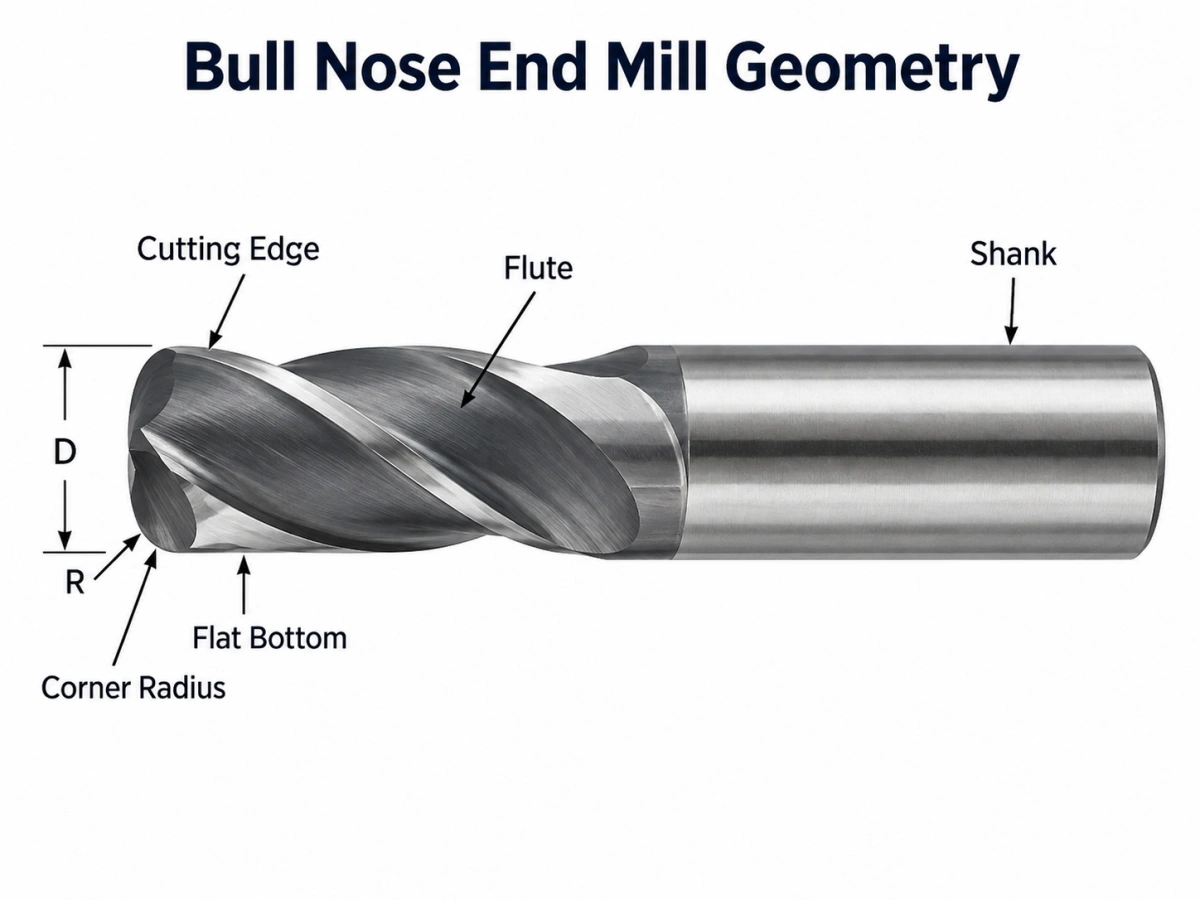 ส่งผลให้, the tool is useful when a part requires a flat or stepped feature together with a radiused bottom-to-wall transition.
The exact cutter still needs to match the required part dimensions, corner geometry, เข้าถึง, และสภาวะการตัดเฉือน.
Bull Nose End Mill and Corner Radius End Mill Terminology
The terms ดอกเอ็นมิลล์บูลโนส และ ดอกเอ็นมิลล์รัศมีมุม often describe closely related flat-bottom cutter geometry with radiused cutting corners.
“Corner radius end mill” is a common catalog term because it directly describes the tool geometry. “Bull nose end mill” is also widely used by buyers, ช่างเครื่อง, and suppliers.
อย่างไรก็ตาม, naming conventions can vary between manufacturers. Some catalogs may use the terms differently or separate product families according to radius size, ชุด, หรือใบสมัคร.
ด้วยเหตุนี้, do not rely on the product name alone. Confirm the actual cutter diameter, รัศมีมุม, เรขาคณิตของขลุ่ย, and other required dimensions before ordering.
For available product configurations, ดูของเรา ดอกเอ็นมิลล์บูลโนส.
Why the Corner Radius Matters
The corner radius is located where the flat bottom of the cutter transitions into the side cutting edge.
This radius changes the geometry produced at the bottom-to-wall transition of the machined feature. Instead of leaving the sharp-corner geometry associated with a square-profile cutter, the bull nose geometry creates or follows a radiused transition.
The required radius should therefore match the drawing and finished part geometry.
A larger or smaller radius should not be selected from a general rule alone. The exact R value depends on the required feature, ขนาดเครื่องตัด, ความต้องการเครื่องจักร, and part design.
What Is a Bull Nose End Mill Used For?
Bull nose end mills are used in CNC milling applications where the part geometry benefits from a flat bottom combined with a corner radius.
การใช้งานทั่วไปได้แก่:
- การกัดรูปร่าง
- การกัดโปรไฟล์
- กึ่งสำเร็จ
- การตัดเฉือนโพรง
- การตัดเฉือนแม่พิมพ์และแม่พิมพ์
- Stepped features with radiused lower corners
- Bottom-to-wall transitions where a corner radius is required
The same cutter type may be used for different workpiece materials, but the final tool configuration should match the material and machining conditions.
ตัวอย่างเช่น, เกรดคาร์ไบด์, เรขาคณิตของขลุ่ย, การเคลือบหรือการรักษาพื้นผิว, ขนาดเครื่องมือ, and cutting design may vary according to the actual application.
ดังนั้น, the tool name alone does not determine the complete machining setup.
Basic Bull Nose End Mill Selection
Selecting a bull nose end mill starts with the geometry of the part rather than with a general performance rule.
Part and Corner Geometry
อันดับแรก, check the drawing.
Confirm whether the feature:
- Requires a corner radius
- Allows a radiused transition
- Requires a flat bottom
- Has enough access for the selected cutter diameter
- Requires a sharp internal corner instead
If the drawing requires a sharp 90-degree cutting-corner result with no specified radius, a bull nose geometry may not be the correct choice for that feature.
ขนาดเครื่องมือ
The cutter diameter and corner radius must match the feature being machined.
Length of cut, การเข้าถึงเครื่องมือ, ขนาดก้าน, and overall tool geometry also need to suit the part and machine setup.
This page does not list every possible size combination because standard and custom configurations vary. For actual dimensions and available product options, see the ดอกเอ็นมิลล์บูลโนส หน้าผลิตภัณฑ์.
Workpiece and Machining Requirement
After confirming the basic geometry, the final cutter configuration depends on the workpiece and machining requirement.
Different applications may require different flute geometry, การเคลือบหรือการรักษาพื้นผิว, ความยาวเครื่องมือ, การออกแบบตัดตรงกลาง, or tolerance requirements.
สำหรับการใช้งานที่ไม่ได้มาตรฐาน, the drawing and machining information provide the best basis for confirming the final tool.
Related End Mill Comparisons
A bull nose end mill is sometimes compared with other cutter profiles, but each comparison has a different selection question.
If you need a sharp-corner comparison, ดู บูลโนสกับดอกเอ็นมิลล์แบบแบน.
สำหรับความแตกต่างระหว่างหัวกัดที่มีรัศมีก้นแบนกับปลายตัดที่โค้งมนเต็มที่, ดู เอ็นมิลล์บูลโนส vs เอ็นมิลล์บอลโนส.
Bull nose / corner radius cutters are also different from corner rounding form cutters. ดู รัศมีมุมเทียบกับดอกเอ็นมิลการปัดเศษมุม.
คำถามที่ถามบ่อย
ดอกเอ็นมิลล์บูลโนสคืออะไร?
A bull nose end mill is a flat-bottom milling cutter with a defined radius at the cutting corners. The corner radius creates a radiused transition between the machined bottom and side wall.
ดอกเอ็นมิลล์บูลโนสใช้ทำอะไร?
Typical uses include contour milling, การกัดโปรไฟล์, กึ่งสำเร็จ, การกลึงโพรง, การตัดเฉือนแม่พิมพ์และแม่พิมพ์, and features that require a radiused bottom-to-wall transition.
The actual application depends on the part geometry and tool configuration.
ดอกเอ็นมิลล์บูลโนสเหมือนกับดอกเอ็นมิลล์รัศมีมุม?
The terms are often used for closely related flat-bottom cutters with radiused cutting corners, and “corner radius end mill” is a common catalog description for this geometry.
อย่างไรก็ตาม, terminology can vary between manufacturers, so the actual radius and cutter geometry should always be confirmed.
How do I choose a bull nose end mill?
Start with the part drawing and required corner geometry.
Confirm the cutter diameter, รัศมีมุม, การเข้าถึงที่จำเป็น, and other dimensions. Then consider the workpiece material and machining requirement when confirming the final flute geometry, การเคลือบหรือการรักษาพื้นผิว, และการออกแบบเครื่องมือ.
For standard dimensions or custom configurations, refer to the ดอกเอ็นมิลล์บูลโนส หน้าผลิตภัณฑ์.
ดอกเอ็นมิลล์บูลโนสเหมือนกับดอกเอ็นมิลล์ปัดมุม?
เลขที่.
A bull nose or corner radius end mill has a radius on the cutting corners of the tool itself. A corner rounding end mill is a different form cutter used to produce a rounded profile on a workpiece edge.
For the detailed distinction, ดู รัศมีมุมเทียบกับดอกเอ็นมิลการปัดเศษมุม.
บทสรุป
A bull nose end mill combines a flat cutting bottom with radiused cutting corners. It is commonly used when the part requires a flat or stepped feature together with a radiused bottom-to-wall transition.
The correct cutter depends on the drawing, รัศมีมุม, ขนาดเครื่องมือ, ชิ้นงาน, and machining requirement rather than on one fixed configuration.
If you need help confirming a bull nose end mill for your part, ส่งข้อกำหนดการวาดภาพหรือการตัดเฉือนของคุณโดย อีเมล หรือติดต่อเราโดยตรงที่ วอทส์แอพพ์.