 หัวกัดที่มีความแม่นยํา,เครื่องมือตัดสําหรับเครื่องจักรกลซีเอ็นซีทุกวัสดุ

If CNC roughing takes too long, chips collect inside deep pockets, or the cutter vibrates during heavy stock removal, you may be asking: what is a roughing end mill used for? It removes a large amount of stock before semi-finishing or finishing, while its serrated or wave-shaped cutting edges divide chips into smaller sections for better chip control.
This design suits pocket, สล็อต, side, mold, and general rough-machining operations. A roughing cutter does not normally produce the final surface. แทน, it creates the basic shape and leaves controlled material for the next machining stage.
What Is a Roughing End Mill?
A roughing end mill removes machining allowance before the final cutting pass. Its serrated or wave-shaped edges divide a wide chip into smaller sections, helping chips leave pockets, สล็อต, and cavities more easily.
This design becomes useful when a smooth-edge cutter produces long chips, repeated chip recutting, or unstable cutting during heavy stock removal. The cutter still needs the correct flute count, serrated pitch, length, เกรดคาร์ไบด์, and coating for the workpiece and operation.
Roughing cutters are also called hog mills, hogging end mills, corn cob end mills, or serrated roughers. The exact tooth profile and recommended application can vary between manufacturers.
A roughing cutter belongs to the wider end mill category. For general slotting, การทําโปรไฟล์, and pocket milling options, ดูของเรา เครื่องตัดดอกเอ็นมิลล์.
Serrated and Wave-Shaped Cutting Edges
The cutting edge contains repeated waves or serrations. Each raised section cuts part of the material, while the spaces between the teeth divide the chip.
Because the edge does not contact the workpiece as one continuous line, the cutting action differs from that of a smooth finishing cutter. This interrupted contact can make heavy stock removal easier to control when the tool, เครื่องจักร, holder, and cutting strategy suit the operation.
The serrated geometry may use a coarse pitch, ระดับเสียงที่ดี, or another chip-breaking profile. Manufacturers can also adjust flute count, เกรดคาร์ไบด์, การเคลือบ, ความยาวขลุ่ย, and edge preparation for different materials.
Why It Is Used Before Finishing
Rough machining and finish machining have different goals.
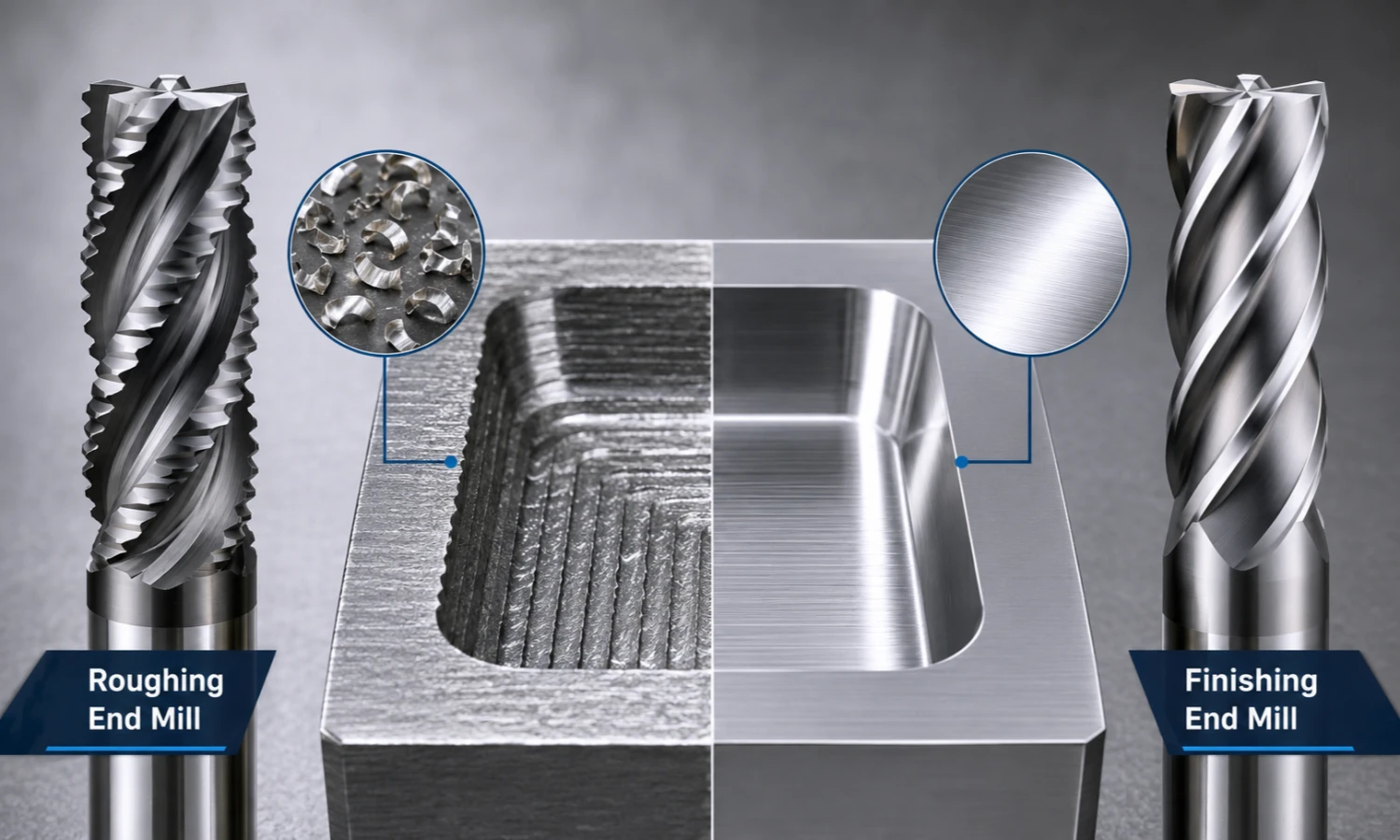
Roughing focuses on removing material and controlling chips. Finishing focuses on surface quality, final dimensions, and profile accuracy.
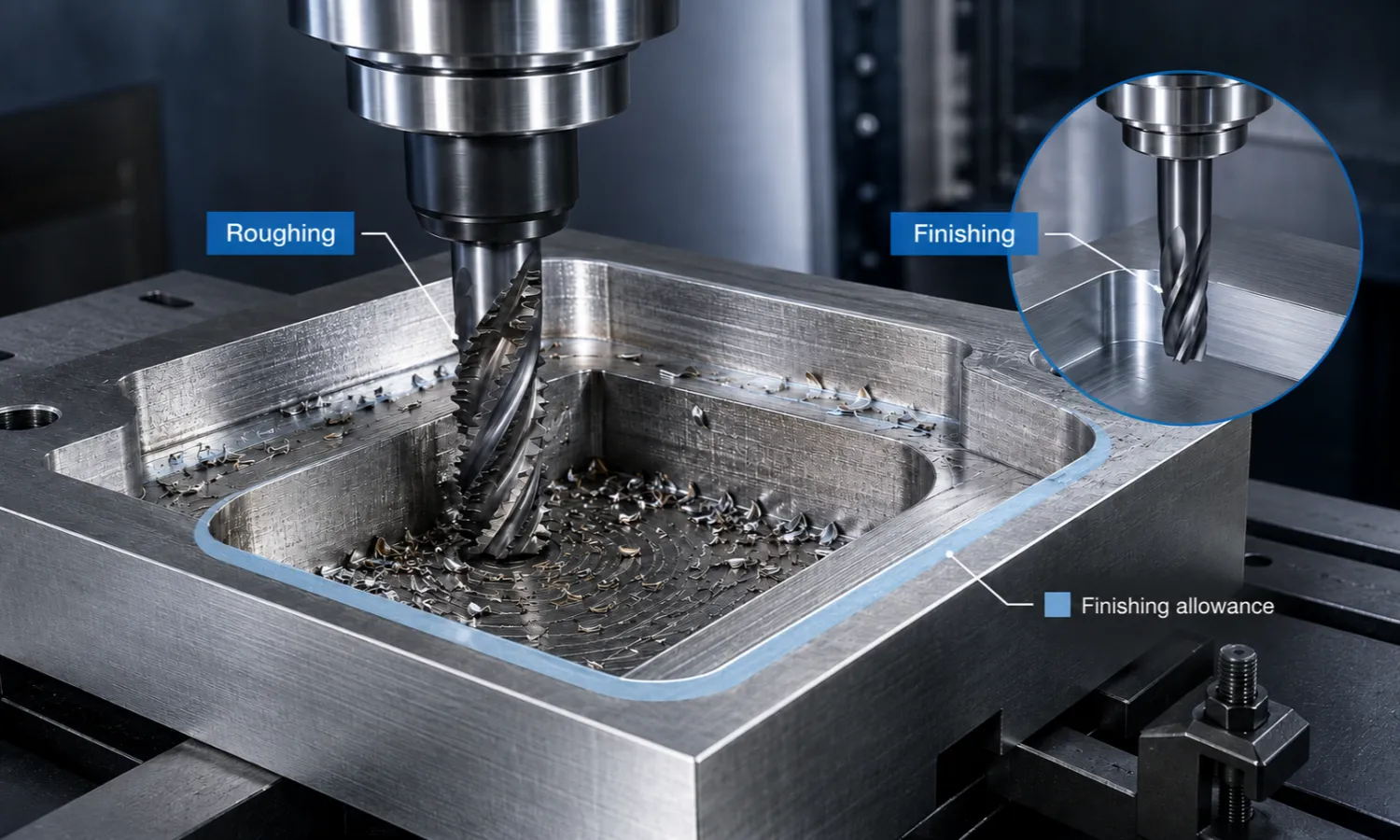
Many CNC processes use a roughing cutter first. A smooth-edge tool then removes the remaining allowance and produces the required surface.
For carbide, ไฮสปีด, coarse-pitch, fine-pitch, and custom options, ดูของเรา Carbide Roughing End Mills.
What Is a Roughing End Mill Used For?
Roughing end mill applications include operations where the machine must remove a larger machining allowance before the final pass.
The cutter must still match the operation. Pocket roughing, full-slot milling, ตัดด้านข้าง, เครื่องจักรกลแม่พิมพ์, and trochoidal toolpaths do not place the same load on the cutting edge.
Pocket and Cavity Roughing
Pocket and cavity roughing remove material from an enclosed area inside a component.
During deep-pocket machining, chips can collect around the cutter or remain at the bottom of the cavity. When the tool cuts those chips again, heat and edge damage may increase. The operation can also become noisy or unstable.
A serrated edge divides the chips into smaller sections. Smaller chips are usually easier to remove, although the process still needs enough flute space, a suitable coolant or air-blast method, and controlled tool overhang.
Mold bases, fixtures, ส่วนประกอบของเครื่อง, and general CNC parts often require pocket roughing before later semi-finishing and finishing passes.
Slot Roughing
Slot roughing opens a new slot or removes material from an existing groove.
Full-width slot cutting creates high engagement because both sides of the cutter contact the material. Chip evacuation becomes especially important in this operation.
A suitable roughing cutter helps control the chips, but not every flute count or serrated pitch works well in a deep full-width slot. We recommend reviewing the flute space, ความลึกของช่อง, coolant method, and tool overhang together before confirming the cutter design.
ตัวอย่างเช่น, a cutter with too many flutes may provide insufficient chip space in aluminum. An excessively long tool may also vibrate when cutting a deep slot.
Side and Profile Roughing
Side roughing removes material from a wall, ไหล่, outside profile, or edge of the workpiece.
Only part of the cutter diameter usually contacts the material, so side milling often provides more room for chip evacuation than full-slot cutting.
การหมั้นในแนวรัศมี, axial depth, ความยาวขลุ่ย, and tool overhang still affect cutting stability. The cutter should remove the required stock while leaving enough material for the final wall-finishing pass.
Mold and Die Roughing
Mold and die manufacturing often starts with a block of steel, อลูมิเนียม, or another alloy.
The roughing stage creates the main cavity, removes excess stock, and prepares the part for later toolpaths. It can represent a significant part of the total machining process.
A serrated cutter may suit open cavities, mold pockets, side walls, and larger internal features. Deep areas and long-reach applications require additional attention to rigidity, holder condition, and chip removal.
Heavy Stock Removal
Heavy stock removal includes rough machining of plates, บล็อก, forgings, castings, and components with large machining allowances.
A solid carbide roughing end mill can suit smaller and medium cutter diameters, especially when the machine supports the required spindle speed and toolholding conditions.
For very large diameters, powerful machining centers, or extremely high stock-removal requirements, an indexable milling cutter may offer a more economical solution.
Trochoidal and Adaptive Roughing
Trochoidal and adaptive toolpaths use controlled cutter engagement instead of maintaining a wide radial cutting width throughout the path.
This strategy can help manage cutting load and heat when the CAM program, cutter geometry, holder, and machine work together correctly.
Selected roughing cutters can support these toolpaths. The diameter, การนับขลุ่ย, การสู้รบในแนวรัศมี, ความลึกของการตัด, ส่วนที่ยื่นออกมาของเครื่องมือ, and chip-evacuation method must still match the application.
| Roughing Application | Main Machining Challenge | Why a Roughing Cutter May Help |
|---|---|---|
| Pocket and Cavity Roughing | Chips can collect inside enclosed areas | Serrated edges divide chips into smaller sections for easier evacuation |
| Slot Roughing | High cutter engagement and limited chip space | Suitable flute space and chip-breaking geometry can improve chip control |
| Side and Profile Roughing | Stock must be removed while material remains for finishing | The tool removes side-wall allowance before the final pass |
| Mold and Die Roughing | Large volumes of material must be removed from cavities | Wave-shaped edges support controlled material removal |
| Heavy Stock Removal | High cutting load and large machining allowance | Serrated geometry reduces continuous edge engagement |
| Trochoidal Roughing | Repeated tool engagement must remain stable | Controlled radial engagement can work with suitable roughing geometry |
How Does a Roughing End Mill Work?
The main difference between a roughing cutter and a smooth-edge end mill is the way the cutting edge forms and controls the chip.
How Serrated Edges Break Chips
A smooth cutting edge can create a longer chip along the flute. Serrations interrupt that chip at repeated points.
The chip then separates into shorter sections during the cut. This explains why roughing cutters are also called chip-breaking or hogging end mills.
The tooth profile does not work alone. Flute space, helix design, เส้นผ่านศูนย์กลางของเครื่องตัด, ความลึกของการตัด, สารหล่อเย็น, and toolpath also influence chip formation.
Why Shorter Chips Improve Evacuation
Long chips can wrap around the tool, collect inside pockets, block the flute, or return to the cutting zone.
When the cutter recuts trapped chips, heat may rise and the cutting edge can suffer additional wear or damage. Chips can also scratch the machined surface and create unstable cutting noise.
Shorter chip sections usually leave the cutting area more easily. Coolant or air blast must still direct them away from the tool and workpiece.
Why Roughing Leaves a Different Surface
The serrated teeth do not create the same continuous surface contact as a smooth finishing edge.
The rough-machined wall or floor normally shows visible cutting marks. These marks are acceptable when the process leaves stock for a later finishing pass.
We do not recommend using a serrated roughing cutter when the same pass must produce the final surface quality.
When Should You Use a Roughing End Mill?
A roughing end mill is worth considering when the application meets several basic conditions.
Large Stock Removal Before Finishing
The part should have enough material to remove before the final machining stage.
When only a small allowance remains, a smooth-edge cutter or finishing tool may provide better control and surface quality.
The correct decision depends on the cutter diameter, วัสดุชิ้นงาน, stock distribution, depth, and machining strategy. A fixed stock value cannot apply to every operation.
Stable Machine and Workholding
Heavy material removal needs a rigid machine, stable workpiece clamping, and reliable toolholding.
Long overhang, holder runout, weak fixtures, or insufficient machine capability increase the risk of vibration and edge damage. We recommend using the shortest practical tool that still reaches the machining area.
Operations That Need Better Chip Control
A roughing cutter can help when chips collect inside pockets, สล็อต, or cavities.
The cutter also needs enough flute space for the workpiece material. Coolant, air blast, เส้นทางเครื่องมือ, and pocket geometry must support chip evacuation.
Processes with a Separate Finishing Pass
A roughing tool works best when another cutter will complete the final surface and dimensions.
The first stage creates the basic shape. The finishing stage then removes the remaining allowance and produces the required result.
Is a Roughing End Mill Suitable for Your Operation?
The following table provides a general decision guide.
| Machining Condition | General Direction |
|---|---|
| A large amount of stock must be removed before finishing | A roughing end mill is worth considering |
| Chips collect inside pockets or slots | Review serrated geometry, flute space, สารหล่อเย็น, and chip evacuation |
| A separate finishing pass is already planned | Roughing and finishing cutters can work as a machining sequence |
| The same pass must produce the final surface | Use a smooth-edge or finishing cutter |
| The part has thin walls or weak clamping | Use a lighter and more controlled machining strategy |
| The cutter requires excessive overhang | Reduce tool length or adjust toolpath and engagement |
| The operation uses a very large cutter diameter | Compare solid carbide and indexable milling options |
| The machine or holder lacks rigidity | Reduce cutting load or select another machining strategy |
This table provides a starting point rather than a fixed rule. Material grade, ความแข็ง, ขนาดเครื่องตัด, สภาพเครื่อง, and part geometry can change the final recommendation.
When Is a Roughing End Mill Not the Best Choice?
Although roughing end mills support many stock-removal operations, they do not suit every situation.
Final Surface and Dimensional Control
A serrated cutter normally leaves visible tool marks. We do not recommend it when the same operation must immediately produce the final surface and dimensions.
A finishing end mill or another smooth-edge cutter is more suitable for this stage.
Thin Walls or Weak Workholding
Thin walls can deflect under cutting pressure. Weak fixtures may also allow the workpiece to move or vibrate.
A lighter cutting strategy, smaller engagement, or smooth-edge cutter may provide better control under these conditions.
Excessive Tool Overhang
A long cutter acts like a longer lever. As overhang increases, rigidity decreases and vibration risk rises.
When a deep cavity requires a long tool, choose the shortest practical cutting length and neck design. Reduce unnecessary engagement and use stable toolholding.
Very Large Diameters or Extreme Stock Removal
Large machining centers may remove stock more economically with an indexable cutter.
Indexable tools allow the user to replace inserts instead of replacing the complete cutter. The best choice depends on cutter diameter, machine power, spindle range, เรขาคณิตของชิ้นส่วน, and required reach.
Common Warning
Do not expect a serrated roughing cutter to produce the final surface. Its tooth profile normally leaves visible machining marks, so another pass may be required for the final dimensions and surface quality.
Aggressive roughing can also cause wall deflection, การสั่นสะเทือน, or dimensional variation when the part has thin walls, weak clamping, excessive tool overhang, or insufficient machine rigidity. In these cases, reduce the engagement or use a more controlled machining strategy.
What Materials Can Roughing End Mills Machine?
A roughing cutter can machine many materials, but one flute count, pitch, substrate, and coating cannot suit every workpiece.
เหล็กกล้า, สแตนเลส, and Cast Iron
Fine-pitch carbide roughing cutters are commonly considered for carbon steel, โลหะผสมเหล็ก, สแตนเลส, และเหล็กหล่อ.
Steel machining needs a balance of edge strength and heat resistance. Stainless steel also requires stable chip control because it can create high cutting heat, built-up edge, and work hardening.
เหล็กหล่อสามารถมีฤทธิ์กัดกร่อนได้. The carbide grade and cutting edge need enough wear resistance for the application.
Aluminum and Copper Alloys
Aluminum and copper alloys usually need sharp cutting edges and enough chip space.
ก 2- or 3-flute coarse-pitch design may provide a useful starting point. Uncoated or DLC-coated surfaces can also reduce material adhesion in suitable applications.
For common wrought aluminum grades such as 6061 หรือ 7075, a sharp uncoated edge may work well. Abrasive high-silicon cast aluminum may benefit from a wear-resistant, application-specific coating.
Titanium and Selected Hardened Steel
Titanium alloys retain heat near the cutting edge. รูปทรงของเครื่องมือ, การเคลือบ, สารหล่อเย็น, engagement, and toolpath must be reviewed together.
For selected hardened-steel applications up to approximately HRC 60, we recommend reviewing the carbide grade, การเคลือบ, cutting engagement, holder, and tool overhang as one complete system.
Applications between HRC 55 and HRC 60 require a stable machine, short overhang, and controlled stock removal. A standard general-purpose roughing cutter may not be suitable for every hardened-steel component.
Practical Selection Note
สำหรับอะลูมิเนียมและโลหะผสมทองแดง, start with sharp cutting edges and enough flute space for chip evacuation. A coarse-pitch, 2- or 3-flute design with an uncoated or DLC-coated surface may provide a useful starting direction.
สำหรับเหล็ก, สแตนเลส, และเหล็กหล่อ, ความแข็งแรงของขอบ, ทนความร้อน, and stable engagement usually become more important. Fine-pitch carbide designs are commonly considered, although the final carbide grade and coating still depend on material grade and hardness.
When the workpiece hardness approaches HRC 55–60, review the machine, holder, ส่วนที่ยื่นออกมาของเครื่องมือ, เกรดคาร์ไบด์, การเคลือบ, and cutting engagement as one complete system.
How Roughing and Finishing Work Together
Roughing and finishing are separate stages because they solve different machining problems.
Roughing Removes Most of the Stock
The roughing cutter creates the basic pocket, สล็อต, cavity, side wall, or profile.
During this stage, stock-removal efficiency and chip control matter more than the final appearance.
Finishing Produces the Final Surface
A finishing cutter removes the remaining allowance and creates the final wall, floor, รัศมี, or profile.
Because the finishing cut is lighter, the tool can focus on surface quality, dimensional control, and profile accuracy.
Why One Cutter Does Not Always Suit Both Stages
A roughing cutter uses serrated geometry to divide chips and manage stock removal.
A finishing cutter uses a smooth cutting edge to create a more continuous surface. One design cannot always provide the best result for both stages.
Some operations may combine roughing and semi-finishing. Strict final surfaces usually still need a separate finishing pass.
Cost Considerations in Rough Milling
The lowest cutter price does not always produce the lowest machining cost.
Buyers should compare tool price together with cycle time, อายุการใช้งานของเครื่องมือ, การควบคุมชิป, setup stability, machine interruptions, and the need for a separate finishing pass.
A low-cost tool may become expensive when unstable chip evacuation causes frequent stops, edge damage, repeated setup adjustments, or rejected parts. An expensive roughing cutter may also provide little value when the part has only a small amount of stock or the machine lacks sufficient rigidity.
ในบางแอพพลิเคชั่น, a standard smooth-edge end mill is the more economical choice. In others, a purpose-built roughing cutter makes chip control and heavy stock removal easier to manage.
We recommend comparing the complete machining process instead of evaluating only the purchase price of one cutter.
What Information Should Buyers Provide?
A supplier can recommend a more suitable tool when the inquiry includes the actual machining conditions.
| Information to Provide | ทำไมมันถึงสำคัญ |
|---|---|
| Workpiece Material and Hardness | Helps determine carbide grade, cutting-edge design, and coating direction |
| Machining Operation | Shows whether the cutter will machine a pocket, สล็อต, side wall, mold cavity, or another feature |
| Required Tool Dimensions | Affects rigidity, พื้นที่ชิป, reach, and manufacturability |
| Stock Allowance | Helps identify the type and level of roughing work |
| Machine and Holder Information | Helps assess spindle capability, ความแข็งแกร่ง, runout, and tool overhang |
| Coolant or Air-Blast Method | Affects chip evacuation and temperature control |
| Drawing or Sample | Shows part geometry, machining area, depth, and possible interference |
| Current Cutting Problem | Helps identify vibration, chip recutting, edge damage, or unstable tool life |
| Order Quantity | Supports quotation, production planning, and lead-time confirmation |
ตัวอย่างเช่น, a useful inquiry might say:
We need to rough-machine a pocket in alloy steel at approximately HRC 32. The required cutter diameter is 10 มม, the pocket depth is 25 มม, and the machine uses an ER collet holder. Please recommend a suitable roughing cutter for a trial quantity of 10 pieces.
This information gives the supplier a clearer starting point than a request that only includes the cutter diameter.
FAQ About Roughing End Mill Uses
What is a roughing end mill mainly used for?
A roughing end mill removes stock before semi-finishing or finishing. It commonly machines pockets, สล็อต, side walls, โพรงแม่พิมพ์, forged parts, castings, and other components with a larger machining allowance.
Is a hog mill the same as a roughing end mill?
A hog mill is a common name for a roughing end mill with serrated or chip-breaking cutting edges. การนับขลุ่ย, serrated pitch, tooth shape, and application can still vary between manufacturers.
Can a roughing end mill be used for finishing?
It can cut the material, but we do not recommend it for the final finishing pass. The serrated edge normally leaves a rougher surface than a smooth-edge finishing cutter.
Can roughing end mills cut aluminum?
ใช่. Aluminum usually needs sharp cutting edges, sufficient chip space, and effective chip evacuation. ก 2- or 3-flute coarse-pitch cutter with an uncoated or DLC-coated surface may provide a useful starting direction.
Can roughing end mills machine hardened steel?
For selected applications up to approximately HRC 60, the carbide grade, การเคลือบ, cutting engagement, holder, and tool overhang must be reviewed together.
Applications between HRC 55 and HRC 60 need a stable setup, short overhang, and controlled stock removal. A general-purpose cutter may not suit every hardened-steel component.
Can roughing end mills be used for trochoidal milling?
ใช่, selected designs can work with trochoidal or adaptive toolpaths. Cutter geometry, การสู้รบในแนวรัศมี, depth, ความแข็งแกร่งของเครื่องจักร, สารหล่อเย็น, and chip evacuation must suit the operation.
Send Your Roughing End Mill Requirement
Need to improve chip control, reduce chip recutting, or stabilize a pocket, สล็อต, mold, or side-roughing operation? Review our Carbide Roughing End Mills and send your material, ความแข็ง, การทำงานของเครื่องจักร, required dimensions, machine and holder information, drawing or sample, and order quantity to sales@cutterbest.com. We will review the application and recommend a suitable standard or custom roughing cutter.
Related Resource
Learn how common milling cutters differ in shape, วิธีการตัด, and application in our Milling Cutter Types Guide.