 قواطع الطحن الدقيقة,أدوات القطع لتصنيع كل مادة باستخدام الحاسب الآلي

مقدمة
In CNC machining, bull nose vs ball nose is a common comparison because the right end mill affects surface finish, حياة الأداة, استقرار الآلات, والكفاءة الشاملة. Many machinists want to understand the difference between a bull nose end mill and a ball nose end mill.
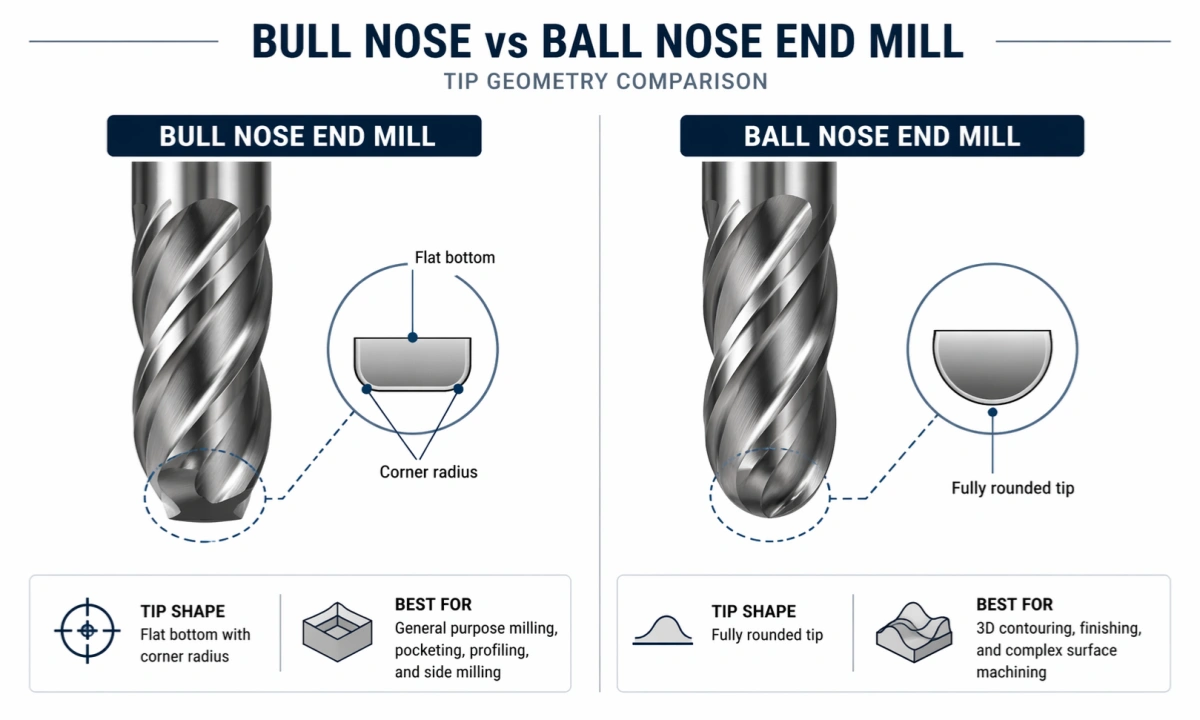
Although these two cutters are both used in contour-related machining, they are not designed for exactly the same purpose. A bull nose end mill has a flat bottom with a corner radius, while a ball nose end mill has a fully rounded tip. Because of this difference, each tool performs better in specific machining situations.
بعبارات بسيطة, a bull nose end mill is often preferred when stronger corners, smoother transitions, and better control on stepped or semi-flat features are needed. By contrast, a ball nose end mill is usually the better option for continuous 3D surfaces and complex curved forms.
If you need stronger corner support, semi-finishing, or stepped profile machining, عرض لدينا custom R corner cutter options.
If your project focuses on 3D contour finishing or curved surface machining, you can also check our مطاحن نهاية الأنف الكروية.
Quick Answer
هذا bull nose vs ball nose comparison helps you choose the right cutter based on tip geometry, corner strength, 3D surface machining, and finish requirements.
Choose a مطحنة نهاية الأنف الثور when you need better corner strength, more stable contouring, and smoother transitions on profiles or stepped surfaces.
Choose a ball nose end mill when you need continuous contact on 3D surfaces, sculpted forms, or complex curved parts.
In many real machining jobs, the key question is not which tool is universally better. Instead, the better choice depends on the part geometry, machining goal, and finish requirement.
ما هي مطحنة نهاية أنف الثور?
A bull nose end mill is an end mill with a flat bottom and a rounded corner radius. It sits between a flat end mill and a ball nose end mill in terms of geometry and application.
Because the sharp corner is replaced by a radius, the cutting edge becomes stronger and less likely to chip. في نفس الوقت, the flat bottom still allows practical machining on many profiles, steps, and semi-flat surfaces. نتيجة ل, a bull nose end mill is widely used for contour milling, semi-finishing, cavity machining, and mold work.
If you want a more complete explanation of tool geometry and common uses, read our tool geometry and application guide.
What Is a Ball Nose End Mill?
A ball nose end mill has a fully rounded tip. Unlike a bull nose end mill, it does not have a flat bottom. This geometry allows the tool to stay in smoother contact with curved and three-dimensional surfaces.
For this reason, a ball nose end mill is commonly used in 3D contour machining, sculpted surfaces, mold finishing, and freeform geometry. لكن, because the tip is fully rounded, it is usually less efficient on flat or stepped surfaces than a bull nose end mill.
In practice, a ball nose end mill is often selected when the machining path involves continuous curves instead of flat-bottom or semi-flat features.
For 3D contour finishing, curved surface machining, and mold finishing, you can view our مطاحن نهاية الأنف الكروية.
The Main Difference Between a Bull Nose End Mill and a Ball Nose End Mill
The main difference is the tip geometry, and that difference directly affects cutting behavior, finish quality, and application range.
Bull Nose End Mill Geometry
A bull nose end mill has:
- a flat bottom
- a corner radius
- stronger edge support
- better control on stepped or semi-flat features
Ball Nose End Mill Geometry
A ball nose end mill has:
- a fully rounded tip
- continuous curved contact
- better performance on 3D surfaces
- less support for flat-bottom machining
Why Geometry Matters
A bull nose end mill usually offers better corner durability and more practical cutting on stepped or semi-flat shapes. A ball nose end mill, however, is better when the tool must move smoothly across complex curved surfaces. In short, a bull nose tool is more balanced for strength and contour stability, while a ball nose tool is more specialized for curved surface finishing.
Quick Comparison Table
| Machining Need | Better Choice |
|---|---|
| Stronger cutting corners | Bull nose end mill |
| Continuous 3D surfaces | Ball nose end mill |
| Semi-finishing and contouring | Bull nose end mill |
| Smooth freeform surface finishing | Ball nose end mill |
| Better flat-surface control | Bull nose end mill |
| Sculpted mold details | Ball nose end mill |
This table is intentionally simple so it stays easy to read on mobile devices.
Surface Finish and Cutting Performance
Although both tools can be used in contour-related work, their cutting behavior is different.
Surface Finish on Curved Surfaces
A ball nose end mill is often the better choice for continuous curved surfaces because the rounded tip moves more smoothly across 3D contours. لذلك, it is widely used in finishing operations for molds, dies, and sculpted parts.
Surface Finish on Stepped or Semi-Flat Areas
A bull nose end mill is often more practical when the workpiece includes transitions between flat and curved sections. Because it has a flat bottom and a corner radius, it can offer a better balance between finish quality and cutting stability.
Tool Stability
A bull nose end mill usually has stronger corners. نتيجة ل, it often performs better in demanding conditions where edge durability matters. A ball nose end mill can still perform very well, but its fully rounded tip is not always the most efficient choice for every geometry.
Tool Life
In many practical applications, a bull nose end mill can provide better edge support and lower local chipping risk. A ball nose end mill, however, often performs better when the priority is smooth finishing on continuous curves rather than stronger corner durability.
Which Tool Is Better for Different Applications?
The answer depends on the application. Each tool has clear strengths in specific machining tasks.
Bull Nose End Mill Is Better For
- contour milling
- semi-finishing operations
- cavity machining
- mold machining with stronger edge support
- stepped or partially flat surfaces
- jobs where corner chipping is a concern
Ball Nose End Mill Is Better For
- continuous 3D surface machining
- sculpted shapes
- curved finishing paths
- mold finishing on freeform surfaces
- parts with complex flowing geometry
For 3D contour finishing and curved surface machining, يمكنك أيضًا مشاهدة موقعنا مطاحن نهاية الأنف الكروية.
Best Practical Choice
If the job includes both semi-flat transitions and curved features, a bull nose end mill is often more versatile. If the job is mostly 3D finishing with continuous curvature, a ball nose end mill is usually the better option.
How to Choose the Right Tool
Choosing between a bull nose end mill and a ball nose end mill depends on the part shape, machining goal, and finish requirement.
Choose a Bull Nose End Mill When
- you need better corner strength
- you are machining stepped profiles or semi-flat transitions
- you want more stable semi-finishing or contour milling
- you want to reduce local edge chipping
Choose a Ball Nose End Mill When
- you are machining continuous 3D surfaces
- you need smoother contact on curved geometry
- you are finishing sculpted molds or freeform parts
- you want a more natural toolpath on complex contours
Choose Based on the Most Critical Feature
If the part includes both curved and stepped features, choose the tool based on the most critical surface. In many real applications, machinists may use a bull nose end mill for semi-finishing and a ball nose end mill for final 3D finishing. This approach often gives a better balance between efficiency and surface quality.
If you also need to compare bull nose with a sharp-corner flat-bottom tool, read our flat end mill comparison guide.
Common Search Confusion
Many users compare bull nose, ball nose, and flat end mills at the same time. لكن, each comparison has a different search intent.
- مطحنة نهاية الثور مقابل مطحنة نهاية الأنف الكرة focuses on flat bottom with corner radius vs fully rounded tip
- Bull Nose vs Flat End Mill focuses on rounded corner vs sharp corner
- ما هي مطحنة نهاية أنف الثور focuses on tool definition, uses, and geometry
To keep the topic clear, this article focuses on the difference between a bull nose end mill and a ball nose end mill. If you need other comparisons, you can read the related guides for flat end mills or general bull nose tool geometry.
الأسئلة المتداولة
What is the difference between a bull nose end mill and a ball nose end mill?
A bull nose end mill has a flat bottom with a corner radius, while a ball nose end mill has a fully rounded tip. لذلك, the bull nose tool is usually better for stronger corners and semi-flat profiles, while the ball nose tool is better for continuous 3D surfaces.
Which tool is better for 3D surface machining?
A ball nose end mill is usually the better choice for continuous 3D surfaces because its rounded tip follows curved geometry more smoothly.
Which tool is better for contour milling?
In many contour milling applications, a bull nose end mill is more practical because it offers stronger edge support and better control on stepped or semi-flat profiles.
Is a bull nose end mill stronger than a ball nose end mill?
In many applications, yes. A bull nose end mill often provides stronger edge support because of its flat bottom and corner radius design.
Can one tool replace the other?
Not completely. These tools may overlap in some applications, but they are designed for different surface types and finishing goals.
Where can I check bull nose end mill specifications?
You can view our custom R corner cutter options for dimensions, radius options, and machining details.
Where can I check ball nose end mill specifications?
You can view our مطاحن نهاية الأنف الكروية for 3D contouring, curved surface machining, mold finishing, and related specifications.
خاتمة
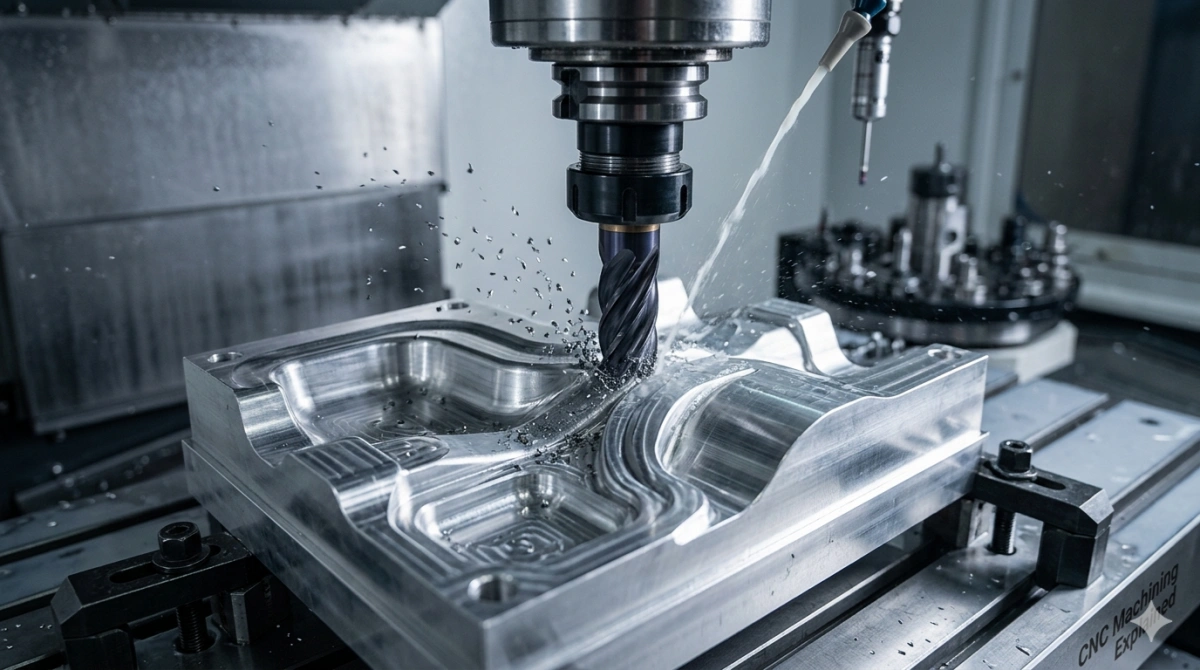
In this bull nose vs ball nose comparison, the two cutters may seem similar, but they are designed for different machining needs. A bull nose end mill is usually better for stronger corners, semi-finishing, contour stability, and stepped profiles. A ball nose end mill is usually better for smooth 3D surfaces, sculpted forms, and freeform finishing.
لذلك, the right choice depends on part geometry, cutting strategy, and finish requirement. For stronger edge support, semi-finishing, or stepped profile machining, a bull nose end mill is often the better option. For continuous 3D contour finishing, curved surface machining, or mold finishing, a ball nose end mill is usually the right tool.
For custom radius options and stepped profile machining, عرض لدينا custom R corner cutter options.
For 3D contour finishing and curved surface machining, check our مطاحن نهاية الأنف الكروية.
Need help choosing the right cutter? Send us your workpiece material, machining surface, قطر الأداة, radius or ball size, متطلبات الطلاء, وكمية الطلب.