 قواطع الطحن الدقيقة,أدوات القطع لتصنيع كل مادة باستخدام الحاسب الآلي

في أ face mill vs end mill مقارنة, a face mill is generally the better choice for a broad, open, accessible flat surface because its wider cutting coverage can reduce the number of lateral toolpaths. An end mill is usually more flexible when the machining area is small, access is limited, or the same part also requires slots, جيوب, الملفات الشخصية, or contours.
The choice is not simply “large part = face mill” and “small part = end mill.”
Surface size, cutter access, usable cutter diameter, صلابة الآلة, عقد العمل, surrounding features, and the overall machining plan all affect the final decision.
This guide compares face mill vs end mill selection from a practical CNC machining perspective and explains when each tool makes more sense.
مطحنة الوجه مقابل مطحنة النهاية: مقارنة سريعة
Both tools can machine flat surfaces, but they are designed around different priorities.
A face mill focuses on efficient planar machining. An end mill provides broader toolpath flexibility and can machine both local flat areas and more complex features.
| عامل المقارنة | Face Mill | مطحنة نهاية |
|---|---|---|
| Main purpose | Broad planar and facing operations | General-purpose feature machining |
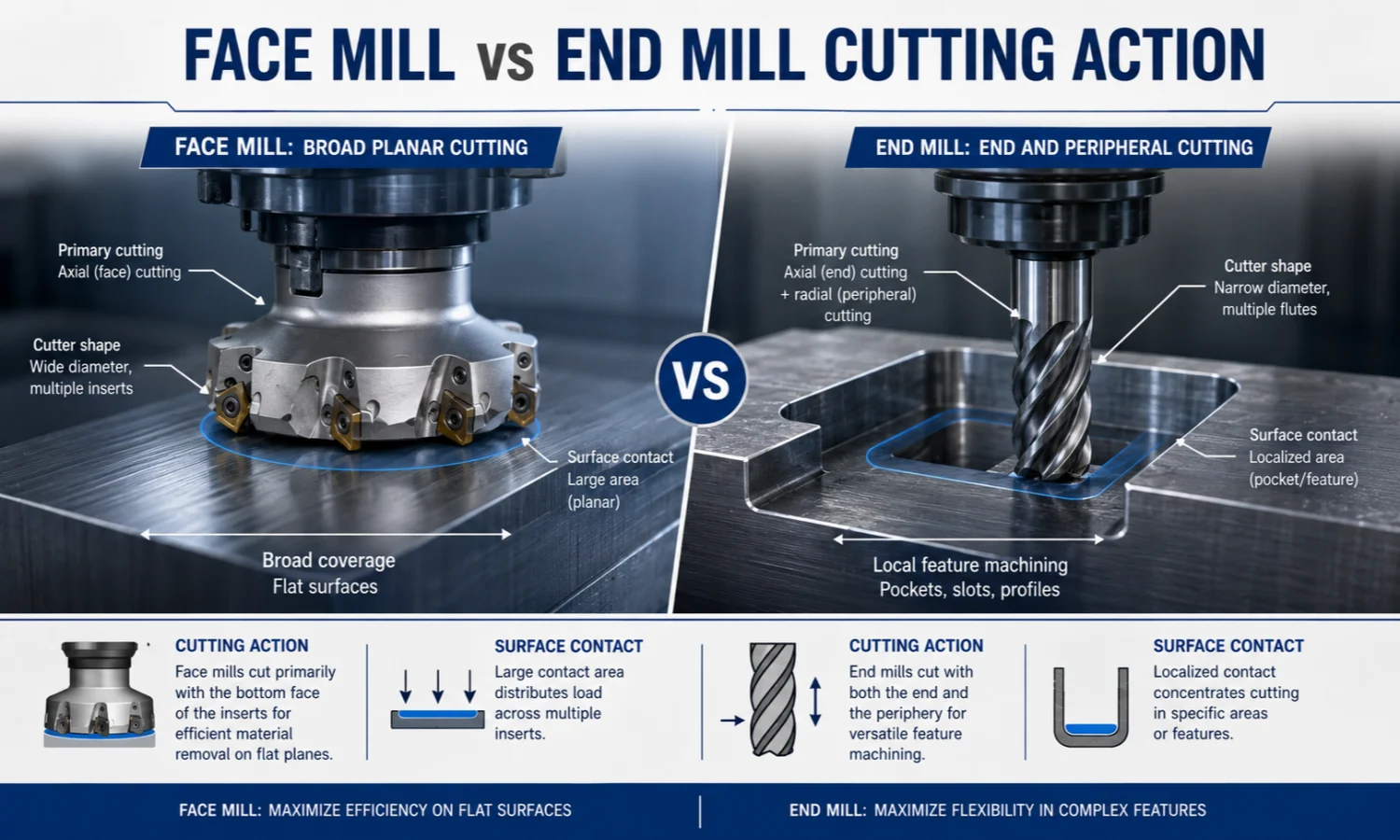
| Primary cutting action | Mainly optimized for face cutting across a flat surface | Uses end and peripheral cutting edges depending on the operation |
| Typical geometry | Comparatively large cutting diameter; many designs use multiple inserts | More compact cylindrical tool with end and side cutting edges |
| Surface coverage | Generally wider | Generally narrower |
| Open flat surfaces | Usually the more direct choice for broad, accessible faces | Suitable for small or local flat areas |
| Small or restricted flat surfaces | May be limited by cutter clearance | Often easier to access |
| فتحات, جيوب, الملفات الشخصية | Not the primary purpose | Usually more versatile |
| Lateral passes on a wide face | May require fewer passes when usable cutter coverage is wider | Often requires more adjacent toolpaths on the same wide surface |
| Toolpath flexibility | أكثر تخصصا | أعلى |
| Machine and access considerations | Larger cutter size may require more clearance and suitable machine/setup capability | Compact size often suits restricted areas |
| Tool-change trade-off | Adds a dedicated facing tool | May handle facing plus other features with one tool |
| Typical selection rule | Broad, open, accessible planar work | صغير, restricted, or mixed-feature machining |
The key point is that capability and suitability are different. An end mill may be capable of machining a flat face, but that does not automatically make it the preferred tool for a wide, open, repeated facing operation.
What Is a Face Mill?
طاحونة الوجه عبارة عن قاطعة طحن مصممة أساسًا لتصنيع الأسطح المسطحة بحيث يكون محور القطع عموديًا بشكل عام على الوجه المُشكل آليًا.
بالمقارنة مع مطحنة نهاية نموذجية, عادةً ما توفر مطحنة الوجه مساحة قطع فعالة أكبر. تستخدم العديد من قواطع الطحن الوجهية أيضًا عدة قطع قابلة للاستبدال مرتبة حول جسم القاطع.
ميزتها الرئيسية ليست مجرد قطرها المادي. ال ميزة عملية يأتي من مقدار السطح المستهدف الذي يمكن للقاطع تغطيته أثناء كل تمريرة.
إجراء القطع الأساسي وتصميم الأداة النموذجية
تعمل مطحنة الوجه على تشغيل قطعة العمل بشكل رئيسي من خلال حواف القطع الموضوعة للمعالجة المستوية.
لأن القاطع يمكن أن يوفر تغطية واسعة نسبيًا قابلة للاستخدام عندما يسمح الوصول والإعداد بذلك, يمكن أن يكون مفيدًا عند التشغيل الآلي:
- وجوه علوية كبيرة
- فتح الأسطح المستوية
- Stock requiring surface leveling
- Reference or datum faces
- Repeated facing operations
Face mills are available in different geometries and entering angles. على سبيل المثال, 45° face mills commonly suit general face milling, while 90° cutters can be useful when the operation also requires access close to a square shoulder.
لكن, this article does not treat every face mill as interchangeable. Cutter geometry still needs to match the actual workpiece and machining requirement.
Where a Face Mill Makes the Most Sense
A face mill generally makes the most sense when the target surface is:
- Broad
- Open
- Accessible
- Suitable for a comparatively large cutter diameter
This matters because cutter coverage can reduce the number of adjacent lateral toolpaths.
على سبيل المثال, if a wide plate can accept a suitable face mill without interference from clamps, الجدران, bosses, أو غيرها من الميزات, قد يغطي عرض القطع الأكبر القابل للاستخدام الوجه بتمريرات أقل من المطحنة النهائية الأصغر.
وهذا لا يضمن تحسينًا محددًا في وقت الدورة. الإنتاجية الفعلية لا تزال تعتمد على الجهاز, عقد العمل, ظروف القطع, مسار الأدوات, مادة الشغل, والإعداد.
ما هي مطحنة النهاية?
الطاحونة النهائية هي أداة طحن أكثر تنوعًا يمكنها استخدام حواف القطع في نهاية الأداة وحول محيطها.
تسمح هذه الهندسة للطاحونة النهائية بتصنيع أكثر من مجرد سطح علوي مستو.
في هذه المقارنة, يشير مصطلح "المطحنة النهائية" بشكل أساسي إلى الأدوات المستخدمة بشكل شائع للأسطح المسطحة العامة, الشق, جيب, التنميط, والعمل الكنتوري. تعتمد القدرة الدقيقة على النمط النهائي وهندسة القطع, لذلك لا ينبغي التعامل مع كل نوع من أنواع المطاحن النهائية على أنها قابلة للتبديل.
قدرة القطع الطرفية والمحيطية
The combination of end and peripheral cutting edges gives an end mill greater flexibility in toolpath direction and feature access.
Depending on the specific tool design and operation, an end mill can machine:
- Local flat surfaces
- فتحات
- Pockets
- Side walls
- Profiles
- ملامح
- Mixed geometric features
This flexibility is one reason an end mill may remain the practical choice even when a dedicated face mill could machine one of the flat surfaces more efficiently.
Where an End Mill Makes the Most Sense
An end mill is usually more practical when:
- The flat surface is relatively small
- The machining area is inside or near a pocket
- Walls, clamps, تركيبات, or other features restrict cutter access
- The same part also needs slots, جيوب, الملفات الشخصية, or contours
- One tool can complete several features and avoid an additional tool change
لذا, ان end mill vs face mill يجب أن يأخذ القرار في الاعتبار مهمة المعالجة بأكملها بدلاً من سطح واحد بشكل منفصل.
الاختلافات الرئيسية بين مطحنة الوجه ومطحنة النهاية
الفرق بين طحن الوجه مقابل الطحن النهائي يصبح أكثر وضوحًا عندما ننظر إلى سبب اختلاف سلوك الأدوات, بدلاً من مجرد إدراج طلباتهم.
عمل القطع الأساسي وهندسة الأداة
تم تحسين مطحنة الوجه بشكل أساسي لتتمكن من مسح سطح مستو.
تجمع المطحنة النهائية بين القدرة على القطع النهائي والقطع المحيطي, مما يمنحها المزيد من الحرية للدخول إلى المناطق المحلية وميزات الآلة في اتجاهات مختلفة.
وهذا يؤدي إلى الاختلاف العملي الرئيسي:
مطحنة الوجه متخصصة في التغطية المستوية, بينما تؤكد المطحنة النهائية على المرونة الهندسية.
That distinction also explains why the two tools can overlap in some operations without becoming direct substitutes for every application.
Surface Coverage, Flat-Surface Size, and Number of Passes
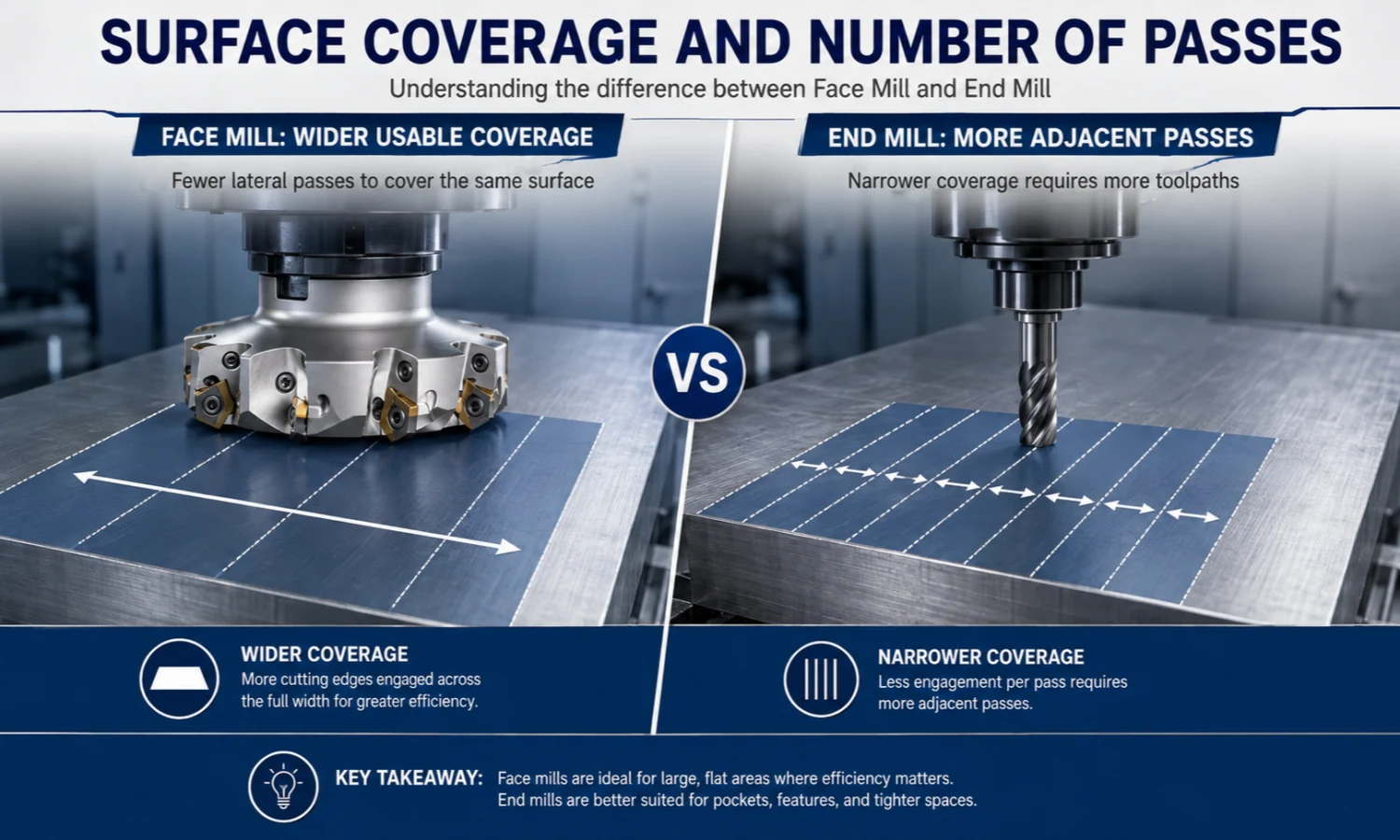
This is one of the most important factors when choosing a face mill or end mill.
A wider surface does not automatically require a face mill. The important relationship is:
Surface size → usable cutter coverage → number of lateral toolpaths
Suppose two cutters can both reach the surface.
A comparatively large face mill may cover a greater width during each pass. لذلك, it can often reduce the number of adjacent toolpaths required to machine a broad open face.
A smaller end mill may need more passes to cover the same area.
لكن, cutter diameter alone does not decide the result.
The usable cutter coverage may be limited by:
- Clamps
- Fixtures
- الجدران القريبة
- Holes
- Bosses
- Steps
- Part edges
- Tool approach
- Available machine clearance
لذلك, “large surface” should not be treated as a fixed dimensional threshold. It is large relative to the cutter that can practically reach and machine it.
Surface Finish and Flatness: What Tool Choice Can and Cannot Decide
A face mill can be a very suitable tool for creating a consistent finish across a broad planar surface because its geometry and coverage are designed around facing operations.
لكن, tool type alone does not determine surface finish or flatness.
Actual results can also depend on:
- نفاذ القاطع
- Cutting-edge or insert geometry
- Tool condition
- Feed conditions
- مادة الشغل
- حالة الآلة
- استقرار العمل
- استراتيجية مسار الأدوات
- Setup accuracy
An end mill can also produce a suitable finish on a smaller or localized flat surface.
لذلك, it is not technically accurate to say that a face mill always produces a better surface finish than an end mill.
The more useful question is:
Which tool is better suited to the size, openness, إمكانية الوصول, and overall machining requirement of this particular surface?
Why End Mills Are Usually Better for Slots, Pockets, and Profiles
When the part includes slots, جيوب, الملفات الشخصية, ملامح, or localized side features, an end mill generally provides more flexibility than a face mill.
The end and peripheral cutting edges allow the tool to follow:
- Internal paths
- Pocket boundaries
- Profile geometry
- Narrower machining zones
- Areas that a larger cutter cannot easily access
Shoulder machining requires more careful consideration. Some 90° face milling cutters can approach or machine square-shoulder features, so “shoulder = end mill” is not a universal rule.
If your main decision is specifically between a dedicated side cutter and an end mill for grooves or side-oriented machining, see our guide to قطع الطحن الجانبي مقابل مطحنة النهاية.
For a broader comparison of face-oriented and side-oriented milling operations, يرى الطحن الجانبي مقابل الطحن الوجهي.
آلة, عقد العمل, and Tool-Access Limits
The theoretically most productive cutter is not useful if the setup cannot support it.
Before selecting a larger face mill, consider:
- Available cutter clearance
- Spindle and toolholder capability
- صلابة الآلة
- استقرار العمل
- Clamp position
- Nearby walls or fixtures
- Approach direction
A broad surface may appear ideal for face milling, but a fixture or nearby feature can prevent a large cutter from reaching the full area.
في هذه الحالة, a smaller end mill may provide the more practical solution.
When Fewer Tool Changes Favor an End Mill
Tool productivity should not be judged only by the width of one cutting pass.
Consider a small component that needs:
- A top face machined
- A pocket
- A slot
- A profile
A face mill may be better at machining the top face by itself. لكن, if an end mill can machine the top face and then continue with the pocket, فتحة, and profile, using the end mill may reduce unnecessary tool changes.
This does not mean an end mill is always more productive.
بدلاً من, it shows why tool selection should consider the complete process rather than one operation in isolation.
Can You Face Mill With an End Mill?
نعم, an end mill can be used for facing in suitable conditions.
But capability does not equal preferred choice.
An end mill may work very well for a small or restricted flat surface. On a wide, open surface, لكن, a dedicated face mill may provide more useful surface coverage and reduce the number of lateral passes.
The correct choice depends on the geometry of the end mill, the target surface, إمكانية الوصول, إعداد الآلة, and the other features that must be machined.
When an End Mill Is Reasonable for Facing
Using an end mill for facing may make sense when:
- The flat surface is small
- The surface lies inside a pocket
- A large cutter cannot clear nearby walls or fixtures
- Clamps restrict face-mill access
- The same end mill is already required for other features
- Avoiding an additional tool change improves the overall process
The end mill must also have suitable end geometry for the intended cutting direction and surface requirement.
لذلك, “an end mill can face” should never be interpreted as “every end mill is equally suitable for facing.”
When a Dedicated Face Mill Makes More Sense
A dedicated face mill generally becomes more attractive when:
- The target is a broad, open surface
- The cutter can access most or all of the face
- Useful cutter coverage is significantly wider than the available end mill
- The operation requires repeated facing
- Reducing adjacent lateral toolpaths matters
- Planar machining is the main purpose of the operation
لهذه التطبيقات, يمكنك مراجعة لدينا قواطع طحن الوجه.
If you are unsure about cutter diameter, entering angle, insert style, or the suitability of a face mill for your workpiece, the final selection should be based on the actual part geometry and machining conditions rather than a generic rule.
How to Choose Between a Face Mill and an End Mill
The easiest way to choose is to start with the geometry of the machining task.
Do not begin with: Which tool is more powerful?
Instead ask: What surface or feature must I machine, how accessible is it, and what other operations must the same setup complete?
Choose a Face Mill When…
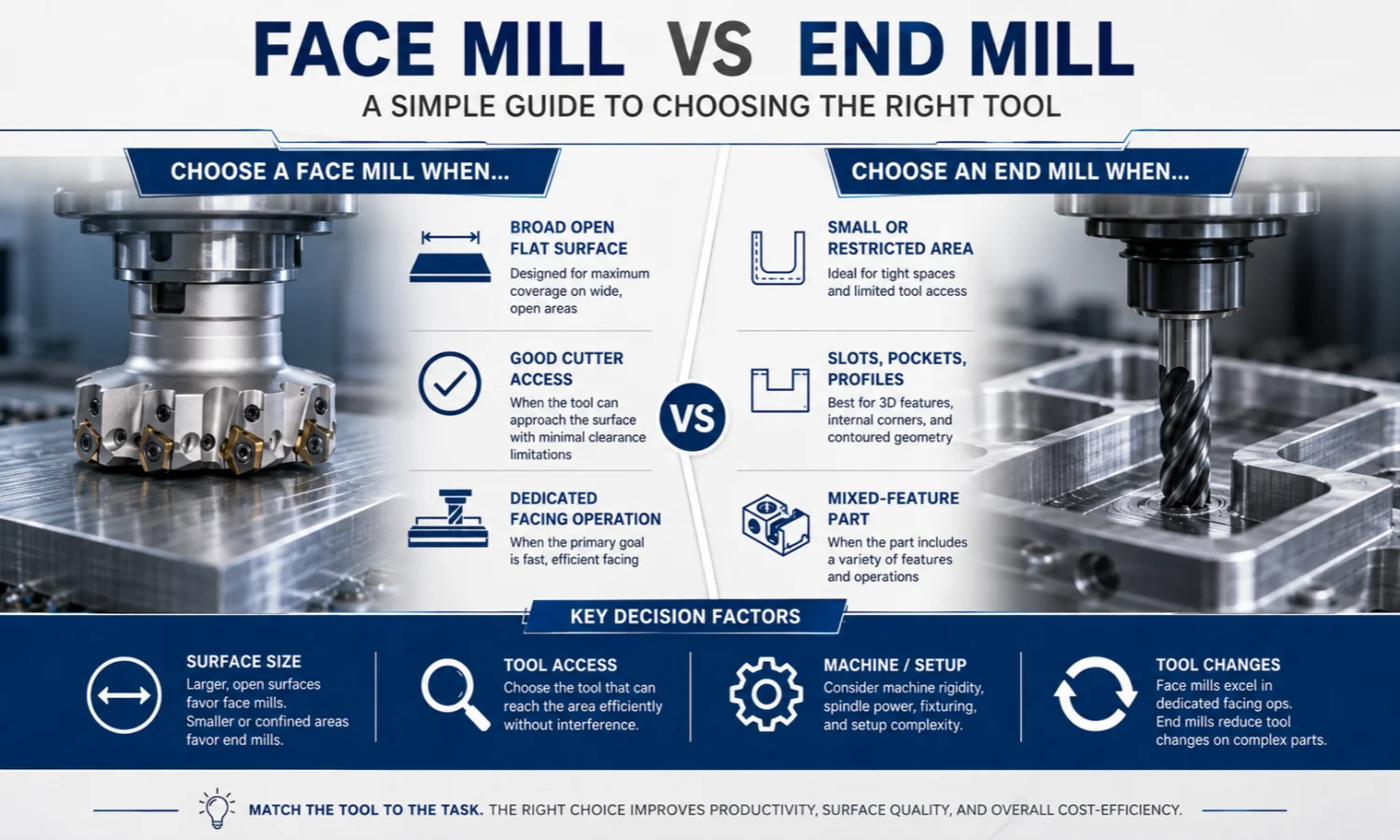
A face mill is generally the stronger candidate when:
- The target is a broad, open, accessible flat surface
- Cutter clearance allows useful surface coverage
- The machine and toolholder can support the cutter
- The workholding is stable
- Facing is repeated enough to justify a dedicated tool
- Reducing lateral toolpaths is valuable
- Planar machining is the main objective
This is why face mills are widely used for large open surfaces, top faces, leveling operations, and other dedicated planar machining tasks.
Choose an End Mill When…
An end mill may be the better choice when:
- The flat area is relatively small
- The surface is localized
- Access is limited
- The surface lies inside or near another feature
- The part also needs slots, جيوب, الملفات الشخصية, or contours
- A larger face mill cannot clear walls, تركيبات, or clamps
- One end mill can complete several operations and reduce unnecessary tool changes
بعبارة أخرى, the end mill often wins when flexibility matters more than broad-area coverage.
Three Part-Geometry Selection Scenarios
Scenario 1: Broad open plate face
The part has a large, accessible top surface with enough clearance around the machining area.
A face mill will generally be the more direct choice because its wider usable coverage may reduce the number of adjacent passes.
Typical direction: Face Mill
Scenario 2: Small part with a top face, جيب, and slot
The top surface needs light facing, but the same component also requires a pocket and slot.
If a suitable end mill can complete all three operations, keeping one tool in the machining sequence may be more practical than adding a dedicated face mill.
Typical direction: End Mill may be more practical
Scenario 3: Flat area limited by clamps or nearby features
The target surface is flat, but walls, تركيبات, clamps, or nearby geometry restrict the approach of a large-diameter cutter.
Even if a face mill would normally suit the surface size, inadequate clearance may make a smaller end mill the more workable option.
Typical direction: Depends on tool access; End Mill may be more practical
Face Mill vs End Mill FAQs
Can You Use an End Mill as a Face Mill?
نعم. A suitable end mill can machine flat surfaces, especially small or localized areas.
لكن, a dedicated face mill often makes more sense for broad, open surfaces because wider cutter coverage can reduce adjacent lateral toolpaths when the setup allows.
What Is the Main Difference Between Face Milling and End Milling?
Face milling primarily focuses on machining planar surfaces with a cutter optimized for broad face contact and coverage.
End milling uses end and peripheral cutting capability to machine a wider range of features, including local flat surfaces, فتحات, جيوب, الملفات الشخصية, and contours.
Which Tool Is Better for Large Flat Surfaces?
For a broad, open, accessible flat surface, a face mill is generally the more suitable choice.
Its larger usable cutting coverage can often reduce the number of lateral passes compared with a smaller end mill.
لكن, clamps, تركيبات, machine capability, nearby features, and cutter access can change the final selection.
Which Tool Is Usually Better for Slots, Pockets, and Profiles?
An end mill is generally more versatile for slots, جيوب, الملفات الشخصية, and contours because it can use both end and peripheral cutting edges.
The exact tool still depends on the feature geometry, الأبعاد المطلوبة, مادة الشغل, الوصول إلى الأداة, وظروف التصنيع.
Does a Face Mill Always Produce a Better Surface Finish Than an End Mill?
No.
A face mill can be well suited to producing a consistent finish on a broad flat surface, but surface quality also depends on tool condition, نفد, الهندسة المتطورة, عقد العمل, حالة الآلة, مادة, مسار الأدوات, ومعلمات القطع.
A properly selected end mill can also produce a suitable finish on smaller or localized flat surfaces.
Need Help Choosing a Face Mill or End Mill?
The best face mill vs end mill choice depends on more than tool diameter. Surface size, openness, وصول, عقد العمل, machine capability, and the other features on the part all influence the decision.
If your main requirement is broad planar machining, explore our face milling cutter options for different planar machining requirements:
لتطبيق جديد أو غير قياسي, أرسل لنا رسم الشغل الخاص بك أو رسمًا بسيطًا مع مواد الشغل ومتطلبات التصنيع.
يمكننا مراجعة الطلب والمساعدة في تحديد ما إذا كان أ face mill or end mill هي نقطة البداية الأكثر ملاءمة لمهمة التصنيع.