 Fresas de precisión,Herramientas de corte para el mecanizado CNC de todos los materiales

A ball mill cutter is a CNC milling tool with a fully rounded cutting end. It is mainly used for 3D contouring, acabado de la cavidad del molde, mecanizado de superficies curvas, y fresado de perfiles de precisión. Because the cutting end follows complex shapes smoothly, the tool can produce a more consistent finish on curved and freeform surfaces.
Buyers may also call this tool a ball end mill cutter, ball cutter tool, milling cutter with a ball end, or ball nose end mill. In professional cutting tool catalogs, “ball nose end mill” is usually the more standard product name. For standard sizes and custom options, ver nuestro fresas de punta esférica de carburo.
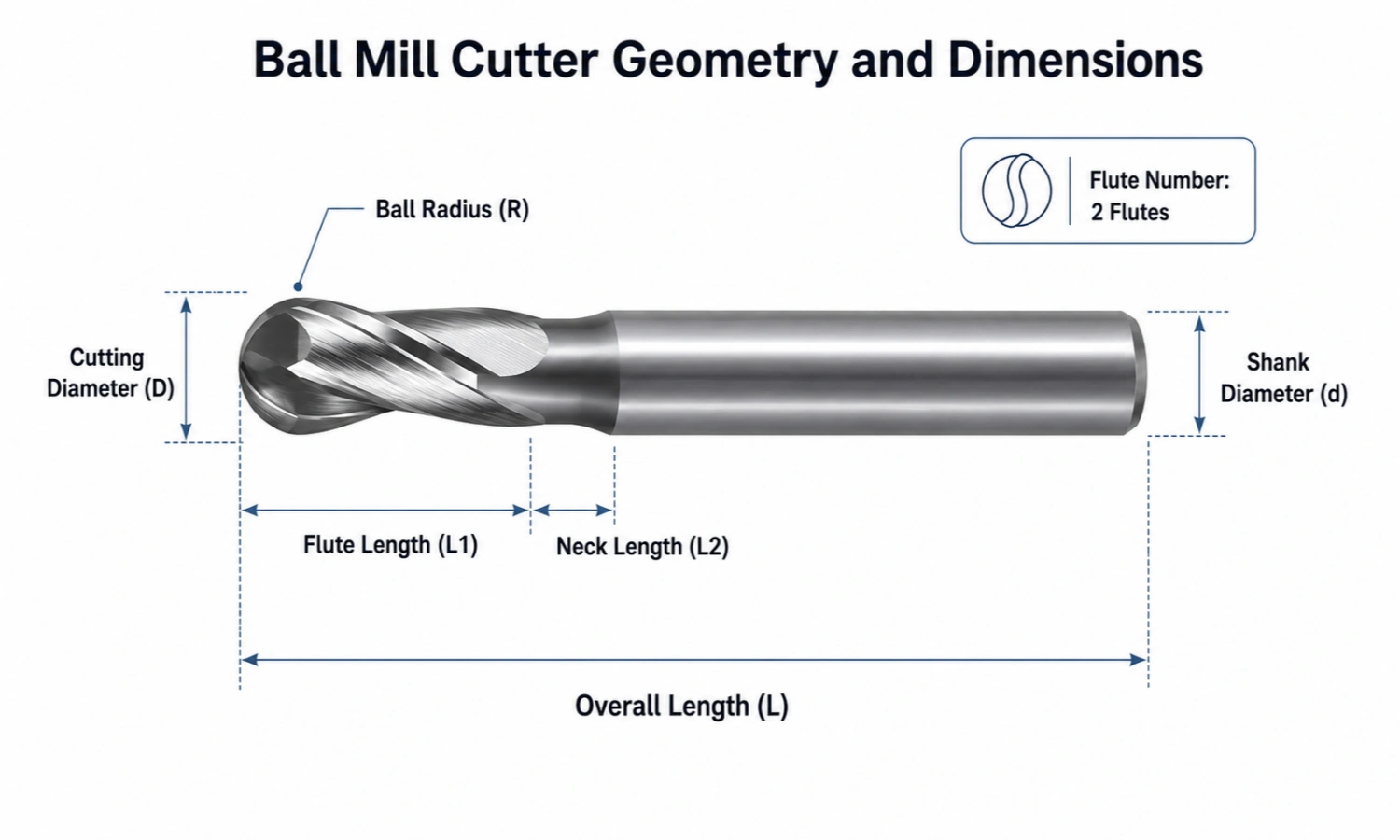
Ball Mill Cutter Geometry and Working Principle
The cutter has a hemispherical end rather than a flat cutting face. As the tool follows a programmed CNC path, different points along the curved edge contact the workpiece. Por lo tanto, the cutter can machine radii, pendientes, caries, and freeform surfaces without creating abrupt transitions.
Para un diseño estándar con extremo esférico, El radio de la punta es normalmente la mitad del diámetro de corte.. Por ejemplo, a 6mm cutting diameter normally has a 3mm ball radius. Sin embargo, surface finish also depends on the programmed step-over, velocidad del husillo, tasa de alimentación, tool runout, cutter overhang, y rigidez de la máquina.
The center of the ball end has a lower effective cutting speed than the outer edge. Como resultado, toolpath strategy matters. A suitable tilt angle or finishing path can improve cutting action and reduce rubbing near the tool center.
Main Uses of a Ball Mill Cutter
Machinists choose this rounded-end cutter when a part contains complex curves, smooth transitions, or three-dimensional features.
Common uses include:
- 3fresado de contorno D
- Acabado de la cavidad del molde
- Mecanizado de matrices y moldes
- Acabado de superficies curvas
- Mecanizado de radios y perfiles.
- Freeform surface cutting
- Graphite and copper electrode machining
- Acabado de piezas aeroespaciales y de automoción
- Mecanizado de componentes médicos y de precisión.
- CNC engraving and detailed finishing
Un diámetro más pequeño puede alcanzar cavidades estrechas y detalles finos.. Mientras tanto, a larger diameter can improve machining efficiency on wider surfaces. The selected tool should match the part geometry, required surface finish, rigidez de la máquina, and setup stability.
For a more detailed application guide, leer ¿Para qué se utiliza una fresa de punta esférica?.
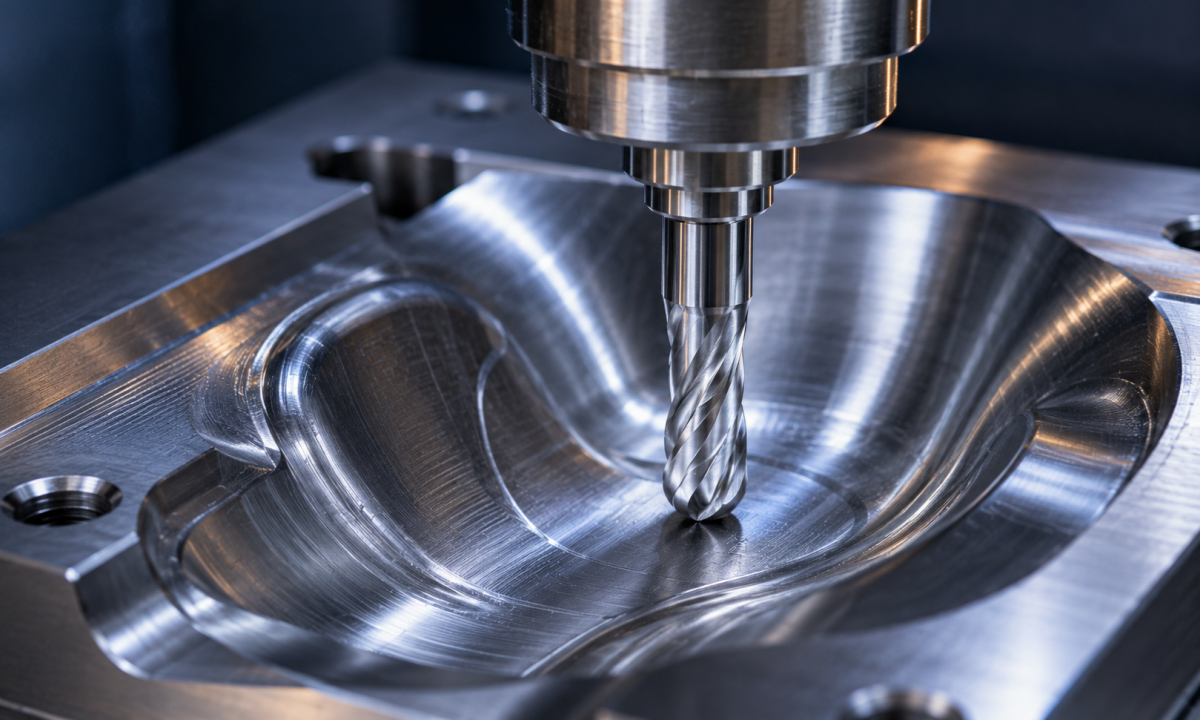
Common CNC Applications
The table below shows where this cutter is commonly used and why its rounded geometry is helpful.
| Solicitud | Why the Cutter Is Used |
| Acabado de la cavidad del molde | Follows curved cavity walls and helps produce a smooth finish |
| 3fresado de contorno D | Moves along complex toolpaths and sculpted surfaces |
| Die finishing | Machines radii, transitions, and shaped surfaces |
| Mecanizado de electrodos | Produces detailed graphite or copper profiles |
| Componentes aeroespaciales | Finishes complex surfaces and blended contours |
| moldes automotrices | Supports cavity, radio, and freeform surface finishing |
| Prototype machining | Works well on organic shapes and complex profiles |
In many machining processes, a flat end mill removes most of the material during roughing. Después, a rounded-end cutter finishes the curved areas and improves the final surface quality.
Ball Mill Cutter vs Flat End Mill
These tools serve different machining purposes. A ball mill cutter has a rounded end, while a flat end mill has a flat cutting face.
| Característica | cortador de molino de bolas | Fresa de extremo plano |
| Cutting End | Fully rounded | Departamento |
| Best Use | 3D contours and curved surfaces | Tragamonedas, bolsillos, pasos, and flat bottoms |
| Typical Operation | Finishing and semi-finishing | Desbaste, ranurado, facing, y fresado en escuadra |
| Resultado de superficie | Smooth on radii and freeform profiles | Flat on pocket bottoms and planar surfaces |
| Corner Shape | Creates rounded transitions | Creates sharp or square-bottom features |
Las dos herramientas se utilizan a menudo juntas.. Primero, a flat cutter removes material efficiently. Entonces, the rounded cutter finishes cavities, radios, y superficies curvas.
For flat-bottom slots, bolsillos, pasos, y hombros cuadrados, ver nuestro molino de extremo plano producto.
Is a Ball Mill Cutter the Same as a Ball Nose End Mill?
In CNC cutting tool applications, the two names usually describe the same general tool type. Both refer to a cutter with a fully rounded end for 3D contouring, acabado de moldes, and curved surface machining.
“Ball nose end mill” is the more formal name used in many professional catalogs. Por el contrario, “ball mill cutter” is a shorter search term used by some buyers.
The name should not be confused with a ball mill machine, which is grinding equipment used for powders or bulk materials.
How to Choose a Ball Mill Cutter
La herramienta correcta depende del material de la pieza de trabajo., part geometry, profundidad de mecanizado, surface finish target, and CNC machine condition. Antes de realizar el pedido, check the following factors.
Cutting Diameter and Ball Radius
Select a diameter that matches the workpiece radius, cavity width, and detail size. A small diameter can reach fine features, while a larger diameter can improve efficiency on broad curved areas.
Flute Count and Chip Space
Los diseños de dos flautas proporcionan más espacio para las virutas y, a menudo, se adaptan al aluminio., cobre, grafito, and other applications that need efficient chip evacuation.
Los diseños de cuatro flautas proporcionan más filos de corte y pueden mejorar la estabilidad durante las operaciones de mecanizado y acabado del acero..
Other flute counts can be evaluated according to the cutter diameter, material de la pieza de trabajo, y acabado superficial requerido.
Longitud de la flauta, Longitud del cuello, and Overall Length
Use the shortest practical tool that can reach the required depth. Un voladizo excesivo reduce la rigidez y puede provocar vibraciones., poor surface finish, or premature wear.
For deep cavities, a relieved neck or long-reach design may provide better access than an excessively long cutting edge.
Carbide Grade and Coating
The carbide grade and coating should match the workpiece material, dureza, temperatura de corte, y condición del refrigerante.
For aluminum and other non-ferrous materials, sharp edges and polished flutes can reduce chip adhesion. para acero, acero inoxidable, molde de acero, y materiales endurecidos, a suitable heat-resistant coating can improve wear resistance and tool life.
Machine and Tool-Holder Stability
Tool runout, condición del titular, spindle rigidity, and cutter overhang directly affect the final finish. Por lo tanto, even a correctly selected tool may perform poorly if the machine setup is unstable.
For a more detailed selection process, leer Cómo elegir una fresa de punta esférica.
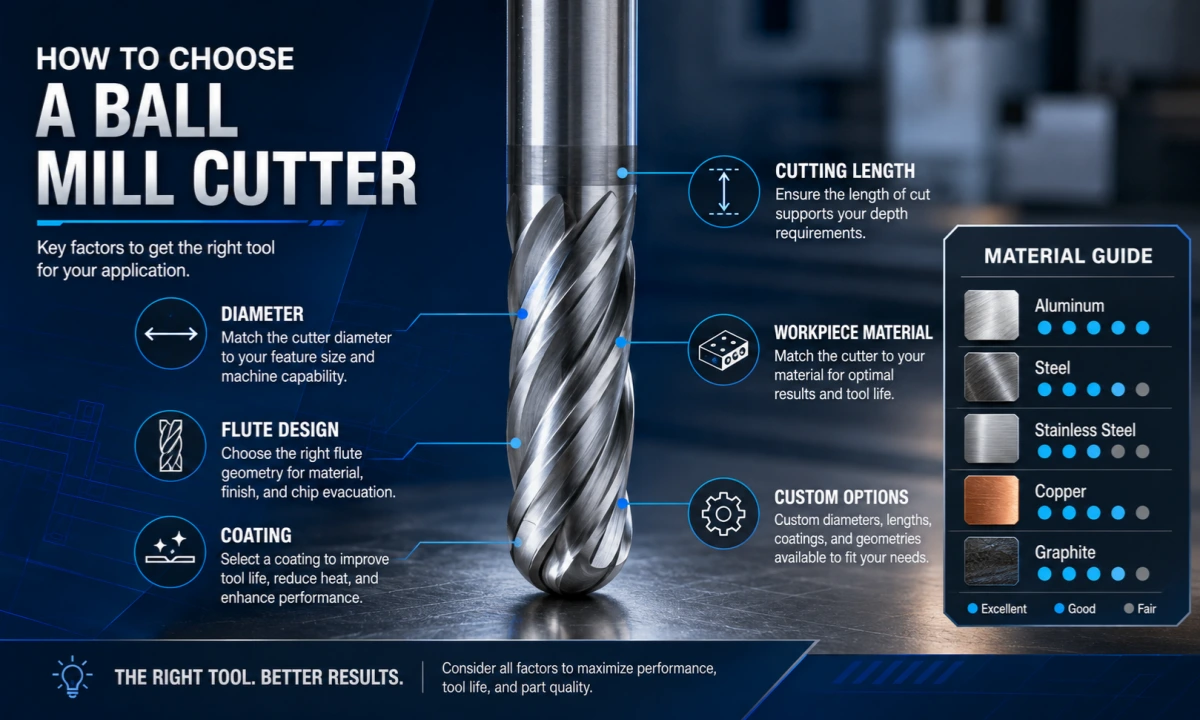
Ball Mill Cutter Materials and Design Considerations
Different materials require different edge geometries, diseños de flauta, and coatings.
Aluminum and Non-Ferrous Materials
Good chip evacuation is essential when machining aluminum, cobre, and similar materials. Sharp cutting edges, larger flute space, and polished flutes can help reduce built-up edges and improve surface finish.
Steel and Stainless Steel
Steel and stainless steel require stable cutting edges, suitable carbide grades, and appropriate coatings. Además, excessive tool overhang should be avoided because vibration can damage the finish and shorten tool life.
Mold Steel and Hardened Materials
For mold steel and hardened materials, fuerza del borde, resistencia al calor, and wear resistance become more important.
Standard designs can support many applications up to approximately HRC65. Selected carbide grades and coatings may support HRC68–70, depending on the exact material, diámetro del cortador, machining allowance, rigidez de la máquina, and cutting parameters.
Graphite and Copper Electrodes
Graphite machining requires wear resistance and stable cutter geometry. Copper electrode machining usually benefits from sharp cutting edges and a smooth flute surface.
Por lo tanto, the tool design should be selected according to the electrode material and required finish.
Common Selection Mistakes
Several common mistakes can reduce tool life or surface quality:
- Choosing a cutter that is longer than necessary
- Using an unsuitable coating for the workpiece material
- Ignoring flute count and chip evacuation
- Applying a rounded cutter to a flat-bottom operation
- Using excessive step-over during finishing
- Ignoring tool runout or holder condition
- Ordering a custom tool without a clear drawing
Checking these points before ordering can reduce trial-and-error costs and improve machining stability.
Custom Cutter Options
Standard tools may not suit every cavity, mold, radio, or special CNC component. Por lo tanto, CutterBest supports custom cutter production according to drawings, muestras, listas de tallas, y requisitos de mecanizado.
Available custom options may include:
- Diámetro de corte
- Ball radius
- longitud de la flauta
- Longitud total
- Diámetro del mango
- Longitud del cuello
- Relieved-neck or long-reach design
- recuento de flautas
- Grado de carburo
- Coating or uncoated carbide
- Dimensional tolerance
- OEM laser marking
- Neutral or private-label packaging
For an accurate quotation, provide the workpiece material, dureza, diámetro del cortador, longitud de la flauta, longitud total, diámetro del vástago, recuento de flauta, requisito de recubrimiento, cantidad, y dibujando.
Preguntas más frecuentes
What is a ball mill cutter used for?
It is used for 3D contour milling, acabado de la cavidad del molde, mecanizado de superficies curvas, morir acabado, perfiles de forma libre, y acabado CNC de precisión. The rounded end helps the cutter follow complex shapes smoothly.
Is a ball mill cutter the same as a ball end mill cutter?
In many CNC milling applications, Sí. Buyers may use “ball mill cutter,” “ball end mill cutter,” and “ball nose end mill” for a similar rounded-end cutting tool.
Can this cutter machine aluminum?
Sí. It can machine aluminum molds, superficies curvas, y perfiles 3D. Sin embargo, sharp cutting edges, buena evacuación de virutas, and suitable flute geometry are important for reducing chip adhesion.
Can it make a flat-bottom pocket?
It can machine curved cavity bottoms, pero no crea eficientemente un perfil de fondo completamente plano. A flat end mill is usually more suitable for flat-bottom pockets, tragamonedas, pasos, y hombros.
What information is needed for a custom quotation?
Please provide the cutting diameter, radio de la bola, longitud de la flauta, longitud total, diámetro del vástago, recuento de flauta, revestimiento, material de la pieza de trabajo, dureza, cantidad, and drawing if available.
Send Your Ball Mill Cutter Requirement
Need a standard or custom cutter for 3D contouring, acabado de moldes, or curved surface machining?
Send your size list, dibujo, material de la pieza de trabajo, dureza, requisito de recubrimiento, y cantidad. Nuestro equipo revisará la aplicación y proporcionará una propuesta y cotización de herramienta adecuada..
Envía tus requisitos a sales@cutterbest.com.