 Fresas de precisión,Herramientas de corte para el mecanizado CNC de todos los materiales

A fresa lateral vs fresa de extremo La decisión no se trata simplemente de qué herramienta puede cortar una ranura.. Ambas herramientas pueden mecanizar algunas características superpuestas., pero tampoco es automáticamente la mejor opción.
En esta guía, una fresa lateral se refiere principalmente a una fresa lateral de tipo disco o de lado y cara con montaje en orificio o eje. No se trata simplemente de una fresa que realiza una trayectoria de fresado lateral..
La elección práctica depende del acceso a las funciones., ancho requerido, profundidad de corte, alcanzar, rigidez de la máquina y del portaherramientas, y si el trabajo necesita una operación dedicada o un proceso CNC flexible de múltiples operaciones.
Fresa lateral versus fresa de extremo: Comparación rápida
Utilice esta tabla como punto de partida en lugar de una regla de selección absoluta..
| Factor | Fresa lateral | Fresa |
|---|---|---|
| Estructura típica | Cortadora tipo disco | Cortador tipo mango |
| Montaje típico | Aburrir / montaje del eje | Portaherramientas para fresadora final |
| Fortalezas típicas | Ranuras accesibles, tragamonedas, espalda, y características laterales | Tragamonedas, bolsillos, perfiles, contornos, y características mixtas |
| Acceso a funciones cerradas | Depende en gran medida del acceso lateral y del espacio libre para el cortador | Generalmente más adaptable |
| Ranuras cerradas | Generalmente limitado por el acceso y la geometría del cortador. | A menudo, la opción inicial más fuerte |
| Estrategia de ancho | Fijado, seleccionado, ajustable, o personalizado dependiendo del diseño | Diámetro de herramienta más trayectoria de herramienta programada y compensación |
| Flexibilidad de configuración | Más dependiente de la disposición del cortador y del eje | Generalmente más fácil en flujos de trabajo CNC mixtos |
| Punto de partida | Dedicado, característica de acceso lateral | Mecanizado CNC general o de funciones mixtas |
Al comparar una fresa lateral con una fresa de extremo, ancho de ranura, profundidad, longitud, acceso, condiciones de la máquina, y la frecuencia de operación afectan la decisión. Por lo tanto, las fresas laterales y frontales y las fresas de mango tienen aplicaciones superpuestas en lugar de una simple relación "mejor o peor"..
Fresa lateral versus fresa de extremo: Diferencias clave
1. Estructura y montaje de la herramienta
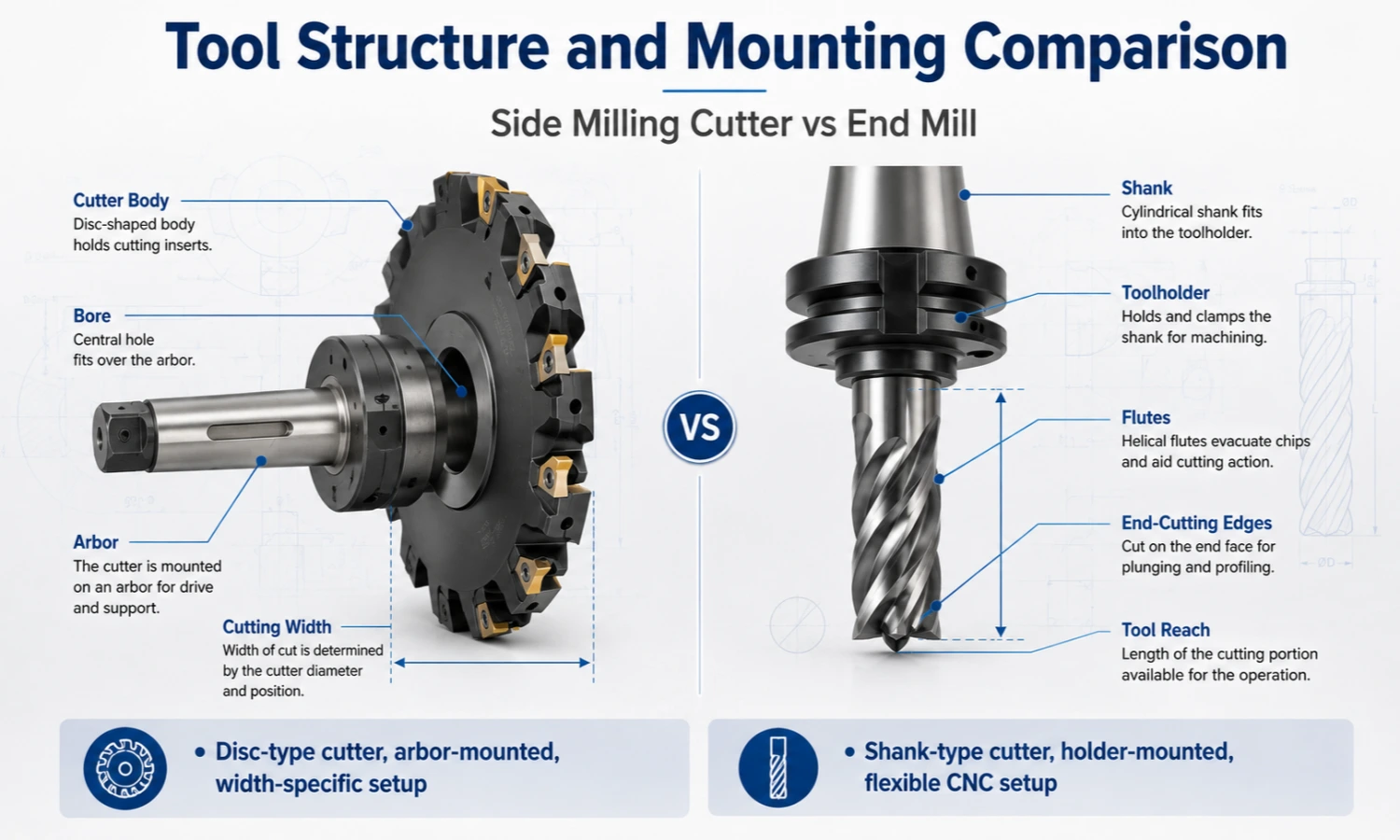
La diferencia más visible es la estructura del cortador..
Una fresa lateral típica tiene un cuerpo en forma de disco con un orificio central.. Se monta en un cenador u otra interfaz compatible.. Como resultado, diámetro del cortador, ancho de corte, tamaño del orificio, posición del cenador, y el espacio libre alrededor de la pieza de trabajo pueden afectar el acceso.
La gama de productos de fresas laterales de CutterBest incluye configuraciones indexables de tipo disco con cuerpos de fresa e inserciones de carburo reemplazables.. Aburrir, ancho de corte, disposición de inserción, y el montaje también se puede revisar de acuerdo con los requisitos de mecanizado reales.
Una fresa de extremo utiliza un vástago sostenido en un portaherramientas adecuado.. Dependiendo de la máquina y la aplicación, el sistema de sujeción puede utilizar una pinza, mandril hidráulico, soporte retráctil, mandril de fresado, u otra interfaz compatible.
Por lo tanto, Las fresas de mango montadas generalmente se adaptan más fácilmente a los flujos de trabajo de mecanizado CNC estándar.. Sin embargo, rigidez del soporte, sin, extensión de herramienta, y el estado del husillo aún influyen en la estabilidad del corte.
2. Ranuras abiertas versus ranuras cerradas: Acceso a herramientas
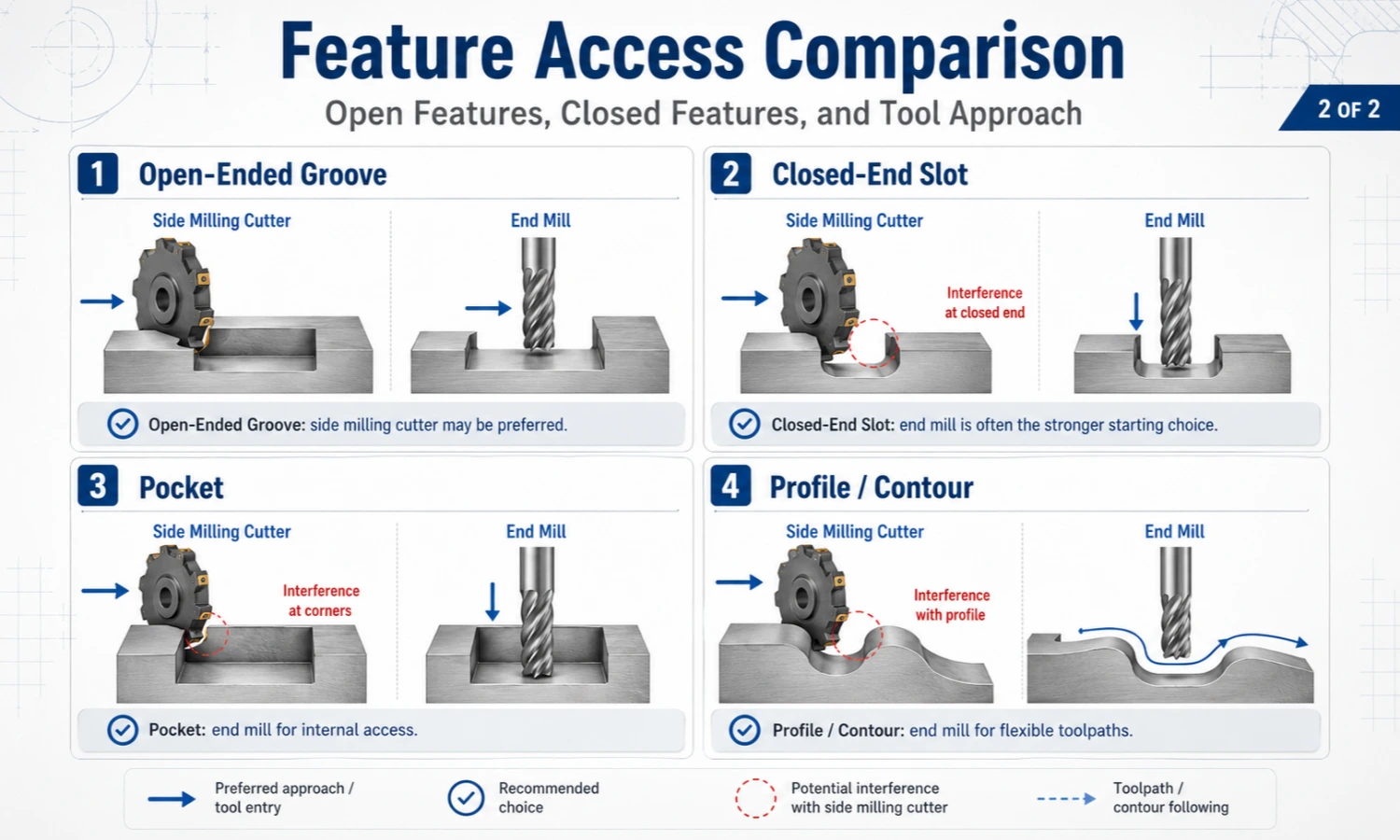
El acceso a la herramienta suele ser más importante que el nombre de la operación de mecanizado..
Para una ranura abierta o de acceso lateral, una fresa lateral de tipo disco puede ser una buena opción inicial. Sin embargo, el cuerpo del cortador y el eje necesitan suficiente espacio libre.
Una ranura abierta no requiere automáticamente un cortador lateral. Una fresa también puede resultar práctica cuando la configuración favorece el acceso vertical, la característica es relativamente accesible, o la misma herramienta debe realizar otras operaciones.
Las ranuras cerradas crean una condición de acceso diferente. Dependiendo de la función y la estrategia de entrada., La herramienta puede necesitar capacidad de corte de extremos o un método de entrada helicoidal o de rampa adecuado..
Por lo tanto, Una fresa de extremo es generalmente la opción inicial más sólida para ranuras de extremo cerrado y características cerradas cuando su geometría admite la estrategia de entrada y corte prevista.. La guía de fresado de ranuras de Sandvik distingue de manera similar las aplicaciones de ranura abierta para cortadores laterales y frontales de las aplicaciones de ranura cerrada que requieren una solución de fresado frontal..
3. Profundidad de corte, Alcanzar, Rigidez, y evacuación de virutas
Una cortadora de disco no debe describirse automáticamente como rígida, mientras que una fresa de mango se describe como flexible.. La rigidez depende del sistema de mecanizado completo..
Para una fresa lateral, factores importantes incluyen:
- diámetro del cortador;
- diámetro del eje y soporte;
- posición del cortador;
- sujeción de piezas;
- profundidad de la ranura;
- condición de la máquina;
- evacuación de viruta.
Para una fresadora, considerar:
- diámetro de la herramienta;
- longitud de la flauta;
- alcance general;
- tipo de soporte;
- saliente de la herramienta;
- cortar el compromiso;
- rigidez de la máquina y del accesorio.
Una fresa de mango larga con un saliente excesivo puede deformarse o vibrar.. Por otro lado, un eje mal apoyado o una configuración de disco de corte inadecuada también pueden perder estabilidad.
Por lo tanto, No se debe asignar automáticamente una ranura profunda o larga a ninguna de las herramientas.. Comparar acceso, alcanzar, soporte cortador, sujeción de piezas, y retirada de viruta antes de tomar la decisión. Saliente de herramienta, rigidez, fuerzas de corte, desviación, vibración, y la evacuación de viruta son consideraciones relevantes en el fresado de ranuras..
4. Estrategia de ancho de ranura, Control, y repetibilidad
El ancho de la ranura es un factor de selección importante, pero requiere una comparación cuidadosa.
Se puede seleccionar una fresa lateral con un ancho de corte adecuado al ancho de ranura deseado.. Dependiendo del diseño del cortador, el ancho puede ser fijo, ajustable, insertado configurado, basado en espaciador, o hecho según una especificación personalizada.
Sin embargo, El ancho ajustable no es una característica universal de todas las cortadoras de disco.. Los sistemas de fresado de ranuras montados en eje específicos están diseñados con anchos de corte ajustables, mientras que otras cortadoras utilizan una configuración fija o específica de la aplicación.
Con fresa, La característica se puede mecanizar en una sola pasada o con múltiples pasadas programadas., dependiendo del diámetro de la herramienta y del ancho de ranura requerido.
Las dimensiones finales también pueden verse afectadas por:
- sin;
- deflexión de la herramienta;
- desgaste de herramientas;
- posicionamiento de la máquina;
- sujeción de piezas;
- compensación del cortador.
Por lo tanto, El ancho del cortador no garantiza automáticamente la precisión de la ranura terminada..
Un cortador configurado alrededor del ancho objetivo puede simplificar el control del ancho en algunas operaciones repetidas.. Sin embargo, Ambos conceptos de herramientas pueden producir dimensiones controladas cuando todo el proceso de mecanizado es estable..
5. Características adjuntas, Bolsillos, Perfiles, y trayectorias complejas
Las fresas de extremo generalmente ofrecen mayor flexibilidad cuando la pieza contiene características cerradas o variadas..
Las operaciones típicas pueden incluir:
- ranuras cerradas;
- bolsas y cavidades;
- fresado lateral;
- Perfiles;
- contornear;
- características internas;
- múltiples operaciones compatibles en un programa CNC.
La página actual de End Mill de CutterBest también cubre el ranurado, Perfiles, embolsarse, fresado lateral, contornear, y acabado como operaciones típicas de fresado final.
Sin embargo, No todas las geometrías de las fresas ranuradoras son compatibles con todas las estrategias de corte.. Geometría de corte central, diseño de flauta, diámetro, longitud de corte, y las condiciones de mecanizado afectan si una fresa en particular puede hundirse, rampa, interpolar, o realizar cortes de ranura completa.
Para disponible fresa de extremo opciones, ver la página del producto correspondiente.
6. Flexibilidad de configuración, Repetibilidad del proceso, y necesidades de producción
Una configuración de fresado lateral dedicada se vuelve más atractiva cuando la misma ranura o característica lateral accesible se repite a lo largo de una tirada de producción y la configuración del cortador coincide con el ancho requerido., alcanzar, y acercarse.
En contraste, una fresadora puede ser más práctica cuando el programa CNC contiene varios tipos de características.
Por ejemplo, una herramienta adecuada puede realizar ranurados compatibles, fresado lateral, embolsarse, u operaciones de perfilado sin introducir otra configuración de corte dedicada.
Esta versatilidad es una de las razones por las que las fresas de mango se utilizan ampliamente en el mecanizado CNC general..
Sin embargo, Esto no significa que los cortadores laterales pertenezcan únicamente a la producción en masa o que las fresas de mango pertenezcan únicamente al trabajo de prototipo.. Cualquiera de las herramientas se puede utilizar en diferentes volúmenes de producción.. La mejor elección depende de si el trabajo se beneficia más de un proceso dedicado o de la flexibilidad del mecanizado..
¿Cuándo es una fresa lateral una buena opción inicial??
Repetido, Ranuras accesibles lateralmente con un ancho definido
Vale la pena considerar una fresa lateral cuando se puede acceder a una ranura desde el lateral y tiene un ancho objetivo claramente definido..
Esto se vuelve más relevante cuando la misma característica se repite en una tirada de producción porque la configuración del cortador se puede seleccionar según los requisitos de mecanizado..
Antes de elegir el cortador, controlar:
- acceso lateral;
- espacio libre del cuerpo de corte;
- limpieza del cenador;
- profundidad de corte;
- ancho requerido;
- configuración de la máquina.
Para disponible fresa lateral configuraciones, ver la página del producto correspondiente.
Características laterales y hombros accesibles
Los cortadores laterales de tipo disco y de lado y cara también pueden adaptarse a superficies laterales accesibles, espalda, y características de escalón cuando la geometría proporciona suficiente espacio de aproximación.
Sin embargo, El mecanizado en escuadra no es automáticamente una aplicación de corte lateral.. Fresas, fresas de escuadra indexables, y otros tipos de cortadores también pueden ser adecuados.
Por lo tanto, verifique la geometría de 90 grados requerida, alcanzar, estabilidad de la pared, requisito de acabado, y acceso al cortador antes de realizar la selección..
Operaciones de mecanizado dedicadas o repetidas
Una cortadora dedicada puede resultar más atractiva cuando una operación repetida se beneficia de un diámetro específico, ancho de corte, disposición de montaje, o geometría de corte.
En esta situación, la cuestión no es sólo si una fresa poder cortar la característica.
En cambio, Considere si un cortador dedicado puede hacer que todo el proceso de mecanizado sea más fácil de controlar..
Para cambio de piezas u operaciones ocasionales., la configuración adicional puede ofrecer poca ventaja. Para una característica repetida con geometría estable, sin embargo, una configuración dedicada puede merecer una revisión adicional.
¿Cuándo es una fresadora una buena opción inicial??
Ranuras cerradas, Bolsillos, y características internas
Una fresa de extremo es generalmente un punto de partida más sólido cuando el cortador debe trabajar dentro de una característica cerrada..
Una ranura de extremo cerrado requiere una estrategia de entrada adecuada y capacidad de corte de extremos. Un bolsillo requiere movimiento interno de la herramienta., mientras que otras características internas introducen restricciones adicionales de acceso e interferencia.
Esto a menudo hace que las fresas de mango montadas en mango sean más adaptables en configuraciones de centros de mecanizado CNC verticales..
Perfiles, Contornos, y geometría compleja
Las familias de fresas de extremo también brindan una amplia flexibilidad de trayectorias de herramientas para perfiles y contornos..
Un programa CNC puede guiar una fresa de ranurar alrededor de la geometría externa o interna en lugar de depender del enfoque de ancho fijo o acceso lateral de una cortadora de disco..
Diferentes geometrías de fresas de mango soportan diferentes requisitos de contorneado. Sin embargo, un molino de extremo plano, fresa de punta esférica, herramienta de nariz de toro, fresa cónica, y las fresas de largo alcance no realizan el mismo trabajo simplemente porque todas pertenecen a la familia de fresas escariadoras..
Mecanizado CNC flexible con múltiples operaciones
Una fresa de extremo resulta especialmente útil cuando una herramienta adecuada puede realizar varias operaciones compatibles y al mismo tiempo cumplir con los requisitos de mecanizado..
Por ejemplo, el proceso puede incluir:
- ranurado;
- fresado lateral;
- Perfiles;
- embolsarse.
En este caso, una fresadora puede reducir los cambios de herramientas dedicadas y simplificar el flujo de trabajo del CNC.
Esta flexibilidad es particularmente útil cuando la pieza contiene múltiples características en lugar de una ranura o característica lateral repetida..
Fresa lateral o fresa de extremo por tarea de mecanizado
Utilice la siguiente tabla como punto de partida práctico., no es una regla absoluta.
| Tarea de mecanizado | Elección inicial | Condición importante |
| Ranura cerrada | Molino de extremo | Requiere una estrategia adecuada de entrada y corte final. |
| Bolsillo o característica cerrada | Molino de extremo | Rutas de herramientas internas más flexibles |
| Perfil o contorno | Molino de extremo | Se adapta a trayectorias de contorno programadas |
| Abierto, ranura de acceso lateral | Puede ser preferible una fresa lateral | Confirmar la separación del eje, ancho, y acercarse |
| Ranura repetida con ancho objetivo controlado | Puede ser preferible una fresa lateral | Depende de la configuración y configuración del cortador. |
| Ranura general en trabajos CNC de funciones mixtas | Frecuentemente se prefiere la fresadora | Especialmente cuando se mecanizan también cajas o perfiles. |
| Superficie lateral o hombro | depende | Comprobar geometría, alcanzar, estabilidad de la pared, y terminar |
| Surco profundo o largo | depende | Comparar acceso, sobresalir, apoyo, rigidez, y evacuación de virutas |
| Geometría de ranura personalizada | depende | Se pueden considerar herramientas dedicadas si el proceso lo justifica. |
Si el requisito principal es una superficie amplia y plana o de referencia en lugar de una ranura, bolsillo, o característica lateral, la pregunta de selección cambia. Vea nuestra guía para fresado lateral vs fresado frontal por esa comparacion.
¿Puede una fresa de extremo reemplazar una fresa lateral??
A veces, pero no siempre.
Una fresa de extremo puede reemplazar una fresa lateral cuando puede alcanzar la característica, generar la geometría requerida, y cumplir con las dimensiones, estabilidad, finalizar, y requisitos de tiempo de ciclo.
Sin embargo, el reemplazo es una decisión de proceso, no sólo una decisión de geometría. En la práctica, La elección entre fresa lateral y fresa de extremo debe basarse en la configuración completa del mecanizado en lugar de en la profundidad de la ranura o el tipo de herramienta únicamente..
Considerar:
- ancho y profundidad de la ranura;
- acceso abierto o cerrado;
- alcance requerido;
- rigidez del eje o soporte;
- sujeción de piezas;
- evacuación de viruta;
- repetición de producción;
- otras operaciones en la misma parte.
Si una fresa de extremo requiere un alcance excesivo o una trayectoria de herramienta ineficiente, un cortador lateral dedicado puede merecer consideración. Por otro lado, si un cortador de disco crea problemas de acceso o agrega configuraciones innecesarias, la fresadora puede seguir siendo la solución más práctica.
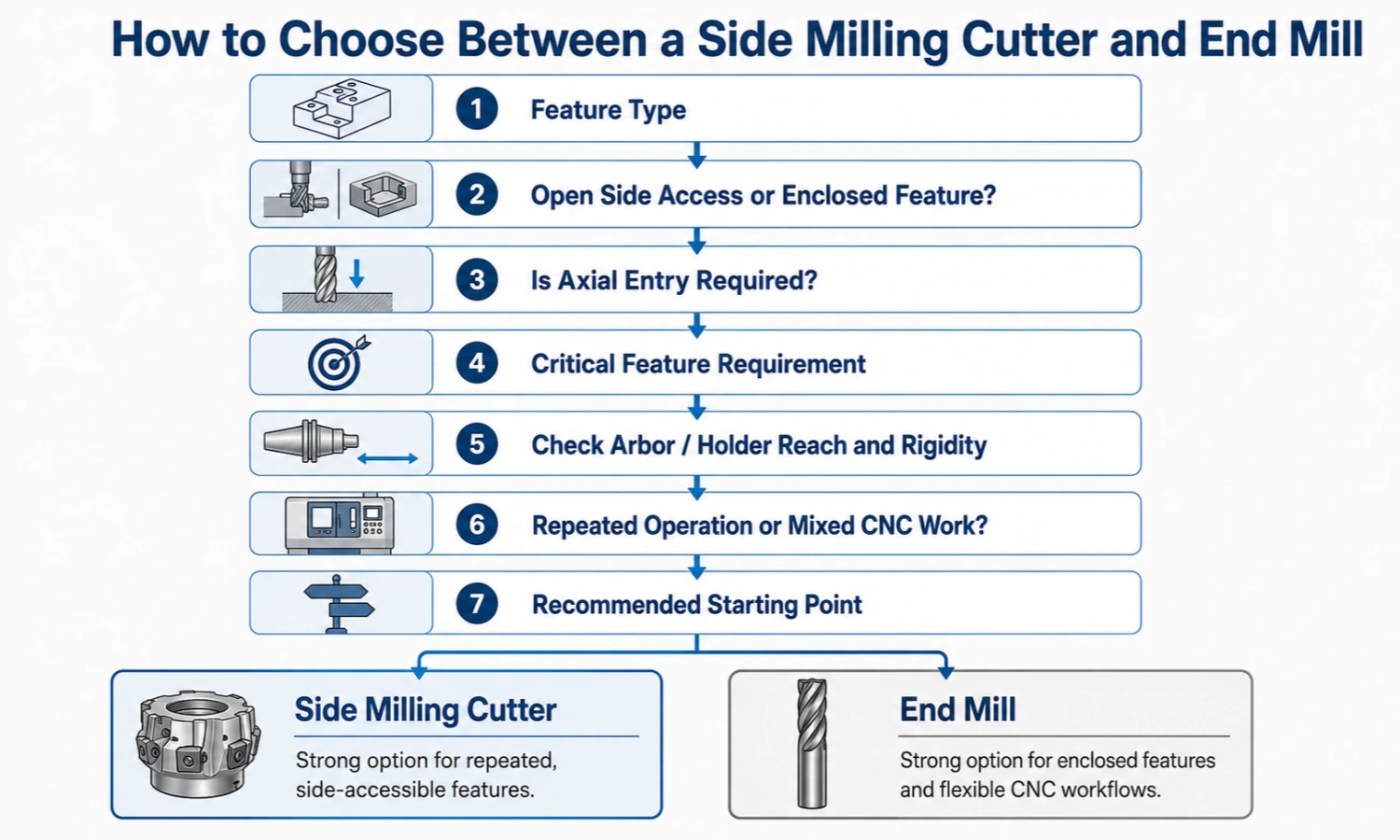
Cómo elegir entre una fresa lateral y una fresa de extremo
Paso 1: Identificar la característica
Empezar con el dibujo, no la herramienta.
¿Es la característica un surco abierto?, ranura cerrada, bolsillo, hombro, superficie lateral, o perfil?
La geometría característica ayuda inmediatamente a reducir las opciones de corte disponibles.
Paso 2: Verificar acceso a herramientas
Próximo, determinar cómo el cortador puede alcanzar físicamente la característica.
Preguntar:
- ¿Está disponible el acceso lateral??
- ¿Se requiere entrada axial??
- ¿Hay suficiente espacio para el cuerpo del cortador??
- ¿Hay suficiente espacio libre para el eje o el soporte??
- ¿El accesorio o la pieza de trabajo interferirá con el cortador??
Un cortador que no puede acercarse correctamente a la característica no es una opción práctica.
Paso 3: Identificar el requisito de característica crítica
No se centre en el tipo de herramienta antes de identificar lo que más importa en el dibujo..
El requisito crítico puede incluir:
- ancho de ranura;
- profundidad;
- geometría de la pared;
- condición de esquina;
- finalizar;
- alcance de la herramienta;
- repetibilidad;
- requisito de ciclo.
El concepto de fresa debe soportar la característica que controla la decisión de mecanizado..
Paso 4: Máquina de cheques, Portaherramientas, y rigidez
Evaluar el sistema de corte completo..
Para una fresa lateral, revisar el cenador, aburrir, posición del cortador, interfaz de la máquina, artículos fijos, y liquidación disponible.
Para una fresadora, tipo de titular de la reseña, sobresalir, longitud de corte, diámetro, condición del husillo, y sujeción de piezas.
En ambos casos, soporte estable y evacuación efectiva de virutas.
Paso 5: Considere la flexibilidad del mecanizado y la repetición de la producción
Finalmente, Considere cómo la operación se adapta al proceso de producción completo..
Si la misma característica de acceso lateral se repite a lo largo de una tirada de producción, una fresa lateral dedicada puede proporcionar una opción de proceso práctica.
Si la pieza cambia con frecuencia o una herramienta CNC necesita mecanizar varias características compatibles, una fresa de extremo puede ofrecer mayor flexibilidad.
La elección inicial debe ajustarse a la pieza completa., máquina, configuración, y requisitos de producción, no simplemente el cortador con la lista de aplicaciones más larga.
Preguntas más frecuentes
¿Se puede utilizar una fresa de extremo para fresado lateral??
Sí. Las fresas tienen bordes de corte periféricos y se usan comúnmente para fresado lateral.. Sin embargo, acoplamiento radial adecuado, alcance de la herramienta, rigidez del soporte, geometría de la flauta, y las condiciones de corte dependen de la aplicación.. Un voladizo excesivo o una configuración inestable pueden aumentar la deflexión y la vibración..
¿Puede una fresa de extremo reemplazar una fresa lateral??
A veces. Una fresa de extremo puede ser un reemplazo práctico cuando puede alcanzar la característica y cumplir con la geometría requerida., calidad, estabilidad, y tiempo de ciclo. Un cortador lateral dedicado aún puede tener sentido cuando se corta el ancho, acceso lateral, montaje, o una operación repetida crea un caso de proceso más fuerte.
¿Qué cortador es mejor para ranuras y bolsillos de extremo cerrado??
Una fresa de extremo es generalmente la opción inicial más sólida porque puede proporcionar el acceso axial e interno requerido cuando la geometría seleccionada admite la estrategia de entrada y corte deseada.. La elección final aún depende de la geometría de la característica., alcanzar, y condiciones de mecanizado.
¿Qué cortador es mejor para ranuras profundas o largas??
Eso depende. Comparar acceso a ranura, diámetro del cortador, alcance de la herramienta, soporte de árbol o soporte, rigidez de la máquina, sujeción de piezas, y evacuación de virutas. La profundidad de ranura por sí sola no es motivo suficiente para seleccionar un tipo de fresa automáticamente.
¿Una fresa lateral siempre proporciona una mejor precisión del ancho de la ranura??
No. Un cortador configurado alrededor del ancho objetivo puede simplificar el control del ancho en algunas aplicaciones., pero la precisión final aún depende del estado y el desgaste del cortador, montaje, sin, capacidad de la máquina, sujeción de piezas, deflexión de la herramienta, y condiciones de corte.
La elección entre una fresa lateral y una fresa de extremo comienza con la característica de la pieza y el acceso a las herramientas disponibles.. Si necesita ayuda para revisar una solicitud específica, envía tu dibujo, material de la pieza de trabajo, dimensiones de ranura o ranura, tolerancia, información de la máquina, y requisitos de producción para sales@cutterbest.com para una revisión de la selección de cortadores.