 Fresas de precisión,Herramientas de corte para el mecanizado CNC de todos los materiales

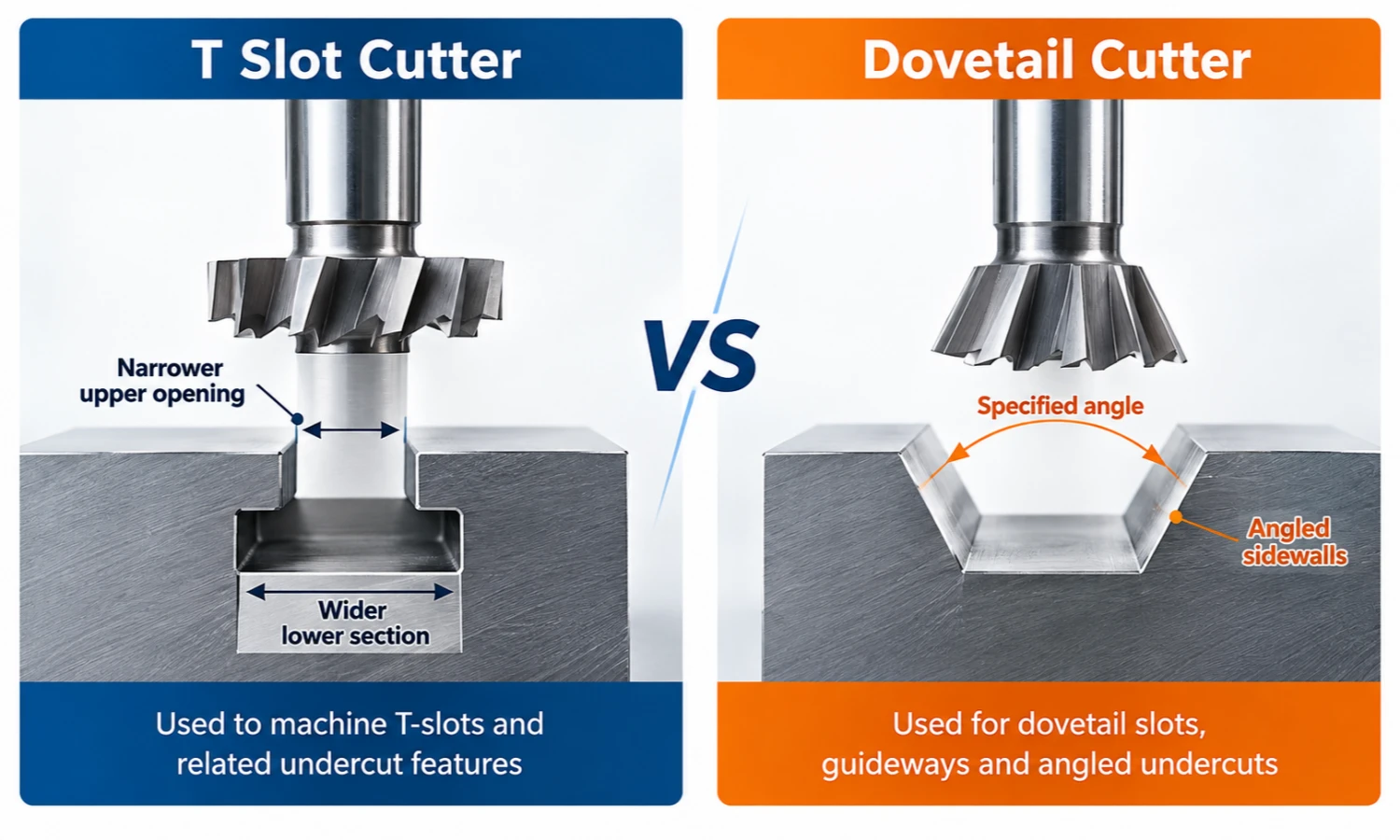
The T Slot Cutter vs Dovetail Cutter comparison starts with the finished profile. Both tools can machine undercut-type features, but they are designed around different geometries.
A conventional T-slot generally has a narrower upper opening with a wider lower section. A dovetail feature uses angled sidewalls that must match the required mating geometry and angle shown on the part drawing.
Debido a esta diferencia, the two cutters are not normally direct substitutes. A tool may be able to enter the machining area or remove material without producing the required finished profile.
The safest way to choose between them is to start with the finished cross-section, then check the angle definition, geometría del cortador, autorización, reach and entry path.
Cortador de ranura en T versus cortador de cola de milano: Comparación rápida
A T slot cutter is typically used to machine the wider lower section of a T-shaped slot after sufficient access has been prepared.
A dovetail cutter is used when the finished feature requires inclined sidewalls or another specified dovetail profile.
| Comparación | Cortador de ranura en T | Dovetail Cutter |
|---|---|---|
| Finished Profile | Wider lower undercut below a narrower opening | Angled or inclined dovetail profile |
| Aplicación típica | T-slots and related undercut features | Dovetail slots, guideways and angled undercuts |
| Diámetro del cortador | Must suit the required undercut geometry and available access | Must be checked together with angle, cutting dimensions and finished profile |
| Cutting Dimensions | Cutting width should be confirmed from the cutter drawing | Width, height or length-of-cut terminology should be confirmed from the cutter drawing |
| Angle Requirement | Normally not the defining feature of a conventional T-slot | A key part of the finished dovetail geometry |
| Neck / Acceso | Neck and entry clearance are important | Neck, relief, reach and cutter access may all need checking |
| Directly Interchangeable? | Normally no | Normally no |
How Dovetail Cutter Angles Are Defined
Angle is one of the most important differences between a dovetail cutter and a conventional T slot cutter.
For a dovetail feature, the cutter angle must correspond to the required inclined surfaces. Sin embargo, manufacturers do not always describe dovetail angles with the same catalog terminology.
Included Angle vs Angle Per Side
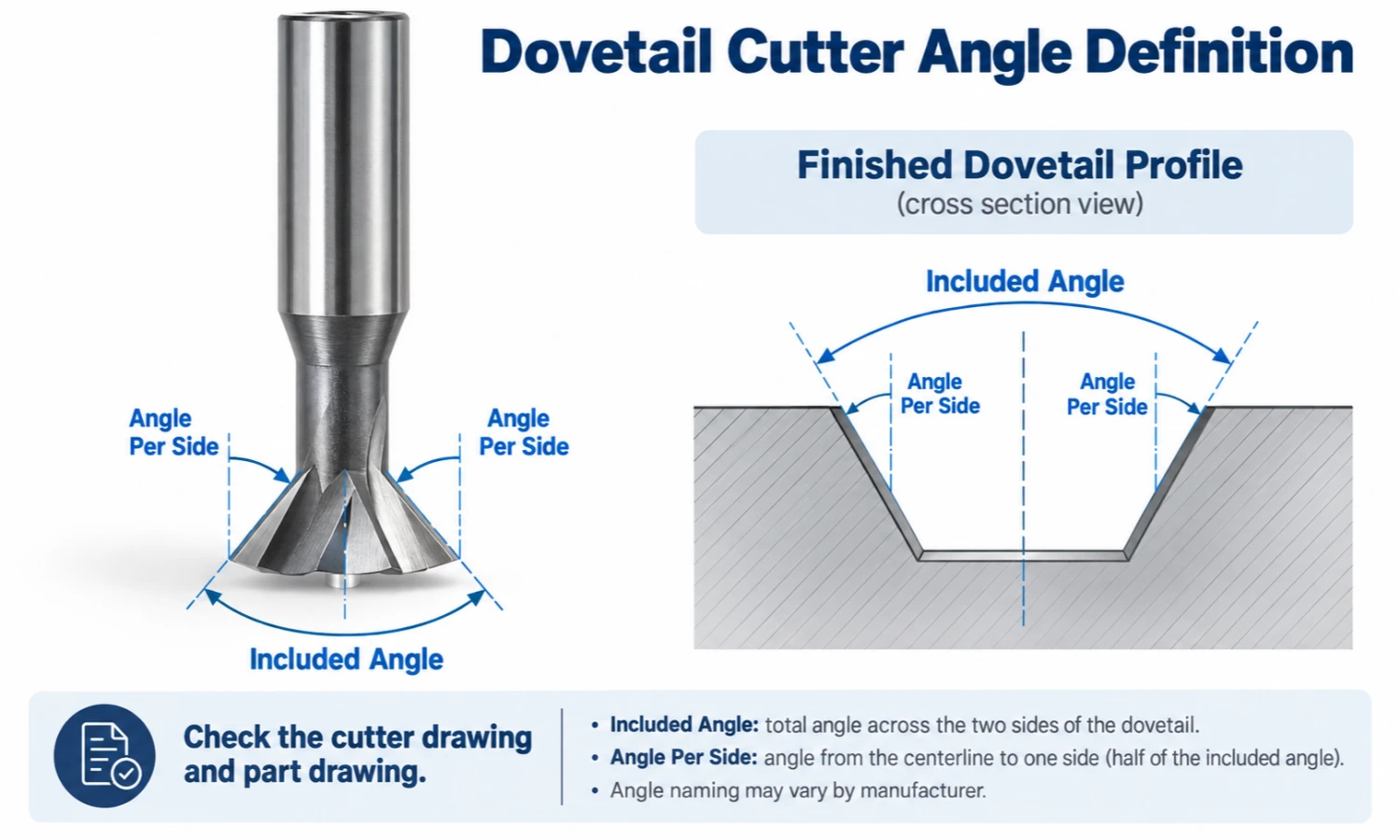
Manufacturers may describe a dovetail cutter by an included angle, an angle per side or another angle reference.
For a symmetric cutter using the appropriate convention, a 60° included angle corresponds mathematically to 30° per side. Sin embargo, apply this relationship only after confirming the reference lines used in the cutter drawing.
Do not assume that every cutter described as “60°” uses the same catalog definition.
Two catalogs may show different numbers while describing related geometric relationships. En cambio, the same angle number in two catalogs does not automatically prove that the cutters have identical cutting geometry.
Match the Cutter Angle to the Part Drawing
Start with the angle shown on the part drawing.
Then compare it with:
- the angle reference lines on the cutter drawing;
- the surfaces the cutter must generate;
- the intended tool orientation;
- the required mating profile;
- any relevant root or corner requirements.
A matching nominal angle is not enough if the reference surfaces or required profile differ.
For non-standard dovetail features, the cutter drawing should clearly show how the catalog angle relates to the required part geometry.
Geometría de la herramienta, Clearance and Access
After confirming the required profile and angle, check whether the cutter geometry can physically create and reach the feature.
Diameter alone is not enough.
Cutter Diameter and Cutting Dimensions
Diámetro del cortador, ancho de corte, cutting height and length of cut must be interpreted from the cutter drawing; the terms do not necessarily identify equivalent dimensions across product families.
Catalog terminology can also vary between manufacturers. Check the dimension arrows and identify whether a dimension is axial, radial or measured along another part of the cutting profile.
For a T-slot operation, cutter diameter and cutting width must work with the required lower undercut and planned toolpath.
For a dovetail feature, cutter diameter should be considered together with the specified angle, effective cutting height and finished profile.
The root or corner profile may also matter. A cutter with the correct nominal angle and an apparently suitable diameter can still be unsuitable if the resulting corner radius, root geometry or measurement position does not match the part drawing.
Do not apply a universal conversion between cutting width, cutting height or length of cut across different cutter families unless the cutter drawings clearly support it.
Neck Clearance and Reach
Neck geometry becomes important when the cutting head must reach behind, below or inside another feature.
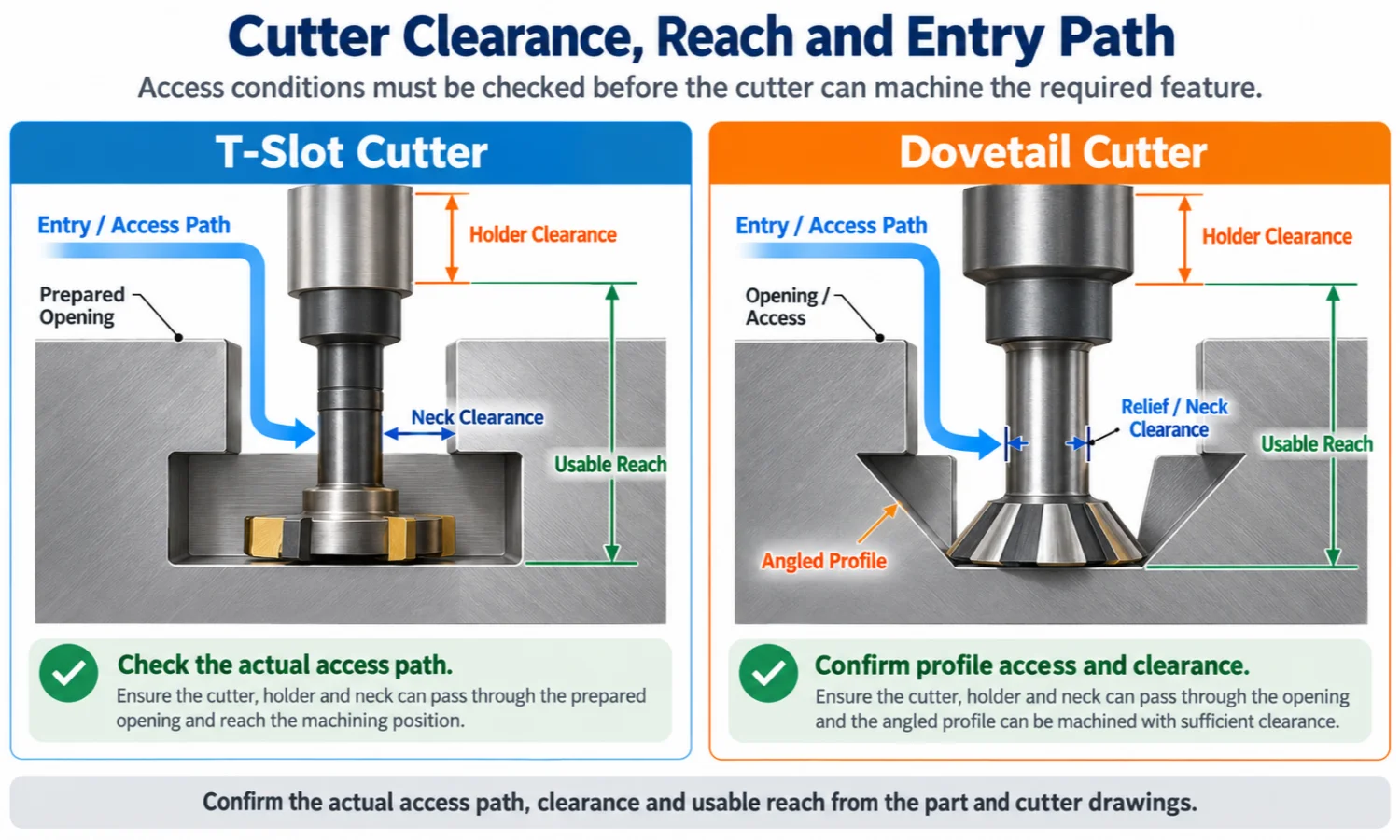
For T-slot milling, the neck may need to pass through a prepared opening while allowing the cutting head to reach the wider lower section.
For dovetail machining, the neck and relief geometry may also affect whether the cutter can reach the angled surfaces without rubbing or interference.
Important checks can include:
- diámetro del cuello;
- neck or relief geometry;
- alcance utilizable;
- workpiece clearance;
- shank and holder interference.
Do not treat overall tool length as the same thing as usable cutting reach.
Whenever possible, confirm these dimensions from the actual cutter drawing rather than estimating them from a product photograph.
For more background on the machining sequence and cutter access for T-slots, ver how T-slot milling works.
Can the Cutter Actually Enter the Feature?
A cutting head that fits inside the finished cavity does not automatically have a valid path into the machining position.
Depending on the part and cutter design, an internal T-slot or dovetail feature may require a preliminary opening or another machining step before the form cutter can reach the required surfaces.
Controlar:
- whether the available opening allows the cutting head to enter;
- whether sufficient clearance exists along the full entry and exit path;
- whether the cutter has enough reach and clearance at the actual machining position.
The exact machining sequence can vary with cutter design, part geometry and setup. One entry method should not be treated as a universal rule.
Are T-Slot and Dovetail Cutters Directly Interchangeable?
Generally, no.
This comparison refers to conventional cutter geometries used in their normal machining orientation. Custom profiles or different machining setups may require a separate drawing-based assessment.
The central principle is:
Removing material is not the same as producing the specified finished profile.
A cutter may remove material from the required area and still leave the wrong sidewall angle, shoulder geometry, root profile or final dimensions.
Can a Dovetail Cutter Be Used for a T-Slot?
A conventional dovetail cutter is generally not a direct substitute for a cutter intended to produce a specified T-slot profile.
A dovetail cutter is designed around angled cutting surfaces, while a conventional T-slot requires a different lower cross-section.
Depending on the setup, a dovetail cutter may be able to remove material in the same general area. That does not mean it can produce the required T-shaped finished profile.
If the cutter geometry does not match the required cross-section, condición de esquina, dimensions and tolerances, it should not be treated as a direct replacement.
Can a T-Slot Cutter Cut a Dovetail Slot?
The reverse situation requires the same caution.
A conventional T slot cutter may be able to remove material from an undercut area, but it is not normally designed to generate the specified inclined sidewalls of a dovetail profile.
The part may require a particular angle, cutting height, corner condition and mating geometry.
A cutter that can reach the feature is therefore not automatically suitable for finishing it.
If a special cutter or alternative setup is being considered, evaluate the cutter drawing, part drawing and intended setup rather than assuming interchangeability from visual similarity.
How to Choose Between a T Slot Cutter and a Dovetail Cutter
- Confirm the finished cross-section.
Determine whether the part requires a conventional T-shaped lower undercut, an angled dovetail profile or another custom geometry. - Confirm the angle definition where applicable.
For a dovetail feature, identify exactly how the angle is defined on the drawing. Do not select a cutter from an isolated angle number. - Check cutting dimensions, root profile and tolerances.
Compare the cutter diameter, effective cutting dimensions, corner or root geometry and critical tolerances with the part requirements. - Verify clearance, reach and the entry / exit path.
Make sure the cutting head, cuello, shank and holder can reach the feature without interference. - Compare the cutter drawing with the part drawing and intended setup.
This final check is especially important for non-standard features or custom tooling.
If the drawing calls for a conventional T-shaped undercut, review the available Cortador de ranura en T opciones.
If the feature requires inclined dovetail surfaces, review the Dovetail Cutter range and confirm the required angle definition before ordering.
Need Help Matching the Cutter to Your Drawing?
If you are deciding between a T slot cutter and a dovetail cutter, send us your part drawing, dimensioned sketch or section view.
Where available, Por favor envíe:
- your part drawing or sketch;
- key dimensions or required profile;
- material de la pieza de trabajo;
- any relevant machining or tool information.
We can review your requirements and help determine whether a standard T-slot cutter, a dovetail cutter or a drawing-based custom tool is appropriate before preparing a quotation.
Envía tu dibujo por correo electrónico, o contáctanos por WhatsApp for technical confirmation.