 Frese di precisione,Utensili da taglio per la lavorazione CNC di ogni materiale

Le fresatrici sono utensili da taglio per fresatrici e centri di lavoro CNC. Rimuovono il materiale dal metallo, plastica, grafite, and other workpieces to create slots, holes, profili, flat surfaces, threads, and 3D shapes.
Per gli acquirenti, engineers, and machinists, choosing the right milling tool is important. Di conseguenza, the correct cutter can improve surface finish, reduce tool wear, and make machining more stable.
Tuttavia, different tools have different shapes and functions. Perciò, this guide explains the most common milling machine tools, their names, their uses, and how to choose the right tool for different CNC milling operations.
What Are Milling Machine Tools?
Manufacturers use milling machine tools as rotary cutting tools for milling operations. These tools usually have one or more cutting edges. When the tool rotates, the cutting edges remove material from the workpiece.
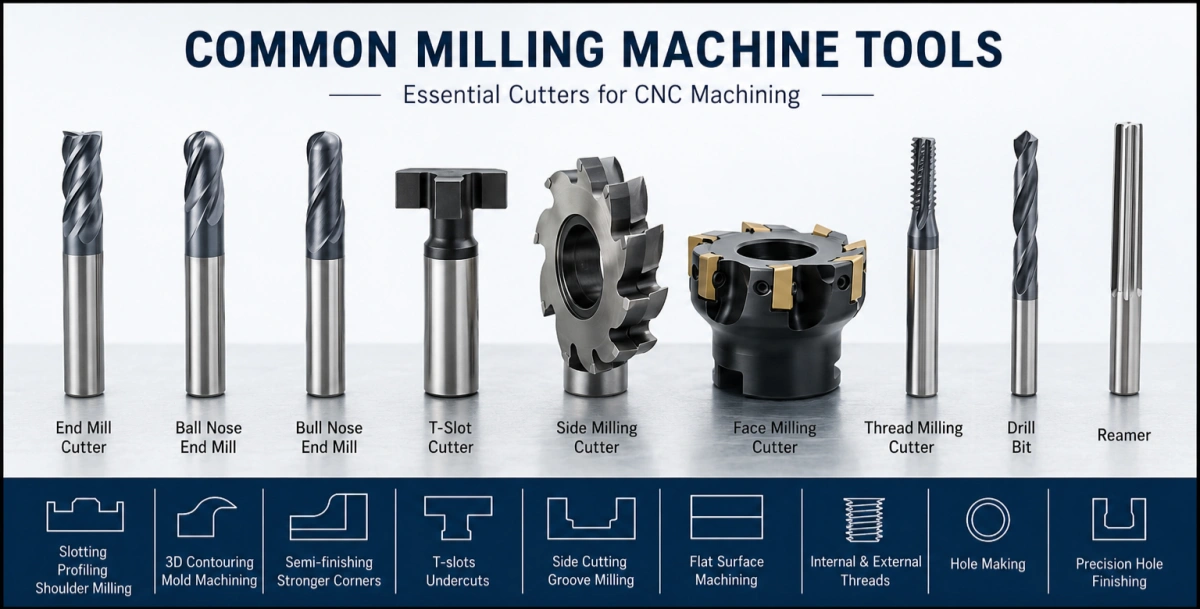
Many factories use these tools in mold making, produzione di macchinari, parti automobilistiche, parti aerospaziali, electronic components, and general metalworking. Common milling tools include end mills, frese per facciate, Frese a candela a testa sferica, bull nose end mills, Frese per scanalature a T, frese laterali, thread milling cutters, trapani, e alesatori.
In parole semplici, milling machine tools help manufacturers cut different shapes with accuracy, stabilità, and repeatability.
Common Milling Machine Tools Names and Uses
The table below shows common tools used in milling machines and their main applications. This section also helps users who search for “milling machine tools list”, “milling cutter types”, and “tools used in milling machine”.
| Milling Tool Name | Utilizzo principale | Applicazione comune |
|---|---|---|
| Fresa a candela | Scanalatura, profilazione, fresatura laterale | General CNC milling |
| Fresa a candela a testa sferica | 3D contouring and curved surfaces | Mold machining, die making |
| Fresa a punta di toro | Semi-finishing and stronger corners | Steel and stainless steel machining |
| Fresa per scanalature a T | T-slots and undercuts | Machine tables, infissi |
| Fresa laterale | Side cutting and groove milling | Slot, spalle, side surfaces |
| Face Milling | CutterFlat surface machining | Large surface finishing |
| Fresa per filettare | Internal and external threads | CNC thread machining |
| Punta | Hole making | Pre-drilling before milling |
| Reamer | Precision hole finishing | High-accuracy holes |
For general slotting, profilazione, e fresatura di spallamenti, many factories use an fresa a candela.
You can also check Frese CNC.for more CNC cutting tool options
Main Types of Milling Machine Tools
Frese a candela
End mill cutters are among the most common milling machine tools. They can cut from the side and the end of the tool. A causa di questo disegno, they are suitable for slotting, profilazione, contornatura, fresatura di tasche, e fresatura di spallamenti.
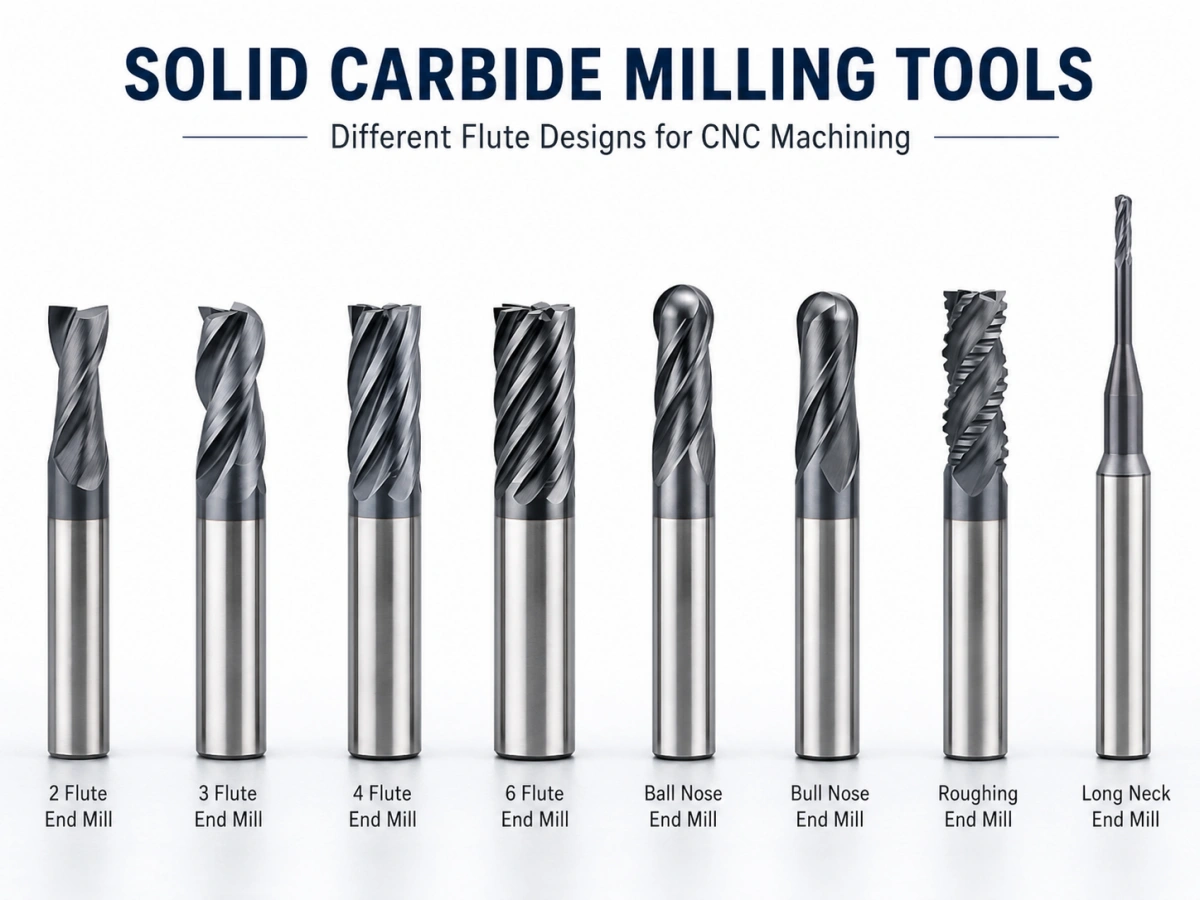
End mills are available in different flute numbers, rivestimenti, lunghezze, and materials. Per esempio, 2 flute end mills are often used for aluminum and soft materials because they offer better chip removal. Al contrario, 4 flute end mills are more suitable for steel and stainless steel because they provide stronger cutting stability.
For general CNC machining, an end mill cutter for CNC milling.is usually one of the first tools to consider.
Frese a candela a testa sferica
Ball nose end mills have a round cutting tip. This design makes them suitable for 3D surface machining, superfici curve, cavità dello stampo, and complex contours.
Mold shops often use ball nose end mills for die machining, graphite machining, and precision finishing. Rispetto alle frese a candela, ball nose tools can produce smoother curved surfaces. Tuttavia, they are not the best choice for sharp inside corners.
When machining 3D profiles and mold cavities, Frese a candela a testa sferica are a better choice.
Bull Nose End Mills
Bull nose end mills are also called corner radius end mills. They have a small radius on the cutting corner. This radius improves tool strength and reduces corner chipping.
Di conseguenza, bull nose end mills work well for semi-finishing, rough finishing, and machining materials such as steel and stainless steel. They are also a good choice when the tool needs more corner strength than a sharp flat end mill.
For stronger corner cutting and semi-finishing, Vedere fresa a candela a testa tonda.
T-Slot Cutters
T-slot cutters cut T-shaped slots in machine tables, infissi, molds, and clamping systems. This tool usually works after a straight slot has already been made.
Primo, an end mill opens the slot. Poi, the T-slot cutter creates the wider undercut area. Perciò, you should not use a T-slot cutter as the first tool for opening a straight slot.
For slot and undercut machining, you can use a Taglierina per scanalature a T.
Side Milling Cutters
Side milling cutters cut grooves, slot, and side surfaces. They remove material from the side of the workpiece and help machine wider or deeper grooves.
In molti casi, factories use these cutters for general machinery, mold parts, and metal component production. They are suitable when the cutting operation needs stable side cutting.
For groove and side surface machining, Vedere fresa laterale.
Utensili da taglio in metallo duro integrale
Solid carbide cutting tools are widely used in modern CNC machining. Carbide has higher hardness and better wear resistance than high-speed steel. Perciò, it supports higher cutting speeds and longer tool life.
Many manufacturers choose solid carbide tools for steel, acciaio inossidabile, ghisa, alluminio, rame, grafite, e materiali induriti. Inoltre, coatings can improve heat resistance and wear resistance.
For high-precision CNC machining, you can choose utensili da taglio in metallo duro integrale.
How to Choose Milling Machine Tools by Operation
Different milling operations need different tool designs. Perciò, you should choose the tool based on the cutting task first.
| Operazione di lavorazione | Strumento consigliato | Reason |
|---|---|---|
| Scanalatura | End mill cutter | Good for straight slots and pockets |
| Fresatura laterale | End mill or side milling cutter | Stable side cutting |
| 3Lavorazione della superficie D | Fresa a punta sferica | Smooth curved surface cutting |
| Semifinitura | Fresa a punta toro | Stronger cutting corner |
| T-slot machining | Taglierina per scanalature a T | Creates T-shaped slots |
| Graphite machining | Diamond-coated end mill | Migliore resistenza all'usura |
For Slotting
End mills are usually the most common choice for slotting. Un 2 flute end mill is useful for aluminum and other soft materials because it has more chip space. Nel frattempo, UN 4 flute end mill is better for steel when higher stability is needed.
For aluminum and slotting, Vedere 2 fresa a candela a flauto.
For Side Milling and Profiling
When you need side milling, choose an end mill with good rigidity and a suitable flute length. If the workpiece material is harder, coated carbide end mills can improve tool life.
Per la lavorazione dell'acciaio, Vedere 4 fresa a candela a flauto.
For 3D Surface Machining
For 3D surfaces, profili curvi, e cavità dello stampo, ball nose end mills are more suitable. Their round tip can follow complex tool paths and produce smooth surfaces.
For mold and 3D surface machining, Vedere Frese a candela a testa sferica.
For T-Slot Machining
Use a T-slot cutter for T-slots and undercuts. Tuttavia, do not use it for the first straight slot. Primo, use an end mill to make the opening. Poi, use the T-slot cutter to finish the special shape.
For undercut machining, Vedere Taglierina per scanalature a T.
For Graphite and Abrasive Materials
Graphite and other abrasive materials can wear normal tools quickly. Per questo motivo, many graphite machining shops choose diamond-coated tools because they improve wear resistance and keep the cutting edge sharper for longer.
Per la lavorazione della grafite, scegliere frese con rivestimento diamantato.
How to Choose Milling Tools by Material
Inoltre, material is one of the most important factors when choosing milling machine tools. A tool that works well for aluminum may not work well for stainless steel or graphite.
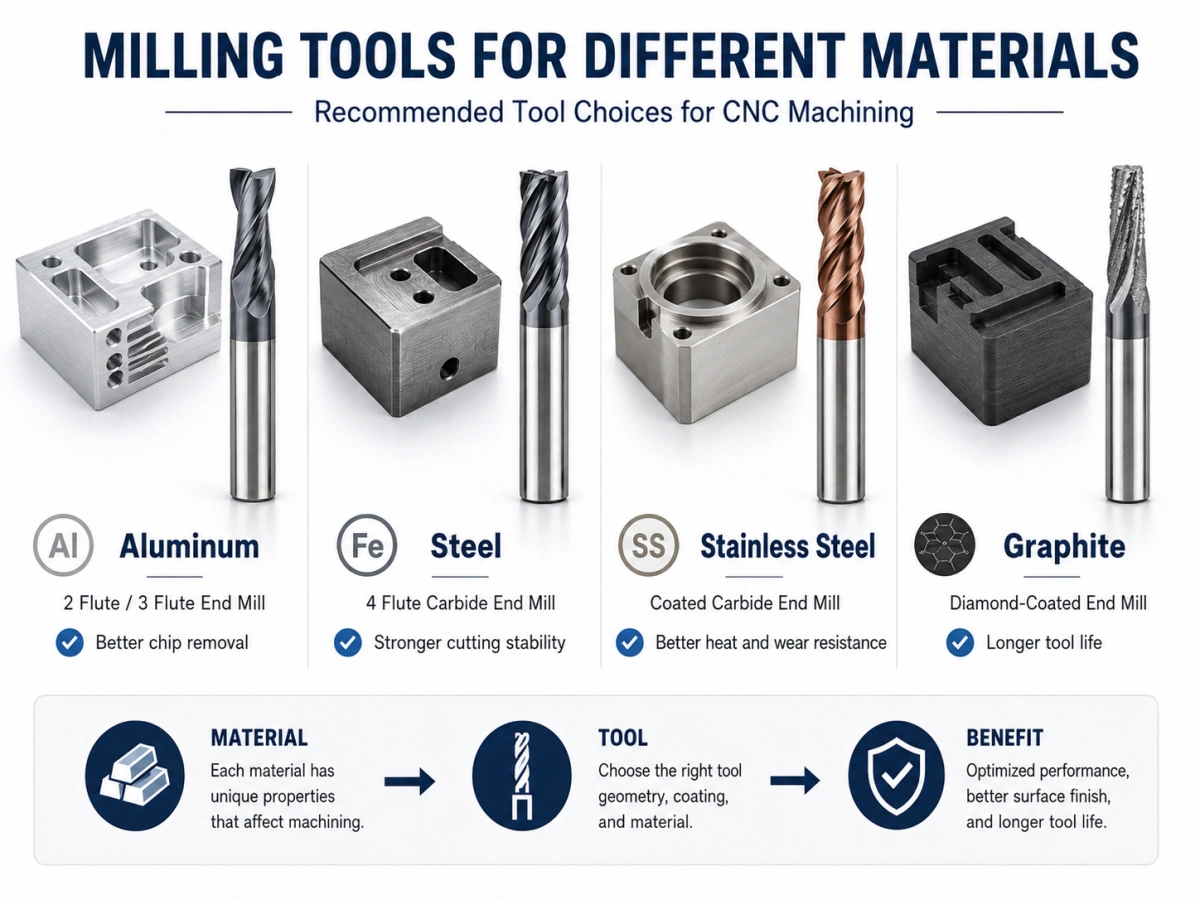
| Materiale del pezzo | Scelta dello strumento suggerito | Main Reason |
| Alluminio | 2 flauto o 3 fresa a candela a flauto | Better chip removal |
| Acciaio | 4 fresa in metallo duro con scanalatura | Stronger cutting stability |
| Acciaio inossidabile | Coated carbide end mill | Better heat and wear resistance |
| Grafite | Diamond-coated end mill | Longer tool life |
| Acciaio temprato | High-performance coated carbide tool | Higher hardness and rigidity |
Alluminio
L'alluminio è morbido, but it can stick to the cutting edge if chip removal is poor. Per questo motivo, tools with fewer flutes and polished flutes are often preferred. Un 2 flauto o 3 flute end mill can help remove chips smoothly.
Acciaio
Steel needs stronger cutting edges and better tool rigidity. In molti casi, 4 flute carbide end mills are suitable for steel milling. Coated tools can also improve heat resistance and tool life.
Acciaio inossidabile
Stainless steel is more difficult to machine because it can generate heat and work harden. Perciò, you need a sharp carbide tool, bloccaggio stabile, and a suitable coating. Proper cutting parameters are also important.
Grafite
Graphite is abrasive, so tool wear is a major problem. Diamond-coated end mills are often used because they provide better wear resistance and longer tool life.
Acciaio temprato
For hardened steel, tool hardness, rivestimento, disegno del flauto, and rigidity are very important. High-performance carbide end mills or special coated tools are usually required.
Milling Machine Tools Selection Checklist
Before choosing milling machine tools, check the points below. This can help reduce wrong tool selection and improve machining efficiency.
| Punto di selezione | Cosa controllare |
| Materiale del pezzo | Alluminio, acciaio, acciaio inossidabile, grafite, acciaio temprato |
| Operazione di lavorazione | Scanalatura, profilazione, sgrossatura, finitura, trivellazione, threading |
| Materiale dello strumento | HSS, carburo, carburo rivestito, diamond-coated carbide |
| Numero di flauto | 2 flauto, 3 flauto, 4 flauto, 6 flauto |
| Rivestimento | TiAlN, Altin, DLC, rivestimento diamantato |
| Dimensione dello strumento | Diametro, lunghezza del flauto, diametro del gambo, lunghezza complessiva |
| Condizioni della macchina | CNC rigidity, velocità del mandrino, tool holding |
| Requisito di superficie | Sgrossatura, semifinitura, finitura |
Perciò, a correct tool choice should match the material, operazione di taglio, condizione della macchina, e requisiti di finitura superficiale. It is better not to choose a milling cutter only by price. In molti casi, a more suitable cutter can reduce tool wear, improve surface finish, and lower the total machining cost.
FAQ About Milling Machine Tools
What are the different types of tools used in milling machines?
Common tools used in milling machines include end mills, Frese a candela a testa sferica, bull nose end mills, frese per facciate, Frese per scanalature a T, frese laterali, thread milling cutters, drill bits, e alesatori. Each tool has a different shape and cutting purpose.
What is the most common milling machine tool?
The end mill cutter is one of the most common milling machine tools. It can be used for slotting, fresatura laterale, profilazione, fresatura di tasche, e contornatura.
For general CNC milling, puoi controllare il nostro fresa a candela.
Which milling tool is used for slots?
End mills are commonly used for straight slots. For T-shaped slots, a T-slot cutter is needed after the first slot is opened.
For T-slot machining, Vedere Taglierina per scanalature a T.
How do I choose a milling cutter for CNC machining?
Primo, check the material you need to cut. Poi, confirm the machining operation, such as slotting, sgrossatura, finitura, or 3D contouring. Dopo di che, choose the correct tool type, numero di flauto, rivestimento, and size.
If you are not sure, you can send the material, disegno, dimensione dell'utensile, and machining requirement to the tool supplier for advice.
Conclusione
Milling machine tools include many cutter types, such as end mills, Frese a candela a testa sferica, bull nose end mills, Frese per scanalature a T, frese laterali, and carbide cutting tools. Each tool has a different function, so the right choice depends on the material, metodo di lavorazione, finitura superficiale, e requisito di produzione.
If you need custom milling cutters for CNC machining, Cutterbest can support different tool types, sizes, rivestimenti, and application requirements.
For common CNC milling applications, start with our Frese CNC.
For general slotting and profiling, visualizza il nostro fresa a candela.
For graphite and abrasive materials, scegliere frese con rivestimento diamantato.