 Frese di precisione,Utensili da taglio per la lavorazione CNC di ogni materiale

An end mill cutter is a rotating cutting tool used in CNC milling to remove material from the end and side of a workpiece. It can machine slots, tasche, profili, side walls, superfici curve, and finishing features in materials such as aluminum, acciaio, acciaio inossidabile, rame, e plastica.
In questa guida, you will learn what an end mill cutter is, how it differs from a drill bit, what it does in CNC milling, common cutter types, basic specifications, and how to choose the right tool for different machining applications.
What Is an End Mill Cutter?
An end mill cutter is a rotary cutting tool used on CNC machines and milling machines. It rotates at high speed while the tool or workpiece moves along a controlled path to remove material.
The main difference between an end mill cutter and many other tools is its cutting geometry. Most end mills have cutting edges on the end and along the sides. Perciò, they can cut vertically and laterally. This makes them suitable for slotting, fresatura laterale, profilazione, fresatura di tasche, contornatura, e rifinitura.
Manufacturers commonly make end mill cutters from high-speed steel or solid carbide. Tuttavia, many CNC machine shops choose solid carbide tools because they offer better rigidity, higher wear resistance, and more stable cutting performance.
If you need standard or custom tools for production machining, puoi anche visitare il nostro end mill cutter product page.
Main Parts of an End Mill Cutter
Although end mill cutters come in different shapes and designs, most tools include several basic parts. Understanding these parts helps buyers choose the right cutter for their material, machine, e obiettivo della lavorazione.
| Part | Function | Perché è importante |
| Cutting edges | Remove material from the workpiece | Affect cutting efficiency and surface finish |
| Flauti | Help evacuate chips during machining | Influence chip removal, rigidità, e stabilità al taglio |
| Tool tip | Defines the end geometry of the cutter | Affects slotting, contornatura, finitura, and corner strength |
| Gamba | Held by the tool holder or spindle | Must match the holder for stable clamping |
| Rivestimento | Protects the cutting edge during machining | Improves wear resistance, resistenza al calore, e la durata dell'utensile |
Cutting Edges
The cutting edges are the working part of the tool. They remove material during milling and directly affect cutting performance, accuracy, e finitura superficiale.
Flauti
Flutes are the grooves along the body of the cutter. They help remove chips from the cutting area. Inoltre, flute design affects rigidity, heat control, e stabilità al taglio.
Tool Tip
The tool tip design depends on the cutter type. Some end mills have flat ends, while others have ball nose, raggio d'angolo, or tapered geometry. Di conseguenza, different tip designs are used for different machining tasks.
Gamba
The shank is the part held by the tool holder or spindle. Its diameter must match the holder correctly. Otherwise, vibrazione, poor accuracy, or tool runout may occur.
Rivestimento
Many end mill cutters use coatings such as TiAlN, Altin, TiSiN, Stagno, DLC, or Nano blue coating. The right coating can improve heat resistance, reduce wear, and extend tool life.
End Mill Cutter vs Drill Bit
Many beginners confuse an end mill cutter with a drill bit. Tuttavia, they are designed for different machining purposes.
A drill bit mainly cuts in the axial direction to create round holes. Al contrario, an end mill cutter can cut both axially and laterally. Perciò, it can machine slots, tasche, contorni, profili, side walls, and finished surfaces.
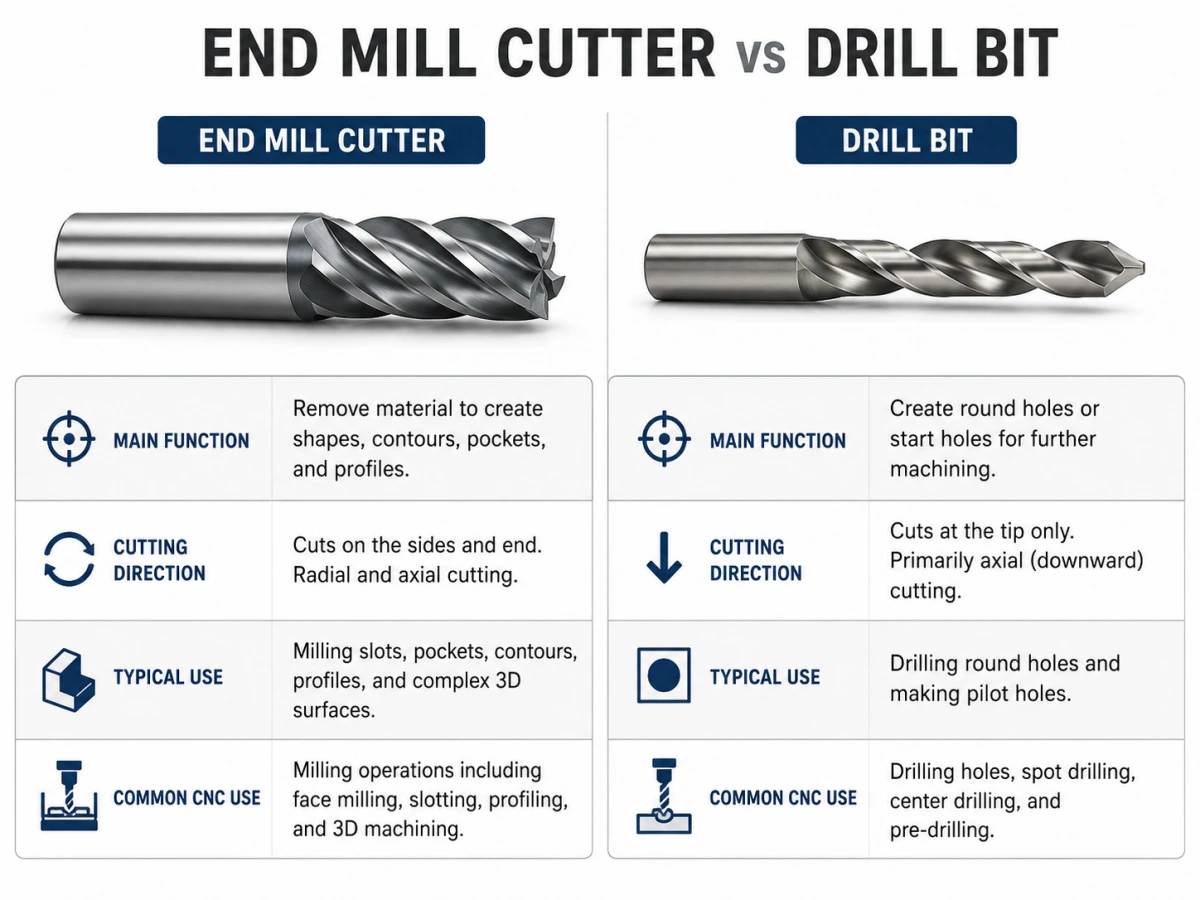
| Caratteristica | Fresa a candela | Punta |
| Main function | Fresatura, scanalatura, profilazione, taglio laterale | Drilling holes |
| Direzione di taglio | Axial and lateral | Mainly axial |
| Utilizzo tipico | Slot, tasche, contorni, side walls | Round holes |
| Tool flexibility | Higher | Lower |
| Common CNC use | General milling operations | Hole-making operations |
Insomma, both tools remove material, but they are not interchangeable in most machining situations. A center-cutting end mill can plunge in some applications, but it is still not the same as a standard drill bit.
Common Types of End Mill Cutters
There are many types of end mill cutters, and each design has a specific purpose. Choosing the right type helps improve cutting efficiency, qualità della superficie, e la durata dell'utensile.
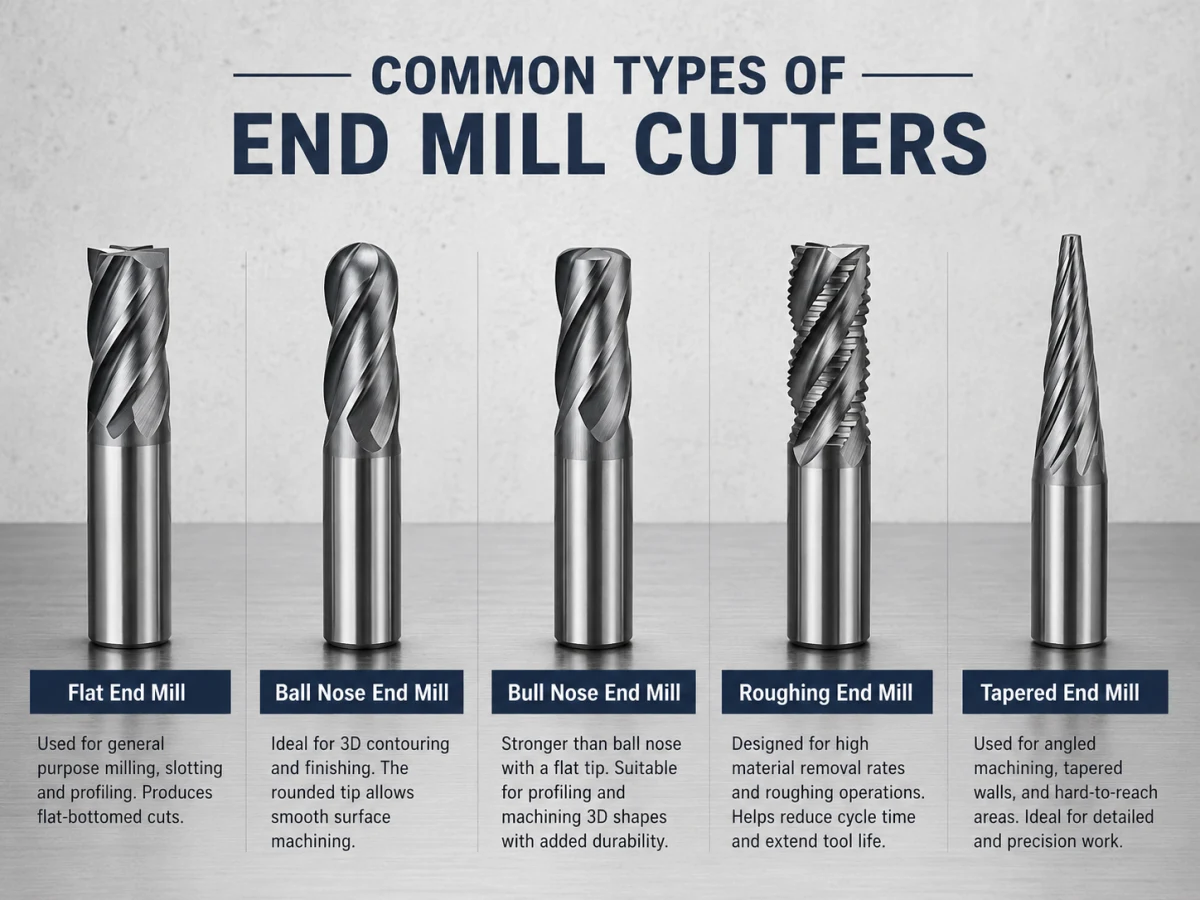
Fresa a testa piatta
A flat end mill has a flat cutting end. It is widely used for slotting, fresatura laterale, fresatura di spallamenti, and general-purpose machining.
Fresa a candela a testa sferica
A ball nose end mill has a rounded cutting end. It is commonly used for 3D contouring, lavorazione degli stampi, superfici curve, e operazioni di finitura.
For curved surface machining and mold work, puoi anche visionare il nostro Frese a candela a testa sferica.
Fresa a punta di toro
A bull nose end mill, also called a corner radius end mill, combines a flat bottom with rounded corners. It improves edge strength and helps create smoother transitions.
For stronger corner geometry, vedi il nostro fresa a candela a testa tonda.
Fresa per sgrossatura
A roughing end mill is designed for aggressive material removal. It is often used before finishing to remove large amounts of stock quickly.
For heavy stock removal, puoi controllare il nostro frese per sgrossatura.
Fresa conica
A tapered end mill has a gradually changing diameter. It is used for angled walls, deep cavities, lavorazione degli stampi, and special profiles.
For mold cavities and angled machining, visita il nostro Fresa conica.
For a more detailed comparison of tool geometries, leggi il nostro end mill cutter types guide.
What Is an End Mill Cutter Used For?
End mill cutters are used in many CNC milling operations. Because they can cut from the end and the side, they are suitable for both simple and complex machining tasks.
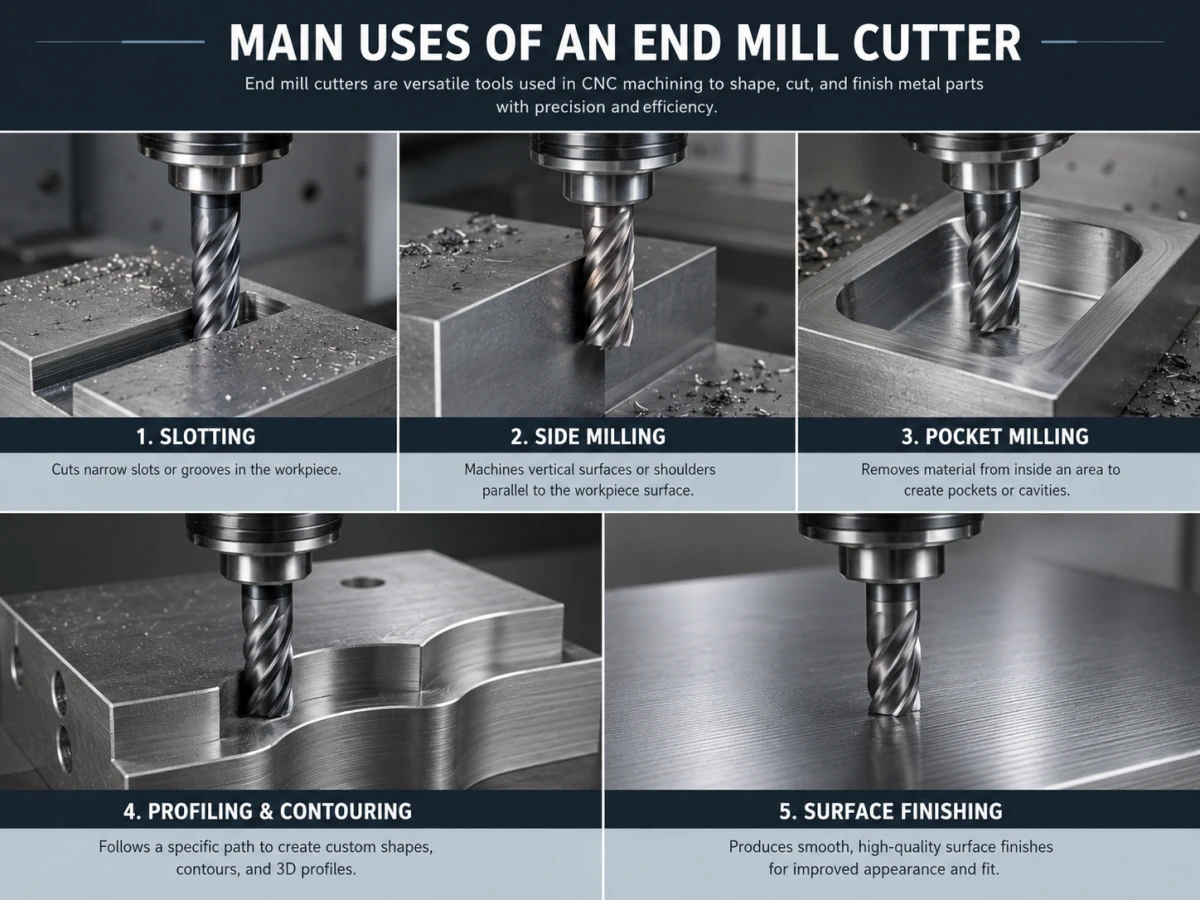
Scanalatura
Slotting is one of the most common applications. An end mill cutter can cut straight or curved slots into a workpiece with good accuracy. These slots can create keyways, scanalature, guide tracks, and assembly features.
For softer materials such as aluminum, chip evacuation is important. Perciò, machinists often select 2 flute tools when the workpiece needs better chip removal.
Side Milling
Side milling uses the side cutting edges of the tool to remove material from the vertical surface of a workpiece. This operation is useful for machining shoulders, passi, and side walls.
Machine shops commonly use side milling for precision parts, componenti dello stampo, tooling parts, and general CNC production.
Profiling and Contouring
Machinists also use end mill cutters for profiling and contouring. These operations create complex shapes, curved paths, and external or internal profiles.
Machinists often select ball nose and corner radius tools for this kind of work because these tools can improve surface transitions and finishing quality.
Fresatura di tasche
Pocket milling removes material from a closed or recessed area inside a workpiece. This operation is common in parts that need internal cavities, weight reduction, or precise material removal within a limited area.
Good chip control, stable tool paths, and the correct cutter geometry are important for this process.
Surface Finishing
After rough machining, an end mill cutter can also be used for finishing. The goal is to improve dimensional accuracy and surface smoothness.
Finishing tools are selected according to tolerance, materiale del pezzo, machine stability, e la qualità della superficie richiesta.
Step Milling and Shoulder Machining
End mill cutters can machine stepped surfaces, spalle, and multi-level features. These features often require sharp transitions, taglio stabile, and accurate dimensions.
Di conseguenza, rigidità dell'utensile, disegno del flauto, and coating selection are important.
End Mill Cutter Uses for Aluminum, Acciaio, and Stainless Steel
Different workpiece materials require different cutter designs. Perciò, buyers should match the end mill cutter to the material and machining condition.
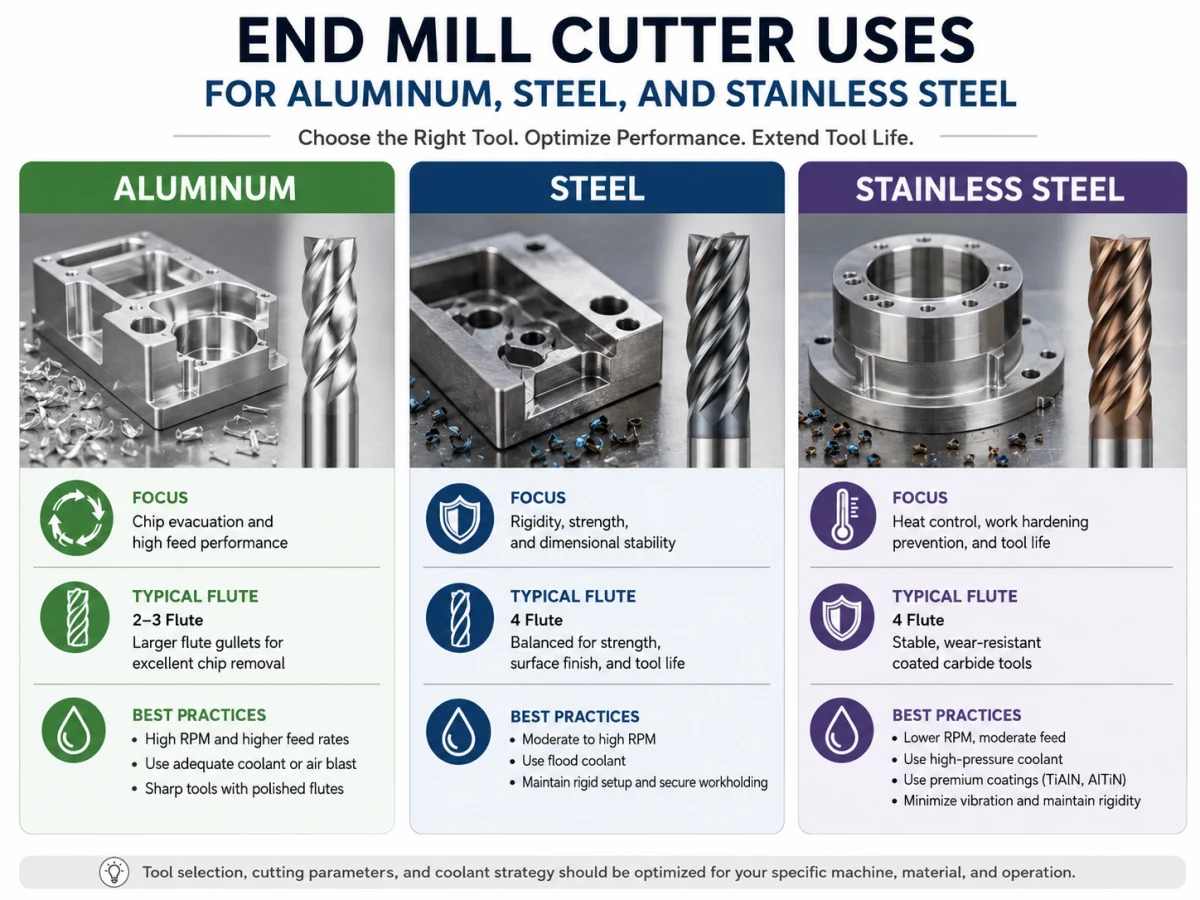
| Materiale del pezzo | Common Cutter Choice | Main Reason |
| Alluminio | 2 flauto o 3 fresa in metallo duro con scanalatura | Better chip evacuation and smooth cutting |
| Acciaio | 4 flute carbide end mill with suitable coating | Migliore rigidità e resistenza all'usura |
| Acciaio inossidabile | Coated carbide end mill with stable geometry | Better heat control and edge protection |
| Rame e ottone | Sharp edge carbide end mill | Clean cutting and reduced burrs |
| Plastica | Sharp, polished flute cutter | Smooth chip removal and lower melting risk |
End Mill Cutter for Aluminum
When machining aluminum, end mill cutters are used for slotting, fresatura di tasche, fresatura laterale, e rifinitura. Aluminum produces larger chips, so tools with fewer flutes and good chip evacuation are often preferred.
High-helix carbide end mills are also common for aluminum because they help improve cutting smoothness and reduce chip buildup.
For aluminum and non-ferrous materials, you can compare flute options on our 2 fresa a candela a flauto E 3 fresa a candela a flauto pages.
End Mill Cutter for Steel
For carbon steel and alloy steel, end mill cutters are often used for side milling, contornatura, shoulder machining, and semi-finishing. Steel usually requires better rigidity and stronger wear resistance.
In molti casi, 4 flute carbide end mills are selected for steel and general-purpose metal machining.
Per la lavorazione dell'acciaio, puoi visionare il nostro 4 fresa a candela a flauto.
End Mill Cutter for Stainless Steel
Stainless steel is more difficult to machine because it generates heat and tends to cause tool wear. In stainless steel applications, end mill cutters are commonly used for profiling, finitura, and controlled side milling.
The right coating, flute geometry, and cutting parameters help maintain cutting stability and reduce edge wear.
How to Choose a Basic End Mill Cutter
Choosing an end mill cutter does not need to be complicated. Tuttavia, buyers should check several factors before ordering.
Materiale del pezzo
The workpiece material is one of the most important factors. Alluminio, acciaio, acciaio inossidabile, rame, ottone, plastica, and cast iron may require different flute designs, rivestimenti, and cutting strategies.
Conte di flauto
Il conteggio delle scanalature influisce sull'evacuazione del truciolo, rigidità, and cutting efficiency. Per esempio, machinists often use 2 flute tools for aluminum, while they commonly choose 4 flute tools for steel and general-purpose machining.
For a deeper comparison, leggi il nostro 2 flauto contro 4 guida della fresa per flauto.
Materiale dello strumento
Many CNC machine shops choose solid carbide end mill cutters because they provide higher rigidity, better wear resistance, and stable performance. Some workshops still use HSS tools for lower-speed or general machining applications.
Rivestimento
The coating should match the material and machining condition. Per esempio, machinists often choose TiAlN and AlTiN coatings for steel, while DLC coating may suit aluminum and non-ferrous materials.
Required Finish
For roughing operations, the main goal is higher material removal. Tuttavia, for finishing work, surface quality and dimensional accuracy become more important.
Basic Specifications to Check Before Buying
Before placing an order, buyers should confirm several key specifications. This helps avoid tool mismatch and improves machining stability.
Diametro taglierina
Cutter diameter affects cutting width, rigidità, and the size of the machined feature.
Lunghezza del flauto
Flute length determines how deep the cutter can machine. Tuttavia, a longer flute may reduce rigidity, so it should match the actual cutting depth.
Lunghezza totale
Overall length affects tool reach and vibration control. A longer tool may be needed for deep cavities, but it should be used carefully to reduce chatter.
Diametro del gambo
Shank diameter must match the holder correctly. Stable clamping helps improve accuracy and tool life.
Corner Geometry
Piatto, naso a palla, raggio d'angolo, and tapered geometries are used for different machining goals. Perciò, corner geometry should match the part shape and required finish.
Tipo di rivestimento
The coating should be selected according to the workpiece material, velocità di taglio, condizione del liquido di raffreddamento, and tool life requirement.
Why Solid Carbide End Mill Cutters Are Common in CNC Milling
Solid carbide end mill cutters are popular because they offer strong rigidity, high hardness, and good wear resistance. They can support higher cutting speeds and provide more stable performance than many standard tool materials.
In production machining, many shops use carbide tools for steel, acciaio inossidabile, ghisa, alluminio, and other demanding materials. Inoltre, the right geometry and coating can improve machining consistency.
Industrial buyers, distributori, and machine shops often prefer carbide tools because they help reduce tool changes and support more stable production.
For standard and custom carbide tools, you can visit our carbide end mill cutter pape.
When Do You Need a Custom End Mill Cutter?
A standard cutter can solve many common machining tasks.
Tuttavia, you may need custom tooling when the part has a special profile, deep cavity, unusual material, strict tolerance, or non-standard size requirement.
Manufacturers can design custom end mill cutters with special diameter, lunghezza del flauto, lunghezza complessiva, raggio d'angolo, rivestimento, dimensione del gambo, e geometria dell'utensile.
For drawing-based or OEM tooling, visita il nostro custom end mills pape.
Domande frequenti
Cos'è una fresa a candela?
An end mill cutter is a rotary cutting tool used for CNC milling operations such as slotting, fresatura laterale, profilazione, contornatura, fresatura di tasche, e rifinitura.
What is an end mill cutter used for?
It is used to remove material from the end and side of a workpiece. Common applications include slots, tasche, side walls, profili, spalle, superfici curve, and finished surfaces.
What is the difference between an end mill cutter and a drill bit?
A drill bit mainly cuts holes in the axial direction. An end mill cutter can cut axially and laterally, so it can perform more milling operations such as slotting, profilazione, and side milling.
What are the common types of end mill cutters?
Common types include flat end mills, Frese a candela a testa sferica, bull nose end mills, frese per sgrossatura, tapered end mills, 2 frese per flauto, 3 frese per flauto, 4 frese per flauto, E 6 frese per flauto.
How do I choose a basic end mill cutter?
You should check the workpiece material, conteggio dei flauti, diametro della fresa, lunghezza del flauto, lunghezza complessiva, diametro del gambo, tool material, rivestimento, e la finitura superficiale richiesta.
Are carbide end mill cutters better than HSS end mills?
Carbide end mill cutters usually provide better rigidity, resistenza all'usura, e stabilità al taglio. Tuttavia, the best choice depends on the machine, materiale del pezzo, velocità di taglio, and budget.
Conclusione
An end mill cutter is a versatile CNC milling tool used for slotting, fresatura laterale, fresatura di tasche, profilazione, contornatura, shoulder machining, e rifinitura. Because it can cut from both the end and the side, it is more flexible than many basic cutting tools.
Per scegliere la taglierina giusta, buyers should understand the tool structure, tipo di taglierina, conteggio dei flauti, materiale, rivestimento, diametro, lunghezza del flauto, e applicazione di lavorazione. Once these factors are matched correctly, the cutter can provide better cutting efficiency, longer tool life, and more stable machining results.
Looking for a reliable end mill cutter manufacturer for aluminum, acciaio, acciaio inossidabile, or custom CNC machining?
Esplora il nostro end mill cutter product page for standard and OEM solutions, or contact us with your drawing and application requirements.