 Frese di precisione,Utensili da taglio per la lavorazione CNC di ogni materiale

UN fresa laterale vs fresa frontale decision is not simply about which tool can cut a slot. Both tools can machine some overlapping features, but neither is automatically the better choice.
In questa guida, a side milling cutter mainly refers to a disc-type side or side-and-face cutter with bore or arbor mounting. It does not simply mean an end mill performing a side-milling toolpath.
The practical choice depends on feature access, required width, profondità di taglio, portata, machine and toolholding rigidity, and whether the job needs a dedicated operation or a flexible multi-operation CNC process.
Fresa laterale vs fresa frontale: Confronto rapido
Use this table as a starting point rather than an absolute selection rule.
| Fattore | Fresa laterale | Fresa a candela |
|---|---|---|
| Typical structure | Disc-type cutter | Shank-type cutter |
| Typical mounting | Bore / arbor mounting | End mill toolholder |
| Typical strengths | Accessible grooves, slot, spalle, and side features | Slot, tasche, profili, contorni, and mixed features |
| Enclosed-feature access | Depends strongly on side access and cutter clearance | Generally more adaptable |
| Closed-end slots | Usually limited by access and cutter geometry | Often the stronger starting choice |
| Width strategy | Fixed, selezionato, adjustable, or custom depending on design | Tool diameter plus programmed toolpath and compensation |
| Setup flexibility | More dependent on cutter and arbor arrangement | Generally easier in mixed CNC workflows |
| Starting point | Dedicated, side-accessible feature | General or mixed-feature CNC machining |
When comparing a side milling cutter vs end mill, larghezza della scanalatura, profondità, lunghezza, accesso, condizioni della macchina, and operation frequency all affect the decision. Side-and-face cutters and end mills therefore have overlapping applications rather than a simple “better or worse” relationship.
Fresa laterale vs fresa frontale: Differenze chiave
1. Tool Structure and Mounting
The most visible difference is the cutter structure.
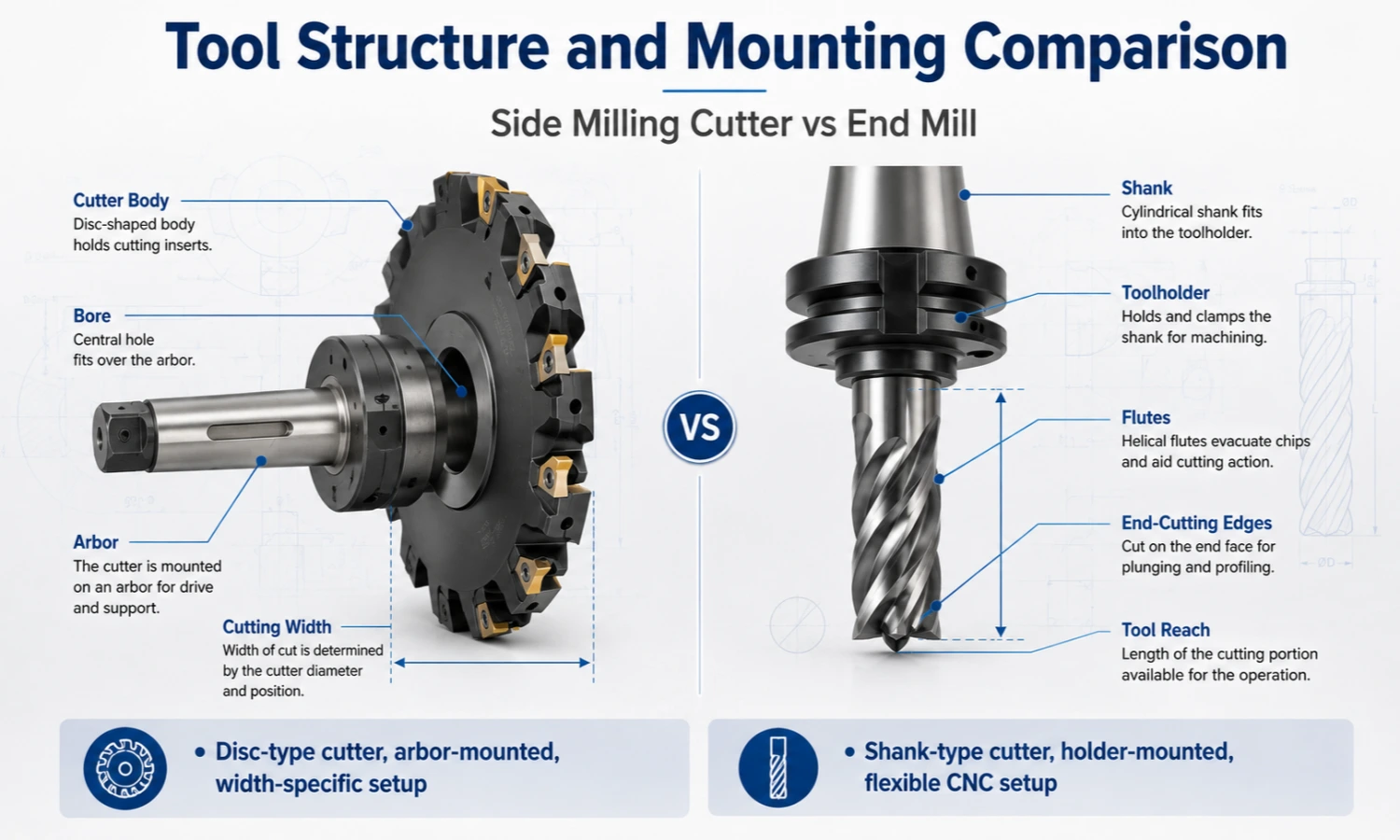
A typical side milling cutter has a disc-shaped body with a central bore. It mounts on an arbor or another compatible interface. Di conseguenza, diametro della fresa, larghezza di taglio, bore size, arbor position, and clearance around the workpiece can all affect access.
CutterBest’s Side Milling Cutter product range includes disc-type indexable configurations with cutter bodies and replaceable carbide inserts. Bore, larghezza di taglio, insert arrangement, and mounting can also be reviewed according to the actual machining requirement.
An end mill uses a shank held in a suitable toolholder. Depending on the machine and application, the holding system may use a collet, mandrino idraulico, supporto termoretraibile, milling chuck, or another compatible interface.
Perciò, shank-mounted end mills generally fit standard CNC machining workflows more readily. Tuttavia, rigidità del supporto, esaurire, tool extension, and spindle condition still influence cutting stability.
2. Open-Ended Grooves vs Closed-End Slots: Tool Access
Tool access is often more important than the name of the machining operation.
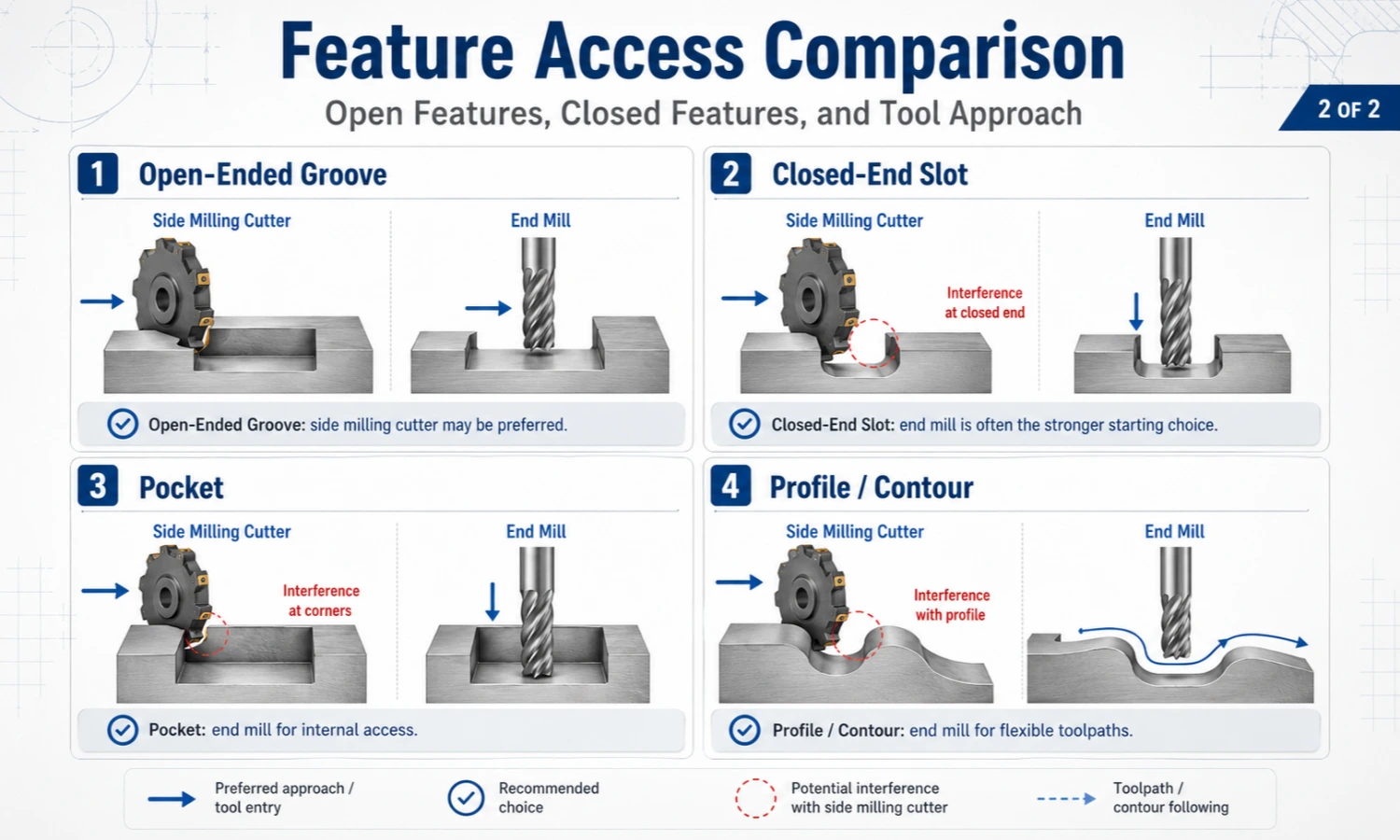
For an open-ended or side-accessible groove, a disc-type side milling cutter may be a strong starting option. Tuttavia, the cutter body and arbor need sufficient clearance.
An open groove does not automatically require a side cutter. An end mill can also be practical when the setup favors vertical access, the feature is relatively accessible, or the same tool must perform other operations.
Closed-end slots create a different access condition. Depending on the feature and entry strategy, the tool may need end-cutting capability or a suitable ramping or helical-entry method.
Perciò, an end mill is generally the stronger starting choice for closed-end slots and enclosed features when its geometry supports the intended entry and cutting strategy. Sandvik’s groove-milling guidance similarly distinguishes open-slot applications for side-and-face cutters from closed-slot applications that require an end-milling solution.
3. Profondità di taglio, Portata, Rigidità, and Chip Evacuation
A disc cutter should not automatically be described as rigid while an end mill is described as flexible. Rigidity depends on the complete machining system.
For a side milling cutter, important factors include:
- diametro della fresa;
- arbor diameter and support;
- cutter position;
- tenuta del lavoro;
- groove depth;
- condizione della macchina;
- evacuazione truciolo.
For an end mill, considerare:
- diametro dell'utensile;
- lunghezza del flauto;
- portata complessiva;
- holder type;
- sporgenza dell'utensile;
- taglio dell'impegno;
- machine and fixture rigidity.
A long end mill with excessive overhang can deflect or vibrate. On the other hand, a poorly supported arbor or unsuitable disc-cutter setup can also lose stability.
Perciò, a deep or long groove should not automatically be assigned to either tool. Compare access, portata, cutter support, tenuta del lavoro, and chip removal before making the decision. Sporgenza dell'utensile, rigidità, forze di taglio, deflessione, vibrazione, and chip evacuation are all relevant considerations in slot milling.
4. Groove Width Strategy, Control, and Repeatability
Groove width is an important selection factor, but it requires careful comparison.
A side milling cutter can be selected with a cutting width suited to the target groove width. Depending on the cutter design, the width may be fixed, adjustable, insert-configured, spacer-based, or made to a custom specification.
Tuttavia, adjustable width is not a universal feature of every disc cutter. Specific arbor-mounted slot-milling systems are designed with adjustable cutting widths, while other cutters use a fixed or application-specific configuration.
With an end mill, the feature may be machined in one pass or with multiple programmed passes, depending on tool diameter and required slot width.
Final dimensions can also be affected by:
- esaurire;
- deflessione dell'utensile;
- usura degli utensili;
- machine positioning;
- tenuta del lavoro;
- cutter compensation.
Perciò, cutter width does not automatically guarantee finished groove accuracy.
A cutter configured around the target width can simplify width control in some repeated operations. Tuttavia, both tool concepts can produce controlled dimensions when the complete machining process is stable.
5. Enclosed Features, Tasche, Profiles, and Complex Toolpaths
End mills generally offer greater flexibility when the part contains enclosed or varied features.
Typical operations can include:
- closed-end slots;
- tasche e cavità;
- fresatura laterale;
- profilazione;
- contornatura;
- internal features;
- multiple compatible operations in one CNC program.
CutterBest’s current End Mill page also covers slotting, profilazione, intascare, fresatura laterale, contornatura, and finishing as typical end-milling operations.
Tuttavia, not every end mill geometry supports every cutting strategy. Geometria a taglio centrale, disegno del flauto, diametro, lunghezza di taglio, and machining conditions affect whether a particular end mill can plunge, ramp, interpolate, or perform full-slot cutting.
For available fresa a candela opzioni, see the relevant product page.
6. Setup Flexibility, Process Repeatability, and Production Needs
A dedicated side-milling setup becomes more attractive when the same accessible groove or side feature repeats across a production run and the cutter configuration matches the required width, portata, and approach.
Al contrario, an end mill may be more practical when the CNC program contains several feature types.
Per esempio, one suitable tool may perform compatible slotting, fresatura laterale, intascare, o operazioni di profilatura senza introdurre un'altra configurazione di fresa dedicata.
Questa versatilità è uno dei motivi per cui le frese a candela sono ampiamente utilizzate nella lavorazione CNC generale.
Tuttavia, ciò non significa che le frese laterali appartengano solo alla produzione di massa o che le frese a candela appartengano solo al lavoro di prototipi. Entrambi gli strumenti possono essere utilizzati in diversi volumi di produzione. La scelta migliore dipende dal fatto che il lavoro tragga maggiore beneficio da un processo dedicato o dalla flessibilità di lavorazione.
Quando una fresa laterale è una buona scelta di partenza?
Ripetuto, Scanalature accessibili lateralmente con larghezza definita
Vale la pena prendere in considerazione una fresa per contornatura quando una scanalatura è accessibile lateralmente e ha una larghezza target chiaramente definita.
This becomes more relevant when the same feature repeats across a production run because the cutter configuration can be selected around the machining requirement.
Before choosing the cutter, controllo:
- side access;
- cutter-body clearance;
- arbor clearance;
- profondità di taglio;
- required width;
- configurazione della macchina.
For available fresa laterale configurations, see the relevant product page.
Accessible Side Features and Shoulders
Disc-type side and side-and-face cutters can also suit accessible side surfaces, spalle, and step features when the geometry provides enough approach space.
Tuttavia, shoulder machining is not automatically a side-cutter application. Frese, indexable shoulder mills, and other cutter types may also be suitable.
Perciò, check the required 90-degree geometry, portata, stabilità della parete, finish requirement, and cutter access before making the selection.
Dedicated or Repeated Machining Operations
A dedicated cutter may become more attractive when a repeated operation benefits from a specific diameter, larghezza di taglio, disposizione di montaggio, or cutter geometry.
In questa situazione, the question is not only whether an end mill Potere cut the feature.
Invece, consider whether a dedicated cutter can make the complete machining process easier to control.
For changing parts or occasional operations, the additional setup may offer little advantage. For a repeated feature with stable geometry, Tuttavia, a dedicated configuration may deserve further review.
When Is an End Mill a Strong Starting Choice?
Closed-End Slots, Tasche, and Internal Features
An end mill is generally a stronger starting point when the cutter must work inside an enclosed feature.
A closed-end slot requires a suitable entry strategy and end-cutting capability. A pocket requires internal tool movement, while other internal features introduce additional access and interference restrictions.
This often makes shank-mounted end mills more adaptable in vertical CNC machining-center setups.
Profiles, Contorni, and Complex Geometry
End mill families also provide broad toolpath flexibility for profiles and contours.
A CNC program can guide an end mill around external or internal geometry rather than relying on a disc cutter’s fixed-width or side-access approach.
Different end mill geometries support different contouring requirements. Tuttavia, a flat end mill, fresa a punta sferica, bull nose tool, tapered end mill, and long-reach cutter do not perform the same job simply because they all belong to the end mill family.
Flexible CNC Machining With Multiple Operations
An end mill becomes especially useful when one suitable tool can perform several compatible operations while still meeting the machining requirement.
Per esempio, the process may include:
- scanalatura;
- fresatura laterale;
- profilazione;
- intascare.
In questo caso, an end mill may reduce dedicated tool changes and simplify the CNC workflow.
This flexibility is particularly useful when the part contains multiple features rather than one repeated groove or side feature.
Side Milling Cutter or End Mill by Machining Task
Use the following table as a practical starting point, not an absolute rule.
| Machining Task | Starting Choice | Condizione importante |
| Closed-end slot | Fresa | Requires a suitable entry and end-cutting strategy |
| Pocket or enclosed feature | Fresa | More flexible internal toolpaths |
| Profile or contour | Fresa | Suits programmed contour paths |
| Aprire, side-accessible groove | Side milling cutter may be preferred | Confirm arbor clearance, width, and approach |
| Repeated groove with controlled target width | Side milling cutter may be preferred | Depends on cutter configuration and setup |
| General slot in mixed-feature CNC work | End mill often preferred | Especially when also machining pockets or profiles |
| Side surface or shoulder | Depends | Check geometry, portata, stabilità della parete, and finish |
| Deep or long groove | Depends | Compare access, sporgenza, support, rigidità, ed evacuazione truciolo |
| Custom groove geometry | Depends | Dedicated tooling may be considered if the process justifies it |
If the main requirement is a broad flat or datum surface rather than a groove, tasca, or side feature, the selection question changes. See our guide to fresatura laterale vs fresatura frontale for that comparison.
Can an End Mill Replace a Side Milling Cutter?
Sometimes, but not always.
An end mill can replace a side milling cutter when it can reach the feature, generate the required geometry, and meet the dimensional, stabilità, fine, and cycle-time requirements.
Tuttavia, replacement is a process decision, not only a geometry decision. In pratica, the side milling cutter vs end mill choice should be based on the complete machining setup rather than groove depth or tool type alone.
Considerare:
- groove width and depth;
- open or enclosed access;
- portata richiesta;
- arbor or holder rigidity;
- tenuta del lavoro;
- evacuazione truciolo;
- production repetition;
- other operations on the same part.
If an end mill requires excessive reach or an inefficient toolpath, a dedicated side cutter may deserve consideration. On the other hand, if a disc cutter creates access problems or adds unnecessary setup, the end mill may remain the more practical solution.
How to Choose Between a Side Milling Cutter and End Mill
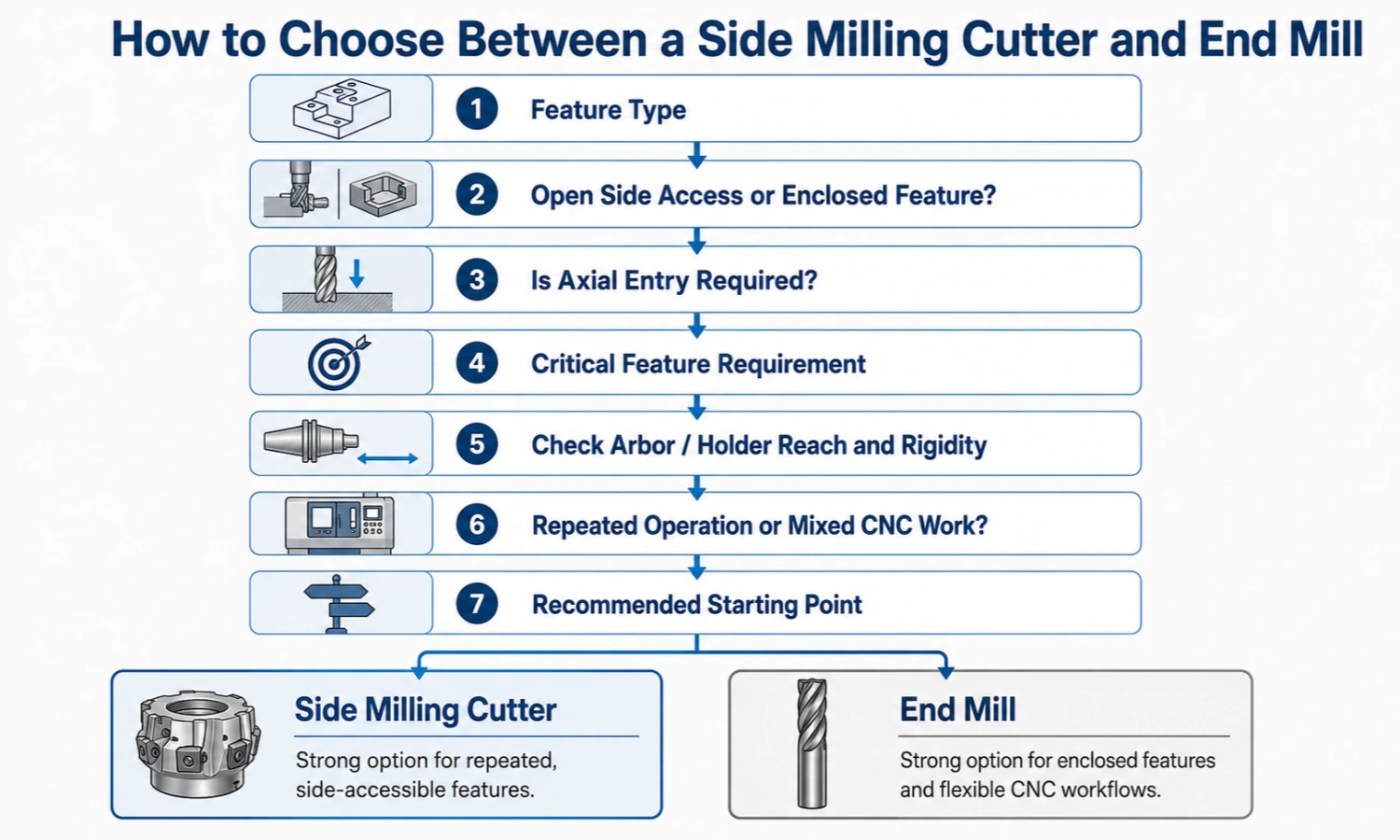
Fare un passo 1: Identify the Feature
Start with the drawing, not the tool.
Is the feature an open groove, closed-end slot, tasca, spalla, side surface, or profile?
The feature geometry immediately helps narrow the available cutter options.
Fare un passo 2: Check Tool Access
Prossimo, determine how the cutter can physically reach the feature.
Ask:
- Is side access available?
- Is axial entry required?
- Is there enough space for the cutter body?
- Is there enough arbor or holder clearance?
- Will the fixture or workpiece interfere with the cutter?
A cutter that cannot approach the feature correctly is not a practical option.
Fare un passo 3: Identify the Critical Feature Requirement
Do not focus on tool type before identifying what matters most on the drawing.
The critical requirement may include:
- larghezza della scanalatura;
- profondità;
- wall geometry;
- condizione d'angolo;
- fine;
- portata dell'utensile;
- repeatability;
- cycle requirement.
The cutter concept should support the feature that controls the machining decision.
Fare un passo 4: Check Machine, Toolholding, and Rigidity
Evaluate the complete cutting system.
For a side milling cutter, review the arbor, bore, cutter position, machine interface, apparecchio, and available clearance.
For an end mill, review holder type, sporgenza, lunghezza di taglio, diametro, spindle condition, e mantenimento del lavoro.
In both cases, stable support and effective chip evacuation matter.
Fare un passo 5: Consider Machining Flexibility and Production Repetition
Finalmente, consider how the operation fits the full production process.
If the same side-accessible feature is repeated across a production run, a dedicated side milling cutter may provide a practical process option.
If the part changes frequently or one CNC tool needs to machine several compatible features, an end mill may offer greater flexibility.
The starting choice should fit the complete part, macchina, impostare, and production requirement—not simply the cutter with the longest application list.
Domande frequenti
Can an End Mill Be Used for Side Milling?
Sì. End mills have peripheral cutting edges and are commonly used for side milling. Tuttavia, suitable radial engagement, portata dell'utensile, rigidità del supporto, geometria del flauto, and cutting conditions depend on the application. Excessive overhang or an unstable setup can increase deflection and vibration.
Can an End Mill Replace a Side Milling Cutter?
Sometimes. An end mill can be a practical replacement when it can reach the feature and meet the required geometry, quality, stabilità, and cycle time. A dedicated side cutter may still make sense when cutting width, side access, mounting, or a repeated operation creates a stronger process case.
Which Cutter Is Better for Closed-End Slots and Pockets?
An end mill is generally the stronger starting choice because it can provide the required axial and internal access when the selected geometry supports the intended entry and cutting strategy. The final choice still depends on feature geometry, portata, e condizioni di lavorazione.
Which Cutter Is Better for Deep or Long Grooves?
It depends. Compare groove access, diametro della fresa, portata dell'utensile, arbor or holder support, rigidità della macchina, tenuta del lavoro, ed evacuazione truciolo. Groove depth alone is not enough reason to select one cutter type automatically.
Does a Side Milling Cutter Always Provide Better Slot Width Accuracy?
NO. A cutter configured around the target width can simplify width control in some applications, but final accuracy still depends on cutter condition and wear, mounting, esaurire, capacità della macchina, tenuta del lavoro, deflessione dell'utensile, e condizioni di taglio.
Choosing between a side milling cutter and an end mill starts with the part feature and available tool access. If you need help reviewing a specific application, invia il tuo disegno, materiale del pezzo, groove or slot dimensions, tolleranza, machine information, and production requirements to sales@cutterbest.com for a cutter-selection review.