 Präzisions-Fräser,Schneidwerkzeuge für die CNC-Bearbeitung jedes Materials

Beim Vergleich von a 2 Flöte vs 3 Schaftfräser für Aluminium, Beginnen Sie mit der Bearbeitung.
Wählen Sie beim Tiefnuten einen Schaftfräser mit zwei Schneiden, starkes Schruppen, oder ein hohes Spanvolumen machen die Spanabfuhr zum Hauptanliegen. Durch die größeren Spanräume haben die Aluminiumspäne mehr Platz, um den Schneidbereich zu verlassen.
Wählen Sie bei Seitenwandqualität einen 3-schneidigen Schaftfräser, Profilstabilität, Halbfertigbearbeitung, oder das Fertigstellen ist wichtiger. Die zusätzliche Schneidkante kann bei einem vergleichbaren Fräserdesign für einen gleichmäßigeren Eingriff und eine bessere Steifigkeit sorgen.
Keine der Nutenzahlen passt zu jeder Aluminiumaufgabe. Schlitztiefe, radialer Eingriff, Werkzeugreichweite, Zustand des Halters, Kühlmittel oder Luftstoß, Werkzeugweg, und Oberflächenanforderungen können die endgültige Wahl beeinflussen.
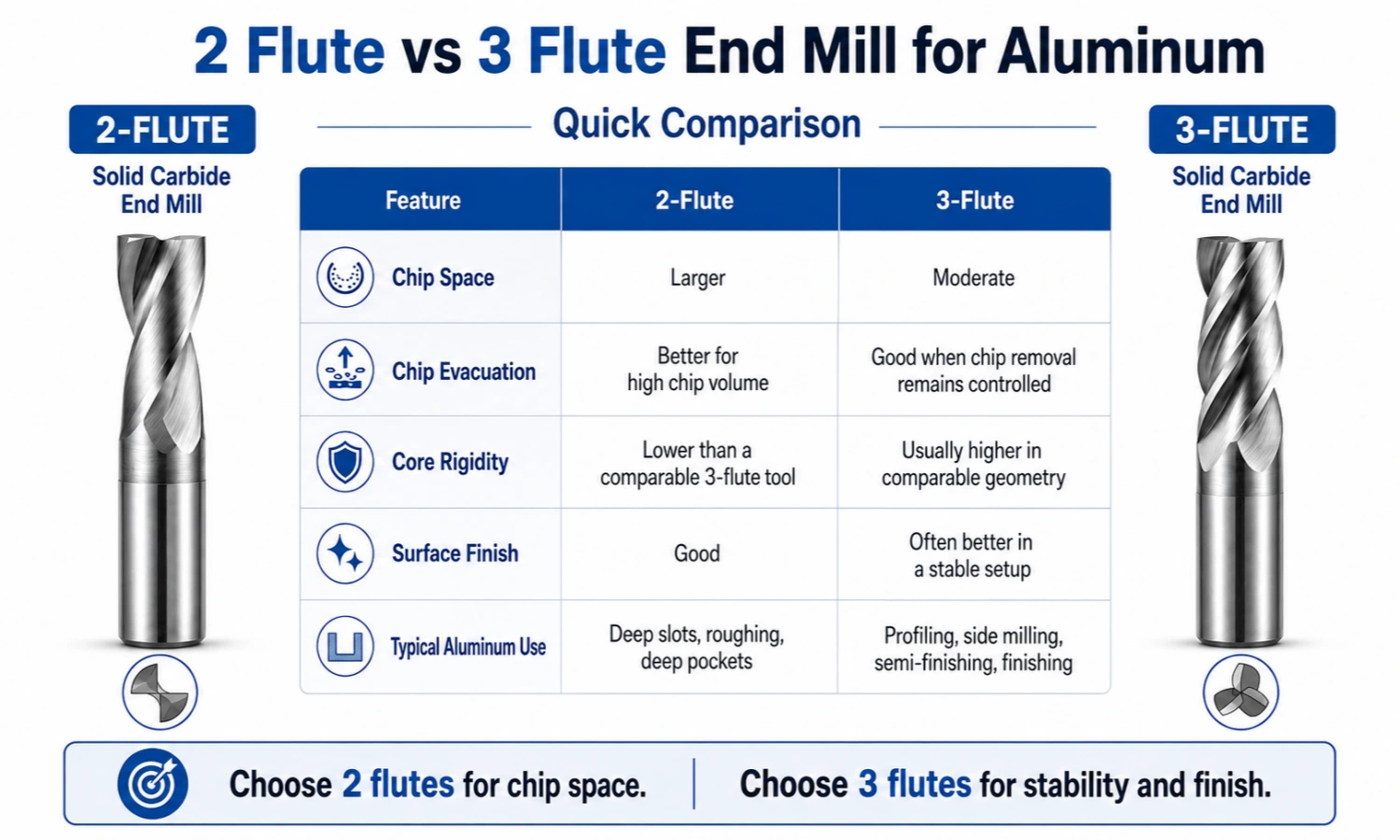
Schneller Vergleich: 2 Flöte vs 3 Nutfräser für Aluminium
| Auswahlfaktor | 2-Schaftfräser mit Nut | 3-Schaftfräser mit Nut |
|---|---|---|
| Chip-Platz | Größer | Mäßig |
| Spanabfuhr | Besser für hohes Spanvolumen | Gut, wenn die Spanabfuhr kontrolliert bleibt |
| Kernsteifigkeit | Niedriger als ein vergleichbares 3-Schneiden-Werkzeug | Normalerweise höher in vergleichbarer Geometrie |
| Tiefe Nuten über die gesamte Breite | Normalerweise bevorzugt | Unter kontrollierten Bedingungen geeignet |
| Schweres Schruppen | Normalerweise bevorzugt | Besser für mäßige Entfernung |
| Seitenfräsen | Geeignet | Wird oft bevorzugt |
| Oberflächenbeschaffenheit | Gut | In einem stabilen Aufbau ist es oft besser |
| Typische Verwendung von Aluminium | Tiefe Schlitze, Schruppen, tiefe Taschen | Profilierung, Seitenfräsen, Halbfertigbearbeitung, Abschluss |
Wählen 2 Spannuten, wenn Spanraum und sichere Spanabfuhr im Vordergrund stehen. Wählen 3 Rillen beim Schneiden Stabilität, Seitenwandqualität, und Abschlusspotenzial sind wichtiger.
Dies sind Startempfehlungen, keine festen Regeln. Die komplette Bearbeitungseinrichtung hat immer noch Einfluss auf das Ergebnis.
Warum die Anzahl der Nuten bei der Aluminiumbearbeitung wichtig ist
Spanraum und Spanabfuhr
Aluminium produziert oft große Mengen, weich, oder kontinuierliche Späne. Wenn diese Chips in einem Schlitz oder einer Tasche verbleiben, Der Cutter kann sie nachschneiden. Späne können auch an der Schneidkante haften bleiben oder die bearbeitete Oberfläche zerkratzen.
Ein 2-schneidiger Schaftfräser bietet größere Spannutenräume. Normalerweise bewältigt er ein hohes Spanvolumen leichter als ein vergleichbarer 3-Schneiden-Fräser.
Dieser Vorteil wird bei tiefen Schlitzen über die gesamte Breite und geschlossenen Taschen wichtig, wo Chips nur begrenzten Raum zum Entweichen haben.
Ein 3-schneidiges Werkzeug bietet immer noch nützlichen Spanraum. Jedoch, der Werkzeugweg, Kühlmittel, Luftstoß, und der Schneideingriff muss dazu beitragen, dass die Späne die Schneidzone verlassen.
Kernsteifigkeit und Werkzeugdurchbiegung
In vergleichbaren Ausführungen, Ein 3-Schneiden-Fräser hat oft mehr Kernmaterial als ein 2-Schneiden-Fräser. Der stärkere Kern kann die Werkzeugdurchbiegung beim Seitenfräsen und Profilieren reduzieren.
Eine geringere Durchbiegung trägt dazu bei, dass der Fräser eine gleichmäßigere Wandposition beibehält. Es kann auch die Profilgenauigkeit verbessern und sichtbare Wandabweichungen reduzieren.
Die Anzahl der Flöten kann ein schwaches Setup nicht korrigieren. Zu große Werkzeugreichweite, Halterschlag, schlechte Klemmung, oder instabile Maschinenbedingungen können dennoch zu Rattern und Maßänderungen führen.
Verwenden Sie die kürzeste praktische Werkzeuglänge und eine stabile Werkzeughaltung, bevor Sie sich auf die Anzahl der Spannuten verlassen, um das Ergebnis zu verbessern.
Modernstes Engagement und Oberflächenfinish
Ein 3-schneidiger Schaftfräser erzeugt drei Schnitteingriffe pro Umdrehung statt zwei.
Unter stabilen Bedingungen, Der zusätzliche Eingriff kann glattere Seitenwände und ein gleichmäßigeres Finish ermöglichen. Dies ist einer der Gründe, warum Dreischneidefräser häufig zum Profilieren ausgewählt werden, Halbfertigbearbeitung, und Abschluss.
Die endgültige Oberfläche hängt auch davon ab:
- Vorschub pro Zahn
- Werkzeugunrundheit
- Kantengeometrie
- Werkzeugverschleiß
- Zustand des Halters
- Steifigkeit der Maschine
- Radialer Eingriff
- Kühlmittel- oder Luftzufuhr
Eine höhere Anzahl an Nuten kann das Finishing-Potenzial verbessern, Es ist jedoch kein Garant für ein bestimmtes Oberflächenergebnis.
Wann sollte man sich für einen 2-schneidigen Schaftfräser für Aluminium entscheiden?
Tiefe Nuten über die gesamte Breite
Wählen Sie einen Schaftfräser mit zwei Schneiden, wenn der Schlitz tief ist, Ein Eingriff über die gesamte Breite ist erforderlich, und Chips haben nur begrenzten Raum zum Entweichen.
Beim Nuten über die gesamte Breite, Beide Seiten des Fräsers bleiben im Eingriff mit dem Material. Die Späne müssen durch die Rillen wandern, bevor sie den Schlitz verlassen.
Ein zweischneidiges Design bietet mehr Raum für den Spanfluss. Dies ist in der Regel die sicherere Ausgangswahl, wenn das Packen von Chips ein höheres Risiko darstellt.
Kühlmittel oder Luftstoß bleiben wichtig. Ein 2-Schneiden-Fräser kann einen übermäßigen Eingriff oder eine schlechte Spanabfuhr nicht ausgleichen.
Schwere Schruppbearbeitung und hohes Spanvolumen
Wählen 2 Spannuten, wenn ein hohes Spanvolumen und eine sichere Spanabfuhr wichtiger sind als die endgültige Wandbeschaffenheit.
Durch starkes Schruppen wird mehr Material abgetragen und es entstehen mehr Späne. Größere Spannutenräume können das Risiko eines Nachschneidens von Spänen und einer Blockierung der Spannut verringern.
Der Fräser muss noch zur Maschine passen, Halter, Werkzeuglänge, und Schnittlast. Übermäßiger Eingriff kann jeden Fräser überlasten.
Tiefes Taschenfräsen
Tiefe und geschlossene Taschen können Späne um das Werkzeug herum festhalten. Für diese Bedingungen ist ein 2-schneidiger Schaftfräser oft eine praktische Einstiegslösung.
Ein rasanter Einstieg, spiralförmiger Eintritt, oder ein adaptiver Werkzeugweg können den Schnitteingriff reduzieren. Auch starker Luftstoß oder Kühlmittel können die Späne vom Boden der Tasche wegbewegen.
Für tiefe Schlitze, Schruppen, und Aluminiumbearbeitung mit hohem Spanvolumen, Sehen Sie sich unsere an 2 Schaftfräser mit Nut.
Wann sollte man sich für einen 3-schneidigen Schaftfräser für Aluminium entscheiden?
Seitenfräsen und Profilieren
Wählen Sie einen Schaftfräser mit 3 Schneiden, wenn ein stabiler Seitenschnitt und eine gleichbleibende Wandqualität wichtiger sind als maximaler Nutraum.
Beim Seitenfräsen, nur ein Teil des Fräserdurchmessers darf das Werkstück berühren. Die Spanabfuhr ist oft einfacher als beim Nutenfräsen über die gesamte Breite.
Die dritte Schneidkante kann beim Fräsen von geraden Wänden für einen gleichmäßigeren Eingriff sorgen, externes Profiling, interne Konturierung, und Kantenbearbeitung.
Halb- und Endbearbeitung
Wählen 3 Rillen, wenn Oberflächenkonsistenz und Seitenwandbeschaffenheit die Hauptziele sind.
Ein Werkzeug mit drei Schneiden bietet einen sanfteren Eingriff als einige Fräser mit zwei Schneiden. Es funktioniert am besten, wenn die Maschineneinstellung stabil bleibt und der Werkzeugüberhang unter Kontrolle bleibt.
Ein 3-Schneiden-Fräser führt keine automatische Korrektur durch:
- Übermäßiger Rundlauf
- Abgenutzte Schneidkanten
- Schlechte Klemmung
- Instabiles Futter
- Zu große Werkzeugreichweite
- Falscher radialer Eingriff
Überprüfen Sie diese Bedingungen, bevor Sie die Flötenanzahl ändern.
Kontrolliertes Schlitzen und Taschenfräsen
Ein 3-schneidiger Schaftfräser kann flaches oder kontrolliertes Nutenfräsen bewältigen, wenn der Werkzeugweg und die Spanabfuhr geeignet sind.
Leichteres Engagement, Stufenschnitt, ein Rampeneinstieg, ein spiralförmiger Eintritt, oder ein adaptiver Werkzeugweg kann die Menge des gleichzeitig eingesetzten Materials reduzieren.
Für tiefere Schlitze über die gesamte Breite oder schweres Schruppen, Beginnen Sie mit einem 2-schneidigen Werkzeug. Die größeren Spannutenräume bieten einen größeren Spielraum für die Spanabfuhr.
Zum Seitenfräsen, Profilierung, Halbfertigbearbeitung, und Abschluss, Sehen Sie sich unsere an 3 Hartmetall-Flachschaftfräser für Aluminium.
Weitere Informationen zu dreischneidigen Anwendungen, Lesen Sie unsere Anwendungsanleitung für Dreischneidefräser.
Entscheidungsregeln: 2 Flöte bzw 3 Flöte für Aluminium?
Regel 1: Beginnen Sie mit Chip-Volumen und Slot-Zugriff
Beginnen Sie mit einem 2-Schneiden-Fräser:
- Der Schlitz ist tief
- Ein Eingriff über die gesamte Breite ist erforderlich
- Die Tasche ist beiliegend
- Späne haben nur begrenzten Platz zum Entweichen
- Es wird mit einem hohen Chipaufkommen gerechnet
Ein 3-Schneiden-Fräser ist praktischer, wenn der Schneidbereich offen ist und der Werkzeugweg den ungehinderten Abgang der Späne ermöglicht.
Regel 2: Definieren Sie das Hauptbearbeitungsziel
Wählen 2 Spannuten, wenn Materialabtrag und Spanabfuhr im Vordergrund stehen.
Wählen 3 Flöten, wenn sich die Operation darauf konzentriert:
- Seitenwandqualität
- Profilkonsistenz
- Halbfertigbearbeitung
- Abschluss
- Stabiler Seitenschnitt
Das primäre Bearbeitungsziel sollte die Ausgangswahl leiten.
Regel 3: Überprüfen Sie die Werkzeugreichweite und die Setup-Steifigkeit
Eine große Werkzeugreichweite erhöht das Ablenkungsrisiko. Verwenden Sie das kürzeste praktische Werkzeug und verbessern Sie die Klemmung, bevor Sie die Nutenzahl ändern.
Verwenden Sie keine zusätzlichen Spannuten als Ersatz für eine stabile Werkzeughaltung.
Wenn das Setup schwach bleibt, Ein 3-Schneiden-Fräser kann immer noch vibrieren oder inkonsistente Abmessungen erzeugen. Unrundheit des Prüfhalters, Werkzeugreichweite, radialer Eingriff, und Maschinensteifigkeit zusammen.
Regel 4: Kühlmittel prüfen, Luftstoß, und Werkzeugweg
Die Anzahl der Spanflöten ist nur ein Teil der Spankontrolle.
Starker Luftstoß, geeignete Kühlmittelzufuhr, und ein Werkzeugweg, der übermäßigen Eingriff vermeidet, kann die Spanabfuhr verbessern. Diese Bedingungen können dazu führen, dass ein 3-Schneiden-Fräser das kontrollierte Schlitzen erfolgreich durchführen kann.
Wenn sich weiterhin Späne ansammeln, Engagement reduzieren, Spanabfuhr verbessern, oder wechseln Sie zu einem 2-schneidigen Werkzeug.
Regel 5: Passen Sie Kantengeometrie und Oberflächenbehandlung an
Die Aluminiumbearbeitung profitiert im Allgemeinen von scharfen Schneidkanten und einem gleichmäßigen Spanfluss.
Die Fräsergeometrie und die Oberflächenbehandlung sollten übereinstimmen:
- Aluminiumqualität
- Bearbeitungsvorgang
- Kühlmittelmethode
- Gefahr der Spananhaftung
- Erforderliche Werkzeugstandzeit
- Oberflächenbedarf
Wählen Sie einen Fräser nicht nur nach der Anzahl der Nuten oder der Bezeichnung der Beschichtung aus. Das komplette Werkzeugdesign muss zur Anwendung passen.
Empfohlene Nutenzahl bei Aluminiumbetrieb
| Aluminiumbetrieb | Empfohlene Startwahl | Hauptgrund |
|---|---|---|
| Tiefe Schlitzung über die gesamte Breite | 2 Flöten | Mehr Chipraum |
| Schweres Schruppen | 2 Flöten | Bessere Spanabfuhr |
| Tiefes Taschenfräsen | 2 Flöten | Einfachere Spanentfernung |
| Flache, kontrollierte Schlitzung | 2 oder 3 Flöten | Hängt von der Tiefe und der Spankontrolle ab |
| Seitenfräsen | 3 Flöten | Bessere Stabilität und Wandqualität |
| Profil- und Konturfräsen | 3 Flöten | Konsequenteres Engagement |
| Halbfertigbearbeitung | 3 Flöten | Ausgewogener Spanraum und Steifigkeit |
| Abschluss | 3 Flöten | Besseres Finishing-Potenzial |
Hierbei handelt es sich eher um Ausgangsentscheidungen als um absolute Regeln. Werkzeugdurchmesser, Flötenlänge, Gesamtreichweite, Steifigkeit der Maschine, Kühlmittel, und Schnittstrategie können die endgültige Entscheidung ändern.

Anzeichen dafür, dass Ihre Flötenanzahl oder die Einstellung möglicherweise falsch ist
| Beobachtbares Problem | Mögliche Ursache | Praktische Antwort |
|---|---|---|
| Chips stapeln sich im Schlitz | Unzureichender Nutraum oder schwache Spanabfuhr | Luft oder Kühlmittel verbessern, Engagement reduzieren, oder überlegen 2 Flöten |
| Späne werden nachgeschnitten und zerkratzen die Oberfläche | Späne bleiben im Schneidbereich | Passen Sie den Werkzeugweg an und verbessern Sie die Spanabfuhr |
| Aluminium bleibt an der Schneide kleben | Schlechte Spanabfuhr, abgenutzter Rand, oder ungeeignete Oberflächenbehandlung | Schmierung prüfen, Kantenzustand, und Rillenoberfläche |
| Seitenwände weisen Rattermarken auf | Übermäßige Reichweite, schwache Klemmung, oder instabiles Engagement | Verkürzen Sie den Überhang und verbessern Sie die Steifigkeit |
| Die Abmessungen variieren während der Profilierung | Werkzeugdurchbiegung oder Unrundheit | Überprüfen Sie den Halter, Auslaufen, Schnittlast, und Werkzeugreichweite |
| Das Finish bleibt inkonsistent | Das Setup oder die Parameter sind instabil | Überprüfen Sie das gesamte Schneidsystem, bevor Sie die Anzahl der Nuten ändern |
Diese Probleme bedeuten nicht immer, dass die Flötenzählung falsch ist.
Wechsel von 2 Flöten zu 3 Nuten können übermäßige Unrundheit nicht korrigieren. Ebenfalls, umziehen 2 Nuten lösen eine schwache Kühlmittelzufuhr nicht, wenn Späne in einer Tasche eingeschlossen bleiben.
Beginnen Sie mit dem sichtbaren Problem. Spänefluss prüfen, Werkzeugreichweite, Spannen, Schnittlast, und Werkzeugzustand, bevor Sie einen anderen Fräser auswählen.
Häufige Fehler bei der Auswahl eines Aluminium-Schaftfräsers
Allein der Flötenzähler entscheidet
Die Anzahl der Nuten beschreibt einen Fräser nicht vollständig.
Zwei Werkzeuge mit der gleichen Anzahl an Spannuten können unterschiedliche Kerngrößen verwenden, Flötentiefen, Kantengeometrien, Längen, und Oberflächenbehandlungen.
Vergleichen Sie die komplette Werkzeugkonstruktion und die Bearbeitungsbedingungen.
Verwenden Sie mehr Nuten, um ein schwaches Setup auszugleichen
Mehr Nuten können bei vergleichbaren Fräserkonstruktionen die Steifigkeit verbessern. Jedoch, Sie können einen schwachen Halter nicht reparieren, übermäßiger Rundlauf, schlechte Klemmung, oder übermäßiger Werkzeugüberhang.
Korrigieren Sie zuerst das Setup. Wählen Sie dann die Nutanzahl entsprechend dem Spanvolumen und den Oberflächenanforderungen aus.
Empfehlungen als absolute Regeln behandeln
Mit einem 3-Schneiden-Fräser können Schlitze bearbeitet werden, und ein 2-Schneiden-Fräser kann Aluminium bearbeiten.
Die Empfehlungen in diesem Leitfaden beschreiben praktische Startmöglichkeiten:
- 2 Spannuten für mehr Spanraum
- 3 Rillen für stabileren Eingriff und besseres Finishing-Potenzial
Das Endergebnis hängt von der kompletten Bearbeitungseinrichtung ab.
Häufig gestellte Fragen
Ist 2 Flöte bzw 3 Flöte besser für Aluminium?
Ein 2-schneidiger Schaftfräser eignet sich normalerweise besser für tiefe Nuten, starkes Schruppen, und Operationen, bei denen maximaler Chipraum erforderlich ist.
Ein 3-schneidiger Schaftfräser eignet sich oft besser zum Seitenfräsen, Profilierung, Halbfertigbearbeitung, und Endbearbeitung, wenn Schnittstabilität und Wandqualität wichtiger sind.
Ist ein 3-schneidiger Schaftfräser, der sich gut zum Nutenfräsen von Aluminium eignet?
Ja. Ein 3-Schneiden-Fräser kann zum flachen oder kontrollierten Schlitzen von Aluminium eingesetzt werden, wenn die Spanabfuhr effektiv bleibt.
Für tiefere Schlitze über die gesamte Breite oder schweres Schruppen, Ein 2-Schneiden-Fräser ist normalerweise die sicherere Ausgangswahl.
Welcher Schaftfräser sorgt für ein besseres Finish in Aluminium??
Ein 3-schneidiger Schaftfräser bietet oft ein besseres Endbearbeitungspotenzial, da er mehr Schnitteingriffe pro Umdrehung erzeugt und möglicherweise eine bessere Steifigkeit bietet.
Auslaufen, füttern, Werkzeugverschleiß, Spannen, Maschinenstabilität, und radialer Eingriff wirken sich auch auf die endgültige Oberfläche aus.
Kann ein 2-schneidiger Schaftfräser zum Schlichten von Aluminium verwendet werden??
Ja. Ein scharfes, Der stabile 2-Schneidenfräser kann Aluminium bearbeiten.
Wenn die Konsistenz der Seitenwände und die Oberflächengüte im Vordergrund stehen, Ein 3-Schneiden-Fräser ist oft die bessere Ausgangswahl.
Benötigen Sie Hilfe bei der Auswahl 2 Und 3 Flöten?
Wählen zwischen 2 Und 3 Die Anzahl der Nuten hängt von der Aluminiumsorte ab, Bearbeitungsvorgang, Schlitztiefe, Werkzeugreichweite, Methode zur Spankontrolle, und erforderliche Oberflächenbeschaffenheit.
Schicken Sie uns das Werkstückmaterial zu, erforderliche Abmessungen, Schlitz- oder Taschentiefe, Menge, und alle verfügbaren Zeichnungs- oder aktuellen Fräserinformationen.
Ich bin mir nicht sicher, welche Flötenanzahl ich wählen soll? Senden Sie Ihre Anforderungen per E-Mail an sales@cutterbest.com, und wir prüfen, ob ein 2- oder 3-schneidiges Werkzeug besser zur Anwendung passt.