 Präzisions-Fräser,Schneidwerkzeuge für die CNC-Bearbeitung jedes Materials

In diesem Leitfaden zur Schaftfräserauswahl wird erläutert, wie Sie einen Fräser nach Bearbeitungsvorgang auswählen, Abschlussprofil, Werkzeugmaterial, Flötenzahl, Beschichtung, Abmessungen, und Maschineneinrichtung. Die Wahl des falschen Werkzeugs kann zu einer schlechten Spanabfuhr führen, Geschwätz, schneller Kantenverschleiß, Maßfehler, Werkzeugbruch, oder eine inkonsistente Oberflächenbeschaffenheit.
Dieser Leitfaden richtet sich an Maschinisten, Verfahrenstechniker, Werkstattleiter, Händler, und Käufer, die einen praktischen Ausgangspunkt benötigen, bevor sie einen Schaftfräser auswählen oder anfordern.
Was ist ein Schaftfräser??
Ein Schaftfräser ist ein rotierendes Schneidwerkzeug, das zum Schlitzen verwendet wird, Taschenbildung, Profilierung, Seitenfräsen, Schruppen, Abschluss, und 3D-Konturierung. Im Gegensatz zu einem Standardbohrer, Es kann sowohl mit der End- als auch mit der Außenschneide geschnitten werden.
Einige mittig schneidende Designs unterstützen Ramping, spiralförmiger Eintritt, oder begrenztes Eintauchen. Jedoch, Die Zentrumsgeometrie und die Eingabemethode müssen zum Betrieb passen.
Für eine grundlegende Erklärung, lesen Was ist ein Schaftfräser?.
Kurzanleitung zur Auswahl von Schaftfräsern
Die folgende Tabelle enthält praktische Startanweisungen. Die endgültige Werkzeugauswahl sollte immer noch die Werkstücksorte widerspiegeln, Fräserdurchmesser, Schnitttiefe, Zustand des Halters, Steifigkeit der Maschine, und spanabhebendes Verfahren.
| Bearbeitungssituation | Startrichtung des Werkzeugs | Hauptgrund |
|---|---|---|
| Aluminiumschlitze oder tiefe Taschen | 2–3 Flöten, Scharfe Kante, Polierte Flöten | Mehr Platz für die Chips und geringeres Risiko von Chip-Packungen |
| Allgemeines Seitenfräsen von Stahl | 4 Flöten, Starker Kern, Hitzebeständige Beschichtung | Ausgewogenheit der Steifigkeit, Kantenanzahl, und Spanabfuhr |
| Seitenfräsen oder Schlichten von Edelstahl | 4–6 Flöten, Geometrie mit variabler Helix oder ungleicher Steigung | Hilft Vibrationen zu kontrollieren, Hitze, und instabiles Schneiden |
| Schweres Schruppen | Niedrigere oder mittlere Flötenzahl, Schrupp- oder Spanbrechergeometrie | Mehr Spanraum und kontrollierte Schnittlast |
| Abschluss mit leichtem Engagement | Höhere Nutenzahl und stabile Geometrie | Mehr Schneidkontakte und verbesserte Oberflächenkonsistenz |
| Schlitze und Taschen mit flachem Boden | Flacher Schaftfräser | Erzeugt einen flachen Boden und gerade Wände |
| 3D Konturen und Formhohlräume | Kugelfräser | Das abgerundete Ende folgt gekrümmten Oberflächen |
| Halbschlichten und stärkere Ecken | Bull-Nase- oder Eckenradius-Schaftfräser | Der Radius verstärkt die äußere Schneidecke |
| Tiefe Merkmale mit begrenzter Schnitttiefe | Langhalswerkzeug mit minimal erforderlicher Nutlänge | Reduziert die Durchbiegung im Vergleich zu einer zu langen Nut |
Verwenden Sie diese Matrix als ersten Filter. Danach, Bestätigen Sie das Endprofil, Werkzeugmaterial, Flötenzahl, Beschichtung, Abmessungen, und Maschineneinrichtung.
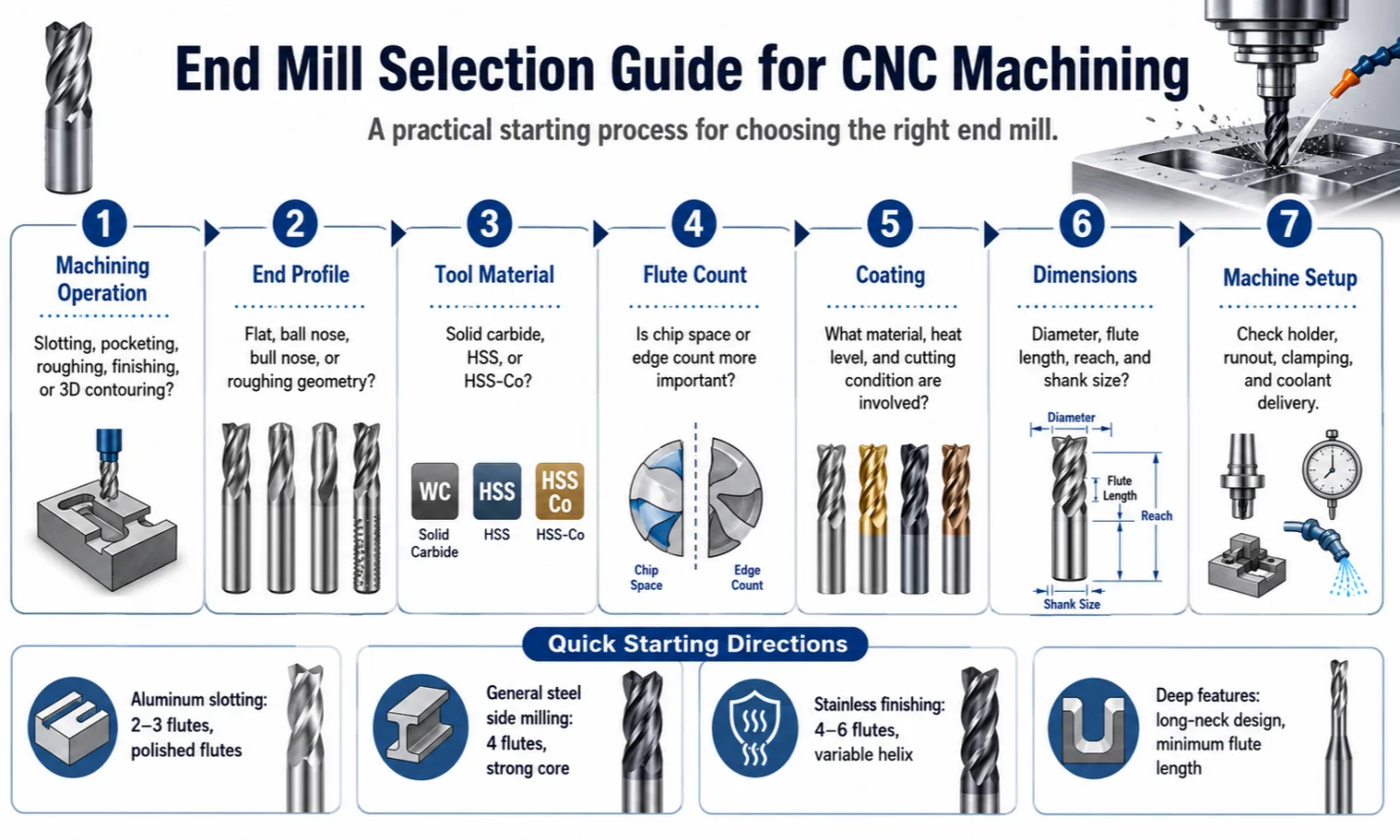
Schritt 1: Wählen Sie einen Schaftfräser per CNC-Operation
Der Bearbeitungsvorgang sollte die erste Entscheidung leiten, da er die Schnittrichtung bestimmt, Spanvolumen, Engagement, und benötigter Fläche.
Schlitzen
Beim Schlitzen über die gesamte Breite entsteht ein hohes Spanvolumen, da der Fräser über den gesamten Durchmesser in das Material eingreift.
Beim Schneiden eines Schlitzes über die gesamte Breite, Priorisieren Sie den Spanraum, bevor Sie die Anzahl der Spannuten erhöhen. Beginnen Sie mit weniger Spannuten, wenn die Späne groß sind oder der Abtransport schwierig ist.
Normalerweise ist ein geeignetes Schlitzwerkzeug erforderlich:
- Genügend Flötenplatz
- Zuverlässige Spanabfuhr
- Ein mittig schneidendes Design, wenn ein direkter Einstieg erforderlich ist
- Kurzer und stabiler Werkzeugüberhang
- Auf das Material abgestimmte Kantenstärke
Für Aluminium oder andere Materialien, die größere Späne erzeugen, 2–3 Flöten bieten einen praktischen Ausgangspunkt. Für Stahl, Die endgültige Anzahl der Nuten hängt auch von der Schlitztiefe ab, radialer Eingriff, Fräserdurchmesser, und Kühlmittel- oder Luftzufuhr.
Wenn Späne im Schlitz verbleiben, Erhöhen Sie nicht sofort den Vorschub oder wechseln Sie die Beschichtung. Überprüfen Sie zunächst den Flötenraum, Schnitttiefe, Luft- oder Kühlmittelrichtung, und Werkzeugüberhang.
Taschenfräsen
Beim Taschenfräsen kann das Rampenfräsen kombiniert werden, spiralförmiger Eintritt, seitliches Schneiden, Eckeingriff, und Bodenbearbeitung.
Verwenden Sie einen Schaftfräser mit Mittelschnitt, wenn der programmierte Eintrag ein Schneiden in der Nähe der Werkzeugmitte erfordert. Jedoch, Mittelschneiden verwandelt einen Schaftfräser nicht in einen Standardbohrer. Die Werkzeuggeometrie und die CAM-Eingabestrategie müssen die Bewegung unterstützen.
Auch tiefe Taschen brauchen eine zuverlässige Spanabfuhr. Eingeschlossene Späne können nachgeschnitten werden, Dies erhöht die Hitze und kann die Schneidkante beschädigen.
Wenn die Tasche tief ist, die tatsächliche Schnitttiefe jedoch gering ist, Wählen Sie ein Werkzeug mit langem Hals anstelle eines Schaftfräsers mit einer unnötig langen Spannut.
Seitenfräsen und Profilieren
Beim Seitenfräsen werden die äußeren Schneidkanten belastet. Infolge, radialer Eingriff, Steifigkeit des Fräsers, Auslaufen, und Seitenwandgenauigkeit werden wichtig.
Verwenden Sie für gerade Wände und Schultern einen Flachfräser. Wählen Sie ein Spitz- oder Eckenradiuswerkzeug, wenn die Außenecke mehr Festigkeit benötigt.
Zum allgemeinen Seitenfräsen von Stahl, Ein 4-schneidiges Werkzeug sorgt für ein praktisches Gleichgewicht zwischen der Kantenanzahl, Rumpfstärke, und Spanraum.
Für leichteren radialen Eingriff und stabile Endbearbeitung, 5–6 Nuten können die Anzahl der Schneidkontakte erhöhen. Jedoch, Die Spanabfuhr muss stabil bleiben.
Schruppen
Beim Schruppen entsteht eine hohe Schnittlast und ein hohes Spanvolumen. daher, Der Fräser benötigt genügend Nutenraum und eine Kantenstruktur, die den Eingriff bewältigen kann.
Für traditionelles Schruppen, Wählen Sie eine niedrigere oder mittlere Spanzahl, wenn die Spanentfernung schwierig ist. Die Schrupp- oder Spanbrechergeometrie unterteilt die Späne in kleinere Abschnitte und kann den Schnittwiderstand verringern.
Für dynamische oder trochoidale Werkzeugwege mit geringerem radialen Eingriff, Eine höhere Anzahl an Nuten kann praktisch sein, da jede Nut einen kleineren Span entfernt, während das Werkzeug einem kontrollierten Eingriffspfad folgt.
Die CAM-Strategie, Steifigkeit der Maschine, Zustand des Halters, und Werkzeuggeometrie müssen zusammenarbeiten. Ein Hochleistungs-Schruppwerkzeug kann eine schwache Spannung oder einen zu großen Überhang nicht kompensieren.
Abschluss
Die Endbearbeitung erfordert eine stabile Geometrie, kontrollierter Rundlauf, gleichmäßige Schnittkanten, und ein Werkzeugprofil, das zur erforderlichen Oberfläche passt.
Wenn der radiale Eingriff gering ist und die Spanabfuhr stabil bleibt, Mehr Nuten erhöhen die Anzahl der Schneidkontakte und können eine glattere Oberfläche ermöglichen.
Vor dem Messerwechsel, überprüfen:
- Modernste Kleidung
- Genauigkeit des Halters
- Werkzeugüberhang
- Werkstückspannung
- Futterkonsistenz
- Erforderliche Eckform
Ein abgenutztes Werkzeug oder ein instabiler Halter können selbst bei korrekter Nutenzahl zu einer schlechten Oberfläche führen.
3D Konturierung und Formbearbeitung
Kugelkopffräser werden häufig für gekrümmte Oberflächen verwendet, Formhohlräume, stirbt, und 3D-Veredelung. Ihr abgerundetes Ende folgt komplexen Oberflächen effektiver als ein flaches Schneidende.
Bull-Nose-Werkzeuge eignen sich zum Vorschlichten und Profilieren, wenn stärkere Außenecken erforderlich sind. Ihr Eckenradius stärkt die Schneidkante und sorgt gleichzeitig für einen flacheren Mittelbereich.
Für gehärteten Formenstahl, Passen Sie die Werkzeugserie an die tatsächliche Werkstückhärte an. Ein Werkzeug, das für Materialien bis zu HRC45 vorgesehen ist, kann eine andere Hartmetallsorte verwenden, Kantenvorbereitung, und Beschichtung von einem, das für HRC60 oder HRC65 ausgelegt ist.
Schritt 2: Wählen Sie das Endprofil aus
| Endprofil | Hauptmerkmal | Gemeinsame Anwendung |
|---|---|---|
| Flacher Schaftfräser | Flaches Schneidenende mit scharfen Außenecken | Spielautomaten, Taschen, Schultern, flache Oberflächen, und Seitenwände |
| Kugelfräser | Vollständig abgerundetes Schneidenende | 3D-Konturen, gekrümmte Oberflächen, stirbt, und Formhohlraumveredelung |
| Bull-Nase-Schaftfräser | Flaches Ende mit abgerundeten Außenecken | Profilierung, Halbfertigbearbeitung, Formenbearbeitung, und stärkere Ecken |
| Schruppfräser | Gezahnte oder Spanbrecherschneiden | Hoher Materialabtrag und Schruppbearbeitung |
| Mittenschneidender Schaftfräser | Die Schneidkanten erstrecken sich über oder nahe der Mitte | Bestimmtes Rampen, spiralförmiger Eintritt, und Tascheneingabeoperationen |
Wählen Sie das Profil entsprechend dem zu bearbeitenden Merkmal aus.
Ein Flachschaftfräser erzeugt flache Bodenmerkmale und gerade Wände. Ein Kugelfräser folgt gekrümmten Oberflächen. Ein Bull-Nose-Werkzeug stärkt die Außenecke und eignet sich oft für die Vorbearbeitung.
Ein mittig schneidender Schaftfräser kann bestimmte Eintrittsbewegungen unterstützen, Die Fähigkeit zum Eintauchen hängt jedoch von der Geometrie des Zentrums ab, Fräserdurchmesser, Werkstückmaterial, und programmierter Werkzeugweg.
Für einen detaillierteren Vergleich, Lesen Sie unsere Leitfaden zu Schaftfräsertypen und Verwendungszwecken.
Schritt 3: Wählen Sie Vollhartmetall oder HSS
Werkzeugmaterial beeinflusst die Steifigkeit, Zähigkeit, Verschleißfestigkeit, Schnittgeschwindigkeitspotenzial, und Kosten.
Vollhartmetall-Schaftfräser
Vollhartmetall sorgt für hohe Steifigkeit, gute Verschleißfestigkeit, und stabile Maßhaltigkeit unter geeigneten Bearbeitungsbedingungen.
Wählen Sie Vollhartmetall, wenn die Anwendung es erfordert:
- CNC-Bearbeitung mit höheren Schnittgeschwindigkeiten
- Stabile Maßgenauigkeit
- Stahl, Edelstahl, Gusseisen, oder Formstahlbearbeitung
- Längere Produktionsläufe
- Gleichbleibende Oberflächenqualität
- Kleine oder mittlere Fräserdurchmesser bei ausreichender Maschinensteifigkeit
Hartmetall ist weniger schlagfest, übermäßiger Rundlauf, instabile Klemmung, und starke Vibrationen. daher, Maschine und Halter müssen das Werkzeug tragen.
Für Vollhartmetall-Optionen, Sehen Sie sich unsere an Produktseite für Hartmetall-Schaftfräser.
HSS- und HSS-Co-Schaftfräser
HSS und Kobalt-HSS bieten eine höhere Zähigkeit und vertragen Vibrationen oder Schnittunterbrechungen bei einigen Anwendungen besser.
Wählen Sie HSS oder HSS-Co, wenn:
- Die Maschine läuft mit einer niedrigeren Spindeldrehzahl
- Der Aufbau weist eine begrenzte Steifigkeit auf
- Der Schnitt wird unterbrochen
- Es ist ein größerer Spezialschneider erforderlich
- Die Bestellmenge ist gering
- Zähigkeit ist wichtiger als maximale Schnittgeschwindigkeit
Für eine Maschine mit geringer Steifigkeit, HSS-Co verträgt Vibrationen und Schnittunterbrechungen möglicherweise besser als Vollhartmetall. Jedoch, Hartmetall bietet in der Regel eine höhere Steifigkeit und Verschleißfestigkeit, wenn der Aufbau stabil ist.
Die endgültige Wahl sollte die Maschine widerspiegeln, Werkstück, Fräsergröße, Schneidvorgang, Menge, und Kostenziel.
Schritt 4: Wählen Sie die Flötenzählung
Die Anzahl der Nuten verändert den Spanraum, Rumpfstärke, Futterfähigkeit, und die Anzahl der Schneiden.
| Flötenzählung | Allgemeine Auswahlrichtung |
|---|---|
| 2 Flöten | Maximaler Spanraum; nützlich, wenn die Spanabfuhr oberste Priorität hat |
| 3 Flöten | Balance zwischen Spanraum, Steifigkeit, und hochmoderne Zählung |
| 4 Flöten | Gemeinsame Richtung für allgemeines Stahlfräsen und Seitenschneiden |
| 5–6 Flöten | Mehr Schneidkanten für stabiles Seitenfräsen oder Schlichten mit kontrolliertem Eingriff |
Wenn es vor allem auf den Spanraum ankommt, verwenden Sie 2–3 Spannuten. Dies gilt häufig für das Schlitzen von Aluminium, tiefe Taschen, und Betriebe, die größere Chips produzieren.
Verwenden 4 Nuten als praktischer Ausgangspunkt für viele allgemeine Stahl- und Seitenfräsanwendungen.
Wählen Sie 5–6 Nuten, wenn der radiale Eingriff geringer ist, Die Maschine ist starr, und die Spanabfuhr ist bereits geregelt.
Mehr Spannuten machen ein Werkzeug nicht automatisch für härtere Materialien geeignet. In Schlitzung über die gesamte Breite, Zu viele Nuten können Späne einfangen und Hitze verursachen, Kantenschäden, oder Werkzeugbruch.
Für eine tiefere Erklärung, Lesen Sie unsere Leitfaden zur Auswahl der Schaftfräsernuten.
Zum direkten Vergleich, lesen 2 Flöte vs 4 Flöte vs 6 Nutfräser.
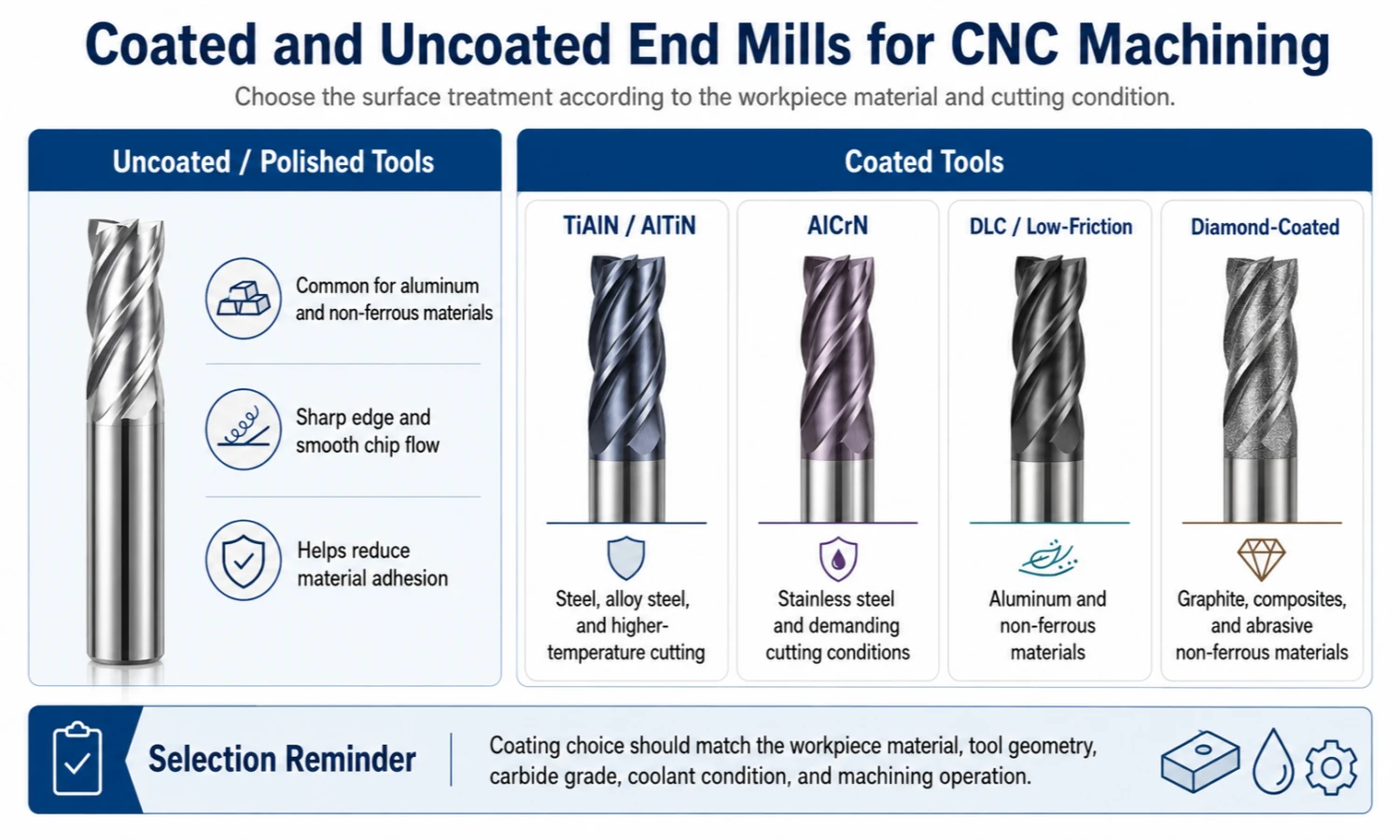
Schritt 5: Wählen Sie beschichtete oder unbeschichtete Schaftfräser
Die Beschichtung beeinflusst die Reibung, Hitzebeständigkeit, Verschleißfestigkeit, Materialhaftung, und modernster Schutz.
Verwenden Sie die folgende Tabelle als Auswahlrichtung und nicht als feste Regel.
| Werkstückrichtung | Beschichtungs- oder Oberflächenrichtung | Hauptüberlegung |
|---|---|---|
| Aluminium und Nichteisenmaterialien | Unbeschichtet, Poliert, DLC, oder geeignete reibungsarme Beschichtung | Reduziert Adhäsion und unterstützt den Spanfluss |
| Kohlenstoff- und legierter Stahl | TiAlN, Altin, oder geeignete hitzebeständige Beschichtung | Hitzebeständigkeit und Kantenschutz |
| Edelstahl | AlCrN, TiAlN, Altin, oder anwendungsspezifische Beschichtung | Hitze, tragen, und Schnittstabilität |
| Graphit- und Schleifverbundwerkstoffe | Diamantbeschichtete Werkzeuge | Abrasive Verschleißfestigkeit |
| Allgemeine Anwendungen mit niedrigerer Geschwindigkeit | TiN- oder unbeschichtete Optionen | Schmierfähigkeit und allgemeiner Verschleißschutz |
Aluminium und Nichteisenmaterialien
Für Aluminium, Beginnen Sie mit einer scharfen Kante, polierte Flöte, und unbeschichteter oder reibungsarmer Oberfläche.
Eine Beschichtung mit hoher Hitzebeständigkeit ist für Aluminium nicht automatisch geeignet. Wenn die Oberfläche die Materialhaftung erhöht, Es kann zu Aufbauschneidenbildung und schlechtem Spanfluss kommen.
Stahl
Für Kohlenstoff- und legierten Stahl, TiAlN, Altin, TiSiN, oder eine andere geeignete hitzebeständige Beschichtung kann die Schneide schützen.
Mit steigender Werkstückhärte und Schnitttemperatur, Hartmetallsorte, Kantenvorbereitung, und Beschichtung gewinnen an Bedeutung.
Edelstahl
Für Edelstahl, Wählen Sie eine Beschichtung und Geometrie, die die Wärmekontrolle und Schnittstabilität unterstützt.
AlCrN, TiAlN, oder AlTiN können nützliche Startanweisungen liefern, Die endgültige Wahl sollte jedoch mit der Edelstahlsorte übereinstimmen, Betrieb, Flötenzahl, Kühlmittelzustand, und Schnittlast.
Diamantbeschichtete Werkzeuge
Diamantbeschichtete Schaftfräser eignen sich für Graphit, Verbundwerkstoffe, abrasive Nichteisenmaterialien, und andere spezifische Anwendungen.
Verwenden Sie die Diamantbeschichtung nicht als universelle Wahl für alle Metalle. Die Werkstückchemie und die Schnittbedingungen müssen kompatibel sein.
Die genaue Beschichtung sollte zur Hartmetallsorte passen, Werkzeuggeometrie, Werkstücksorte, Schneidvorgang, und Kühlmittelzustand.
Schritt 6: Bestätigen Sie Abmessungen und Geometrie
Der Fräserdurchmesser ist nur ein Teil der Werkzeugspezifikation.
Vor der Bestellung, bestätigen:
- Fräserdurchmesser
- Flötenlänge
- Gesamtlänge
- Schaftdurchmesser
- Erforderliche Bearbeitungstiefe
- Werkzeugreichweite
- Eckenradius
- Helixwinkel
- Flötenzählung
- Anforderung an den Mittenschnitt
- Maßtoleranz
Verwenden Sie das kürzeste praktische Werkzeug, das den Bearbeitungsbereich erreicht.
Wenn die erforderliche Reichweite groß, aber die Schnitttiefe gering ist, Wählen Sie ein Werkzeug mit langem Hals anstelle eines Schaftfräsers mit einer unnötig langen Spannut. Ein kürzerer Schneidabschnitt kann für eine bessere Steifigkeit sorgen.
Eine zu große Spannutenlänge oder Gesamtlänge erhöht das Risiko:
- Geschwätz
- Werkzeugablenkung
- Maßfehler
- Ungleichmäßiger Verschleiß
- Eckenabplatzer
- Werkzeugbruch
Wählen Sie einen kundenspezifischen Schaftfräser, wenn Standardabmessungen oder -geometrien das Merkmal nicht erreichen oder den erforderlichen Durchmesser nicht erreichen können, Eckradius, Toleranz, Beschichtung, oder Anwendungsziel.
Schritt 7: Überprüfen Sie die Maschine, Halter, und Spannbedingungen
Der richtige Schaftfräser kann in einer instabilen Konfiguration immer noch schlecht funktionieren.
Werkzeugüberhang
Ein langer Überhang verringert die Steifigkeit. Halten Sie das Werkzeug so nah am Halter, wie es die Bearbeitungstiefe zulässt.
Vor dem Wechseln der Beschichtung oder der Nutanzahl, Überprüfen Sie, ob der Fräser weiter als nötig herausragt.
Halterrundlauf
Unrundheit kann dazu führen, dass eine Schneidkante mehr Last trägt als die anderen. Dies führt zu ungleichmäßigem Verschleiß und kann zu einer schlechten Oberflächengüte führen, Abplatzen, oder vorzeitiger Ausfall.
Überprüfen Sie den Halter, Spannzange, Sauberkeit des Schafts, und Werkzeugsitz, wenn eine Nut mehr Verschleiß aufweist als die anderen.
Maschinensteifigkeit
Zustand der Spindel, Genauigkeit des Halters, Maschinenstruktur, und Werkstückspannung beeinflussen das Ergebnis.
Ein starres Hartmetallwerkzeug kann Bewegungen im Werkstück oder Halter nicht korrigieren.
Späne- und Kühlmittellieferung
Luft oder Kühlmittel müssen in den Schnittbereich gelangen.
Bei schlechter Lieferung können Späne in tiefen Taschen und Schlitzen zurückbleiben. Das Werkzeug schneidet diese Späne dann erneut, was die Hitze erhöht und die Kante beschädigt.
Werkstückspannung
Bewegungen am Werkstück können wie ein Werkzeugproblem aussehen.
Vor dem Messerwechsel, Stellen Sie sicher, dass die Vorrichtung das Teil sicher hält und dass der Werkzeugweg keine unnötigen Vibrationen erzeugt.
Wie sich das Werkstückmaterial auf die Auswahl des Schaftfräsers auswirkt
Werkstückmaterial bleibt wichtig, Es sollte jedoch zusammen mit dem Bearbeitungsvorgang berücksichtigt werden.
- Aluminium braucht scharfe Kanten und genügend Spanraum.
- Kohlenstoff- und legierter Stahl benötigen stärkere Schneidkanten und Verschleißfestigkeit.
- Edelstahl benötigt einen stabilen Schnitt, um die Hitze und die Kaltverfestigung zu kontrollieren.
- Gusseisen benötigt eine gute Abriebfestigkeit.
- Formen- und Werkzeugstahl erfordern eine auf die tatsächliche Härte abgestimmte Werkzeugserie.
- Titanlegierungen erfordern eine sorgfältige Wärmekontrolle und eine stabile Verbindung.
Für eine detaillierte Materialauswahl, lesen So wählen Sie einen Hartmetall-Schaftfräser aus.
Probleme bei der Auswahl und Einrichtung des Schaftfräsers
| Symptom | Mögliche Ursache | Erste Verstellrichtung |
|---|---|---|
| Chips-Paket im Slot | Zu viele Flöten, unzureichender Flötenraum, schlechte Spanabfuhr | Reduzieren Sie die Anzahl der Flöten, Verbesserung der Luft- oder Kühlmittelzufuhr, und prüfen Sie die Nutlänge |
| Werkzeugbruch | Chipverpackung, übermäßiger Überhang, Instabiler Halter, schweres Engagement | Verbessern Sie die Spanabfuhr, Reichweite verkürzen, Klemmung prüfen, und instabiles Engagement reduzieren |
| Rattermarken | Langer Überhang, schwaches Setup, sich wiederholende Schnittkräfte | Kürzen Sie das Werkzeug, Verbessern Sie die Klemmung, und berücksichtigen Sie die Geometrie mit variabler Helix |
| Schlechte Oberflächenbeschaffenheit | Abgenutzter Rand, Auslaufen, instabiles Futter, ungeeignetes Abschlussprofil | Überprüfen Sie das Werkzeug und den Halter, stabilisiert den Schnitt, und wählen Sie das richtige Profil aus |
| Schneller Kantenverschleiß | Falsche Hartmetallsorte, Beschichtung, oder Schnittzustand | Passen Sie Sorte und Beschichtung an das Material an, Härte, Hitze, und Betrieb |
| Eckenabplatzer | Scharfe Ecke unter schwerer Last, Vibration, Schnitt unterbrochen | Berücksichtigen Sie einen Eckenradius und verbessern Sie die Stabilität des Aufbaus |
| Aufbaukante aus Aluminium | Hohe Reibung, stumpfer Rand, raue Rillenoberfläche, schlechter Spanfluss | Verwenden Sie eine scharf polierte Geometrie und verbessern Sie die Spanabfuhr |
Ein Bearbeitungsproblem kann mehrere Ursachen haben. Eine bloße Änderung der Beschichtung oder der Anzahl der Nuten löst das Problem möglicherweise nicht.
Beginnen Sie mit der Einrichtung, Spanfluss, Werkzeugzustand, und Engagement. Bewerten Sie dann, ob die Werkzeuggeometrie geändert werden muss.
Häufige Fehler bei der Auswahl des Schaftfräsers
Auswahl nur nach Durchmesser
Zwei Schaftfräser mit demselben Durchmesser können unterschiedliche Spannutenlängen haben, Flöte zählt, Abschlussprofile, Hartmetallsorten, Beschichtungen, und Anwendungen.
Überprüfen Sie immer die vollständige Spezifikation.
Spanabfuhr ignorieren
Eine schlechte Spanabfuhr verursacht Hitze, Spannachschneiden, Aufbaukante, Geschwätz, und Werkzeugbruch.
Dieses Problem tritt besonders häufig beim Schlitzen über die gesamte Breite auf, tiefe Taschenbildung, und Aluminiumbearbeitung.
Verwendung eines zu großen Werkzeugüberhangs
Eine zu große Reichweite verringert die Steifigkeit.
Verwenden Sie das kürzeste Werkzeug, das die Bearbeitungstiefe sicher erreicht. Wenn die Funktion tief ist, Erwägen Sie ein Langhalsdesign mit der minimal erforderlichen Schnittlänge.
Auswahl mehrerer Nuten, ohne den Spanraum zu prüfen
Mehr Schneidkanten verbessern die Vorschubfähigkeit und die Oberflächenkonsistenz, wenn der Eingriff gering ist und der Spanfluss stabil bleibt.
In tiefer Schlitzung, Jedoch, Eine übermäßige Anzahl an Nuten kann Späne festhalten und den Fräser beschädigen.
Eine Beschichtung nur nach Namen auswählen
Eine teurere Beschichtung ist nicht automatisch besser.
Passen Sie die Beschichtung an das Material an, Hartmetallsorte, Geometrie, Kühlmittel, Schnitttemperatur, und Betrieb.
Verwendung eines Schaftfräsers für jede Operation
Ein Schruppfräser, Endbearbeitungswerkzeug, Schlitzfräser, und Kugelfräser erfüllen unterschiedliche Aufgaben.
Wählen Sie den Schaftfräser entsprechend der Funktion und der Bearbeitungsstufe aus, anstatt für jeden Arbeitsgang ein allgemeines Werkzeug zu verwenden.
Häufig gestellte Fragen
Kann ein Schaftfräser ein Loch bohren??
Einige Schaftfräser mit Mittenschnitt unterstützen Ramping, spiralförmiger Eintritt, oder begrenztes Eintauchen. Jedoch, Sie sollten einen Bohrer nicht automatisch ersetzen.
Bestätigen Sie die Mittengeometrie, Fräserdurchmesser, Werkstückmaterial, und programmierte Eintrittsmethode, bevor Sie einen Schaftfräser für den axialen Eintritt verwenden.
Sollte ich Hartmetall oder HSS für eine Maschine mit geringer Steifigkeit wählen??
HSS oder HSS-Co können bei langsameren oder weniger steifen Maschinen für mehr Robustheit und Vibrationstoleranz sorgen.
Hartmetall sorgt für höhere Steifigkeit und Verschleißfestigkeit, aber es braucht eine stabile Halterung, kontrollierter Rundlauf, und zuverlässiges Spannen.
Warum bricht ein Schaftfräser beim Schlitzen??
Häufige Ursachen sind Chip-Packung, übermäßige Flötenanzahl, zu großer Werkzeugüberhang, instabile Klemmung, schweres Engagement, und schlechte Kühlmittel- oder Luftzufuhr.
Überprüfen Sie die Spanabfuhr und die Stabilität des Aufbaus, bevor Sie davon ausgehen, dass die Hartmetallsorte das einzige Problem ist.
Wann sollte ich einen Schaftfräser mit variabler Helix wählen??
Wählen Sie eine Geometrie mit variabler Helix oder ungleicher Steigung, wenn sich wiederholende Schnittkräfte beim Seitenfräsen zu Rattern führen, Profilierung, oder beenden.
Das Design kann Vibrationen reduzieren, es bedarf aber dennoch einer starren Halterung und einer stabilen Werkstückspannung.
Wann sollte ich einen Schaftfräser mit langem Hals anstelle eines Schaftfräsers mit langer Spannut verwenden??
Verwenden Sie ein Werkzeug mit langem Hals, wenn das Merkmal eine größere Reichweite, aber nur einen kurzen Schnittabschnitt benötigt.
Die reduzierte Spannutenlänge bietet normalerweise mehr Halt als eine unnötig lange Schneidkante.
Welche Informationen helfen bei der Anfrage eines kundenspezifischen Schaftfräsers??
Senden Sie die verfügbaren Werkzeugabmessungen, Zeichnung, Produktbild, Werkstückmaterial, Bearbeitungsvorgang, erforderliche Funktion, aktuelles Werkzeugmodell, Menge, und jedes bestehende Bearbeitungsproblem.
Sie müssen nicht jedes Detail vorbereiten, bevor Sie den Lieferanten kontaktieren. Fehlende Spezifikationen können im Rahmen des Angebotsprozesses bestätigt werden.
Benötigen Sie Hilfe bei der Auswahl des richtigen Schaftfräsers??
Der richtige Schaftfräser hängt vom Bearbeitungsvorgang ab, Werkstückmaterial, Merkmalsform, erforderliche Abmessungen, Maschineneinrichtung, und Oberflächenbeschaffenheitsziel.
Schicken Sie uns Ihre Zeichnung, Werkzeugmodell, erforderliche Abmessungen, Produktbild, Probe, oder verfügbare Bearbeitungsinformationen. Mit 16 Jahrelange Erfahrung in der Herstellung von Schneidwerkzeugen, Wir können die Anwendung überprüfen und dabei helfen, eine geeignete Standard- oder kundenspezifische Werkzeugrichtung zu ermitteln.
Sehen Sie sich unseren Standard und unsere Sonderanfertigungen an Produktseite für Schaftfräser.
Um Ihre Bewerbung zu besprechen, Schicken Sie uns eine E-Mail an sales@cutterbest.com.