 Fresas de precisión,Herramientas de corte para el mecanizado CNC de todos los materiales

en un 2 flauta vs. 4 comparación de fresas de extremo de flauta, la decisión principal es cómo equilibrar la evacuación de virutas, recuento de vanguardia, soporte de herramientas, y el resultado de mecanizado requerido.
A menudo se prefiere una cortadora de dos canales cuando la eliminación de virutas es el principal desafío.. Los ejemplos típicos incluyen ranuras de ancho completo, bolsillos cerrados, y mecanizado de alto volumen de viruta en aluminio u otros materiales no ferrosos.
A menudo se selecciona una cortadora de cuatro flautas cuando las virutas pueden salir de la zona de corte de manera confiable y la operación se beneficia de más contactos de corte., mayor apoyo central, o fresado lateral estable y acabado.
Sin embargo, El número de flautas no es el único factor de selección.. Diámetro del cortador, profundidad de la flauta, alcance de la herramienta, material de la pieza de trabajo, revestimiento, compromiso, rigidez de la máquina, y el suministro de refrigerante también afectan el resultado.
Respuesta rápida
Utilice un 2-fresa de ranura cuando la operación crea un alto volumen de viruta o restringe la evacuación de viruta. Es una dirección inicial común para ranuras de ancho completo., bolsillos profundos, mecanizado de aluminio, y otros cortes con muchas virutas.
Utilice un 4-fresa de ranura cuando el espacio para las virutas es suficiente y el proceso se beneficia de más filos de corte. Se considera comúnmente para fresado lateral., Perfiles, semiacabado, refinamiento, y muchas aplicaciones de acero.
Ningún diseño es automáticamente mejor para cada trabajo. La elección correcta depende de dónde se acopla el cortador., cómo salen las patatas fritas del corte, y si el espacio del chip, rigidez, productividad, o terminar es la principal prioridad.
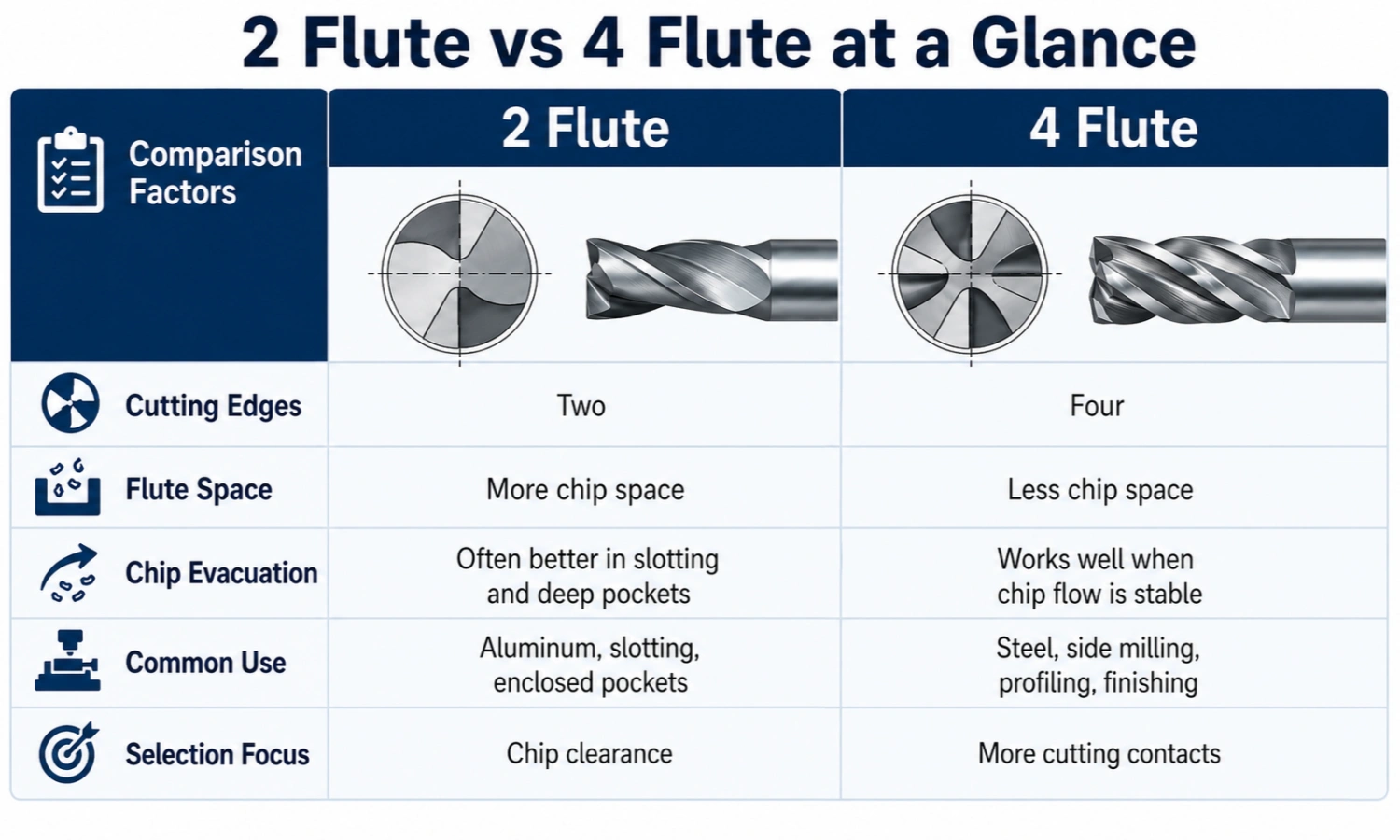
2 Flauta vs. 4 Fresa de extremo de flauta de un vistazo
| Factor | 2-Dirección de flauta | 4-Dirección de flauta |
|---|---|---|
| Bordes cortantes | Dos filos de corte | Cuatro filos de corte |
| Espacio de flauta | Más espacio para patatas fritas | Menos espacio entre los filos de corte |
| Evacuación de virutas | A menudo es útil en cortes cerrados o con muchas astillas. | Adecuado cuando las virutas pueden salir del corte de forma fiable |
| Soporte básico | Depende de la profundidad y la geometría de la flauta. | A menudo permite más soporte básico. |
| Ranurado de ancho completo | Común cuando el volumen de viruta es alto | Requiere un espacio libre de viruta adecuado |
| Fresado lateral | Adecuado cuando la evacuación de viruta sigue siendo importante | A menudo es útil con un compromiso radial más ligero. |
| Acabado superficial | Puede producir un buen acabado en condiciones estables. | Más contactos de corte pueden ayudar al acabado |
| Dirección de materiales | Común en cortes de aluminio y no ferrosos. | Común en muchas aplicaciones de acero y acabado. |
| Enfoque de selección principal | Espacio de chip y evacuación. | Soporte de herramientas y recuento de vanguardia |
 Cómo el número de flautas cambia el rendimiento de corte
Espacio de flauta y evacuación de virutas
Un cortador tiene un espacio limitado entre sus filos y su núcleo..
Con dos flautas, Normalmente se puede asignar una mayor parte del diámetro de la fresa a las ranuras de las ranuras.. Por lo tanto, Las virutas tienen más espacio para formarse y alejarse de la zona de corte..
Esto puede ser útil durante:
- Ranurado de ancho completo
- Fresado de cajeras profundas o cerradas
- Mecanizado de aluminio
- Mecanizado de plástico
- Otras operaciones de alto volumen de chips
Un cortador de cuatro flautas tiene más filos de corte dentro del mismo diámetro. Como resultado, las ranuras individuales de las flautas suelen ser más pequeñas.
Esto no significa que una herramienta de cuatro canales no pueda evacuar virutas.. En cambio, significa que la aplicación debe proporcionar suficiente espacio, refrigerante, aire, o movimiento de la trayectoria de la herramienta para que las virutas salgan del corte..
Filos de corte y capacidad de avance
Una cortadora de dos flautas tiene dos contactos de corte por revolución, mientras que un cortador de cuatro flautas tiene cuatro.
Con la misma velocidad de giro y carga de viruta por diente, La herramienta de cuatro flautas requeriría un avance programado más alto porque entran más bordes cortantes en el material durante cada revolución..
Sin embargo, Este avance más alto sólo es práctico cuando:
- La evacuación de viruta se mantiene estable
- La potencia de la máquina es suficiente.
- El encaje de la herramienta es adecuado
- El calor de corte está controlado
- La pieza de trabajo y el soporte son rígidos.
- La geometría de la fresa coincide con el material.
Por lo tanto, cuatro canales no significan automáticamente un mecanizado más rápido. Asimismo, dos canales no significan automáticamente una menor productividad.
El avance utilizable depende de las condiciones generales de mecanizado..
Soporte central y rigidez de la herramienta
Un diseño de cuatro flautas a menudo permite que quede más material cerca del núcleo de la herramienta.. Esto puede proporcionar un mayor soporte central en algunos diseños de cortadores..
Sin embargo, La rigidez real también depende de:
- Diámetro del cortador
- Profundidad de la flauta
- longitud de la flauta
- Longitud total de la herramienta
- Saliente de herramienta
- ángulo de hélice
- Grado de carburo
- Condición del titular
Un cortador corto de dos canales puede ser más estable que un cortador largo de cuatro canales del mismo diámetro. Por esta razón, El número de flautas no debe usarse como única medida de la rigidez de la herramienta..
Acabado superficial y estabilidad de corte
Más filos de corte pueden proporcionar contactos de corte más frecuentes. Por lo tanto, una cortadora de cuatro flautas puede brindar un acabado uniforme durante las operaciones de acabado y fresado lateral adecuadas.
Sin embargo, El acabado superficial también depende de:
- Desviación de la herramienta
- Calidad de vanguardia
- Alimentación por diente
- Compromiso radial
- Deflexión de la herramienta
- Estabilidad de la máquina
- Sujeción de piezas
- Estrategia de trayectoria
Un cortador de dos flautas bien seleccionado aún puede producir una superficie con buen acabado., especialmente en aluminio y otros materiales no ferrosos.
Para una explicación más amplia del espacio de la flauta, diámetro del núcleo, ángulo de hélice, y selección de recuento de flautas, lee nuestro Guía de diseño y selección de flautas de fresado final..
Cuándo utilizar una fresa de extremo de 2 flautas
Ranurado de ancho completo
El ranurado de ancho completo engancha el cortador en todo su diámetro. Como consecuencia, La operación produce un alto volumen de viruta mientras que las paredes de la ranura restringen las rutas de salida de viruta disponibles..
A menudo se considera una fresa de dos canales porque sus ranuras más anchas proporcionan más espacio para las virutas..
El posicionamiento estable también depende de:
- Profundidad de la ranura
- Diámetro del cortador
- longitud de la flauta
- Saliente de herramienta
- Entrega de aire o refrigerante
- Rigidez de la máquina
- Parámetros de corte
Una ranura poco profunda y una ranura profunda no crean las mismas condiciones de corte. Por lo tanto, la herramienta y la estrategia de corte deben coincidir con la característica real.
Bolsillos profundos o cerrados
Las virutas pueden permanecer dentro de un bolsillo profundo o cerrado en lugar de salir de la zona de corte..
Cuando se vuelven a cortar las virutas, El calor de corte y la carga de la herramienta pueden aumentar.. Marcas de superficie, borde construido, y también se puede desarrollar daño temprano en los bordes.
Una cortadora de dos canales puede proporcionar una útil eliminación de virutas en estas aplicaciones.. Sin embargo, profundidad del bolsillo, método de entrada, compromiso lateral, alcance de la herramienta, y el acceso al refrigerante aún debe revisarse.
Mecanizado de aluminio y no ferrosos
Muchas aleaciones de aluminio producen virutas relativamente grandes o continuas.. Cobre, latón, y los plásticos seleccionados también pueden requerir una eliminación de virutas fiable.
Para estos materiales, se puede utilizar una herramienta de dos flautas:
- Bordes cortantes afilados
- Superficies de flauta lisas o pulidas
- Espacio de flauta adecuado
- Preparación de bordes específica para la aplicación
- Aire confiable, neblina, o entrega de refrigerante
Un diseño de dos flautas no es la única opción para el aluminio. Las cortadoras de tres canales y de cuatro canales para aplicaciones específicas también pueden funcionar bien en ciertas condiciones de fresado lateral o acabado..
La selección debe basarse en la operación y no solo en el nombre del material..
Otras operaciones con gran cantidad de chips
Las herramientas de dos canales también pueden admitir aplicaciones de desbaste ligero y ranurado de acero seleccionado cuando la evacuación de viruta es difícil..
La pregunta clave es:
¿La operación crea más virutas de las que el espacio disponible para la flauta puede eliminar de manera confiable??
Si la respuesta es si, un recuento de flautas más bajo puede proporcionar una dirección inicial útil.
Para ejemplos detallados de aplicaciones de dos flautas, leer que 2 El molino de extremo de flauta se utiliza para.
Vea nuestros estándares y personalizados carburo sólido 2 fresa de ranura opciones.
Cuándo utilizar una fresa de extremo de 4 flautas
Fresado lateral y perfilado
Durante el fresado lateral, sólo una parte del diámetro de la fresa puede engancharse en la pieza de trabajo. Las fichas suelen tener más espacio abierto para dejar que durante el ranurado de ancho completo.
En esta situación, una herramienta de cuatro flautas puede proporcionar:
- Más contactos de corte
- Mayor soporte central en muchos diseños
- Corte radial estable
- Perfiles consistentes
- Mayor productividad en condiciones adecuadas
Sin embargo, El compromiso radial debe seguir siendo apropiado.. El acoplamiento lateral intenso aún puede generar calor, desviación, y problemas de control de chips.
Semiacabado y Acabado
Las cortadoras de cuatro flautas se usan comúnmente para semiacabado y acabado porque la operación a menudo crea un volumen de viruta menor que el desbaste de ancho completo..
Es posible que se admitan más contactos de corte:
- Acabado de pared consistente
- Fresado de contorno estable
- Perfilado más suave
- Mayor avance programado en condiciones adecuadas
Aún, una herramienta de cuatro flautas no garantiza una mejor superficie.
Sin, avance por diente, calidad del borde, trayectoria de herramienta, compromiso radial, y la rigidez de la máquina siguen siendo importantes.
Aplicaciones de acero y acero inoxidable
Las fresas de cuatro canales se utilizan ampliamente para muchas operaciones de mecanizado de acero y acero inoxidable..
En estos materiales, la herramienta puede beneficiarse de:
- Mayor apoyo central
- Más bordes cortantes
- Recubrimiento adecuado
- Enganche radial controlado
- Condiciones estables de la máquina y los accesorios.
Sin embargo, la categoría del material por sí sola no determina el número de flautas.
Por ejemplo, El ranurado de ancho completo en acero aún puede requerir dos o tres canales cuando la evacuación de viruta es limitada.. El acero inoxidable también requiere un control cuidadoso del calor de corte., endurecimiento por trabajo, revestimiento, y fuerza del borde.
Operaciones con evacuación de viruta estable
Una cortadora de cuatro flautas se vuelve más práctica cuando las virutas pueden salir de la zona de corte sin acumularse alrededor de la herramienta..
Esto puede ocurrir durante:
- fresado lateral
- perfilado poco profundo
- Acabado de bolsillo abierto
- Semiacabado
- Cortes radiales ligeros
- Operaciones con suministro eficaz de refrigerante o aire.
Cuando el espacio del chip ya no es la principal limitación, El recuento de vanguardia y el soporte de herramientas pueden recibir mayor prioridad..
2 Flauta vs. 4 Flauta por material de pieza de trabajo
La siguiente tabla muestra direcciones iniciales comunes en lugar de reglas fijas..
| Material | Dirección inicial común | ¿Qué puede cambiar la elección? |
|---|---|---|
| Aluminio | Dos o tres flautas para cortes con muchas virutas | fresado lateral, refinamiento, Grado de aleación y refrigerante. |
| Cobre | Dos canales para evacuación de virutas | Grado de cobre, control de rebabas y acabado |
| Latón | Pueden funcionar dos o más flautas | Grado de latón, forma de viruta y operación de mecanizado |
| Plástica | Una o dos flautas son comunes. | Tipo de plástico, Cortar los requisitos de calor y bordes. |
| Acero | Cuatro flautas son comunes. | Ranurado completo, diámetro de la herramienta, revestimiento y profundidad |
| Acero inoxidable | Cuatro canales se adaptan a muchas operaciones | Endurecimiento por trabajo, compromiso, refrigerante y resistencia del borde |
| Hierro fundido | Pueden funcionar varios recuentos de flautas | Abrasividad, corte en seco, polvo y operación |
| Compuestos seleccionados | Se requiere un cortador específico para la aplicación | Estructura de materiales, abrasividad y calidad del borde |
Esta tabla debe utilizarse como guía inicial.. La decisión final también debe reflejar el diámetro de la herramienta., profundidad de corte, condición de la máquina, y acabado requerido.
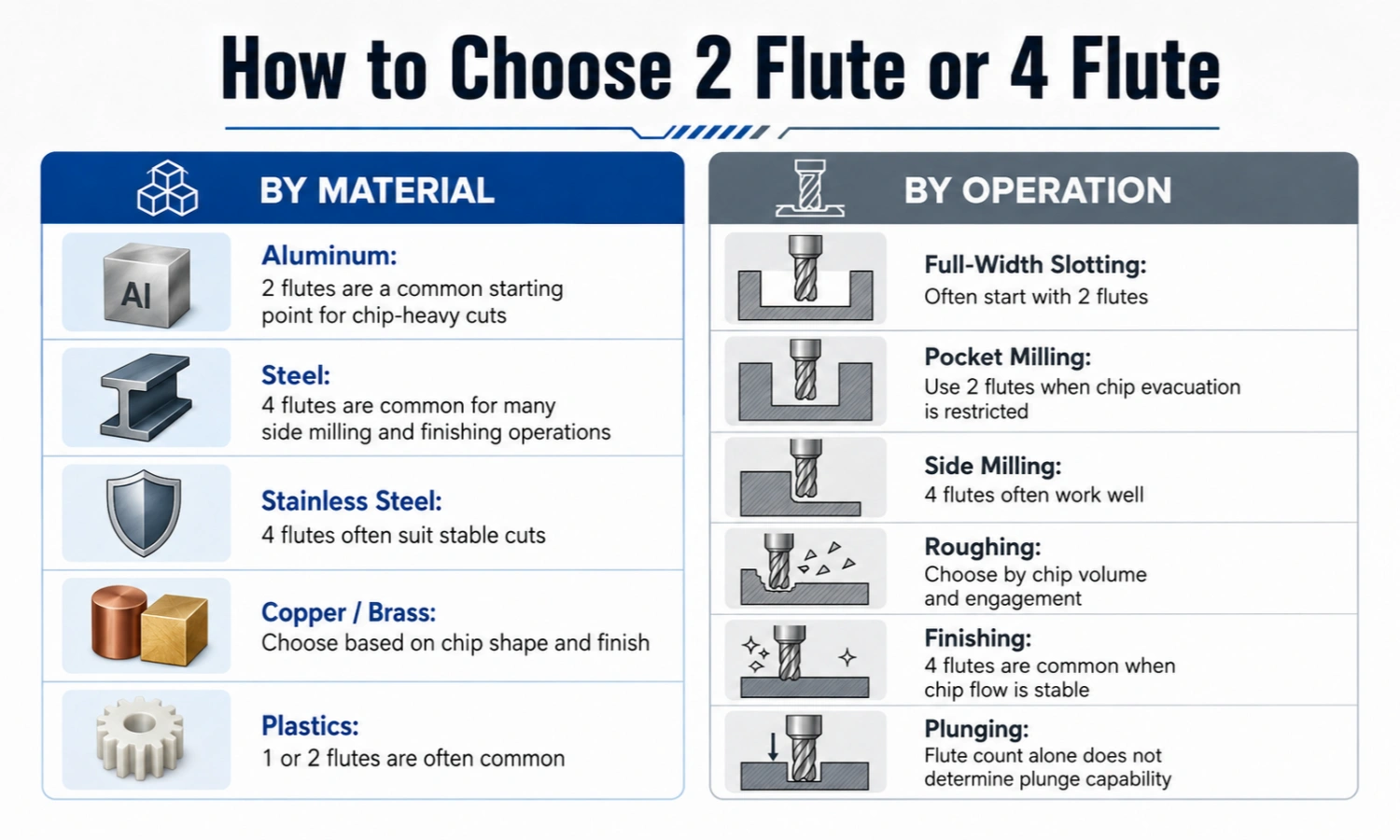
2 Flauta vs. 4 Flauta por operación CNC
Ranurar
Para ranuras de ancho completo, Dos canales son a menudo un punto de partida práctico porque la operación produce un alto volumen de viruta y restringe el movimiento de la misma..
Una cortadora de cuatro flautas aún puede realizar ranuras superficiales o controladas cuando:
- La ranura no es profunda.
- La evacuación de virutas es fiable
- El material produce virutas manejables.
- Los parámetros de corte están ajustados correctamente.
Cuanto más profunda y cerrada se vuelve la ranura, el espacio de la flauta más importante generalmente se vuelve.
Fresado de bolsillo
El fresado de cajeras incluye tanto el movimiento de entrada como el recorrido posterior de retirada de material..
Un cortador de dos flautas puede ser adecuado para bolsillos profundos o cerrados donde el empaque de virutas es una preocupación. Una cortadora de cuatro flautas puede ser adecuada para el corte lateral o el acabado después de abrir la cavidad principal..
Por lo tanto, un bolsillo puede implicar diferentes requisitos de número de flautas durante diferentes etapas de la operación.
Fresado lateral y perfilado
Para fresado lateral, La evacuación de virutas suele estar menos restringida que en el ranurado de ancho completo..
Cuatro flautas pueden admitir más contactos de corte y perfiles estables. Sin embargo, dos flautas aún pueden funcionar bien al mecanizar aluminio, plástica, u otros materiales que se benefician de espacio adicional en el chip.
La selección debe reflejar el compromiso radial., acabado requerido, y rigidez de la herramienta.
Desbaste
El desbaste no significa automáticamente que se requieran dos canales.
El desbaste de ancho completo o de alto volumen de viruta puede beneficiarse de menos ranuras. En contraste, El desbaste lateral con enganche radial controlado puede utilizar tres, cuatro, o más bordes cortantes.
Las fresas de desbaste dedicadas también pueden utilizar rompevirutas o geometría dentada.. Por lo tanto, no deben seleccionarse únicamente por el recuento de flautas.
Acabado
Las cortadoras de cuatro flautas son comunes en el acabado porque el volumen de viruta suele ser menor y una mayor cantidad de contactos de corte puede mejorar la continuidad del mecanizado..
Sin embargo, el conteo de flautas no puede compensar:
- Escurrimiento excesivo
- Sujeción inestable
- Avance incorrecto por diente
- Saliente largo de la herramienta
- Mala trayectoria
- Bordes cortantes desgastados
Una cortadora de dos flautas también puede producir un buen acabado superficial cuando coincide con el material y las condiciones de corte..
Hundirse y rampar
El número de flautas no determina si una fresa puede hundirse.
Tanto los cortadores de dos canales como los de cuatro canales pueden fabricarse con geometría de corte central o sin corte central.. Antes de programar la inmersión recta, rampa, o entrada helicoidal, Confirmar que los bordes cortantes finales y el diseño de la herramienta soportan el movimiento requerido..
Para obtener orientación detallada, leer ¿Puedes sumergirte con una fresa?.
Lista de verificación de selección rápida
Antes de elegir entre dos y cuatro flautas, confirmar:
- ¿Qué material estás mecanizando??
- ¿La operación es ranurado de ancho completo o fresado lateral??
- ¿Cuánto volumen de chip se producirá??
- ¿Está restringida la evacuación de virutas??
- ¿El bolsillo es profundo o cerrado??
- ¿Es el acabado de la superficie más importante que el espacio de las flautas??
- ¿Cuánto tiempo sobresale la herramienta??
- ¿La configuración de la máquina y los accesorios es rígida??
- ¿Puede llegar refrigerante o aire a la zona de corte??
- ¿La operación requiere geometría de corte central??
- ¿La fresa está diseñada para desbastar?, semiacabado, o terminando?
Elija dos flautas cuando el espacio del chip sea la principal limitación.
Elija cuatro canales cuando la evacuación de viruta sea estable y el proceso se beneficie de más contactos de corte o mayor soporte del núcleo..
Para una comparación más amplia del recuento de flautas, leer comparar 2, 4, y 6 Fresas de ranurar.
Preguntas frecuentes sobre 2 Flauta vs. 4 Fresas de extremo de flauta
¿Cuál es la principal diferencia entre 2 y 4 Fresas de extremo de flauta?
La principal diferencia es el equilibrio entre el espacio de la flauta y el conteo de vanguardia..
Un cortador de dos canales normalmente proporciona más espacio para las virutas.. Un cortador de cuatro flautas proporciona más filos de corte y, a menudo, permite un mayor soporte del núcleo..
El rendimiento real aún depende de la geometría completa de la herramienta y de las condiciones de mecanizado..
Es 2 flauta o 4 Flauta mejor para aluminio?
Dos flautas son una opción común para el ranurado de aluminio., embolsarse, y otros cortes de alto volumen de viruta.
Sin embargo, Una fresa de aluminio de cuatro flautas puede funcionar bien durante el fresado lateral o el acabado cuando su geometría proporciona un espacio libre de viruta adecuado..
La operación es tan importante como el material..
¿Es buena una fresa de extremo de 4 flautas para acero??
Sí. Las fresas de cuatro canales se utilizan comúnmente para fresado lateral., semiacabado, y acabado en acero.
Sin embargo, El ranurado de ancho completo o los cortes profundos pueden requerir menos canales cuando la evacuación de viruta se vuelve difícil..
Capa, geometría del cortador, rigidez, y las condiciones de corte también deben coincidir con el grado del acero..
¿Puede una fresa de extremo de 4 flautas cortar aluminio??
Sí. Una cortadora de cuatro flautas puede mecanizar aluminio cuando su geometría de flauta, preparación de bordes, y las condiciones de corte se adaptan al material.
Puede resultar útil para fresado lateral o acabado más ligero.. Para ranurado profundo o eliminación de virutas pesadas, menos flautas suelen ser más fáciles de manejar.
¿Qué número de flautas es mejor para ranuras de ancho completo??
A menudo se prefieren dos canales porque las ranuras de ancho completo producen un alto volumen de viruta y limitan las rutas de salida de las virutas..
Sin embargo, una fresa de cuatro flautas puede funcionar en ranuras poco profundas cuando la evacuación de viruta se mantiene estable y los parámetros de corte son adecuados.
¿Cuál es mejor para el fresado lateral??
Cuatro canales suelen ser útiles para el fresado lateral porque las virutas tienen más espacio abierto para salir., mientras que los filos de corte adicionales pueden respaldar la productividad y el acabado.
Sin embargo, Todavía se pueden preferir dos flautas en aluminio., plástica, u otras aplicaciones donde la eliminación de virutas sigue siendo importante.
¿Una fresa de 4 flautas siempre ofrece un mejor acabado??
No. Más bordes cortantes pueden ayudar en algunas operaciones de acabado., pero no garantizan una mejor superficie.
Sin, calidad del borde, avance por diente, compromiso radial, deflexión de la herramienta, estabilidad de la máquina, y la trayectoria también afectan el resultado.
¿Puede una fresadora de extremo de 2 flautas de acero inoxidable??
Algunas cortadoras de dos flautas pueden mecanizar acero inoxidable., particularmente durante el ranurado u operaciones donde la evacuación de virutas está restringida.
Sin embargo, El acero inoxidable también requiere un grado de carburo adecuado., revestimiento, fuerza del borde, estrategia de refrigerante, y control del endurecimiento por trabajo.
Se debe revisar la aplicación exacta..
¿El recuento de flautas determina la capacidad de inmersión??
No. La capacidad de inmersión depende de la geometría del extremo., especialmente si el cortador tiene bordes de corte centrales.
Una herramienta de dos o cuatro canales puede ser de corte central o no central..
Confirme siempre la especificación de la herramienta antes de la entrada axial..
Guías relacionadas
Para más información, leer:
Carburo sólido 2 fresa de ranura
¿Qué es un 2 fresa de extremo de flauta utilizada para?
¿Puedes sumergirte con una fresa??
Comparar 2, 4, y 6 Fresas de ranurar
Diseño y selección de flautas de fresado final.
Necesita ayuda para elegir 2 o 4 Flautas?
Envíanos el material de tu pieza, operación de mecanizado, tamaño del cortador, profundidad de corte, alcance de la herramienta, dibujo, modelo de referencia, y cantidad requerida cuando esté disponible.
Revisaremos la información y ayudaremos a identificar si hay espacio en el chip., recuento de vanguardia, soporte de herramientas, o los requisitos de superficie deberían recibir mayor prioridad.
Correo electrónico: sales@cutterbest.com