 Fresas de precisión,Herramientas de corte para el mecanizado CNC de todos los materiales

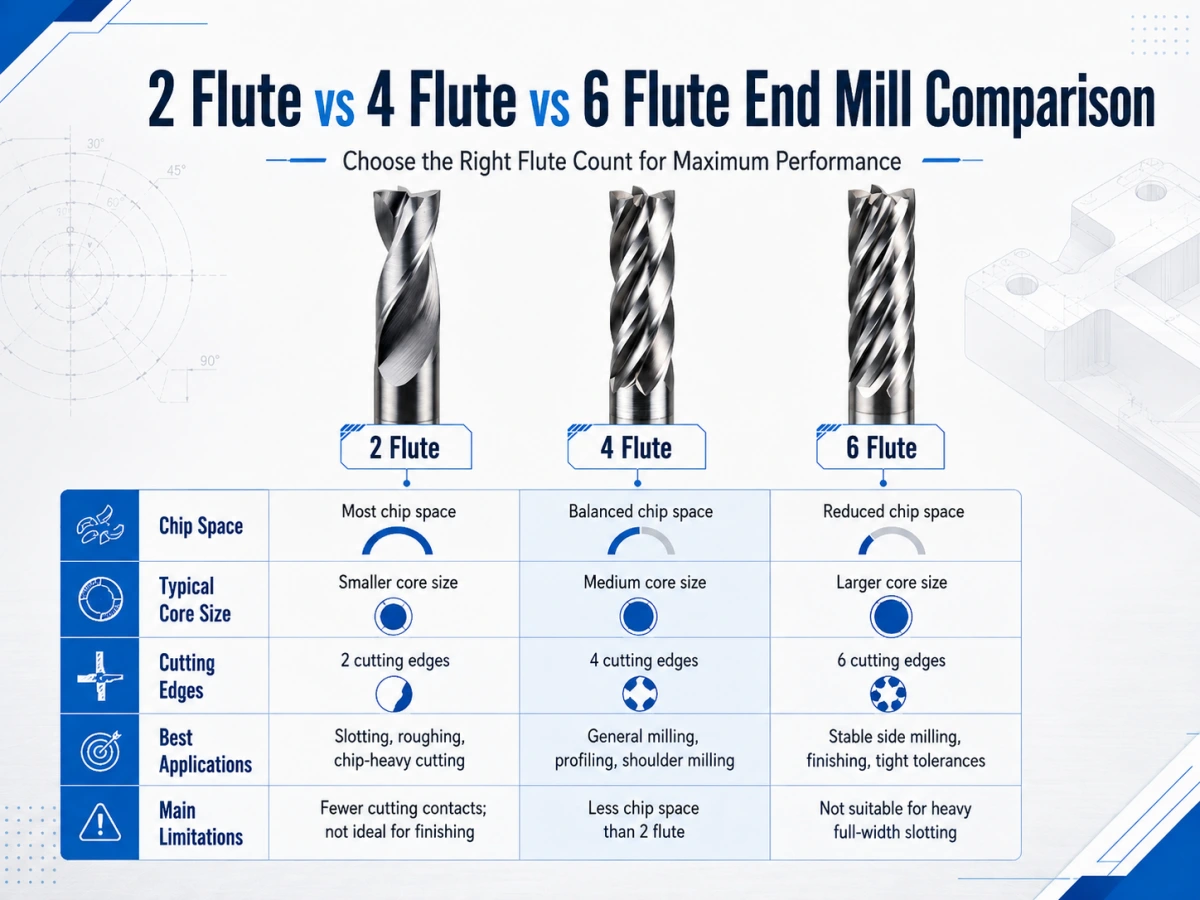
Este 2 flauta vs. 4 flauta vs. 6 La guía de fresas de ranurar explica cómo el número de ranuras afecta el espacio de viruta, tamaño típico del núcleo, contactos de corte, potencial de avance, y acabado superficial.
Utilice dos canales cuando el volumen de viruta sea la principal limitación. Elija cuatro flautas cuando necesite una cortadora equilibrada de uso general. Seleccione seis flautas cuando el compromiso esté controlado y más contactos de corte admitan un fresado lateral o acabado estable.
La elección final también depende del material de la pieza., diámetro del cortador, profundidad de corte, compromiso radial, saliente de la herramienta, condición del titular, rigidez de la máquina, y acabado superficial requerido.
Rápido 2 Flauta vs. 4 Flauta vs. 6 Comparación de fresas de extremo de flauta
| Comparación | 2 Flauta | 4 Flauta | 6 Flauta |
|---|---|---|---|
| Espacio de chip | Mayoría | Equilibrado | Reducido |
| Bordes cortantes | 2 | 4 | 6 |
| Tamaño de núcleo típico | Menor | Medio | Más grande |
| Aplicación común | Ranurado y corte con gran cantidad de virutas | Fresado y perfilado en general | Fresado lateral y acabado estables |
| Ventaja principal | Evacuación de virutas más sencilla | Equilibrio de espacio en fichas y recuento de aristas | Más contactos de corte |
| Limitación principal | Menos contactos de corte | Menos espacio en el chip que 2 flautas | No apto para ranuras pesadas de ancho completo |
Estas son direcciones de diseño típicas.. El diámetro real del núcleo y la rigidez de la herramienta también dependen de la profundidad de la ranura., diámetro del cortador, ángulo de hélice, longitud de la flauta, diámetro del cuello, y la geometría completa de la herramienta.
Por qué el número de flautas cambia el rendimiento de corte
El recuento de flautas cambia principalmente tres partes del proceso de corte.:
- Espacio de chip
- Conteo de vanguardia
- Tamaño de núcleo típico
Un cortador con menos estrías normalmente tiene ranuras más anchas.. El espacio adicional ayuda a sacar las fichas más grandes de una ranura o bolsillo antes de volver a cortarlas..
Esto es especialmente importante en aluminio., plástica, y otros materiales que pueden producir virutas grandes o continuas. Cuando las ranuras de la flauta son demasiado pequeñas, Las virutas pueden acumularse dentro de la zona de corte., creciente fricción, calor, y riesgo de rotura de herramientas.
Una cortadora con más canales proporciona más contactos de corte durante cada revolución del husillo.. Puede admitir velocidades de avance calculadas más altas y un acabado más consistente cuando se controla el compromiso..
Sin embargo, más flautas también dejan menos espacio para las virutas. Por lo tanto, aumentar el número de canales sin revisar la operación de corte puede empeorar el rendimiento en lugar de mejorarlo.
Para explicaciones detalladas sobre la profundidad de la flauta, diámetro del núcleo, ángulo de hélice, tono desigual, y longitud de la flauta, lee nuestro guía de selección de flautas de fresado final.
Cómo el recuento de canales afecta la velocidad de alimentación
El recuento de canales es parte del cálculo de la velocidad de avance.:
Velocidad de avance = RPM × Número de canales × Carga de viruta por diente
Con la misma velocidad de giro y carga de viruta por diente, aumentar el número de canales aumenta la velocidad de avance calculada.
Por ejemplo, una herramienta de 4 flautas tiene el doble de contactos de corte por revolución que una herramienta de 2 flautas. Sin embargo, Esto no significa que la velocidad de avance real siempre pueda duplicarse..
El aumento alcanzable está limitado por:
- Evacuación de virutas
- Compromiso con la herramienta
- potencia del husillo
- Rigidez de la máquina
- Precisión del soporte
- Sujeción de piezas
- Geometría de la herramienta
- Material de la pieza de trabajo
Más canales no crean una capacidad de velocidad de avance ilimitada. Comience siempre con los parámetros recomendados para la serie de herramientas específica., diámetro del cortador, material, y operación de mecanizado.
¿Para qué es mejor una fresa de extremo de 2 flautas??
Una fresa de extremo de 2 flautas proporciona dos filos de corte y ranuras de flauta relativamente grandes. Este diseño proporciona a las virutas más espacio para salir de la zona de corte..
Las herramientas de dos flautas se seleccionan comúnmente para:
- Mecanizado de aluminio
- Mecanizado de latón y cobre.
- Mecanizado de plástico
- Ranurado de ancho completo
- Bolsillos profundos
- Desbaste de materiales blandos
- Operaciones que generan un alto volumen de viruta
Durante el ranurado de ancho completo, todo el diámetro de la fresa se acopla a la pieza de trabajo. Como resultado, la herramienta debe eliminar un gran volumen de virutas a través de las ranuras de las ranuras.
Un diseño de 2 canales reduce el riesgo de que las virutas queden atrapadas dentro de una ranura estrecha.. Esto puede ayudar a controlar el calor., borde construido, y recorte de virutas.
Sin embargo, dos flautas proporcionan menos contactos de corte que cuatro o seis flautas. Por lo tanto, una herramienta de 2 flautas puede tener una velocidad de avance y un potencial de acabado más bajos con la misma velocidad del husillo y carga de viruta por diente.
Un diseño de dos flautas tampoco significa automáticamente que la cortadora pueda sumergirse directamente en la pieza de trabajo.. rampa, entrada helicoidal, o la inmersión limitada requiere una geometría de corte central adecuada y una trayectoria de herramienta compatible.
Ver estándar y personalizado 2 Opciones de fresadora de extremo de flauta.
Para aplicaciones más detalladas, leer que es un 2 fresa de extremo de flauta utilizada para.
¿Qué pasa con las fresas de mango de 3 flautas para aluminio??
Las fresas de tres filos también se utilizan ampliamente para aluminio y otros materiales no ferrosos..
Proporcionan un filo más que un cortador de 2 flautas y al mismo tiempo retienen más espacio para las virutas que muchos diseños de 4 flautas.. Por lo tanto, pueden ofrecer un equilibrio útil de:
- Evacuación de virutas
- Rigidez de la herramienta
- Potencial de avance
- Conteo de vanguardia
- Acabado superficial
Elija dos flautas cuando el volumen de viruta sea alto, el bolsillo o ranura es profundo, o la evacuación de virutas es difícil.
Elija tres flautas para fresado general de aluminio cuando la eliminación de viruta sea estable y necesite más contactos de corte o un mejor potencial de acabado..
Bordes cortantes afilados, superficies de flauta pulidas, y un revestimiento adecuado de baja fricción o una superficie sin revestimiento también son importantes al mecanizar aluminio..
¿Para qué es mejor una fresa de extremo de 4 flautas??
Una fresa de extremo de 4 flautas ofrece un equilibrio práctico entre el espacio de viruta, recuento de vanguardia, tamaño del núcleo, y versatilidad de fresado general.
Las herramientas de cuatro flautas se utilizan comúnmente para:
- Mecanizado de acero al carbono
- Mecanizado de acero aleado
- Fresado general de acero inoxidable.
- fresado lateral
- Fresado en hombro
- Perfiles
- Semiacabado
- Mecanizado CNC general
Comparado con un cortador de 2 flautas, una herramienta de 4 flautas proporciona más contactos de corte por revolución del husillo. Puede admitir una velocidad de avance calculada más alta cuando la carga de viruta por diente y las condiciones de corte siguen siendo adecuadas..
Las ranuras adicionales también reducen el espacio disponible para las virutas.. Por esta razón, una cortadora de 4 flautas puede no ser la primera opción para ranuras profundas de ancho completo o cavidades de aluminio con muchas virutas.
Una herramienta de 4 flautas aún puede mecanizar aluminio durante el fresado lateral o el acabado ligero cuando:
- Los bordes cortantes son afilados.
- Las superficies de la flauta son lisas.
- El compromiso radial está controlado
- El aire o el refrigerante llegan a la zona de corte.
- Las virutas abandonan la pieza de forma fiable
Para ranuras de aluminio profundas, 2-Las herramientas de flauta o de 3 flautas normalmente proporcionan más espacio para virutas..
Para acero y acero inoxidable, El número de flautas debe considerarse junto con el revestimiento y la geometría de control de vibraciones.. Los diseños de hélice variable o de paso desigual pueden ayudar a interrumpir las fuerzas de corte repetitivas durante el fresado lateral y el perfilado..
El recubrimiento también debe coincidir con el grado de carburo., material de la pieza de trabajo, dureza, temperatura de corte, y condición del refrigerante.
Ver estándar y personalizado 4 Opciones de fresadora de extremo de flauta.
¿Para qué es mejor una fresa de extremo de 6 flautas??
Una fresa de extremo de 6 flautas proporciona seis filos de corte y más contactos de corte por revolución del husillo..
Muchas herramientas de 6 flautas utilizan un núcleo relativamente grande. Sin embargo, La rigidez real depende de la geometría completa., incluida la profundidad de la flauta, diámetro del cortador, ángulo de hélice, longitud de la flauta, diámetro del cuello, y preparación de bordes.
Las herramientas de seis flautas se seleccionan comúnmente para:
- Fresado lateral estable
- Enganche radial ligero
- Perfiles
- Semiacabado
- Acabado
- Acabado de acero templado con una serie de herramientas adecuada.
- Aplicaciones que requieren una calidad de superficie constante
Una cortadora de 6 flautas funciona mejor cuando se controla el volumen de viruta y la máquina, titular, y la configuración de la pieza de trabajo son estables.
Porque las ranuras de la flauta son más pequeñas., 6-Las herramientas de flauta normalmente no son la primera opción para:
- Ranurado profundo de ancho completo
- Bolsillos pesados
- Corte de inmersión agresivo
- Operaciones de desbaste que generan un gran volumen de viruta
No se deben seleccionar seis flautas sólo porque la pieza de trabajo es dura.. El grado del material, operación de mecanizado, revestimiento, grado de carburo, compromiso radial, precisión del titular, y la evacuación de virutas son igualmente importantes.
Fresas de mango de seis flautas en fresado de alta eficiencia
Las herramientas de seis filos y otras de múltiples filos también se utilizan en fresado trocoidal o de alta eficiencia..
Estas trayectorias normalmente utilizan:
- Enganche radial ligero
- Mayor compromiso axial
- Enganche controlado del cortador
- Grosor de viruta constante
- Movimiento suave de la herramienta a través de las esquinas.
Debido a que el compromiso radial se reduce, cada flauta elimina una viruta más pequeña. Esto puede hacer que un mayor número de canales sea práctico incluso durante las operaciones de eliminación de material..
Sin embargo, El fresado de alta eficiencia requiere una fresa compatible., estrategia de CAM, titular, máquina, y parámetros de corte. No se debe utilizar automáticamente una herramienta de acabado estándar de 6 canales para cada operación de desbaste dinámico..
Las herramientas especializadas pueden utilizar siete o más canales para un fresado y acabado controlados de alta eficiencia., pero esos diseños están fuera de los 2 flautas principales., 4-flauta, y comparación de 6 flautas cubierta en esta guía.
Ver estándar y personalizado 6 Opciones de fresadora de extremo de flauta.
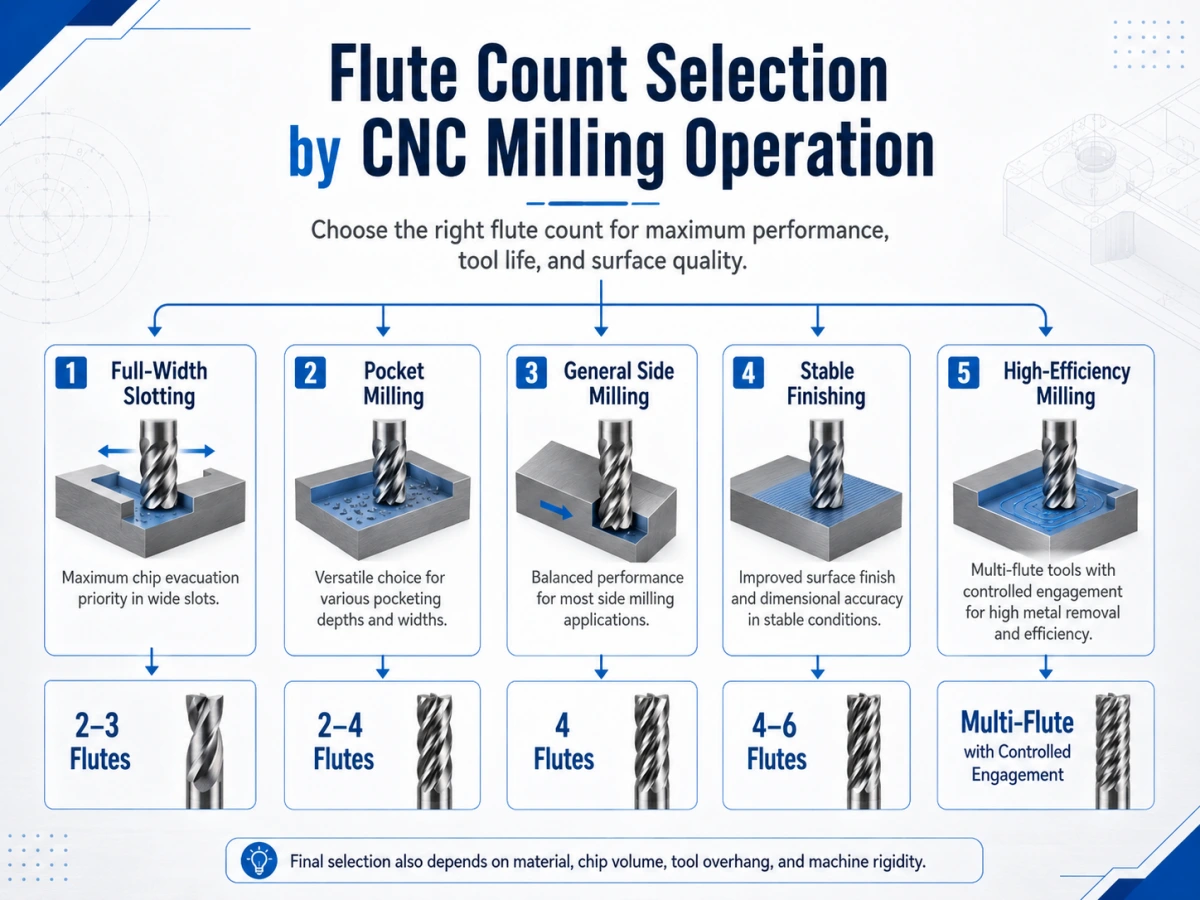
Cómo elegir según la operación de fresado CNC
La operación de mecanizado a menudo proporciona una dirección de selección más clara que el material por sí solo..
Ranurado de ancho completo
El ranurado de ancho completo crea un alto volumen de viruta porque el diámetro completo del cortador se acopla a la pieza de trabajo..
Utilice un recuento de flautas más bajo cuando:
- Las patatas fritas son grandes
- La ranura es profunda
- El acceso al refrigerante o al aire es limitado
- El empaque de virutas ha causado una falla en la herramienta anterior
Para aluminio y otros materiales no ferrosos, 2-Las herramientas de flauta proporcionan una dirección de selección común.. Una cortadora de 3 canales también puede funcionar bien cuando la evacuación de viruta se mantiene estable.
Para ranurado de acero, 2-flauta, 3-flauta, o se pueden usar herramientas de 4 flautas dependiendo de la profundidad de la ranura, diámetro del cortador, serie de herramientas, rigidez de la máquina, y condiciones de eliminación de virutas.
Una herramienta de 6 flautas generalmente no es adecuada para ranurados pesados de ancho completo porque las ranuras de flauta más pequeñas pueden atrapar virutas..
Fresado de bolsillo
El fresado de cavidades puede incluir rampas, entrada helicoidal, corte lateral, compromiso de esquina, y acabado inferior.
Para materiales blandos y bolsillos profundos, un cortador de 2 flautas proporciona más espacio para las virutas.
Una herramienta de 3 flautas puede ofrecer un equilibrio entre la evacuación de viruta y el potencial de velocidad de avance durante el embolsado de aluminio en general..
Una herramienta de 4 flautas puede ser adecuada para cavidades menos profundas u operaciones de corte lateral cuando las virutas pueden salir de la cavidad de manera confiable.
Cuando se requiere entrada axial, Confirmar que la herramienta tiene una geometría de corte central adecuada.. El recuento de flautas por sí solo no confirma la capacidad de inmersión.
Fresado lateral y perfilado
El fresado lateral normalmente utiliza menos compromiso radial que el ranurado de ancho completo. Por lo tanto, 4-Los cortadores de flauta y de 6 flautas se vuelven más prácticos.
Utilice cuatro flautas como dirección equilibrada para perfilado y fresado lateral de acero en general..
Utilice seis flautas cuando:
- El compromiso radial es ligero o controlado
- El soporte tiene un bajo descentramiento.
- El voladizo de la herramienta es limitado
- La evacuación de virutas es estable
- La configuración de la máquina y la pieza de trabajo es rígida.
- Más contactos de corte respaldan el acabado requerido
La geometría de hélice variable o de paso desigual también puede ayudar a reducir la vibración durante el fresado lateral.
Desbaste
El desbaste requiere suficiente espacio para las flautas para el volumen de viruta esperado.
Utilice un cortador de 2 flautas para desbastar aluminio., plástica, y otras aplicaciones donde la evacuación de virutas es la principal limitación.
Para desbaste de acero, una 3 flauta, 4-flauta, o una fresa de desbaste dedicada puede proporcionar un mejor equilibrio entre la resistencia del borde y la eliminación de material..
Las fresas de desbaste con geometría dentada o rompevirutas dividen las virutas en secciones más pequeñas y pueden reducir la resistencia al corte..
El desbaste dinámico o trocoidal también puede admitir un mayor número de canales porque el acoplamiento radial permanece controlado.
Por lo tanto, no seleccione el recuento de flautas únicamente de la palabra "desbaste". Revisar el material, estrategia de corte, compromiso, volumen de chip, y geometría completa de la herramienta.
Semiacabado y Acabado
El semiacabado y el acabado normalmente utilizan un compromiso más ligero y se centran en la precisión dimensional y la calidad de la superficie..
Las herramientas de cuatro flautas proporcionan una dirección equilibrada para muchas operaciones generales de acabado..
Los cortadores de seis flautas brindan más contactos de corte y pueden brindar un acabado más suave cuando:
- Las virutas pueden salir de la zona de corte.
- El descentramiento está controlado
- Los bordes cortantes son afilados y consistentes.
- El voladizo de la herramienta es corto
- La alimentación y el compromiso se mantienen estables
Más flautas no pueden corregir un filo desgastado, titular inexacto, accesorio inestable, o perfil final incorrecto.
Selección rápida por material de pieza de trabajo
| Pieza de trabajo y operación | Dirección sugerida | Razón principal |
|---|---|---|
| Ranuras de aluminio y bolsillos profundos | 2 Flautas | Espacio máximo de chip |
| Fresado General de Aluminio | 2–3 flautas | Balanza de evacuación de viruta y contactos de corte. |
| Fresado lateral de aluminio o acabado ligero | 3–4 flautas | Más contactos de corte cuando el flujo de viruta es estable |
| Fresado de acero en general | 4 Flautas | Equilibrio de espacio de chip y recuento de vanguardia |
| Ranurado de acero inoxidable | 3–4 flautas | Más espacio para patatas fritas y control del calor |
| Fresado lateral de acero inoxidable | 4–6 flautas | Más contactos de corte bajo un compromiso controlado |
| Acabado de acero endurecido | 4–6 flautas | Potencial estable de corte y acabado |
| Plásticos y materiales blandos | 1–2 flautas | Evacuación de virutas más sencilla |
Aunque este artículo se centra en 2 flautas, 4-flauta, y herramientas de 6 flautas, También están disponibles otros recuentos de flautas..
Por ejemplo, Una fresa de extremo de 3 flautas es importante en el mecanizado de aluminio., mientras que un cortador de flauta O de una sola flauta puede ser adecuado para ciertos plásticos y materiales blandos.
Diferentes operaciones en el mismo material también pueden requerir diferentes números de flautas.. El ranurado de ancho completo de acero inoxidable y el fresado lateral ligero de acero inoxidable no deben utilizar automáticamente el mismo cortador.
Para una selección detallada basada en el material, leer Cómo elegir una fresa de carburo.
Errores comunes en la selección del recuento de flautas
Asumir que más flautas siempre son mejores
Más flautas proporcionan más filos, pero reducen el espacio del chip.
Un mayor número de canales funciona mejor cuando se controlan el volumen y el compromiso de las virutas.. Puede causar acumulación de virutas durante cavidades profundas y ranuras de ancho completo..
Suponiendo que más flautas permitan proporcionalmente más alimentación
Más ranuras aumentan la velocidad de avance calculada cuando las RPM y la carga de viruta por diente permanecen sin cambios..
Sin embargo, El aumento real de alimento está limitado por:
- Espacio de chip
- Carga de corte
- potencia del husillo
- Rigidez de la máquina
- Precisión del soporte
- Estabilidad de la pieza de trabajo
No aumente el alimento sólo multiplicando la proporción de conteo de flautas.. Comience con los parámetros recomendados para la herramienta específica y ajústelos según la formación de viruta., carga del husillo, sonido, calidad de la superficie, y desgaste de herramientas.
Usando 6 Flautas para ranurado pesado
Una herramienta de 6 flautas tiene menos espacio para virutas que los diseños de 2 y 4 flautas..
Durante el ranurado pesado de ancho completo, Las virutas pueden permanecer dentro de la ranura y provocar un nuevo corte., calor, daño en el borde, o rotura de herramienta.
Usando 4 Flautas para bolsillos de aluminio con muchas virutas
Una cortadora de 4 flautas puede mecanizar aluminio, pero es posible que no proporcione suficiente espacio para fichas para bolsillos profundos o ranuras de ancho completo.
Elegir 2 o 3 Flautas cuando la evacuación de virutas es difícil..
Seleccionar sólo por material de pieza de trabajo
Los materiales son importantes, pero la operación también cambia la elección correcta.
Una herramienta de 4 flautas puede ser adecuada para el fresado lateral de acero., mientras que un número de flautas más bajo puede ser mejor para una ranura de acero profunda.
Ignorar el saliente y el descentramiento de la herramienta
El voladizo excesivo reduce la rigidez. El descentramiento provoca una carga desigual entre los bordes cortantes.
Una herramienta de 6 flautas no puede proporcionar un acabado estable si un filo soporta la mayor parte de la carga de corte..
Suponiendo que cada fresa de extremo de 2 flautas tiene corte central
El recuento de flautas no confirma la capacidad de corte central.
Verifique la geometría del extremo antes de usar un cortador para hundir, rampa, o entrada helicoidal.
Preguntas más frecuentes
¿Puede una fresa de extremo de 4 flautas cortar aluminio??
Sí. Una fresa de extremo de 4 flautas puede mecanizar aluminio durante el fresado lateral o el acabado ligero cuando la herramienta tiene bordes cortantes afilados., superficies de flauta lisas, y evacuación fiable de virutas.
Para bolsillos profundos y ranuras de ancho completo, un cortador de 2 o 3 flautas normalmente proporciona más espacio para virutas.
¿Cuándo debo elegir? 3 Flautas en lugar de 2 Flautas para Aluminio?
Elija tres canales cuando la evacuación de viruta siga siendo confiable y necesite más contactos de corte, mayor rigidez, mayor potencial de avance, o rendimiento de acabado mejorado.
Elija dos flautas cuando el volumen de viruta sea alto, el bolsillo o ranura es profundo, o la evacuación de virutas es difícil.
¿Es una fresa de extremo de 6 flautas solo para acabado??
No. Una fresa de extremo de 6 flautas también puede realizar un fresado lateral controlado, Perfiles, semiacabado, y ciertas operaciones de fresado de alta eficiencia.
Sin embargo, Normalmente no es la primera opción para desbaste pesado o ranurado profundo de ancho completo porque el espacio de viruta es limitado..
¿Qué número de flautas es mejor para ranuras de ancho completo??
Utilice un número de canales más bajo cuando las ranuras de ancho completo creen un volumen de viruta alto.
Dos o tres flautas son comunes para el aluminio.. El ranurado de acero puede utilizar dos, tres, o cuatro flautas dependiendo de la profundidad de la ranura, diámetro del cortador, rigidez de la máquina, y entrega de refrigerante.
¿Un mayor número de canales permite una mayor velocidad de alimentación??
Con la misma velocidad de giro y carga de viruta por diente, un mayor número de canales aumenta la velocidad de avance calculada.
La velocidad de avance real todavía depende de la evacuación de viruta., carga de corte, potencia del husillo, precisión del titular, geometría de la herramienta, y rigidez de la máquina.
¿Se puede sumergir una fresa de extremo de 2 flautas??
Algunas fresas de extremo de 2 flautas admiten rampa, entrada helicoidal, o inmersión limitada.
La fresa debe tener una geometría de corte central adecuada., y el método de entrada programado debe coincidir con el diseño de la herramienta y el material de la pieza de trabajo..
Guías de fresas de extremo relacionadas
Para comparaciones más detalladas e información de selección, visita:
Guía de selección de flautas para fresas de extremo
2 fresa de extremo de flauta vs. 4 flauta
4 flauta vs. 6 fresa de ranura
Cómo elegir una fresa de carburo
Necesita ayuda para elegir el número de flautas adecuado?
Envíanos tu dibujo, modelo de herramienta, material de la pieza de trabajo, o problema de mecanizado actual. Con 16 años de experiencia en fabricación de herramientas de corte, Podemos revisar la información disponible y ayudar a confirmar una dirección de fresado estándar o personalizada adecuada..
Vea nuestros estándares y personalizados página de producto del cortador de fresado
Para discutir su solicitud, envíenos un correo electrónico a sales@cutterbest.com.