 Fresas de precisión,Herramientas de corte para el mecanizado CNC de todos los materiales

La principal diferencia en un 4 flauta vs. 6 La comparación de fresas de ranurado es el equilibrio entre la evacuación de virutas y la rigidez de la herramienta..
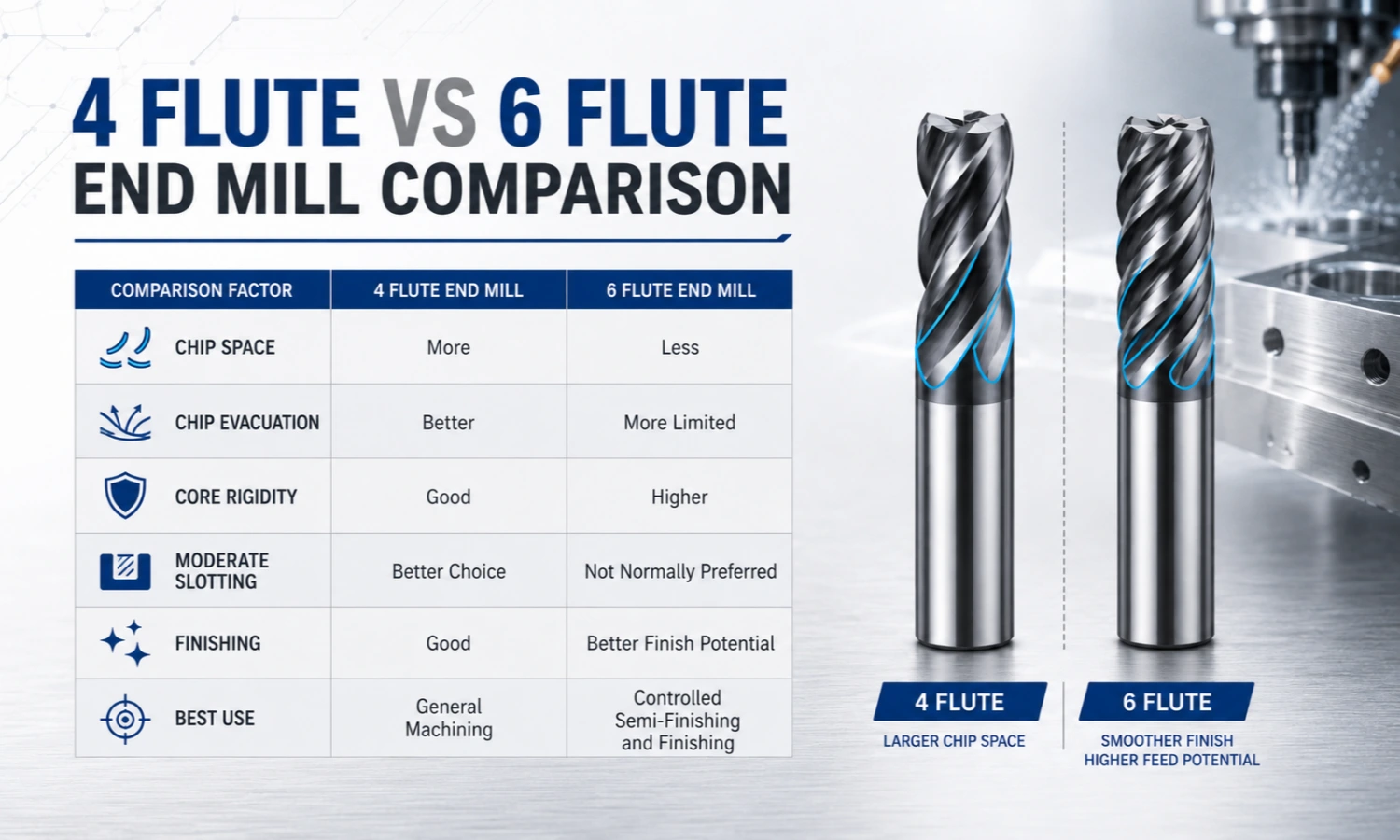
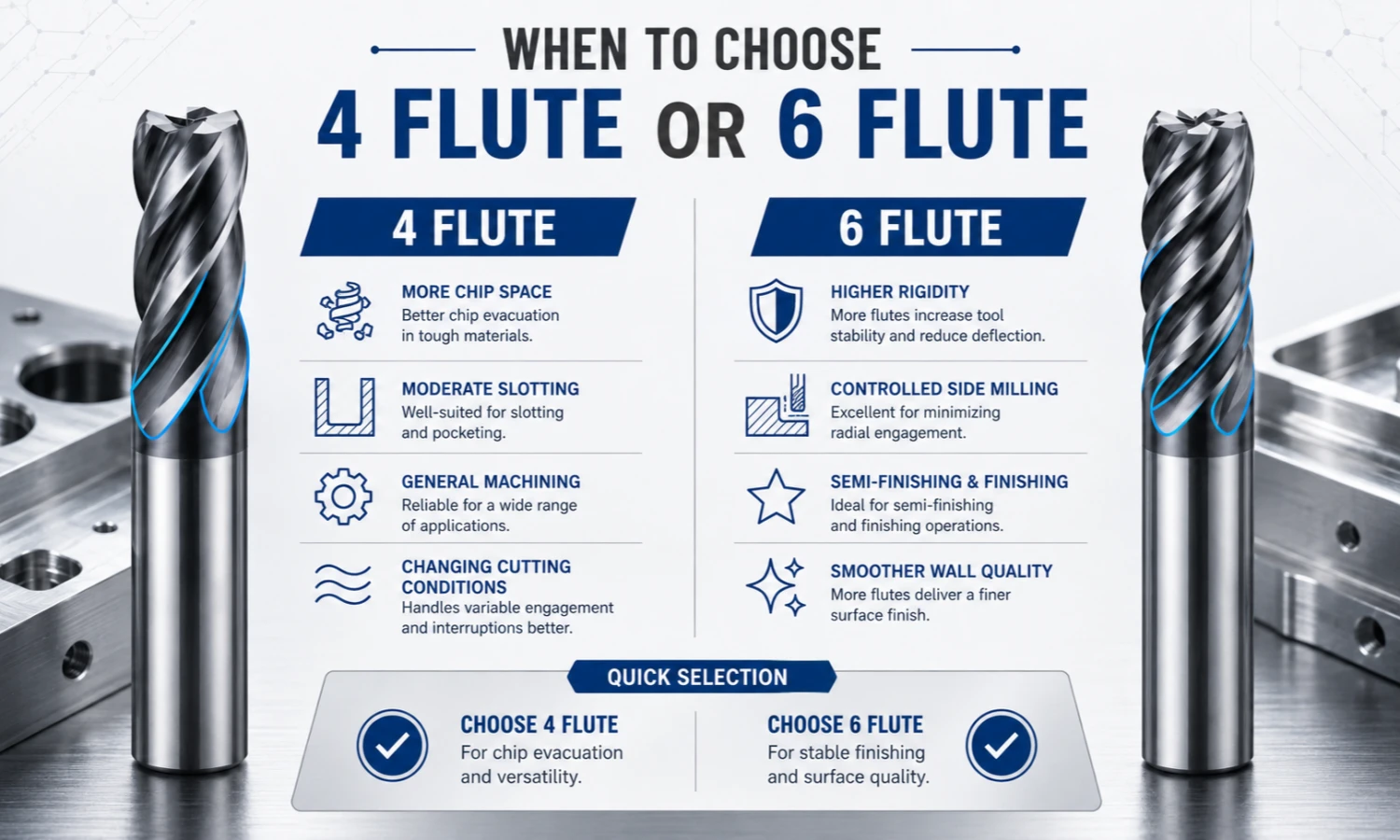
A 4 La fresa de extremo de flauta proporciona más espacio para la flauta.. Por lo tanto, generalmente es más flexible para ranuras moderadas, fresado lateral, fresado de perfiles, y condiciones de corte cambiantes.
En contraste, a 6 La fresa de extremo de flauta tiene más filos de corte y generalmente un núcleo más fuerte.. Puede proporcionar una mejor estabilidad durante el semiacabado y acabado controlados., especialmente cuando la calidad de la pared y el acabado de la superficie son los objetivos principales.
Ningún conteo de flautas es siempre mejor. La elección correcta depende de la operación de mecanizado., volumen de chip, cortar el compromiso, rigidez de la máquina, saliente de la herramienta, y acabado requerido.
Diferencias clave entre 4 flauta y 6 Fresas de extremo de flauta
4 Molino de extremo de flauta: Más espacio en el chip y versatilidad
A 4 La fresa de extremo de flauta tiene cuatro filos de corte con más espacio entre las flautas que un diseño de seis flautas.. Como resultado, Las virutas pueden salir más fácilmente de la zona de corte..
Este diseño proporciona un equilibrio práctico de evacuación de virutas., fuerza central, y estabilidad de corte. Se selecciona comúnmente para mecanizado general de acero y acero inoxidable., ranurado moderado, fresado lateral, fresado de perfiles, y semiacabado.
Una cortadora de cuatro flautas también es más indulgente cuando el compromiso de corte o las condiciones de mecanizado cambian durante la producción..
Para tamaños estándar, diseños de corte central, revestimientos, y opciones personalizadas, revisa nuestro 4 fresa de carburo de flauta.
Para una guía de aplicación más amplia, leer que es un 4 fresa de extremo de flauta utilizada para.
6 Molino de extremo de flauta: Mayor rigidez para el acabado
A 6 La fresa de extremo de flauta tiene seis filos de corte y menos espacio para flautas.. Los filos de corte adicionales y el núcleo más fuerte pueden mejorar la rigidez., estabilidad de la pared, y consistencia de la superficie durante el mecanizado controlado.
Por lo tanto, este diseño se utiliza a menudo para fresado lateral, acabado de perfiles, semiacabado, y acabado en acero, acero inoxidable, y acero aleado.
Sin embargo, el espacio más pequeño de la flauta limita la evacuación de virutas. Una cortadora de seis flautas normalmente no es la primera opción para ranuras profundas de ancho completo., desbaste pesado, u operaciones que producen un alto volumen de viruta.
Para tamaños de productos y opciones de personalización, revisa nuestro 6 fresa de carburo de flauta.
Para más información sobre sus aplicaciones, leer que es un 6 fresa de extremo de flauta utilizada para.
4 Flauta vs. 6 Comparación de fresas de extremo de flauta
| Factor de comparación | 4 Molino de extremo de flauta | 6 Molino de extremo de flauta |
|---|---|---|
| Espacio de chip | More | Menos |
| Evacuación de virutas | Mejor | Más limitado |
| Rigidez del núcleo | Bien | Más alto |
| Mecanizado general de acero | Más versátil | Más especializado |
| Ranurado moderado | Mejor elección | Normalmente no se prefiere |
| Fresado lateral | Adecuado | Adecuado con enganche controlado |
| Fresado de perfiles | Adecuado | Muy adecuado para pasadas de acabado estables |
| Semiacabado | Adecuado | A menudo mejor |
| Acabado | Bien | Mejor potencial de acabado |
| Desbaste pesado | Más adecuado | No es ideal |
| Configuración de la máquina | Más indulgente | Funciona mejor en configuraciones rígidas |
| Mejor uso | Mecanizado general y arranque de viruta moderado. | Semiacabado y acabado controlados |
| Usar con precaución | Acabado muy ligero donde más bordes cortantes pueden ayudar | Tragaperras profundas, mala evacuación de virutas, largo voladizo, o configuraciones inestables |
Esta tabla proporciona una guía de selección general.. El rendimiento real también depende del grado de carburo, revestimiento, ángulo de hélice, diámetro de la herramienta, longitud de la flauta, condición del titular, entrega de refrigerante, y parámetros de corte.
4 Flauta vs. 6 Fresa de extremo de flauta para acero
Ambos tipos de flautas pueden mecanizar acero.. Sin embargo, se adaptan a diferentes operaciones.
A 4 La fresa de ranura es generalmente la opción más flexible para el mecanizado general de acero.. Su espacio de flauta más grande permite una eliminación moderada de virutas., cambiar el compromiso de corte, fresado lateral, fresado de perfiles, y ranurado de ligero a moderado.
A 6 La fresa de extremo de flauta se vuelve más útil cuando la operación se centra en semiacabado o acabado controlado.. Sus bordes cortantes adicionales pueden mejorar la calidad de la pared y la consistencia de la superficie.. Sin embargo, la maquina, titular, sujeción de piezas, y la trayectoria debe permanecer estable.
Elegir 4 Flauta para mecanizado general de acero
Un cortador de cuatro flautas es una opción práctica cuando:
- La operación incluye sloting moderado.
- La evacuación de virutas sigue siendo importante.
- El compromiso de corte puede cambiar.
- Una herramienta debe cubrir varias operaciones..
- La configuración no está optimizada solo para terminar..
Elegir 6 Flauta para acabado controlado
Un cortador de seis flautas puede proporcionar mejores resultados cuando:
- La operación consiste principalmente en semiacabado o acabado..
- Se requiere una mejor calidad de pared.
- El compromiso radial sigue siendo ligero y controlado.
- La máquina y el soporte proporcionan una buena rigidez..
- La calidad de la superficie importa más que el espacio máximo del chip.
En muchos talleres, un diseño de cuatro flautas sirve como punto de partida de uso general. Una herramienta de seis flautas ofrece una opción más especializada cuando la operación se vuelve estable y se centra en el acabado..
4 Flauta vs. 6 Fresa de extremo de flauta para acero inoxidable
El acero inoxidable puede generar calor y endurecerse cuando las condiciones de corte se vuelven inestables.. Por lo tanto, evacuación de viruta, cortar el compromiso, revestimiento, geometría de la herramienta, y la rigidez de la máquina son importantes.
A 4 La fresa de ranura suele ser un punto de partida práctico para el mecanizado general de acero inoxidable.. Proporciona un equilibrio útil entre el espacio del chip y la resistencia del núcleo., para que pueda manejar el fresado de perfiles, fresado lateral, remoción moderada de material, y semiacabado.
A 6 El molino de extremo de flauta es más especializado.. Puede funcionar bien en pasadas controladas de semiacabado y acabado donde la consistencia dimensional, calidad de la pared, y superficies más lisas son los principales objetivos.
Sin embargo, El volumen de viruta y el compromiso de corte deben permanecer controlados.. De lo contrario, Se pueden acumular virutas y calor alrededor de los bordes cortantes..
Para acabados especializados de acero inoxidable, También son comunes las herramientas con cinco o más flautas y ángulos de hélice más altos.. Aún así, Las ranuras adicionales sólo ayudan en la evacuación de virutas., sin, tenencia de herramientas, y la rigidez de la configuración permanecen bajo control. La geometría de hélice variable o de paso variable también puede mejorar el control de la vibración.
En general:
- Elegir 4 Flauta para mayor versatilidad y más espacio para virutas..
- Elegir 6 Flauta para acabado controlado y mayores requisitos de calidad superficial..
Cómo elegir un 4 flauta o 6 Fresa de extremo de flauta en tres pasos
Paso 1: Comience con la operación de mecanizado
Primero, identificar la operación principal.
Elige un 4 fresa de ranurado cuando el trabajo incluye ranurado moderado, cambiar el compromiso de corte, o fresado general de laterales y perfiles. Su mayor espacio de flauta proporciona un camino más seguro para que las virutas salgan de la zona de corte..
Considere un 6 fresa de extremo de flauta cuando la operación utiliza un acoplamiento lateral controlado y se centra en semiacabado o acabado.
Para desbaste pesado, una fresa de desbaste dedicada puede ser más adecuada que una herramienta de acabado estándar de cuatro o seis canales.
Paso 2: Verifique la evacuación del chip y la rigidez de la configuración
Próximo, revisar la configuración completa del mecanizado.
Un cortador de seis flautas funciona mejor cuando:
- El compromiso de corte permanece controlado.
- La máquina y el soporte proporcionan una buena rigidez..
- El voladizo de la herramienta se mantiene lo más corto posible.
- El refrigerante o el aire pueden llegar a la zona de corte..
- Las virutas pueden salir de la pieza de trabajo sin volver a cortarse..
Una herramienta de cuatro flautas generalmente es más indulgente cuando la configuración es menos rígida o las condiciones de corte cambian..
Un número de flautas más alto no puede corregir un soporte inestable, saliente excesivo, mala sujeción del trabajo, o evacuación de viruta bloqueada.
Paso 3: Establecer la prioridad de acabado de superficie
Finalmente, decidir si el control de viruta o la calidad del acabado tienen la mayor prioridad.
Elija cuatro flautas cuando la versatilidad, evacuación de viruta, y la remoción moderada de material es lo más importante.
Elija seis flautas cuando la configuración sea estable y la operación tenga como objetivo la calidad de la pared, consistencia dimensional, y una superficie con acabado más suave.
Más bordes cortantes pueden reducir la carga soportada por cada borde cuando el avance está configurado correctamente. Sin embargo, Un control deficiente de la viruta o un calor excesivo pueden eliminar esta ventaja..
Qué comprobar cuando 6 La fresa de ranurar no mejora el resultado
Una cortadora de seis flautas no produce automáticamente un mejor acabado. Cuando el resultado empeora, Inspeccione la condición de corte completa antes de culpar a la herramienta..
| Signo de mecanizado | Posible causa | Primer punto a comprobar |
|---|---|---|
| Las virutas se acumulan alrededor de los bordes cortantes. | El volumen de viruta es demasiado alto para el espacio disponible para la flauta | Reduzca el compromiso de corte o considere una 4 diseño de flauta |
| La temperatura de corte aumenta rápidamente | Las virutas permanecen en la zona de corte o el acceso al refrigerante es limitado | Mejorar la evacuación de virutas y el suministro de refrigerante. |
| Aparecen marcas de vibración o ruido en la pared | La herramienta sobresale o la configuración completa carece de rigidez. | Titular del cheque, sobresalir, sujeción de piezas, y trayectoria |
| El acabado superficial no mejora | Sin, alimentar, o cortar el compromiso no es adecuado | Verifique el descentramiento y ajuste la estrategia de acabado. |
| Los bordes cortantes se astillan inesperadamente | Recorte de viruta, calor, o compromiso inestable | Revisar el control del chip, revestimiento, y condiciones de corte |
Estas son señales generales de solución de problemas en lugar de reglas de corte fijas.. El ajuste correcto depende del diseño del cortador., material de la pieza de trabajo, máquina, titular, y parámetros de mecanizado.
Ejemplos prácticos de selección
Acero general con ranurado moderado
Para ranurado moderado o cambio de compromiso de corte en acero en general, a 4 La fresa de ranurado suele ser la opción más flexible..
Su mayor espacio de flauta favorece la evacuación de virutas., mientras que el núcleo de cuatro canales sigue proporcionando una rigidez útil para el fresado lateral y de perfiles.
Si la operación cambia a una pasada final ligera de acabado lateral, a 6 El cortador de flauta se puede evaluar por separado..
Acabado de perfiles de acero inoxidable
Cuando el acero inoxidable se mecaniza con un acoplamiento lateral ligero y estable, una configuración rígida, y un objetivo final claro, a 6 La fresa de extremo de flauta puede proporcionar un mejor potencial de acabado.
Sin embargo, si las virutas comienzan a acumularse o la temperatura de corte aumenta rápidamente, a 4 El diseño de la flauta puede proporcionar un equilibrio más seguro entre el espacio de la flauta y la estabilidad del corte..
Estos ejemplos muestran por qué el número de canales debe coincidir con la operación en lugar de seleccionarse únicamente por el nombre del material..
Preguntas frecuentes
¿Cuál es la principal diferencia entre un 4 flauta y 6 fresa de ranura?
La principal diferencia es el equilibrio entre evacuación de viruta y rigidez..
A 4 La fresa de extremo de flauta proporciona más espacio para flauta y mayor versatilidad.. En contraste, a 6 La fresa de extremo de flauta proporciona más filos de corte., mayor rigidez del núcleo, y mejor potencial de acabado en condiciones estables.
es un 4 flauta o 6 fresa de flauta mejor para acero?
A 4 La fresa de ranura suele ser mejor para el mecanizado de acero en general., ranurado moderado, y condiciones de corte cambiantes.
A 6 La fresa de flauta a menudo funciona mejor durante el fresado lateral controlado., semiacabado, y acabado cuando la calidad de la superficie es el objetivo principal.
¿Cuándo debo evitar el uso de un 6 fresa de ranura?
A 6 La fresa de ranura normalmente no es la primera opción para ranuras profundas de ancho completo., desbaste pesado, operaciones con alto volumen de chips, mal acceso al refrigerante, o configuraciones inestables.
Su espacio de flauta más pequeño puede aumentar el recorte de viruta y el calor cuando el compromiso de corte es demasiado alto..
¿Un mayor número de canales siempre produce un mejor acabado superficial??
No. Un mayor número de flautas puede mejorar el potencial de acabado, pero el resultado también depende del runout, avance por diente, geometría de la herramienta, rigidez de la máquina, condición del titular, evacuación de viruta, y estabilidad de la pieza de trabajo.
Si quedan virutas o calor en la zona de corte, Es posible que un cortador de seis flautas no mejore la superficie..
¿Cómo elijo entre un 4 flauta y 6 fresa de ranura?
Comience con la operación de mecanizado y el volumen de viruta.. Luego verifique el compromiso de corte., saliente de la herramienta, condición del titular, y rigidez de la máquina.
Elija cuatro canales cuando la evacuación de virutas y la versatilidad sean más importantes. Elija seis flautas cuando la configuración sea estable y el objetivo principal sea el acabado controlado..
Conclusión
Al comparar un 4 flauta vs. 6 fresa de ranura, Comience con el objetivo de mecanizado..
Una cortadora de cuatro flautas proporciona más espacio para virutas y mayor flexibilidad para el mecanizado general de acero y acero inoxidable., ranurado moderado, fresado lateral, y condiciones de corte cambiantes.
Una cortadora de seis flautas ofrece mayor rigidez y mejor potencial de acabado cuando el compromiso de corte permanece controlado. Por lo tanto, Se adapta a operaciones estables de semiacabado y acabado que requieren una mejor calidad de pared y superficies más lisas..
En lugar de seleccionar un cortador únicamente por el número de flautas, Haga coincidir la herramienta con el material., volumen de chip, profundidad de corte, rigidez de la máquina, tenencia de herramientas, y acabado requerido.
Necesita ayuda para elegir entre 4 flauta y 6 Fresas de extremo de flauta?
Seleccionar el número de canales correcto puede mejorar el control de la viruta, estabilidad de corte, vida útil de la herramienta, y calidad de la superficie.
Envíanos el material de tu pieza, dureza del material, diámetro de corte, longitud de la flauta, operación de mecanizado, requisito de recubrimiento, y cantidad. También puedes proporcionar un dibujo., referencia de herramienta, o foto de la aplicación cuando la especificación está incompleta.
Revisaremos la información disponible y le ayudaremos a seleccionar una fresa de carburo estándar o personalizada adecuada..
Envíe su requisito por correo electrónico directamente a sales@cutterbest.com.