 Fresas de precisión,Herramientas de corte para el mecanizado CNC de todos los materiales

Las fresas cónicas son herramientas de fresado CNC que se utilizan para mecanizar ángulos de inclinación., paredes laterales cónicas, cavidades del molde, perfiles profundos, ranuras estrechas, y características mecanizadas detalladas. A diferencia de una fresa recta estándar, El diámetro de corte aumenta gradualmente desde la punta hacia el vástago..
Como resultado, la herramienta puede seguir superficies en ángulo y al mismo tiempo proporciona más soporte detrás de la pequeña punta de corte. Sin embargo, el cortador correcto todavía depende del ángulo del cono, diámetro de la punta, geometría final, material de la pieza de trabajo, profundidad de corte, y condición de la máquina.
Esta guía explica para qué se utilizan las fresas de extremo cónico, cómo funcionan los diferentes tipos, y cómo seleccionar una herramienta adecuada para la fabricación de moldes, grabado, fresado de perfiles, y otras aplicaciones CNC.
¿Qué es una fresa cónica??
Una fresa de extremo cónico es una fresa con una sección de corte que gradualmente se hace más grande desde la punta hacia el vástago.. La herramienta puede tener un extremo plano., nariz de bola, radio de esquina, o perfil de corte personalizado.
Los fabricantes suelen utilizar estas herramientas cuando una pieza incluye paredes en ángulo., ángulos de tiro, ranuras cónicas, caries profundas, o pequeños detalles que no se pueden mecanizar eficientemente con una cortadora recta.
Las dimensiones principales suelen incluir:
| Característica de herramienta | Descripción |
| ángulo cónico | El ángulo formado por la sección de corte cónica. |
| Diámetro de la punta | El diámetro de corte más pequeño cerca de la punta de la herramienta. |
| Diámetro máximo del cortador | El diámetro más grande de la sección de corte. |
| longitud de la flauta | La longitud de los bordes cortantes. |
| Longitud total | La longitud completa de la herramienta desde la punta hasta el extremo del mango. |
| Diámetro del mango | El diámetro sostenido por el portaherramientas. |
| Geometría final | extremo plano, nariz de bola, extremo del radio, o formulario personalizado |
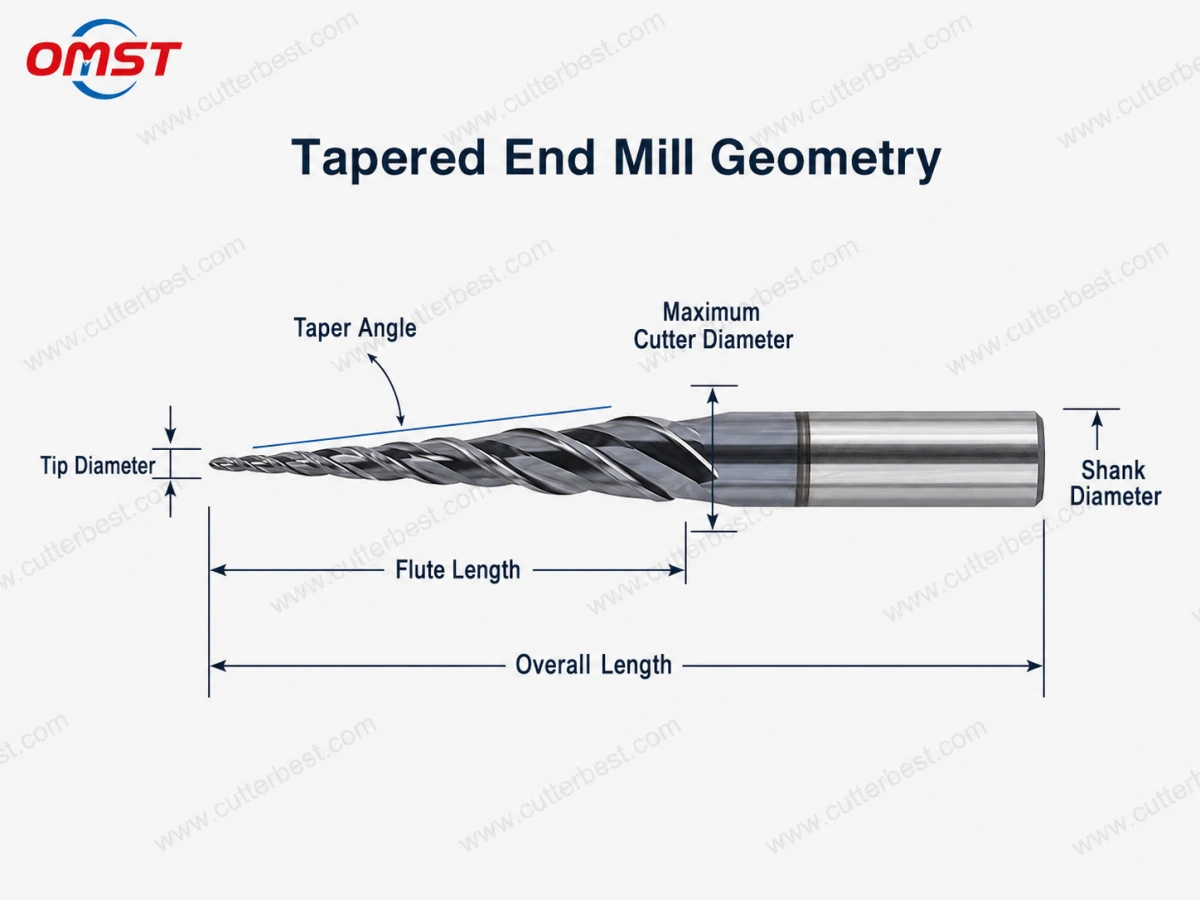
Antes de pedir un cortador, Confirme si el dibujo muestra un ángulo cónico de un solo lado o un ángulo total incluido.. De lo contrario, el perfil terminado puede no coincidir con el diseño de la pieza.
¿Para qué se utilizan las fresas cónicas??
Las fresas cónicas se utilizan para operaciones CNC que requieren superficies en ángulo., cambiar gradualmente los perfiles de las paredes, pequeñas puntas de corte, o soporte mejorado durante el mecanizado de largo alcance.
Sus aplicaciones más comunes incluyen la fabricación de moldes., fresado en ángulo de inclinación, corte de ranura cónica, mecanizado de cavidad profunda, 3D contorneado, grabado, y producción de perfiles personalizados.
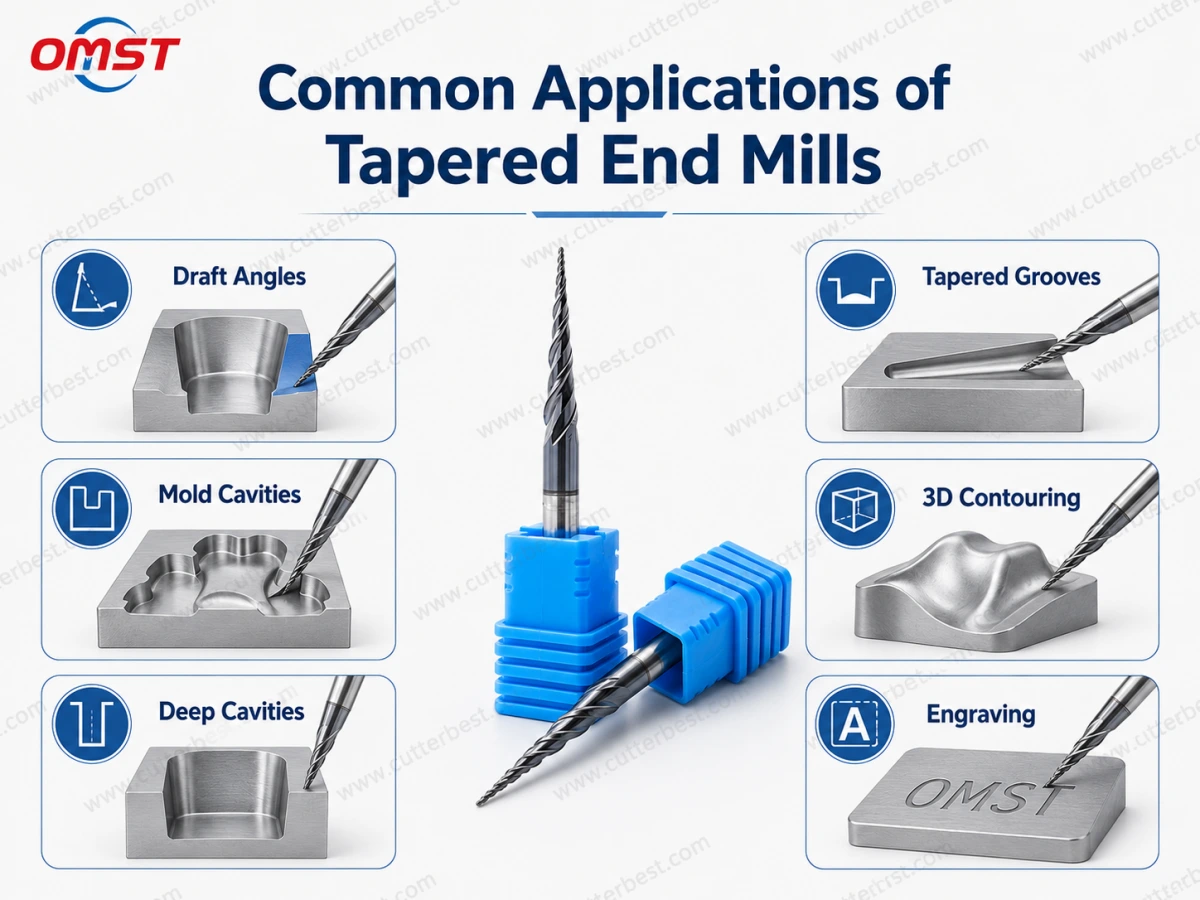
Mecanizado de ángulos inclinados y paredes laterales cónicas
muchos moldes, muere, y los componentes mecanizados incluyen ángulos de salida. Estos ángulos ayudan a que las piezas moldeadas se suelten más fácilmente y permiten a los diseñadores crear paredes no verticales..
Una fresa cónica puede mecanizar el ángulo requerido directamente cuando la geometría del cortador coincide con el dibujo.. Por lo tanto, la herramienta se utiliza a menudo para:
- Muros de moldeo
- Bolsillos cónicos
- Paredes laterales en ángulo
- Perfiles inclinados
- Superficies no paralelas
Sin embargo, El ángulo del cortador debe confirmarse cuidadosamente.. Incluso una pequeña diferencia entre el ángulo de la herramienta y el dibujo puede afectar la geometría final de la pared..
Mecanizado de cavidades de moldes y matrices
Las cavidades del moho frecuentemente contienen áreas profundas., paredes en ángulo, superficies curvas, y transiciones detalladas. Es posible que una fresa estándar no alcance estas características de manera eficiente, especialmente cuando la cavidad se vuelve estrecha cerca del fondo.
Un cortador cónico puede proporcionar una punta de corte pequeña mientras mantiene una sección transversal más grande más cerca del vástago.. Como consecuencia, puede ofrecer una mejor rigidez que una herramienta recta con un diámetro de punta y alcance similares.
Las aplicaciones comunes de moldes y troqueles incluyen:
- Cavidades del molde de inyección
- Moldes de fundición a presión
- matrices de conformado
- Mecanizado de electrodos
- Acabado de muros
- Perfiles de cavidad detallados
Para cavidades curvas y superficies 3D, a menudo se selecciona un diseño de punta esférica cónica.
Mecanizado de cavidades profundas y de largo alcance
Las cavidades profundas requieren un alcance adicional de la herramienta. Sin embargo, aumentar la longitud de la herramienta también puede aumentar la vibración y la deflexión.
Porque una herramienta cónica se vuelve más gruesa hacia el vástago, Puede proporcionar más soporte detrás del área de corte.. Esta geometría puede mejorar la estabilidad durante operaciones ligeras de perfilado y acabado..
El rendimiento real todavía depende de:
- Diámetro de la punta
- ángulo cónico
- longitud de la flauta
- Saliente de herramienta
- Desviación del portaherramientas
- Rigidez de la máquina
- Material de la pieza de trabajo
- Parámetros de corte
Un diseño cónico no reemplaza una configuración de mecanizado adecuada. Por lo tanto, Utilice la longitud de herramienta más corta y práctica siempre que sea posible..
Ranuras Cónicas y Perfiles Especiales
Las ranuras cónicas tienen paredes no paralelas., por lo que no siempre se pueden producir con una fresa recta estándar en una sola operación.
Se puede utilizar una fresa cónica para:
- Ranuras cónicas
- Ranuras en ángulo
- perfiles en forma de V
- Características de forma especiales
- Componentes CNC personalizados
- Piezas de máquinas no estándar
Cuando la ranura tiene un ángulo o perfil especial, una herramienta personalizada puede reducir el número de pasos de mecanizado.
3D Contorneado y superficies curvas
Una fresa de punta esférica cónica combina una sección de corte cónica con una punta redondeada. Esta herramienta es adecuada para superficies curvas., 3contornos D, y acabado de moldes.
Las aplicaciones típicas incluyen:
- Acabado de la cavidad del molde
- Superficies de componentes curvadas
- 3fresado de perfil D
- Formas complejas de matrices
- Superficies de transición
- Piezas esculpidas
El radio de la bola, ángulo cónico, y la trayectoria de la herramienta deben trabajar juntas. Además, Normalmente se requiere un pequeño paso cuando se necesita un acabado superficial más fino..
Para superficies curvas y perfiles 3D que requieren geometría cónica, ver nuestro fresa de punta esférica cónica.
Grabado y mecanizado de detalles finos
Las fresas microcónicas se utilizan a menudo para detalles pequeños., rasgos estrechos, grabado fino, y componentes de moldes en miniatura.
Una pequeña punta puede entrar en zonas estrechas.. Meanwhile, el cuerpo cónico sostiene la herramienta detrás del filo.
Estas herramientas pueden usarse para:
- letras finas
- Pequeños detalles del molde.
- Canales estrechos
- Perfiles decorativos
- Grabado de precisión
- Componentes en miniatura
Sin embargo, Los microcortadores son sensibles al descentramiento y a la carga de corte excesiva.. Por lo tanto, tenencia de herramientas, condición del husillo, y los parámetros de corte deben comprobarse cuidadosamente.
Aplicaciones comunes de fresas de extremo cónico
La siguiente tabla resume varios usos comunes.:
| Solicitud | Tipo de cortador adecuado | Punto de selección principal |
| Mecanizado de ángulo de inclinación | Fresa de extremo plano cónico | Haga coincidir el ángulo cónico con el dibujo. |
| Acabado de la cavidad del molde | Fresa de punta esférica cónica | Confirmar radio, alcanzar, y requerimiento de superficie |
| Fresado de ranuras cónicas | Cortador cónico personalizado o de extremo plano | Compruebe el ancho de la ranura y el ángulo de la pared. |
| Perfilado de cavidades profundas | Fresa cónica de carburo rígido | Minimiza el voladizo y controla la carga de corte. |
| Grabado fino | Fresa micro cónica | Controle el descentramiento y el diámetro de la punta |
| Superficies 3D curvas | Cortador de punta esférica cónica | Seleccione el radio adecuado y pase por encima |
| Perfiles personalizados | Cortador cónico de forma personalizada | Proporcionar un dibujo completo y información sobre el material. |
¿Por qué utilizar una fresa cónica??
No se requiere una fresa cónica para cada operación de fresado. Sin embargo, Ofrece varias ventajas prácticas cuando la pieza de trabajo contiene elementos en ángulo o de difícil acceso..
Rigidez mejorada en aplicaciones de largo alcance
Una fresa recta pequeña con una longitud de corte larga puede deformarse bajo la presión de corte.. En comparación, una herramienta cónica tiene más material detrás de la punta pequeña.
Como resultado, El aumento de la sección transversal puede ayudar a mejorar la rigidez durante las operaciones adecuadas de acabado y fresado de perfiles..
Aún, La rigidez depende de la configuración completa.. Diámetro de herramienta, grado de carburo, condición del titular, profundidad de corte, y también se debe tener en cuenta la estabilidad de la máquina.
Mejor acceso a áreas estrechas y en ángulo
La punta pequeña puede entrar en zonas estrechas., mientras que los bordes cortantes cónicos siguen una pared en ángulo. Por lo tanto, Un cortador puede alcanzar características que de otro modo requerirían varias operaciones o trayectorias de herramientas especiales..
Esto es especialmente útil en las cavidades del molde., partes detalladas, y ranuras cónicas.
Mecanizado directo del ángulo de pared requerido
Cuando el ángulo del cortador coincide con el diseño de la pieza, El filo cónico puede mecanizar directamente el ángulo completo de la pared..
Esto puede simplificar la ruta de la herramienta y mejorar la coherencia del perfil.. Sin embargo, El ángulo debe verificarse antes de la producción porque los dibujos pueden usar diferentes definiciones de ángulo..
Acabado estable de perfiles cónicos
Una herramienta cónica adecuada puede proporcionar un contacto estable a lo largo de un perfil en ángulo. Además, El diseño y recubrimiento correctos de la flauta pueden mejorar la evacuación de virutas y la resistencia al desgaste..
Para el mejor resultado, Los parámetros de corte deben validarse mediante un corte de prueba controlado antes de la producción completa..
Tipos comunes de fresas cónicas
Se seleccionan diferentes geometrías de extremo para diferentes características de la pieza de trabajo..
Fresas de extremo plano cónico
Una fresa de extremo plano cónico tiene una punta de corte plana. Se utiliza comúnmente para:
- Ranuras cónicas de fondo plano
- Paredes laterales en ángulo
- Borradores de perfiles
- Características del molde
- Ranuras cónicas
Este diseño es adecuado cuando la superficie inferior debe permanecer relativamente plana..
Para esta geometría cónica de extremo plano, ver nuestro fresa de extremo cuadrado cónico.
Fresas de punta esférica cónica
Una fresa de punta esférica cónica tiene una punta de corte redondeada. Se utiliza principalmente para:
- Superficies curvas
- 3contornos D
- Cavidades del molde
- Perfiles complejos
- Acabado de superficies
Porque la punta es redondeada, la herramienta puede seguir trayectorias curvas con mayor suavidad que una cortadora de extremo plano.
Fresas de extremo de radio cónico
Una fresa de extremo de radio cónico incluye un radio de esquina entre la parte inferior de la herramienta y los bordes cortantes laterales..
El radio puede fortalecer la esquina de corte y producir una transición suave entre la parte inferior y la pared lateral.. Por lo tanto, este tipo se puede utilizar para semiacabado, perfiles de molde, y características fileteadas.
Para geometría de corte cónica con extremo plano y transición R, ver nuestro fresa de extremo de radio de esquina cónica.
Fresas micro cónicas
Los cortadores microcónicos tienen un diámetro de punta muy pequeño. Se utilizan para perfiles detallados., rasgos estrechos, grabado, y cavidades en miniatura.
Como la punta es pequeña, El control del descentramiento es fundamental.. Incluso un descentramiento limitado puede aumentar las cargas de corte desiguales y acortar la vida útil de la herramienta..
Cortadores cónicos de forma personalizada
Algunos componentes requieren un ángulo cónico no estándar, diámetro de la punta, longitud de la flauta, o perfil de corte. En estos casos, El fabricante puede producir un cortador personalizado según el dibujo..
Cutterbest puede revisar los requisitos de cortadores cónicos estándar y no estándar. Ver nuestro cortador cónico personalizado página de producto para geometría disponible, revestimiento, y opciones OEM.
Fresa de extremo cónico versus fresa de extremo recto
Las fresas cónicas y rectas se utilizan para diferentes requisitos de mecanizado. Una fresa recta mantiene un diámetro de corte constante, mientras que un cortador cónico aumenta gradualmente de diámetro hacia el vástago.
| Punto de selección | Fresa cónica | Fresa de extremo recto |
| Geometría de corte | Sección de corte cónica | Diámetro de corte constante |
| Aplicación principal | Ángulos de salida, paredes cónicas, y perfiles especiales | Paredes rectas, bolsillos, y tragamonedas |
| alcance profundo | El aumento de la sección puede mejorar la rigidez. | La rigidez depende en gran medida del diámetro y el alcance. |
| Mecanizado de moldes | Adecuado para paredes inclinadas y cavidades especiales. | Adecuado para bolsillos generales y paredes verticales. |
| Opciones finales | extremo plano, nariz de bola, radio, o personalizado | extremo plano, nariz de bola, radio, y otros tipos estándar |
| Dimensiones principales | ángulo cónico, diámetro de la punta, y alcanzar | Diámetro del cortador y longitud de corte. |
| Personalización | A menudo personalizado para ángulo y perfil. | A menudo se seleccionan entre diámetros y longitudes estándar. |
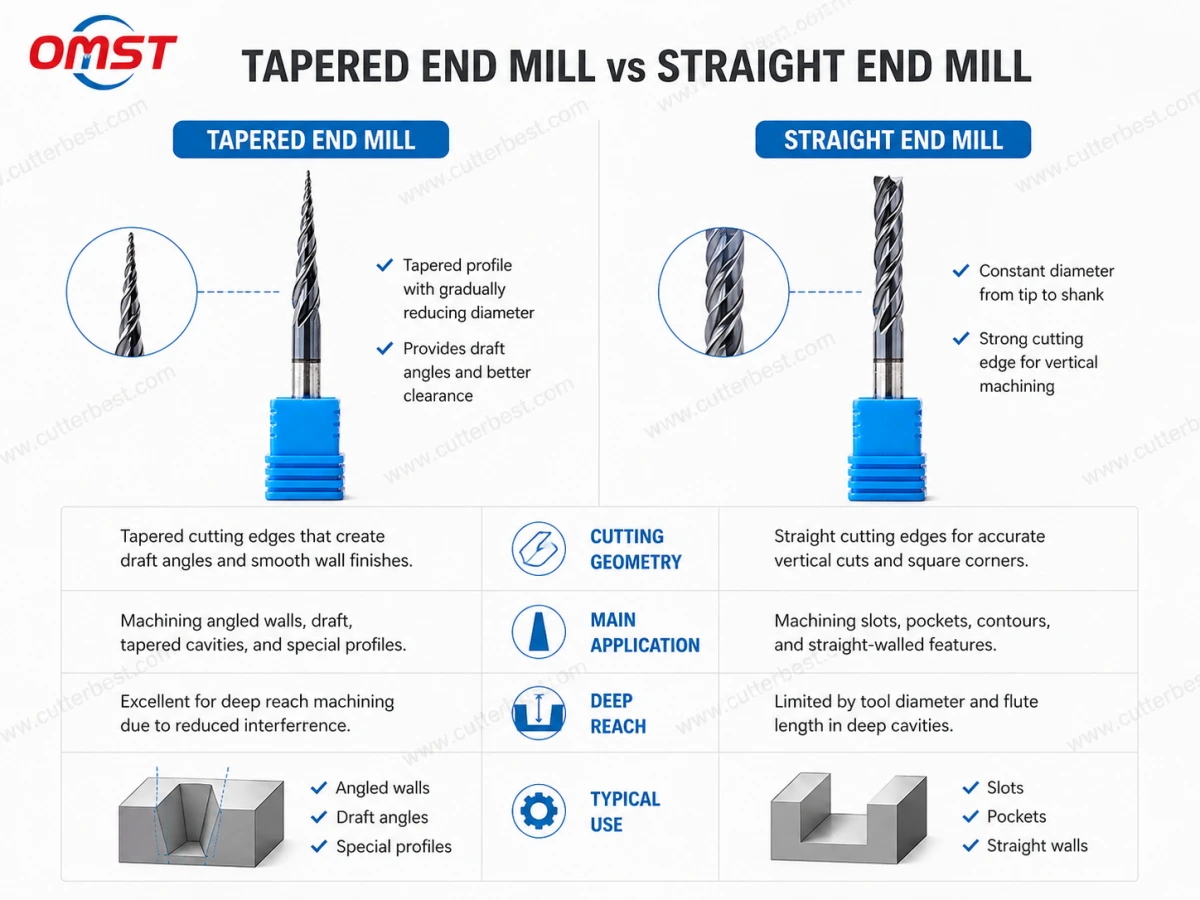
Generalmente se prefiere una herramienta cónica cuando el ángulo de la pared es parte del diseño del componente.. En contraste, Normalmente se selecciona una fresa de extremo recto para ranuras generales., bolsillos, paredes laterales verticales, y fresado de perfiles estándar.
Cómo elegir una fresa cónica
Seleccionar un cortador sólo por el diámetro de la punta no es suficiente. Se debe revisar la geometría completa y las condiciones de mecanizado..
Confirme el ángulo cónico requerido
Primero, verifique el dibujo y confirme cómo se especifica el ángulo.
Algunos dibujos muestran el ángulo en un lado de la herramienta.. Otros muestran el ángulo completo incluido.. Por lo tanto, Este detalle debe ser confirmado antes de la producción..
Compruebe también si la pared final requiere:
- Una reducción constante
- Un ángulo de inclinación
- Una transición curva
- Un perfil especial
- Una tolerancia en el ángulo de la pared.
Seleccione la punta y los diámetros máximos del cortador
El diámetro de la punta afecta la característica más pequeña que la herramienta puede mecanizar..
Una punta más pequeña puede introducir detalles finos.. Sin embargo, También es más sensible a las vibraciones., sin, y carga de corte excesiva.
El diámetro máximo del cortador también debe ajustarse a la abertura de la cavidad y a la geometría de la pieza..
Elija la geometría final correcta
La forma de la pieza determina si un extremo plano, nariz de bola, extremo del radio, o se requiere perfil especial.
| Característica de la pieza de trabajo | Geometría final sugerida |
| Ranura cónica de fondo plano | Extremo plano cónico |
| Cavidad de molde curvada | Nariz esférica cónica |
| Transición fileteada | Extremo de radio cónico |
| Grabado fino | Cortador microcónico |
| Forma no estándar | Cortador de perfil personalizado |
Verifique la longitud de la flauta y el alcance de la herramienta
Utilice la longitud de flauta más corta y la longitud total que pueda alcanzar con seguridad el área de mecanizado..
Una herramienta más larga aumenta el acceso. Sin embargo, También puede aumentar la vibración y la desviación.. Por lo tanto, Se debe evitar la extensión innecesaria de herramientas..
El soporte también debe agarrar la mayor parte del vástago que sea práctico sin hacer contacto con la pieza de trabajo..
Haga coincidir el diseño de la flauta con el material de la pieza de trabajo
Diferentes materiales requieren diferentes diseños de vanguardia y flautas..
Por ejemplo, El aluminio normalmente necesita bordes afilados y suficiente espacio para las virutas.. Por el contrario, El mecanizado de acero a menudo requiere filos de corte más fuertes y una resistencia al desgaste adecuada..
| Material de la pieza de trabajo | Consideración general de selección |
| Aluminio y materiales no ferrosos. | Bordes afilados, flautas pulidas, y buena evacuación de virutas |
| Acero carbono | Grado de carburo adecuado y revestimiento resistente al desgaste. |
| Acero inoxidable | Geometría afilada, tenencia estable, y revestimiento resistente al calor |
| Acero para moldes | Buena rigidez, alcance controlado, y revestimiento adecuado |
| Hierro fundido | Geometría resistente al desgaste y condiciones de corte estables. |
| Acero endurecido | Configuración de alta rigidez, grado de carburo adecuado, y parámetros controlados |
Estas recomendaciones son generales.. La herramienta exacta debe seleccionarse en función de la dureza del material., condición de la máquina, refrigerante, y operación de corte.
Seleccione el grado de carburo y el recubrimiento
El recubrimiento debe coincidir con la pieza de trabajo y las condiciones de corte..
Las opciones comunes incluyen:
- Carburo sin recubrimiento para cortes afilados y algunas aplicaciones no ferrosas
- TiAlN o AlTiN para acero adecuado y operaciones a mayor temperatura
- TiSiN para aplicaciones seleccionadas de materiales duros
- DLC para aluminio y otros materiales no ferrosos
- Canales pulidos para mejorar el flujo de virutas
Sin embargo, ningún recubrimiento es ideal para cada trabajo. Antes de seleccionar uno, considere la velocidad de corte, refrigerante, dureza de la pieza de trabajo, diámetro de la herramienta, y tiempo de mecanizado.
Revisión de la rigidez de la máquina y la sujeción de herramientas
Incluso el cortador correcto puede funcionar mal si la máquina o el soporte son inestables.
Controlar:
- Condición del husillo
- Desviación del portaherramientas
- Extensión de herramienta
- Sujeción de piezas
- Suministro de refrigerante o aire
- Tasa de alimentación
- Velocidad del husillo
- Profundidad de corte axial y radial.
Para microherramientas, El descentramiento debe controlarse tan estrechamente como lo permita el equipo..
Cómo utilizar las fresas cónicas de forma más eficaz
El funcionamiento correcto es especialmente importante cuando el cortador tiene una punta pequeña o un alcance extendido..
Minimizar el descentramiento de la herramienta
El descentramiento hace que un filo elimine más material que los demás.. Como consecuencia, la carga se vuelve desigual y la punta pequeña puede desgastarse o romperse prematuramente.
Utilice un limpio, soporte preciso e inspeccione el husillo y el collar regularmente.
Utilice la extensión de herramienta práctica más corta
El voladizo excesivo reduce la rigidez. Por lo tanto, Monte la herramienta con la extensión más corta que aún proporcione un acceso seguro a la pieza de trabajo..
Sin embargo, asegúrese de que el soporte no entre en contacto con la pieza o el accesorio.
Evite cargas de corte excesivas
No aplique parámetros de corte basados únicamente en el diámetro del vástago.. También se debe considerar la punta pequeña y el diámetro de corte local..
Comience con parámetros conservadores al mecanizar un nuevo material o perfil.. Entonces, ajustar el proceso después de comprobar el sonido de corte, formación de virutas, desgaste de herramientas, y calidad de la superficie.
Mantenga una evacuación eficaz de las virutas
Las virutas pueden acumularse dentro de cavidades profundas.. Si se recortan, La calidad de la superficie puede disminuir y el calor de corte puede aumentar..
Aire, refrigerante, u otro método adecuado de eliminación de virutas debe dirigirse hacia la zona de corte cuando sea práctico..
Inspeccionar la herramienta y la superficie terminada
La inspección regular puede identificar problemas antes de que ocurra una falla en la herramienta.
Buscar:
- Desgaste de los bordes
- astillado
- material edificado
- Desgaste desigual de la flauta
- Marcas de vibración
- Mal acabado superficial
- Cambios de perfil o dimensiones
Si aparecen estos signos, revisar el agotamiento, extensión de herramienta, carga de corte, revestimiento, y evacuación de virutas.
¿Qué información se necesita para una fresa de extremo cónico personalizada??
Proporcione los principales detalles del mecanizado antes de solicitar una herramienta personalizada.:
- Material de la pieza y dureza.
- Ángulo cónico y definición de ángulo.
- Diámetro de la punta y diámetro máximo del cortador
- longitud de la flauta, longitud total, y diámetro del mango
- Requisito de revestimiento y geometría final.
- Dibujo, quantity, y aplicación de mecanizado
Para geometría de corte no estándar, ver nuestro cortador cónico personalizado página del producto:
Para otras herramientas de corte personalizadas, ver nuestro fresas personalizadas.
Preguntas frecuentes
¿Para qué se utiliza una fresa cónica??
Se utiliza una fresa de extremo cónico para mecanizar ángulos de salida., paredes cónicas, cavidades profundas del molde, ranuras estrechas, 3contornos D, detalles de grabado, y perfiles no estándar.
La aplicación exacta depende del ángulo del cono., diámetro de la punta, geometría final, longitud de corte, y material de la pieza de trabajo.
¿Son las fresas de extremo cónico más fuertes que las fresas de extremo recto??
Una sección de corte cónica tiene más material detrás de la punta pequeña.. Por lo tanto, Puede proporcionar una mejor rigidez que una herramienta recta con un diámetro de punta y alcance similares..
Sin embargo, La resistencia real todavía depende del grado de carburo., longitud de la herramienta, tamaño de la punta, agotamiento del soporte, parámetros de corte, y material de la pieza de trabajo.
¿Cuál es la diferencia entre una fresa de extremo plano cónico y una fresa de punta esférica cónica??
Los maquinistas utilizan una fresa de extremo plano cónico para funciones de fondo plano, ranuras cónicas, y paredes laterales en ángulo.
Una fresa de punta esférica cónica tiene una punta redondeada y es más adecuada para superficies curvas., cavidades del molde, 3contornos D, y operaciones de acabado.
Puede fresas cónicas de acero endurecido a máquina?
Las fresas cónicas pueden mecanizar acero endurecido cuando el grado de carburo, revestimiento, geometría de la herramienta, rigidez de la máquina, y los parámetros de corte son adecuados.
Antes de la producción, Confirmar la dureza del material y realizar un corte de prueba controlado..
¿Cómo se especifica el ángulo cónico??
Un dibujo puede especificar el cono como un ángulo de un solo lado o un ángulo total incluido.. Porque los estándares de dibujo y las descripciones de los clientes pueden diferir, Confirmar la definición del ángulo antes de fabricar la herramienta..
¿Se pueden personalizar las fresas de extremo cónico??
Sí. Podemos personalizar el ángulo cónico., diámetro de la punta, diámetro máximo de corte, geometría final, longitud de la flauta, longitud total, diámetro del vástago, grado de carburo, revestimiento, marcado láser, y embalaje según la aplicación.
¿Se puede pedir una muestra antes de la producción??
Generalmente podemos evaluar un pedido de muestra según la geometría del cortador., material de la pieza de trabajo, revestimiento, dificultad de fabricación, y cantidad requerida.
Proporcione un dibujo completo antes de que confirmemos el diseño y la cotización de la herramienta..
Conclusión
Las fresas cónicas se utilizan para ángulos de salida., paredes laterales cónicas, cavidades del molde, perfiles profundos, ranuras cónicas, 3contornos D, grabado, y otras aplicaciones CNC detalladas.
Las herramientas de extremo plano son adecuadas para elementos de fondo plano y paredes en ángulo. Los diseños de punta esférica son mejores para superficies curvas y acabado de moldes.. Meanwhile, Los cortadores microcónicos son útiles para áreas estrechas y detalles finos..
Para seleccionar la herramienta correcta, confirmar el ángulo cónico, diámetro de la punta, diámetro máximo de corte, geometría final, longitud de corte, material de la pieza de trabajo, condición de la máquina, y acabado superficial requerido.
Para cortador cónico personalizado Requisitos, puedes enviar el dibujo, material de la pieza de trabajo, dimensiones requeridas, aplicación de mecanizado, y la cantidad del pedido a Cutterbest para su revisión. Podemos recomendar o personalizar una cortadora cónica de carburo adecuada para pruebas de muestras o mecanizado de producción..