 Fresas de precisión,Herramientas de corte para el mecanizado CNC de todos los materiales

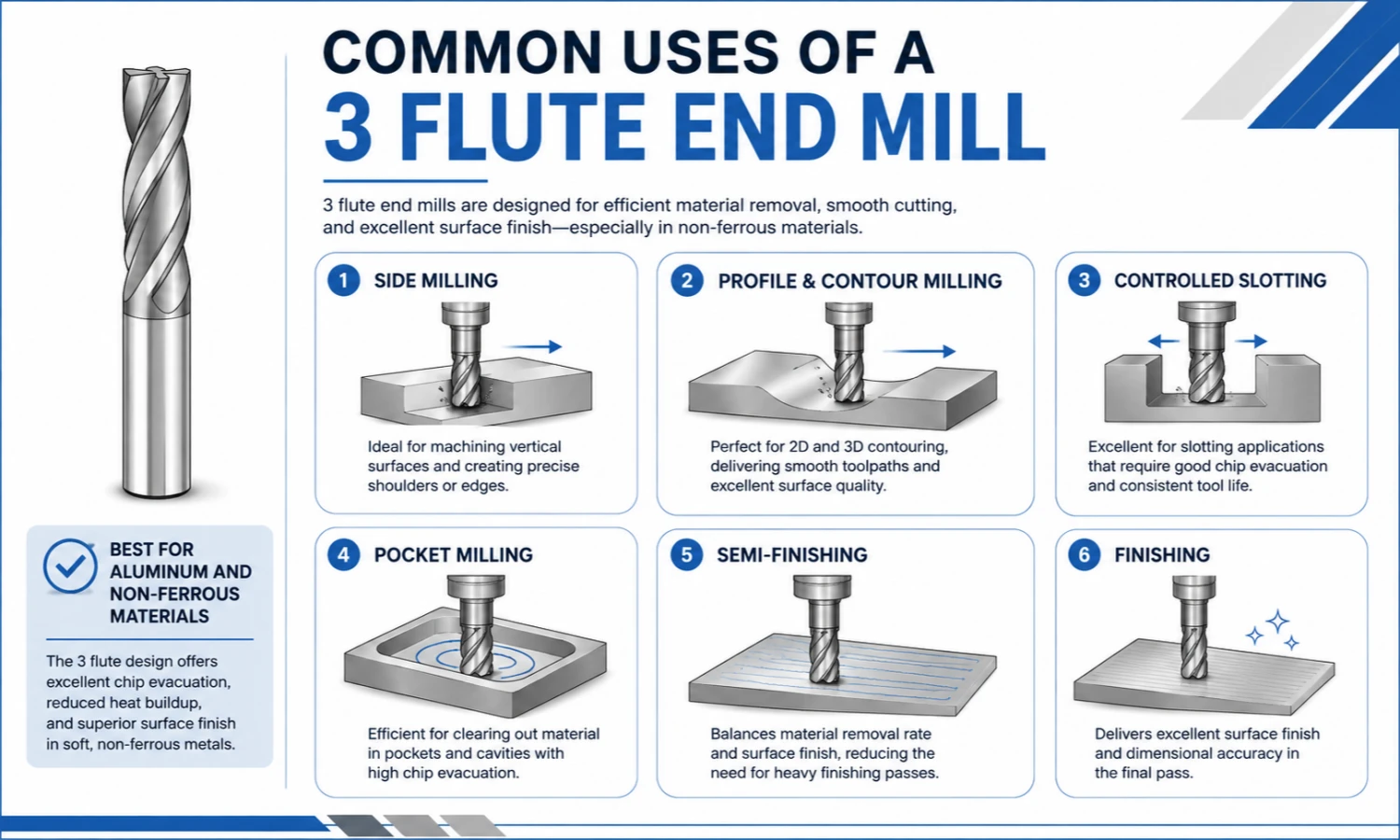
A 3 La fresa de extremo de flauta se utiliza principalmente para el mecanizado de aluminio., fresado lateral, fresado de perfiles, ranurado controlado, fresado de bolsillo, semiacabado, y terminando. Sus tres filos de corte proporcionan un equilibrio práctico entre el espacio de la viruta, rigidez del cortador, y calidad de la superficie.
Comparado con un 2 cortador de flauta, el tercer filo aumenta el compromiso de la herramienta y admite un fresado lateral más estable. Al mismo tiempo, un diseño de tres flautas normalmente retiene más espacio para virutas que muchas herramientas de flautas más altas.
Este equilibrio hace que la cortadora sea útil para piezas de aluminio que requieren paredes limpias y eliminación controlada de virutas.. Sin embargo, la elección correcta aún depende de la operación, profundidad de corte, alcance de la herramienta, configuración de la máquina, y método de refrigerante.
Respuesta rápida: Usos comunes de un 3 Molino de extremo de flauta
Las aplicaciones típicas incluyen:
- Mecanizado de aluminio y aleaciones de aluminio.
- fresado lateral
- Fresado de perfiles y contornos
- Ranurado controlado
- Fresado de cajeras
- Fresado escalonado y en escuadra
- Semiacabado
- Acabado
Una cortadora de tres flautas funciona mejor cuando el proceso de mecanizado necesita tanto evacuación de viruta como corte estable.. Es especialmente útil para operaciones de perfilado y acabado donde la calidad de la pared es importante..
Para ranuras profundas de ancho completo o desbaste pesado, a 2 La herramienta de flauta puede funcionar mejor porque ofrece espacios de flauta más grandes..
Por qué tres flautas funcionan bien en aluminio
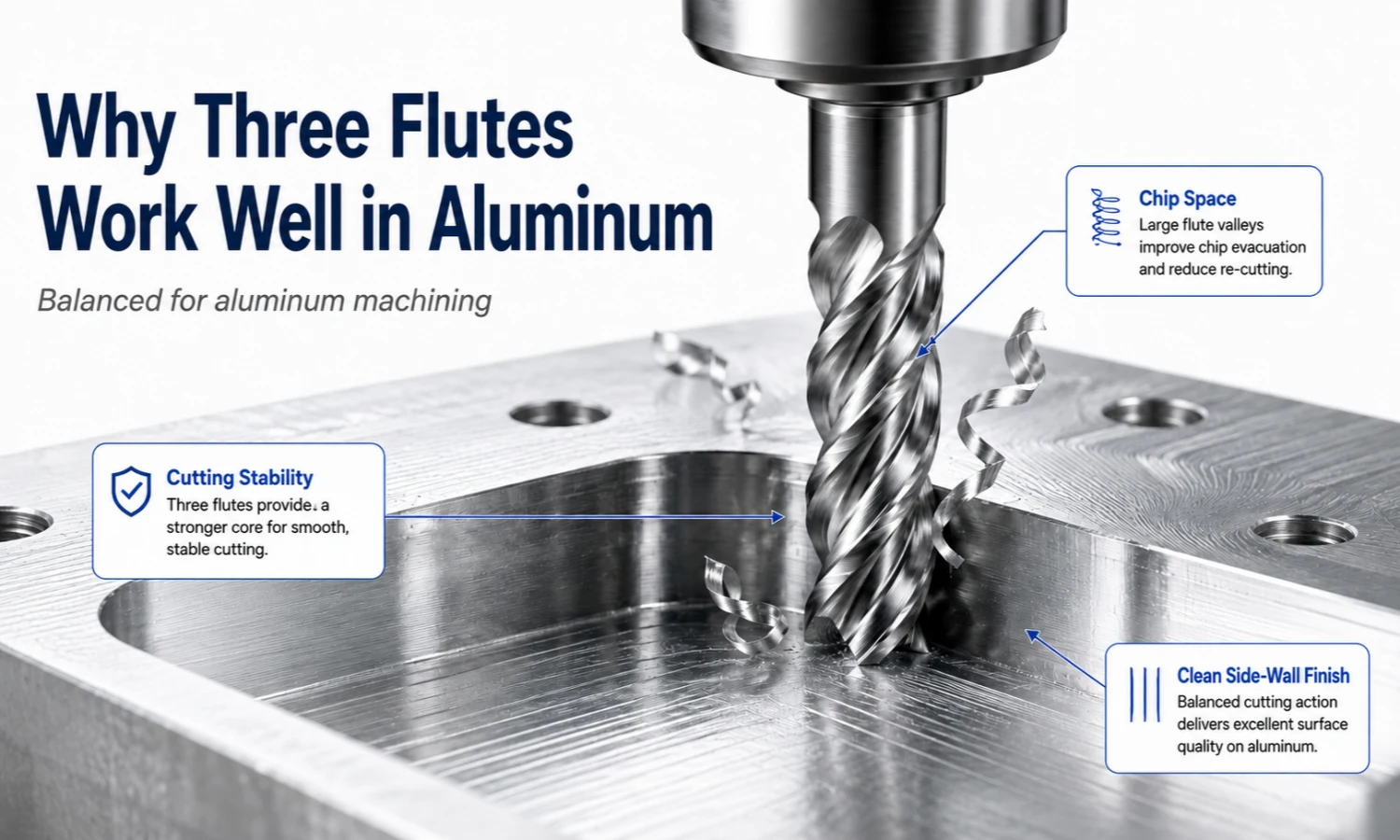
El espacio de la flauta ayuda a controlar las virutas de aluminio
El aluminio suele producir virutas grandes o continuas.. Si estas virutas permanecen dentro del área de corte, pueden ser recortados, recoger en las flautas, o pegarse a la vanguardia.
Un cortador de tres flautas mantiene un espacio útil para las virutas al mismo tiempo que agrega otro filo de corte. Por lo tanto, Puede eliminar aluminio de manera eficiente cuando la trayectoria, refrigerante, explosión de aire, velocidad, y alimentación favorecen una evacuación suave de la viruta.
La fresa no soluciona por sí sola el mal control de viruta. Compromiso profundo, carga excesiva de herramienta, o un suministro débil de refrigerante aún puede causar empaquetamiento de virutas..
Un núcleo más fuerte respalda la estabilidad del corte
En diseños de cortador comparables, agregar una tercera flauta generalmente aumenta la sección central en comparación con una herramienta de dos flautas. Un núcleo más fuerte puede reducir la desviación de la herramienta y respaldar un compromiso más estable.
Esto es importante durante el fresado lateral, Perfiles, y terminando. Una menor deflexión puede ayudar a mantener la geometría de la pared y producir una superficie más consistente.
Sin embargo, La longitud de la herramienta también importa.. Una longitud de flauta larga o un saliente excesivo pueden reducir la rigidez incluso cuando el cortador tiene un núcleo fuerte..
Una mayor participación de vanguardia puede mejorar el acabado
El filo adicional aumenta el número de operaciones de corte por revolución de la herramienta.. Como resultado, La herramienta puede soportar un acabado más suave y consistente en condiciones adecuadas..
Sin, condición del titular, avance por diente, geometría del borde, y la rigidez de la máquina todavía afectan el resultado final. El recuento de flautas es importante., pero es solo una parte del sistema de corte.
Principal 3 Aplicaciones de fresas de extremo de flauta
Fresado lateral y perfilado
El fresado lateral y el fresado de perfiles son usos comunes de una fresa de tres flautas.. Estas operaciones necesitan un contacto estable., geometría de pared precisa, y eliminación controlada de virutas.
El tercer filo permite un contacto regular con la pieza de trabajo.. Mientras tanto, los espacios de las flautas dejan espacio para virutas de aluminio.
Esta combinación se adapta a paredes rectas., perfiles externos, contornos internos, y bordes de componentes.
Ranurado controlado
A 3 La fresa de ranura puede mecanizar ranuras cuando la profundidad de la ranura y las condiciones de control de viruta son adecuadas..
Para ranurado poco profundo o controlado, Proporciona un buen equilibrio entre eliminación de material y estabilidad.. Sin embargo, El ranurado de ancho completo coloca los tres filos de corte en contacto con el material y deja menos espacio para las virutas..
Si las virutas comienzan a acumularse dentro de una ranura profunda, reducir la carga de corte, mejorar el suministro de refrigerante o aire, o mudarse a un 2 cortador de flauta.
Fresado de bolsillo
El fresado de cajeras requiere un corte estable y una trayectoria de herramienta eficaz. El cortador debe eliminar el material y al mismo tiempo permitir que las virutas salgan del bolsillo..
Una entrada rampante, entrada helicoidal, o la trayectoria de herramienta adaptable puede reducir el recorte de viruta. Por el contrario, El acoplamiento agresivo en todo el ancho puede sobrecargar el cortador o atrapar virutas..
Por lo tanto, el diseño de la trayectoria es tan importante como el número de canales.
Semiacabado y Acabado
Las cortadoras de tres filos también funcionan bien para semiacabado y acabado de piezas de aluminio..
El filo adicional puede soportar paredes más limpias y una superficie más uniforme que algunas herramientas de dos flautas.. Por lo tanto, Este recuento de flautas es útil cuando la calidad de la superficie importa más que el volumen máximo de viruta..
¿Qué materiales puede 3 Corte de fresa de extremo de flauta?
Aluminio y aleaciones de aluminio
El aluminio es la aplicación principal de muchas herramientas de tres filos.. El diseño combina espacio para virutas con la rigidez necesaria para el fresado lateral., Perfiles, embolsarse, y terminando.
Antes de seleccionar el cortador, revisar el grado de aluminio, operación, profundidad de corte, forma de chip, método de refrigerante, y requisito de acabado.
Cobre y Latón
Una cortadora de carburo de tres flautas también puede mecanizar cobre y latón cuando la geometría del borde y las condiciones de corte se adaptan al material..
Los bordes cortantes afilados y el buen control de viruta ayudan a reducir las rebabas y a mantener la calidad de la superficie.. Sin embargo, El cobre y el latón no se comportan exactamente como el aluminio., por lo que es posible que un diseño de herramienta no se adapte a todos los grados.
Plásticos y otros materiales no ferrosos
Algunos plásticos y otros materiales no ferrosos también se pueden mecanizar con una herramienta de tres filos..
para plasticos, la acumulación de calor y la fusión de las virutas pueden volverse importantes. Por lo tanto, Utilice una geometría de herramienta y un método de refrigerante que mantengan limpia la zona de corte..
Materiales compuestos
Una cortadora de tres flautas puede ser adecuada para compuestos seleccionados, pero las estructuras compuestas varían ampliamente. Dirección de la fibra, contenido de resina, calidad del borde, y el riesgo de delaminación puede cambiar la geometría requerida.
Para aplicaciones compuestas, Confirme la estructura del material y el objetivo de corte antes de elegir la herramienta..
Problemas comunes y comprobaciones prácticas
| Problema de mecanizado | Comprobación práctica |
|---|---|
| Las fichas se acumulan dentro de una ranura. | Reducir el compromiso, mejorar el refrigerante o el chorro de aire, o considerar un 2 cortador de flauta |
| El aluminio se pega al borde. | Comprobar evacuación de virutas, lubricación, geometría del borde, y tratamiento de superficies |
| Las paredes laterales se ven ásperas | comprobar el descentramiento, saliente de la herramienta, condición del titular, alimentar, y compromiso radial |
| Se producen ruidos o vibraciones | Acortar el alcance de la herramienta, mejorar la sujeción, y reducir el compromiso inestable |
| La vida útil de la herramienta es inconsistente | Revisar el agotamiento, recorte de viruta, carga de corte, refrigerante, y selección de herramientas |
| Quedan rebabas en la pieza | Comprobar la nitidez del borde, desgaste de herramientas, dirección de corte, y parámetros de acabado |
Estos síntomas no siempre provienen del recuento de flautas.. Por ejemplo, cambiar de dos flautas a tres flautas no corregirá el descentramiento excesivo ni un portaherramientas débil.
Comience verificando la configuración completa. Luego ajuste el recuento de flautas si hay espacio para el chip., rigidez, o el compromiso de vanguardia sigue siendo el principal problema.
¿Cuándo es un 3 Flute End Mill a Good Choice?
Choose a three-flute cutter when:
- The workpiece is aluminum or another suitable non-ferrous material
- The operation includes side milling or profiling
- Wall quality is important
- Semi-finishing or finishing is required
- A 2 flute tool does not provide enough stability
- A higher-flute tool leaves insufficient chip space
- The toolpath and coolant method can control chip evacuation
The cutter is not automatically the best option for every aluminum job. Profundidad de corte, compromiso radial, alcance de la herramienta, rigidez de la máquina, and chip form should guide the final decision.
When Should You Choose Another Flute Count?
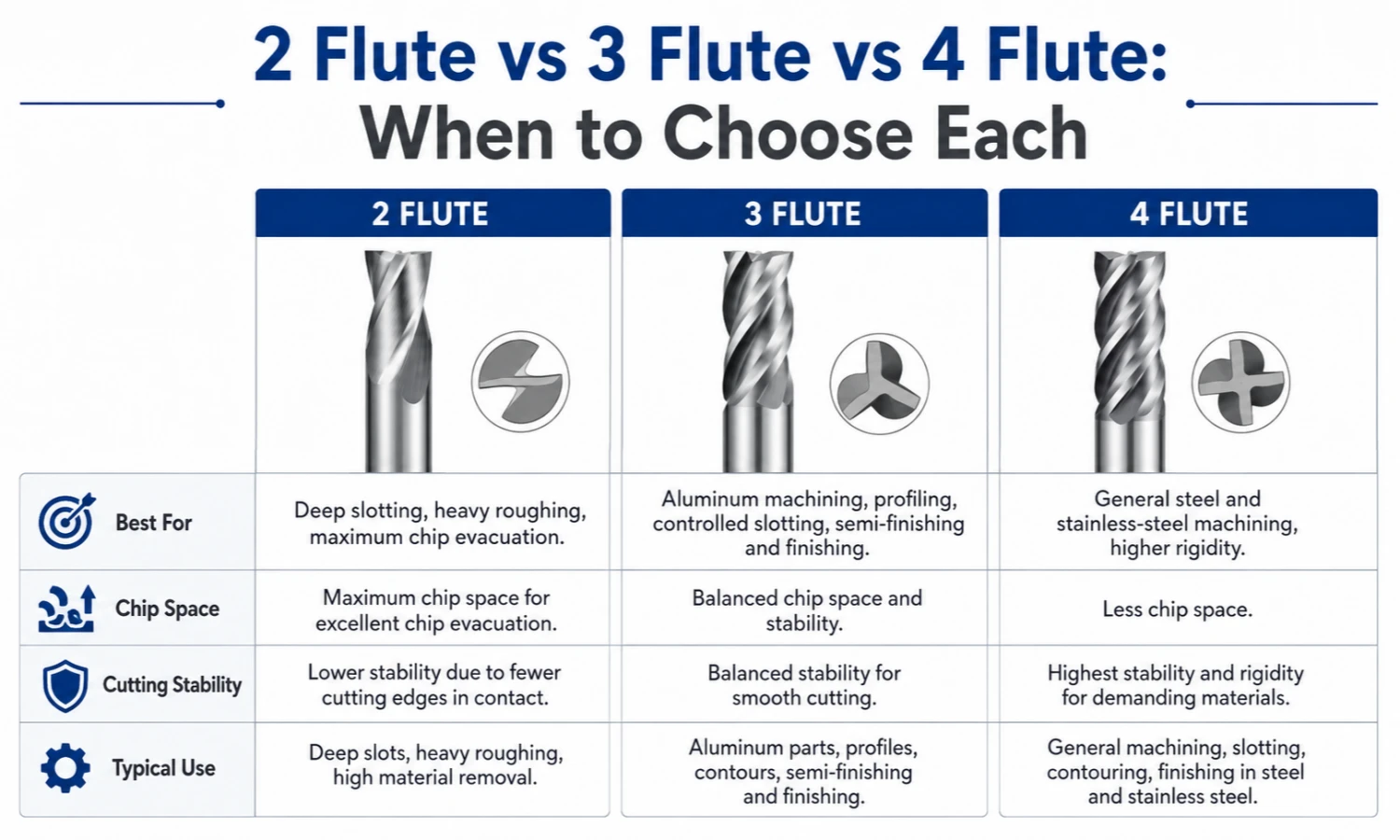
Different flute counts suit different materials, chip-control needs, and machining operations. The following comparison provides a quick selection reference.
Elegir 2 Flutes for Deep Slotting and Heavy Roughing
A 2 flute cutter provides larger flute spaces. A menudo es la mejor opción para:
- Ranurado profundo de ancho completo
- Desbaste de aluminio pesado
- Grandes cargas de virutas
- Operaciones en las que la máxima preocupación es la máxima evacuación de virutas
Una cortadora de tres flautas se vuelve más atractiva cuando la calidad de la pared y la estabilidad del corte son más importantes.
Para una comparación detallada, lee nuestro 2 flauta vs. 3 fresa de extremo de flauta para guía de aluminio.
También puedes ver nuestro 2 Molino de extremo de flauta para ranurado profundo y desbaste de aluminio.
Considerar 4 Flautas para Acero y Acero Inoxidable
A 4 El cortador de flauta proporciona más filos de corte y, a menudo, tiene un núcleo más fuerte que una herramienta de flauta inferior.. Se selecciona comúnmente para mecanizado general de acero y acero inoxidable., donde el volumen de viruta puede ser menor y la rigidez es importante.
Sin embargo, cuatro flautas no son automáticamente mejores. La elección correcta depende del material., forma de chip, profundidad de corte, y operación.
Para aplicaciones de acero y acero inoxidable, ver nuestro 4 Fresas de extremo de flauta.
Cómo seleccionar un 3 Molino de extremo de flauta
Comience con el material de la pieza de trabajo
Primero, identificar el material y el grado. Aluminio, cobre, latón, plástica, y los composites producen diferentes virutas y temperaturas de corte.
El material influye en la geometría del borde requerida., tratamiento superficial, y método de control de chip.
Haga coincidir la herramienta con la operación
Próximo, identificar la operación principal.
Una fresa utilizada para fresado lateral puede necesitar una longitud de ranura y un diseño de borde diferentes a los utilizados para ranurar., embolsarse, o terminando.
El acoplamiento de ancho completo también crea demandas de control de viruta diferentes a las del acabado radial ligero..
Elija las dimensiones y el alcance adecuados
Las dimensiones importantes incluyen:
- Diámetro de corte
- longitud de la flauta
- Longitud total
- Diámetro del mango
- Longitud del cuello, cuando hace falta
Utilice la longitud de flauta y la longitud total más cortas y prácticas.. Una configuración más corta generalmente mejora la rigidez y reduce la vibración..
Las herramientas de largo alcance pueden acceder a funciones profundas o restringidas. Sin embargo, el voladizo adicional aumenta el riesgo de deflexión, por lo que la estrategia de corte debe coincidir con la configuración.
Revisar la geometría de los bordes y el tratamiento de superficies
La geometría del borde y el tratamiento de la superficie deben coincidir con el material., operación, condición del refrigerante, riesgo de adherencia de viruta, y vida útil requerida de la herramienta.
Para aluminio, Los bordes de corte afilados y el flujo suave de viruta son especialmente importantes.. Se debe seleccionar la opción correcta para la aplicación en lugar de elegirla únicamente por el nombre del recubrimiento..
Confirmar los parámetros iniciales para la herramienta real
Un único valor de velocidad y avance no se adapta a todas las cortadoras de tres canales.
Diámetro de herramienta, longitud de la flauta, diseño de borde, revestimiento, grado de la pieza de trabajo, rigidez de la máquina, titular, refrigerante, profundidad axial, y el compromiso radial afectan los parámetros iniciales..
Por lo tanto, Utilice los parámetros proporcionados para la especificación de herramienta confirmada.. Comience con un ensayo controlado, luego revise el formulario del chip, acabado superficial, carga del husillo, sonido, y desgaste del cortador.
Preguntas frecuentes
¿Qué es un 3 fresa de extremo de flauta utilizada para?
Se utiliza principalmente para operaciones de aluminio que requieren una evacuación controlada de viruta., corte estable, y paredes laterales limpias.
Se selecciona cuando la operación necesita tanto evacuación de viruta como corte estable..
¿Es un cortador de tres flautas adecuado para ranurado profundo??
Puede funcionar en ranuras controladas, pero normalmente no es la primera opción para ranuras de ancho completo muy profundas..
Las ranuras profundas dejan menos espacio para que escapen las fichas. In that situation, a 2 cortador de flauta, compromiso más ligero, o una trayectoria de herramienta diferente puede proporcionar un mejor control de viruta.
¿Por qué el aluminio se pega al filo??
El aluminio puede adherirse si las virutas no se eliminan rápidamente, la lubricación es insuficiente, el filo está desgastado, o la geometría de la herramienta no se adapta al material.
Verifique el suministro de refrigerante o aire, recorte de viruta, carga de corte, condición de borde, y tratamiento de superficies.
¿Puede una máquina cortadora de acero de tres flautas??
Se puede diseñar una cortadora de tres flautas para aplicaciones de acero seleccionadas.. Sin embargo, Muchas herramientas de tres filos están destinadas principalmente a aluminio y materiales no ferrosos..
Para mecanizado general de acero y acero inoxidable, a 4 La herramienta de flauta puede ofrecer un equilibrio más adecuado entre rigidez y recuento de vanguardia..
Necesito un 3 Fresa de extremo de flauta para aluminio?
Para especificaciones del producto, dimensiones personalizadas, geometría, revestimiento, calificación, y opciones de embalaje, ver nuestro 3 Fresa de extremo plano de carburo de flauta para aluminio.
Enviar el material de la pieza., operación de mecanizado, dimensiones requeridas, cantidad, y cualquier dibujo disponible o información de corte actual.
Envía tu dibujo por correo electrónico, Fotos de herramientas, o requisitos para sales@cutterbest.com.