 Fresas de precisión,Herramientas de corte para el mecanizado CNC de todos los materiales

Introducción
What is a bull nose end mill? It is a flat-bottom end mill with a defined radius at the cutting corners. This geometry is also commonly described in tooling catalogs as a fresa de extremo de radio de esquina, although naming can vary between manufacturers.
The flat bottom allows the cutter to machine bottom surfaces, while the radiused corners create a rounded bottom-to-wall transition instead of a sharp cutting-corner result.
Bull nose end mills are commonly used for contouring, fresado de perfiles, mecanizado de cavidades, semiacabado, and other CNC operations where the part geometry allows or requires a corner radius.
¿Qué es una fresa de punta de toro??
A bull nose end mill has a flat cutting bottom with radiused corners between the bottom cutting edge and the side cutting edge.
This geometry distinguishes it from two other common end mill profiles. A square or flat end mill has a sharp cutting corner, while a ball nose end mill has a fully rounded cutting end. A bull nose cutter keeps the flat bottom while adding a defined corner radius.
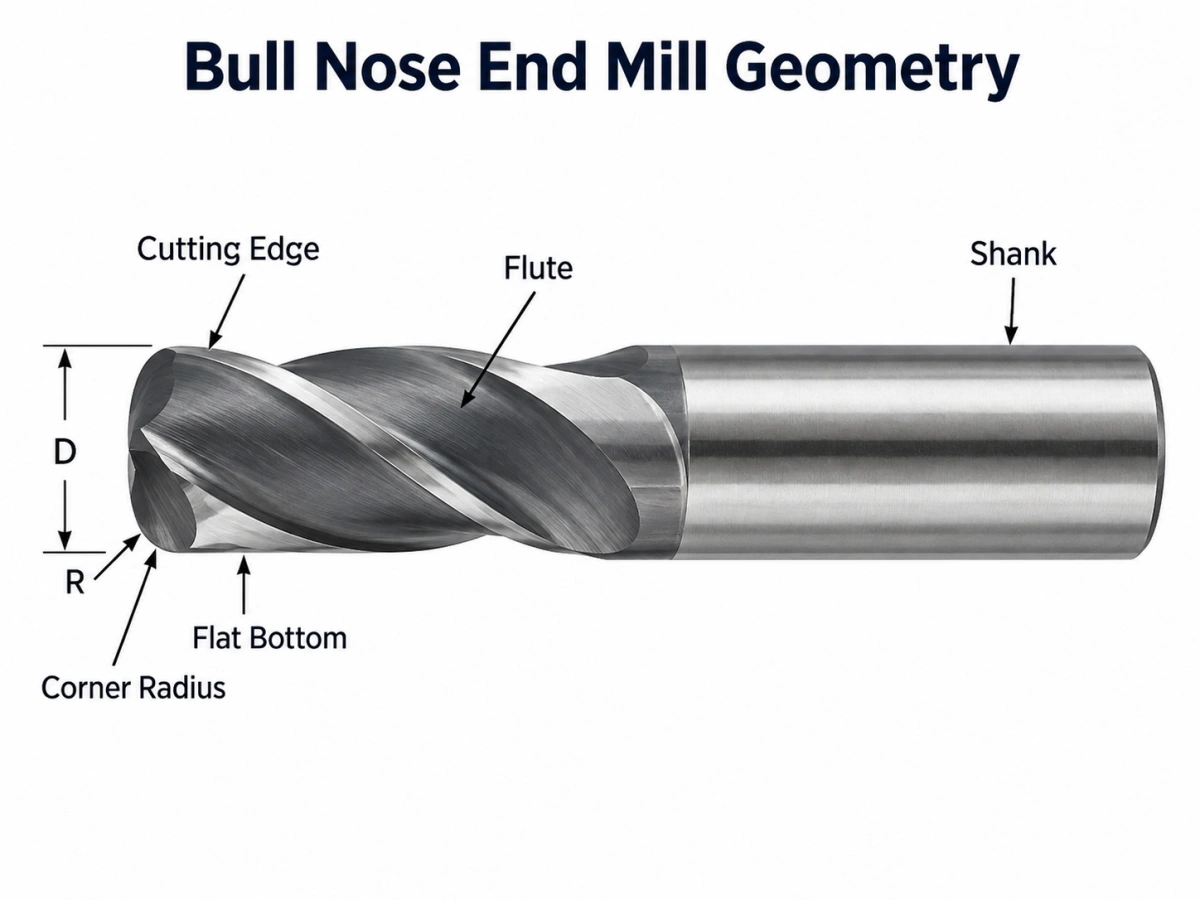 Como resultado, the tool is useful when a part requires a flat or stepped feature together with a radiused bottom-to-wall transition.
The exact cutter still needs to match the required part dimensions, corner geometry, alcanzar, y condiciones de mecanizado.
Bull Nose End Mill and Corner Radius End Mill Terminology
The terms fresa de punta de toro y fresa de extremo de radio de esquina often describe closely related flat-bottom cutter geometry with radiused cutting corners.
“Corner radius end mill” is a common catalog term because it directly describes the tool geometry. “Bull nose end mill” is also widely used by buyers, maquinistas, and suppliers.
Sin embargo, naming conventions can vary between manufacturers. Some catalogs may use the terms differently or separate product families according to radius size, series, o aplicación.
Por esta razón, do not rely on the product name alone. Confirm the actual cutter diameter, radio de esquina, geometría de la flauta, and other required dimensions before ordering.
For available product configurations, ver nuestro Molino de punta de toro.
Why the Corner Radius Matters
The corner radius is located where the flat bottom of the cutter transitions into the side cutting edge.
This radius changes the geometry produced at the bottom-to-wall transition of the machined feature. Instead of leaving the sharp-corner geometry associated with a square-profile cutter, the bull nose geometry creates or follows a radiused transition.
The required radius should therefore match the drawing and finished part geometry.
A larger or smaller radius should not be selected from a general rule alone. The exact R value depends on the required feature, dimensiones del cortador, requisito de mecanizado, and part design.
What Is a Bull Nose End Mill Used For?
Bull nose end mills are used in CNC milling applications where the part geometry benefits from a flat bottom combined with a corner radius.
Las aplicaciones típicas incluyen:
- Contour milling
- fresado de perfiles
- Semiacabado
- Cavity machining
- Mecanizado de moldes y matrices
- Stepped features with radiused lower corners
- Bottom-to-wall transitions where a corner radius is required
The same cutter type may be used for different workpiece materials, but the final tool configuration should match the material and machining conditions.
Por ejemplo, grado de carburo, geometría de la flauta, coating or surface treatment, dimensiones de la herramienta, and cutting design may vary according to the actual application.
Por lo tanto, the tool name alone does not determine the complete machining setup.
Basic Bull Nose End Mill Selection
Selecting a bull nose end mill starts with the geometry of the part rather than with a general performance rule.
Part and Corner Geometry
Primero, check the drawing.
Confirm whether the feature:
- Requires a corner radius
- Allows a radiused transition
- Requires a flat bottom
- Has enough access for the selected cutter diameter
- Requires a sharp internal corner instead
If the drawing requires a sharp 90-degree cutting-corner result with no specified radius, a bull nose geometry may not be the correct choice for that feature.
Dimensiones de la herramienta
The cutter diameter and corner radius must match the feature being machined.
Length of cut, alcance de la herramienta, tamaño del mango, and overall tool geometry also need to suit the part and machine setup.
This page does not list every possible size combination because standard and custom configurations vary. For actual dimensions and available product options, see the Molino de punta de toro página del producto.
Workpiece and Machining Requirement
After confirming the basic geometry, the final cutter configuration depends on the workpiece and machining requirement.
Different applications may require different flute geometry, coating or surface treatment, longitud de la herramienta, center-cutting design, or tolerance requirements.
For non-standard applications, the drawing and machining information provide the best basis for confirming the final tool.
Related End Mill Comparisons
A bull nose end mill is sometimes compared with other cutter profiles, but each comparison has a different selection question.
If you need a sharp-corner comparison, ver Molino de punta toro versus extremo plano.
For the difference between a flat-bottom radiused cutter and a fully rounded cutting end, ver Fresa de punta toro frente a fresa de punta esférica.
Bull nose / corner radius cutters are also different from corner rounding form cutters. See Radio de esquina versus fresa para redondear esquinas.
Preguntas más frecuentes
What is a bull nose end mill?
A bull nose end mill is a flat-bottom milling cutter with a defined radius at the cutting corners. The corner radius creates a radiused transition between the machined bottom and side wall.
¿Para qué se utiliza una fresa de punta redondeada??
Typical uses include contour milling, fresado de perfiles, semiacabado, mecanizado de cavidades, mold and die machining, and features that require a radiused bottom-to-wall transition.
The actual application depends on the part geometry and tool configuration.
¿Es una fresa de punta redondeada lo mismo que una fresa de radio de esquina??
The terms are often used for closely related flat-bottom cutters with radiused cutting corners, and “corner radius end mill” is a common catalog description for this geometry.
Sin embargo, terminology can vary between manufacturers, so the actual radius and cutter geometry should always be confirmed.
How do I choose a bull nose end mill?
Start with the part drawing and required corner geometry.
Confirm the cutter diameter, radio de esquina, alcance requerido, and other dimensions. Then consider the workpiece material and machining requirement when confirming the final flute geometry, coating or surface treatment, and tool design.
For standard dimensions or custom configurations, refer to the Molino de punta de toro página del producto.
¿Es lo mismo una fresa de punta redondeada que una fresa de redondeo de esquinas??
No.
A bull nose or corner radius end mill has a radius on the cutting corners of the tool itself. A corner rounding end mill is a different form cutter used to produce a rounded profile on a workpiece edge.
For the detailed distinction, ver Radio de esquina versus fresa para redondear esquinas.
Conclusión
A bull nose end mill combines a flat cutting bottom with radiused cutting corners. It is commonly used when the part requires a flat or stepped feature together with a radiused bottom-to-wall transition.
The correct cutter depends on the drawing, radio de esquina, dimensiones de la herramienta, pieza de trabajo, and machining requirement rather than on one fixed configuration.
If you need help confirming a bull nose end mill for your part, send your drawing or machining requirements by correo electrónico or contact us directly on WhatsApp.