 Frese di precisione,Utensili da taglio per la lavorazione CNC di ogni materiale

Introduzione
Nella lavorazione CNC, bull nose vs ball nose is a common comparison because the right end mill affects surface finish, vita dell'utensile, stabilità della lavorazione, ed efficienza complessiva. Many machinists want to understand the difference between a bull nose end mill and a ball nose end mill.
Sebbene queste due frese siano entrambe utilizzate nella lavorazione relativa al contorno, non sono progettati esattamente per lo stesso scopo. Una fresa a punta toro ha un fondo piatto con un raggio d'angolo, mentre una fresa a punta sferica ha una punta completamente arrotondata. A causa di questa differenza, ciascun utensile offre prestazioni migliori in specifiche situazioni di lavorazione.
In termini semplici, una fresa a punta toro è spesso preferita quando si hanno angoli più forti, transizioni più fluide, e sono necessari un migliore controllo sulle caratteristiche a gradini o semi-piatte. Al contrario, una fresa a testa sferica è solitamente l'opzione migliore per superfici 3D continue e forme curve complesse.
If you need stronger corner support, semifinitura, or stepped profile machining, visualizza il nostro custom R corner cutter options.
If your project focuses on 3D contour finishing or curved surface machining, puoi anche controllare il nostro Frese a candela a testa sferica.
Risposta rapida
This bull nose vs ball nose comparison helps you choose the right cutter based on tip geometry, corner strength, 3Lavorazione della superficie D, and finish requirements.
Scegli un fresa a candela a testa tonda quando hai bisogno di una migliore forza d'angolo, contorno più stabile, e transizioni più fluide su profili o superfici a gradini.
Scegli una fresa a testa sferica quando hai bisogno di un contatto continuo su superfici 3D, forme scultoree, o parti curve complesse.
In molti lavori di lavorazione reali, la domanda chiave non è quale strumento sia universalmente migliore. Invece, la scelta migliore dipende dalla geometria del pezzo, obiettivo di lavorazione, e requisito di finitura.
Cos'è una fresa a punta di toro?
Una fresa a punta toro è una fresa con fondo piatto e raggio dell'angolo arrotondato. Si colloca tra una fresa a candela piatta e una fresa a testa sferica in termini di geometria e applicazione.
Perché l'angolo acuto è sostituito da un raggio, il tagliente diventa più forte e ha meno probabilità di scheggiarsi. Allo stesso tempo, il fondo piatto consente comunque pratiche lavorazioni su moltissimi profili, passi, e superfici semipiane. Di conseguenza, una fresa a punta toro è ampiamente utilizzata per la fresatura di contornature, semifinitura, lavorazione della cavità, e lavori di stampo.
If you want a more complete explanation of tool geometry and common uses, leggi il nostro tool geometry and application guide.
Cos'è una fresa a punta sferica?
Una fresa a testa sferica ha una punta completamente arrotondata. A differenza di una fresa a punta toro, non ha il fondo piatto. Questa geometria consente all'utensile di rimanere in contatto più fluido con superfici curve e tridimensionali.
Per questo motivo, una fresa a testa sferica è comunemente utilizzata nella lavorazione di contorni 3D, superfici scolpite, finitura dello stampo, e geometria a forma libera. Tuttavia, perché la punta è completamente arrotondata, di solito è meno efficiente su superfici piane o gradinate rispetto a una fresa a punta tonda.
In pratica, una fresa a testa sferica viene spesso scelta quando il percorso di lavorazione prevede curve continue anziché caratteristiche a fondo piatto o semi-piatto.
For 3D contour finishing, lavorazione di superfici curve, e finitura dello stampo, you can view our Frese a candela a testa sferica.
La differenza principale tra una fresa a punta tonda e una fresa a punta sferica
La differenza principale è la geometria della punta, e questa differenza influisce direttamente sul comportamento di taglio, qualità di finitura, e campo di applicazione.
Geometria della fresa a punta toro
Una fresa a punta toro ha:
- un fondo piatto
- un raggio d'angolo
- supporto dei bordi più forte
- migliore controllo su elementi a gradini o semi-piatti
Geometria della fresa a punta sferica
Ha una fresa a punta sferica:
- una punta completamente arrotondata
- contatto curvo continuo
- prestazioni migliori su superfici 3D
- meno supporto per la lavorazione a fondo piatto
Perché la geometria è importante
Una fresa a toro offre solitamente una migliore durata degli angoli e un taglio più pratico su forme a gradini o semi-piatte. Una fresa a punta sferica, Tuttavia, è migliore quando l'utensile deve muoversi agevolmente su superfici curve complesse. Insomma, uno strumento a punta di toro è più bilanciato per resistenza e stabilità del contorno, mentre un utensile a testa sferica è più specializzato per la finitura di superfici curve.
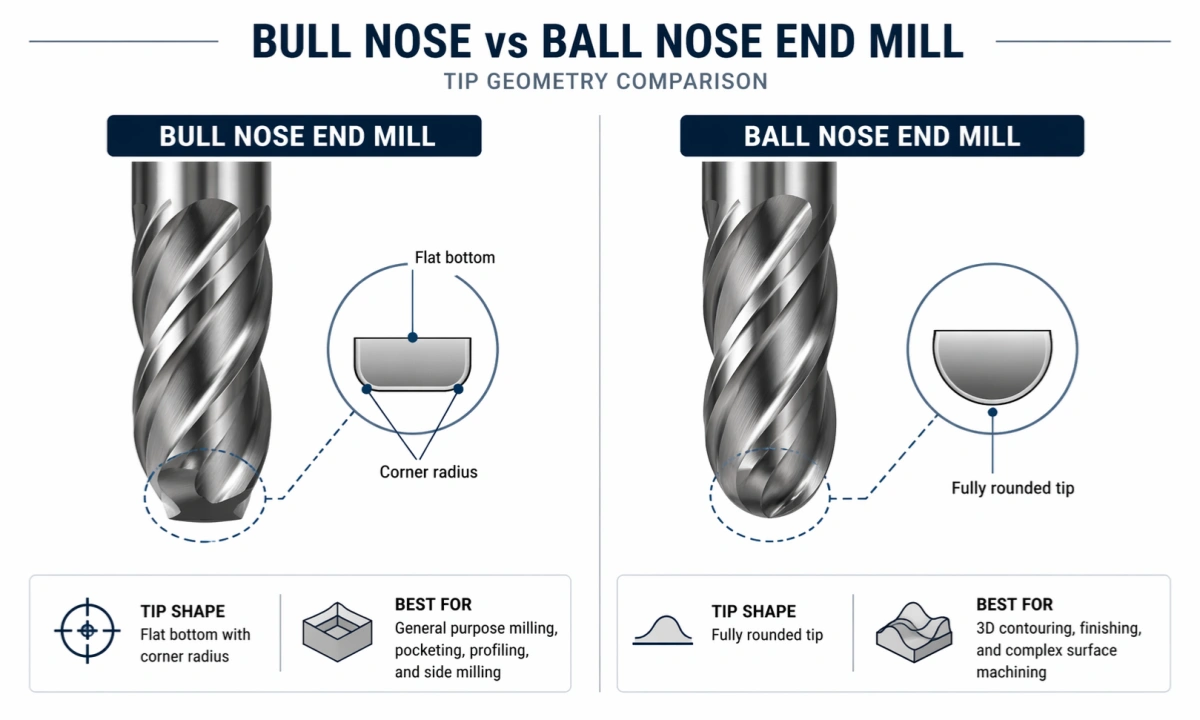
Tabella di confronto rapido
| Necessità di lavorazione | Scelta migliore |
|---|---|
| Angoli di taglio più forti | Fresa a punta toro |
| Superfici 3D continue | Fresa a punta sferica |
| Semifinitura e contornatura | Fresa a punta toro |
| Finitura superficiale liscia a forma libera | Fresa a punta sferica |
| Migliore controllo sulla superficie piana | Fresa a punta toro |
| Dettagli dello stampo scolpito | Fresa a punta sferica |
Questa tabella è volutamente semplice in modo che sia facile da leggere sui dispositivi mobili.
Finitura superficiale e prestazioni di taglio
Sebbene entrambi gli strumenti possano essere utilizzati nei lavori relativi al contorno, il loro comportamento di taglio è diverso.
Finitura superficiale su superfici curve
Una fresa a testa sferica è spesso la scelta migliore per superfici curve continue perché la punta arrotondata si muove più agevolmente lungo i contorni 3D. Perciò, trova largo impiego nelle operazioni di finitura degli stampi, muore, e parti scolpite.
Finitura superficiale su aree a gradini o semipiane
Una fresa a testa tonda è spesso più pratica quando il pezzo prevede transizioni tra sezioni piane e curve. Perché ha un fondo piatto e un raggio d'angolo, può offrire un migliore equilibrio tra qualità di finitura e stabilità di taglio.
Stabilità dello strumento
Una fresa a punta toro di solito ha angoli più forti. Di conseguenza, spesso offre prestazioni migliori in condizioni impegnative in cui la durata dei bordi è importante. Una fresa a testa sferica può ancora funzionare molto bene, ma la sua punta completamente arrotondata non è sempre la scelta più efficiente per ogni geometria.
Durata dell'utensile
In molte applicazioni pratiche, una fresa a testa tonda può fornire un migliore supporto del tagliente e ridurre il rischio di scheggiatura locale. Una fresa a punta sferica, Tuttavia, spesso offre prestazioni migliori quando la priorità è la finitura liscia su curve continue piuttosto che una maggiore durata in curva.
Quale strumento è migliore per diverse applicazioni?
La risposta dipende dall'applicazione. Ogni utensile ha chiari punti di forza in specifiche attività di lavorazione.
La fresa a punta toro è migliore per
- fresatura di contorni
- operazioni di semifinitura
- lavorazione della cavità
- lavorazione di stampi con supporto del bordo più forte
- superfici gradinate o parzialmente piane
- lavori in cui la scheggiatura degli angoli è un problema
La fresa a punta sferica è migliore per
- lavorazione continua di superfici 3D
- forme scultoree
- percorsi di finitura curvi
- finitura dello stampo su superfici a forma libera
- parti con geometria fluida complessa
Per la finitura dei contorni 3D e la lavorazione di superfici curve, puoi anche visionare il nostro Frese a candela a testa sferica.
La migliore scelta pratica
Se il lavoro include sia transizioni semi-piatte che lavorazioni curve, una fresa a punta toro è spesso più versatile. Se il lavoro è prevalentemente di finitura 3D con curvatura continua, una fresa a testa sferica è solitamente l'opzione migliore.
Come scegliere lo strumento giusto
La scelta tra una fresa a testa toro e una fresa a testa sferica dipende dalla forma della parte, obiettivo di lavorazione, e requisito di finitura.
Scegli una fresa a punta tonda quando
- hai bisogno di una migliore forza d'angolo
- si stanno lavorando profili a gradini o transizioni semi-piatte
- desideri una semifinitura o una fresatura di contornatura più stabile
- si desidera ridurre la scheggiatura locale del bordo
Scegli una fresa a punta sferica quando
- si stanno lavorando superfici 3D continue
- è necessario un contatto più fluido sulla geometria curva
- stai rifinendo stampi scolpiti o parti a forma libera
- desideri un percorso utensile più naturale su contorni complessi
Scegli in base alla caratteristica più critica
Se la parte include sia lavorazioni curve che a gradini, scegliere l'utensile in base alla superficie più critica. In molte applicazioni reali, i macchinisti possono utilizzare una fresa a testa tonda per la semifinitura e una fresa a testa sferica per la finitura 3D finale. Questo approccio spesso offre un migliore equilibrio tra efficienza e qualità della superficie.
Se è necessario confrontare anche il naso di toro con uno strumento a fondo piatto con angoli affilati, leggi il nostro flat end mill comparison guide.
Confusione comune nella ricerca
Molti utenti confrontano il naso di toro, naso a palla, e frese a candela contemporaneamente. Tuttavia, ogni confronto ha un intento di ricerca diverso.
- Fresa a punta toro vs Fresa a punta sferica si concentra sul fondo piatto con raggio d'angolo rispetto alla punta completamente arrotondata
- Fresa a punta tonda vs fresa a testa piatta si concentra sull'angolo arrotondato rispetto all'angolo acuto
- Cos'è una fresa a punta di toro si concentra sulla definizione dello strumento, usi, e geometria
To keep the topic clear, this article focuses on the difference between a bull nose end mill and a ball nose end mill. If you need other comparisons, you can read the related guides for flat end mills or general bull nose tool geometry.
Domande frequenti
Qual è la differenza tra una fresa a punta toro e una fresa a punta sferica??
Una fresa a punta toro ha un fondo piatto con un raggio d'angolo, mentre una fresa a punta sferica ha una punta completamente arrotondata. Perciò, lo strumento toro è solitamente migliore per angoli più forti e profili semi-piatti, mentre lo strumento a testa sferica è migliore per superfici 3D continue.
Quale strumento è migliore per la lavorazione di superfici 3D?
Una fresa a testa sferica è solitamente la scelta migliore per superfici 3D continue perché la sua punta arrotondata segue la geometria curva in modo più fluido.
Quale utensile è migliore per la fresatura di contorni?
In molte applicazioni di fresatura di contornatura, una fresa a toro è più pratica perché offre un supporto del tagliente più forte e un migliore controllo su profili a gradini o semi-piatti.
Una fresa a punta toro è più resistente di una fresa a punta sferica?
In molte applicazioni, SÌ. Una fresa a punta toro spesso fornisce un supporto del tagliente più forte grazie al suo fondo piatto e al design del raggio angolare.
Uno strumento può sostituire l'altro?
Non completamente. Questi strumenti potrebbero sovrapporsi in alcune applicazioni, ma sono progettati per diversi tipi di superficie e obiettivi di finitura.
Dove posso controllare le specifiche della fresa a candela con testa toro?
Puoi visionare il nostro custom R corner cutter options for dimensions, opzioni del raggio, e dettagli di lavorazione.
Where can I check ball nose end mill specifications?
Puoi visionare il nostro Frese a candela a testa sferica for 3D contouring, lavorazione di superfici curve, finitura dello stampo, and related specifications.
Conclusione
In this bull nose vs ball nose comparison, the two cutters may seem similar, ma sono progettati per diverse esigenze di lavorazione. Una fresa a toro è solitamente migliore per gli angoli più forti, semifinitura, stabilità del contorno, e profili a gradini. Una fresa a testa sferica è solitamente migliore per superfici 3D lisce, forme scultoree, e finitura a forma libera.
Perciò, la scelta giusta dipende dalla geometria della parte, strategia di taglio, e requisito di finitura. For stronger edge support, semifinitura, or stepped profile machining, una fresa a toro è spesso l'opzione migliore. For continuous 3D contour finishing, lavorazione di superfici curve, or mold finishing, una fresa a testa sferica è solitamente lo strumento giusto.
For custom radius options and stepped profile machining, visualizza il nostro custom R corner cutter options.
Per la finitura dei contorni 3D e la lavorazione di superfici curve, check our Frese a candela a testa sferica.
Need help choosing the right cutter? Send us your workpiece material, machining surface, diametro dell'utensile, radius or ball size, requisito del rivestimento, e la quantità dell'ordine.