 Frese di precisione,Utensili da taglio per la lavorazione CNC di ogni materiale

This end mill selection guide explains how to choose a cutter by machining operation, profilo finale, materiale dell'utensile, conteggio dei flauti, rivestimento, dimensioni, e configurazione della macchina. Choosing the wrong tool can cause poor chip evacuation, chiacchiere, rapid edge wear, errori dimensionali, rottura dell'utensile, or an inconsistent surface finish.
This guide is written for machinists, process engineers, workshop managers, distributori, and buyers who need a practical starting point before selecting or requesting an end mill.
Cos'è una fresa?
An end mill is a rotary cutting tool used for slotting, intascare, profilazione, fresatura laterale, sgrossatura, finitura, e modellamento 3D. A differenza di una punta da trapano standard, it can cut with both the end and outside cutting edges.
Some center-cutting designs support ramping, entrata elicoidale, or limited plunging. Tuttavia, the center geometry and entry method must suit the operation.
For a basic explanation, Leggere cos'è una fresa a candela.
Quick End Mill Selection Guide
The table below provides practical starting directions. Final tool selection should still reflect the workpiece grade, diametro della fresa, profondità di taglio, condizione del titolare, rigidità della macchina, e metodo di rimozione del truciolo.
| Machining Situation | Starting Tool Direction | Motivo principale |
|---|---|---|
| Aluminum Slotting or Deep Pockets | 2–3 Flauti, Sharp Edge, Flauti lucidati | More chip space and lower risk of chip packing |
| General Steel Side Milling | 4 Flauti, Strong Core, Heat-Resistant Coating | Equilibrio di rigidità, conteggio dei bordi, ed evacuazione truciolo |
| Fresatura laterale o finitura dell'acciaio inossidabile | 4–6 Flauti, Variable-Helix or Unequal-Pitch Geometry | Helps control vibration, Calore, e taglio instabile |
| Sgrossatura pesante | Lower or Medium Flute Count, Roughing or Chipbreaker Geometry | More chip space and controlled cutting load |
| Finishing with Light Engagement | Higher Flute Count and Stable Geometry | More cutting contacts and improved surface consistency |
| Flat-Bottom Slots and Pockets | Fresa a testa piatta | Produces a flat bottom and straight walls |
| 3D Contours and Mold Cavities | Fresa a candela a testa sferica | Rounded end follows curved surfaces |
| Semi-Finishing and Stronger Corners | Bull Nose or Corner Radius End Mill | Radius strengthens the outside cutting corner |
| Deep Features with Limited Cutting Depth | Long-Neck Tool with Minimum Necessary Flute Length | Reduces deflection compared with an excessively long flute |
Use this matrix as the first filter. Dopo di che, confirm the end profile, materiale dell'utensile, conteggio dei flauti, rivestimento, dimensioni, e configurazione della macchina.
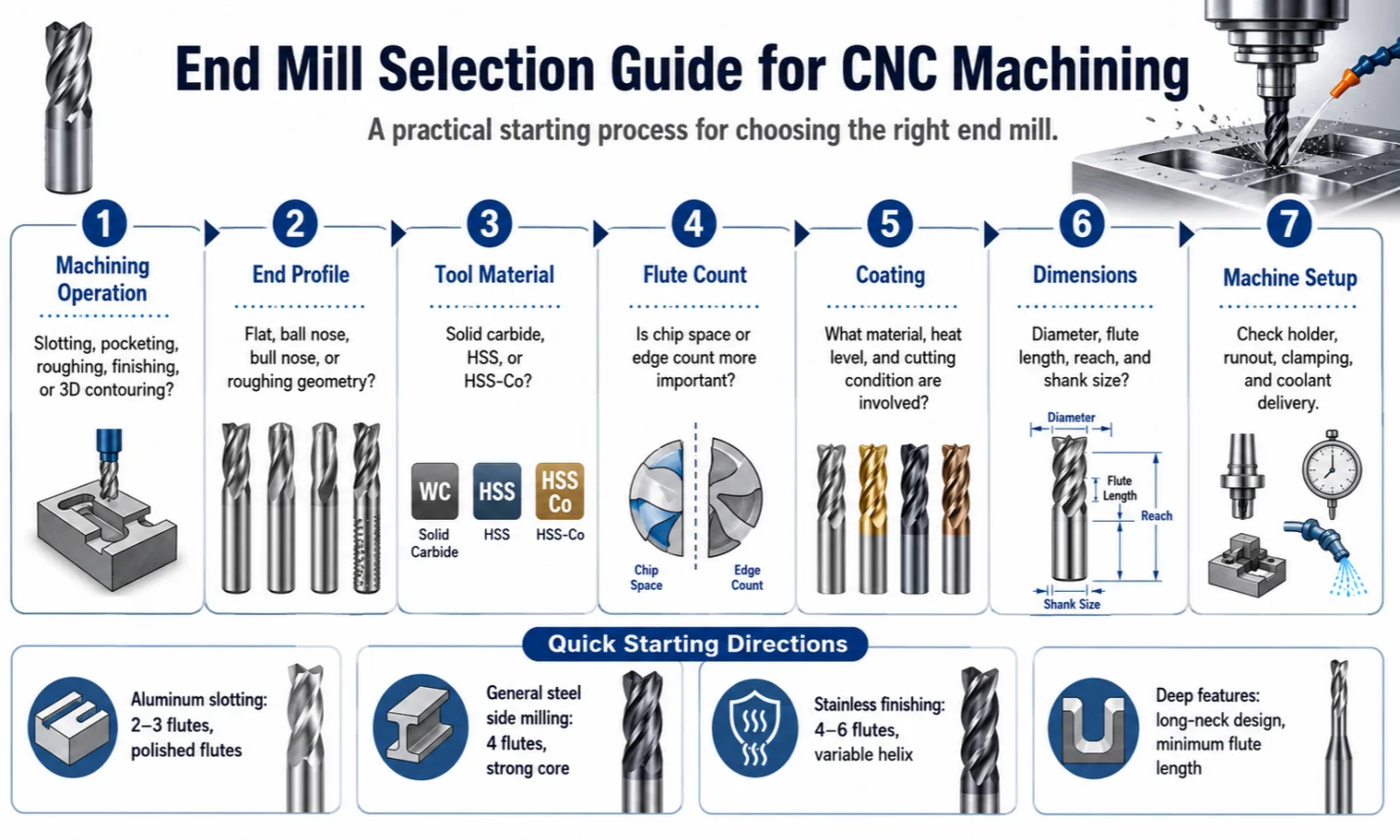
Fare un passo 1: Choose an End Mill by CNC Operation
The machining operation should guide the first decision because it determines the cutting direction, volume del chip, fidanzamento, and required surface.
Scanalatura
La scanalatura a tutta larghezza crea un volume elevato di trucioli perché la fresa impegna il materiale su tutto il suo diametro.
When cutting a full-width slot, prioritize chip space before increasing the flute count. Start with fewer flutes when chips are large or evacuation is difficult.
A suitable slotting tool normally requires:
- Enough flute space
- Reliable chip evacuation
- A center-cutting design when direct entry is required
- Sporgenza utensile corta e stabile
- Edge strength matched to the material
For aluminum or other materials that produce larger chips, 2–3 flutes provide a practical starting point. Per acciaio, the final flute count also depends on slot depth, impegno radiale, diametro della fresa, and coolant or air delivery.
If chips remain inside the slot, do not immediately increase the feed or change the coating. First check the flute space, profondità di taglio, air or coolant direction, e sporgenza dell'utensile.
Fresatura di tasche
Pocket milling may combine ramping, entrata elicoidale, taglio laterale, corner engagement, and bottom finishing.
Use a center-cutting end mill when the programmed entry requires cutting near the tool center. Tuttavia, center cutting does not turn an end mill into a standard drill bit. The tool geometry and CAM entry strategy must support the movement.
Deep pockets also need reliable chip removal. Trapped chips can be re-cut, which increases heat and may damage the cutting edge.
When the pocket is deep but the actual cutting depth is short, choose a long-neck tool rather than an end mill with an unnecessarily long flute.
Fresatura laterale e profilatura
Side milling loads the outside cutting edges. Di conseguenza, impegno radiale, cutter rigidity, esaurire, and side-wall accuracy become important.
Use a flat end mill for straight walls and shoulders. Choose a bull nose or corner radius tool when the outside corner needs more strength.
For general steel side milling, a 4-flute tool provides a practical balance between edge count, forza fondamentale, e spazio per i chip.
For lighter radial engagement and stable finishing, 5–6 flutes can increase the number of cutting contacts. Tuttavia, chip evacuation must remain stable.
Sgrossatura
Roughing produces a high cutting load and chip volume. Perciò, the cutter needs enough flute space and an edge structure that can handle the engagement.
For traditional roughing, choose a lower or medium flute count when chip removal is difficult. Roughing or chipbreaker geometry divides chips into smaller sections and can reduce cutting resistance.
For dynamic or trochoidal toolpaths with lighter radial engagement, a higher flute count can become practical because each flute removes a smaller chip while the tool follows a controlled engagement path.
The CAM strategy, rigidità della macchina, condizione del titolare, and tool geometry must work together. A high-performance roughing tool cannot compensate for weak clamping or excessive overhang.
Finissaggio
La finitura richiede una geometria stabile, runout controllato, consistent cutting edges, and a tool profile that matches the required surface.
When radial engagement is light and chip evacuation remains stable, more flutes increase the number of cutting contacts and can support a smoother finish.
Prima di cambiare la taglierina, inspect:
- Cutting-edge wear
- Holder accuracy
- Sporgenza dell'utensile
- Bloccaggio del pezzo
- Feed consistency
- Required corner shape
A worn tool or unstable holder can produce a poor finish even when the flute count is correct.
3D Contouring and Mold Machining
Ball nose end mills are widely used for curved surfaces, cavità dello stampo, muore, and 3D finishing. Their rounded end follows complex surfaces more effectively than a flat cutting end.
Bull nose tools suit semi-finishing and profiling when stronger outer corners are required. Their corner radius strengthens the cutting edge while retaining a flatter central area.
For hardened mold steel, match the tool series to the actual workpiece hardness. A tool intended for materials up to HRC45 may use a different carbide grade, preparazione dei bordi, and coating from one designed for HRC60 or HRC65.
Fare un passo 2: Select the End Profile
| Fine profilo | Main Feature | Applicazione comune |
|---|---|---|
| Fresa a testa piatta | Flat cutting end with sharp outer corners | Slot, tasche, spalle, superfici piane, e pareti laterali |
| Fresa a candela a testa sferica | Fully rounded cutting end | 3Contorni D, superfici curve, muore, and mold cavity finishing |
| Fresa a punta di toro | Flat end with rounded outer corners | Profilazione, semifinitura, lavorazione degli stampi, and stronger corners |
| Fresa per sgrossatura | Serrated or chipbreaker cutting edges | High material removal and rough machining |
| Center-Cutting End Mill | Cutting edges extend across or close to the center | Certain ramping, entrata elicoidale, and pocket-entry operations |
Select the profile according to the feature being machined.
A flat end mill produces flat-bottom features and straight walls. A ball nose cutter follows curved surfaces. A bull nose tool strengthens the outside corner and often suits semi-finishing.
A center-cutting end mill can support specific entry movements, but its plunging capability depends on the center geometry, diametro della fresa, materiale del pezzo, e percorso utensile programmato.
Per un confronto più dettagliato, leggi il nostro end mill cutter types and uses guide.
Fare un passo 3: Choose Solid Carbide or HSS
Tool material affects rigidity, toughness, resistenza all'usura, cutting-speed potential, and cost.
Frese in metallo duro integrale
Il metallo duro integrale fornisce un'elevata rigidità, good wear resistance, and stable dimensional performance under suitable machining conditions.
Choose solid carbide when the application requires:
- CNC machining at higher cutting speeds
- Stable dimensional accuracy
- Acciaio, acciaio inossidabile, ghisa, or mold steel machining
- Longer production runs
- Consistent surface quality
- Small or medium cutter diameters with sufficient machine rigidity
Carbide is less tolerant of impact, runout eccessivo, unstable clamping, and severe vibration. Perciò, the machine and holder must support the tool.
For solid carbide options, visualizza il nostro Pagina del prodotto della fresa a candela in metallo duro.
HSS and HSS-Co End Mills
HSS and cobalt HSS provide greater toughness and can tolerate vibration or interrupted cutting better in some applications.
Choose HSS or HSS-Co when:
- The machine runs at a lower spindle speed
- The setup has limited rigidity
- The cut is interrupted
- A larger custom cutter is required
- The order quantity is small
- Toughness matters more than maximum cutting speed
For a low-rigidity machine, HSS-Co may tolerate vibration and interrupted cutting better than solid carbide. Tuttavia, carbide usually offers higher rigidity and wear resistance when the setup is stable.
The final choice should reflect the machine, pezzo, dimensione della taglierina, operazione di taglio, quantità, e obiettivo di costo.
Fare un passo 4: Choose the Flute Count
Flute count changes chip space, forza fondamentale, capacità di alimentazione, and the number of cutting edges.
| Conte di flauto | Direzione generale della selezione |
|---|---|
| 2 Flauti | Spazio massimo per i chip; useful when chip evacuation is the first priority |
| 3 Flauti | Balance between chip space, rigidità, and cutting-edge count |
| 4 Flauti | Common direction for general steel milling and side cutting |
| 5–6 Flauti | More cutting edges for stable side milling or finishing with controlled engagement |
Use 2–3 flutes when chip space is the main priority. This often applies to aluminum slotting, tasche profonde, and operations that produce larger chips.
Utilizzo 4 flutes as a practical starting point for many general steel and side-milling applications.
Choose 5–6 flutes when radial engagement is lighter, the machine is rigid, and chip evacuation is already controlled.
More flutes do not automatically make a tool suitable for harder materials. In full-width slotting, too many flutes can trap chips and cause heat, danni ai bordi, o rottura dell'utensile.
For a deeper explanation, leggi il nostro guida alla selezione della scanalatura della fresa.
Per un confronto diretto, Leggere 2 flauto contro 4 flauto contro 6 fresa a candela a flauto.
Fare un passo 5: Choose Coated or Uncoated End Mills
Coating affects friction, resistenza al calore, resistenza all'usura, material adhesion, e protezione all'avanguardia.
Use the following table as a selection direction rather than a fixed rule.
| Direzione del pezzo | Coating or Surface Direction | Considerazione principale |
|---|---|---|
| Alluminio e materiali non ferrosi | Non rivestito, Lucido, DLC, or Suitable Low-Friction Coating | Reduce adhesion and support chip flow |
| Acciaio al carbonio e legato | TiAlN, Altin, or Suitable Heat-Resistant Coating | Heat resistance and edge protection |
| Acciaio inossidabile | AlCrN, TiAlN, Altin, o rivestimento specifico per l'applicazione | Calore, Indossare, e stabilità al taglio |
| Graphite and Abrasive Composites | Diamond-Coated Tools | Abrasive wear resistance |
| General Lower-Speed Applications | TiN or Uncoated Options | Lubricity and general wear protection |
Alluminio e materiali non ferrosi
Per alluminio, start with a sharp edge, flauto lucido, and uncoated or low-friction surface.
A coating with high heat resistance is not automatically suitable for aluminum. If the surface increases material adhesion, built-up edge and poor chip flow may occur.
Acciaio
For carbon and alloy steel, TiAlN, Altin, TiSiN, or another suitable heat-resistant coating can protect the cutting edge.
As workpiece hardness and cutting temperature increase, grado di carburo, preparazione dei bordi, and coating become more important.
Acciaio inossidabile
Per acciaio inossidabile, choose a coating and geometry that support heat control and cutting stability.
AlCrN, TiAlN, or AlTiN can provide useful starting directions, but the final choice should match the stainless grade, operazione, conteggio dei flauti, condizione del liquido di raffreddamento, e taglio del carico.
Diamond-Coated Tools
Diamond-coated end mills suit graphite, compositi, abrasive non-ferrous materials, and other specific applications.
Do not use diamond coating as a universal choice for all metals. The workpiece chemistry and cutting conditions must be compatible.
The exact coating should match the carbide grade, geometria dell'utensile, workpiece grade, operazione di taglio, e le condizioni del liquido di raffreddamento.
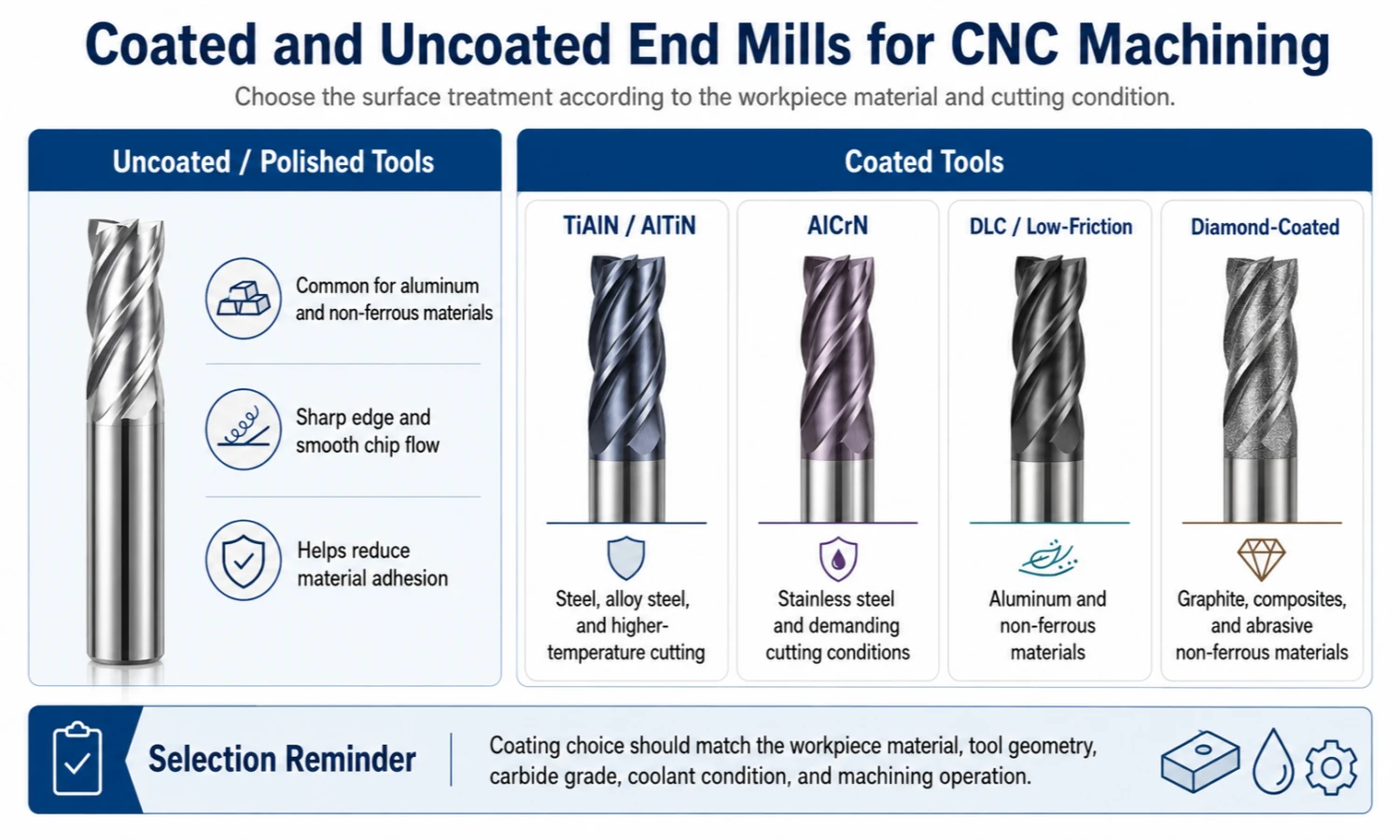
Fare un passo 6: Confirm Dimensions and Geometry
Cutter diameter is only one part of the tool specification.
Prima di ordinare, confermare:
- Diametro taglierina
- Lunghezza del flauto
- Lunghezza
- Diametro del gambo
- Required machining depth
- Portata dello strumento
- Raggio dell'angolo
- Helix angle
- Conteggio del flauto
- Center-cutting requirement
- Tolleranza dimensionale
Use the shortest practical tool that reaches the machining area.
If the required reach is long but the cutting depth is short, choose a long-neck tool rather than an end mill with an unnecessarily long flute. A shorter cutting section can provide better rigidity.
Excessive flute length or overall length increases the risk of:
- Chiacchiere
- Deflessione dell'utensile
- Errore dimensionale
- Usura irregolare
- Scheggiatura degli angoli
- Rottura dell'utensile
Choose a custom end mill when standard dimensions or geometry cannot reach the feature or meet the required diameter, raggio d'angolo, tolleranza, rivestimento, or application target.
Fare un passo 7: Check Machine, Holder, and Clamping Conditions
The correct end mill can still perform poorly in an unstable setup.
Sporgenza dell'utensile
La lunga sporgenza riduce la rigidità. Keep the tool as close to the holder as the machining depth allows.
Before changing the coating or flute count, check whether the cutter extends farther than necessary.
Holder Runout
Runout can make one cutting edge carry more load than the others. This causes uneven wear and may lead to poor surface finish, chipping, or premature failure.
Ispezionare il supporto, pinza, shank cleanliness, and tool seating when one flute shows more wear than the others.
Machine Rigidity
Condizione del mandrino, precisione del supporto, machine structure, and workpiece clamping all affect the result.
A rigid carbide tool cannot correct movement in the workpiece or holder.
Chip and Coolant Delivery
Air or coolant must reach the cutting area.
Poor delivery can leave chips inside deep pockets and slots. The tool then re-cuts those chips, which increases heat and damages the edge.
Workpiece Clamping
Movement at the workpiece can look like a tool problem.
Prima di cambiare la taglierina, confirm that the fixture holds the part securely and that the toolpath does not create unnecessary vibration.
How Workpiece Material Affects End Mill Selection
Workpiece material remains important, but it should be considered together with the machining operation.
- Aluminum needs sharp edges and enough chip space.
- Carbon and alloy steel need stronger cutting edges and wear resistance.
- L'acciaio inossidabile necessita di un taglio stabile per controllare il calore e l'incrudimento.
- Cast iron needs good abrasion resistance.
- Mold and tool steel require a tool series matched to the actual hardness.
- Titanium alloys require careful heat control and stable engagement.
Per una selezione dettagliata basata sui materiali, Leggere come scegliere una fresa in metallo duro.
End Mill Selection and Setup Problems
| Symptom | Possibile causa | First Adjustment Direction |
|---|---|---|
| Chips Pack Inside the Slot | Too many flutes, insufficient flute space, scarsa evacuazione del truciolo | Ridurre il numero dei flauti, migliorare l'erogazione dell'aria o del refrigerante, and check flute length |
| Rottura dell'utensile | Imballaggio dei trucioli, excessive overhang, unstable holder, impegno pesante | Migliora la rimozione dei trucioli, shorten reach, check clamping, e ridurre il coinvolgimento instabile |
| Segni di chiacchiere | Sbalzo lungo, weak setup, forze di taglio ripetitive | Accorciare lo strumento, migliorare il bloccaggio, e considerare la geometria ad elica variabile |
| Finitura superficiale scadente | Worn edge, esaurire, unstable feed, profilo finale inadatto | Inspect the tool and holder, stabilize the cut, and select the correct profile |
| Usura rapida dei bordi | Grado di metallo duro errato, rivestimento, o condizione di taglio | Abbina il grado e il rivestimento al materiale, durezza, Calore, e funzionamento |
| Scheggiatura degli angoli | Sharp corner under heavy load, vibrazione, taglio interrotto | Consider a corner radius and improve setup stability |
| Bordo rialzato in alluminio | Elevato attrito, bordo opaco, rough flute surface, poor chip flow | Utilizza una geometria affilata e lucidata e migliora l'evacuazione dei trucioli |
A machining problem can have several causes. Changing only the coating or flute count may not solve it.
Start with the setup, flusso di trucioli, condizione dell'utensile, and engagement. Then evaluate whether the tool geometry needs to change.
Common End Mill Selection Mistakes
Choosing by Diameter Only
Two end mills with the same diameter may have different flute lengths, conta il flauto, profili finali, gradi di metallo duro, rivestimenti, and applications.
Always review the complete specification.
Ignorare l'evacuazione dei trucioli
Poor chip evacuation causes heat, ritaglio del truciolo, bordo di costruzione, chiacchiere, e rottura dell'utensile.
This problem is especially common during full-width slotting, deep pocketing, and aluminum machining.
Utilizzo di una sporgenza eccessiva dell'utensile
Excessive reach reduces rigidity.
Use the shortest tool that safely reaches the machining depth. If the feature is deep, consider a long-neck design with the minimum necessary cutting length.
Choosing More Flutes Without Checking Chip Space
More cutting edges improve feed capability and surface consistency when engagement is light and chip flow remains stable.
In deep slotting, Tuttavia, excessive flute count can trap chips and damage the cutter.
Choosing a Coating by Name Only
A more expensive coating is not automatically better.
Match the coating with the material, grado di carburo, geometria, refrigerante, temperatura di taglio, e funzionamento.
Using One End Mill for Every Operation
A roughing cutter, finishing tool, slotting end mill, and ball nose cutter perform different jobs.
Choose the end mill according to the feature and machining stage rather than using one general tool for every operation.
Domande frequenti
Can an end mill drill a hole?
Some center-cutting end mills support ramping, entrata elicoidale, or limited plunging. Tuttavia, they should not automatically replace a drill bit.
Confirm the center geometry, diametro della fresa, materiale del pezzo, and programmed entry method before using an end mill for axial entry.
Should I choose carbide or HSS for a low-rigidity machine?
HSS or HSS-Co may provide more toughness and tolerance to vibration on a lower-speed or less rigid machine.
Carbide provides greater rigidity and wear resistance, but it needs a stable holder, runout controllato, and reliable clamping.
Why does an end mill break during slotting?
Common causes include chip packing, excessive flute count, too much tool overhang, unstable clamping, impegno pesante, and poor coolant or air delivery.
Check chip evacuation and setup stability before assuming that the carbide grade is the only problem.
Quando dovrei scegliere una fresa ad elica variabile??
Scegliete la geometria ad elica variabile o a passo diverso quando le forze di taglio ripetitive creano vibrazioni durante la fresatura laterale, profilazione, o rifinitura.
Il design può ridurre le vibrazioni, but it still requires a rigid holder and stable workpiece clamping.
When should I use a long-neck end mill instead of a long-flute end mill?
Use a long-neck tool when the feature needs additional reach but only a short cutting section.
The reduced flute length normally provides more support than an unnecessarily long cutting edge.
What information helps when requesting a custom end mill?
Send the available tool dimensions, disegno, immagine del prodotto, materiale del pezzo, operazione di lavorazione, caratteristica richiesta, current tool model, quantità, and any existing machining problem.
You do not need to prepare every detail before contacting the supplier. Missing specifications can be confirmed during the quotation process.
Need Help Selecting the Right End Mill?
The right end mill depends on the machining operation, materiale del pezzo, feature shape, dimensioni richieste, configurazione della macchina, and surface-finish target.
Inviaci il tuo disegno, modello di strumento, dimensioni richieste, immagine del prodotto, campione, o informazioni sulla lavorazione disponibili. Con 16 anni di esperienza nella produzione di utensili da taglio, we can review the application and help confirm a suitable standard or custom tool direction.
Visualizza i nostri standard e personalizzati pagina del prodotto della fresa a candela.
Per discutere la tua candidatura, inviaci un'e-mail a sales@cutterbest.com.