 Frese di precisione,Utensili da taglio per la lavorazione CNC di ogni materiale

COSÌ, a cosa serve una fresa a testa sferica? Machinists mainly use this rounded-end CNC cutter for 3D contour milling, finitura della cavità dello stampo, lavorazione di superfici curve, freeform profiles, and precision finishing.
A differenza di una fresa a punta piatta, a ball nose tool has a fully rounded cutting tip. Perciò, può seguire i pendii, raggi, cavità, and complex three-dimensional surfaces more smoothly. This geometry also helps create gradual transitions and a more consistent finish on curved parts.
For standard and custom diameters, conta il flauto, rivestimenti, and carbide grades, visualizza il nostro frese a testa sferica in metallo duro.
Cos'è una fresa a punta sferica?
A ball nose end mill is a rotary milling cutter with a hemispherical cutting end. For a standard full ball-end design, the nose radius is normally half of the cutting diameter.
Per esempio, a cutter with a 6mm cutting diameter normally has a 3mm ball radius. Because the cutting edge curves around the tip, different points of the edge contact the workpiece as the tool follows a CNC path.
This geometry works well for curved surfaces. Tuttavia, it does not efficiently create flat-bottom pockets, square shoulders, or straight slot bottoms.
Some buyers also use the name fresa per mulino a sfere for the same general rounded-end CNC tool.
Common CNC Applications of a Ball Nose End Mill
Ball nose end mills are most useful when the workpiece has curved geometry, blended transitions, or complex three-dimensional surfaces.
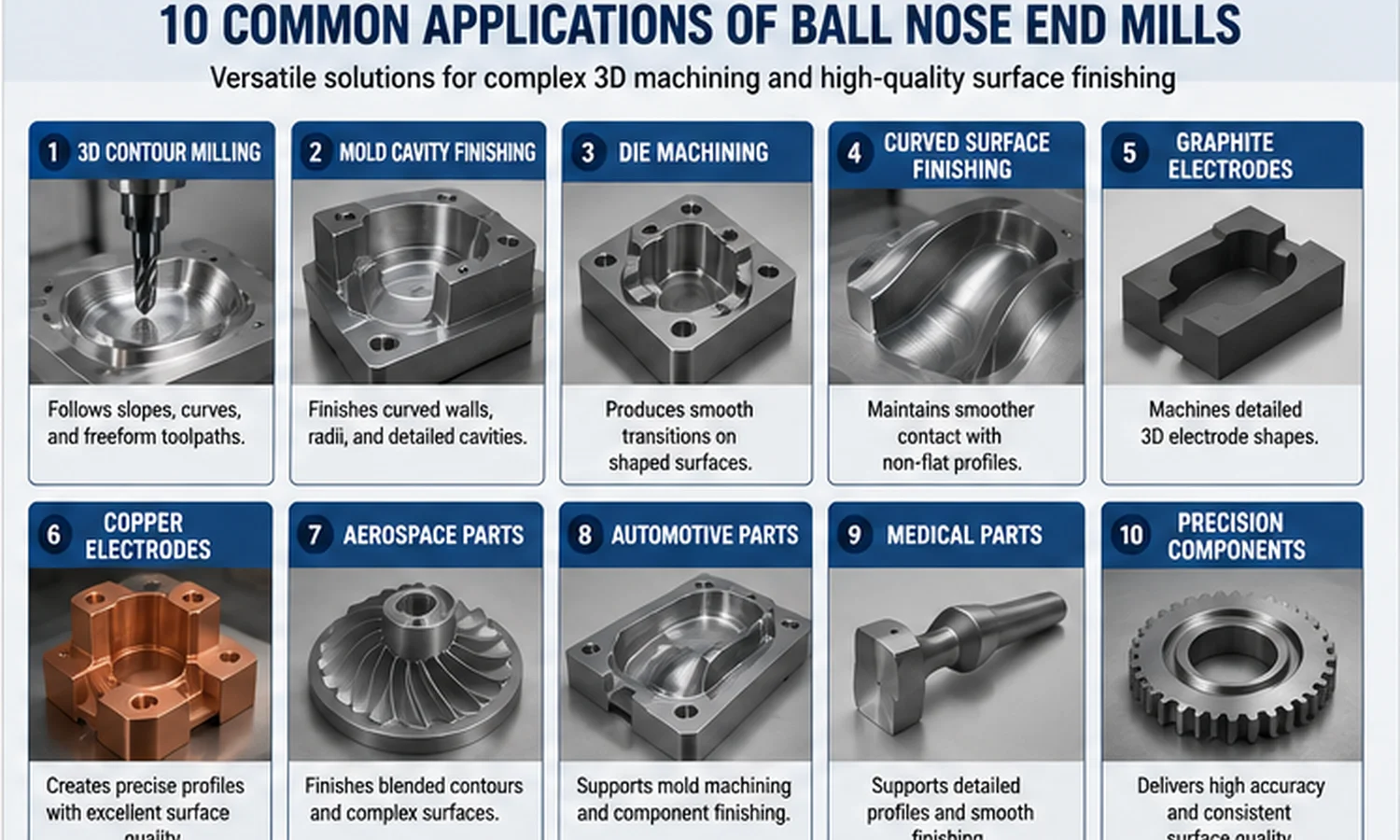
Ten common applications include:
- 3Fresatura di contornitura D
- Finitura della cavità dello stampo
- Die and mold machining
- Curved surface finishing
- Radius and profile machining
- Sculpted and freeform machining
- Lavorazione elettrodi di grafite
- Copper electrode machining
- Aerospace and automotive part finishing
- Medical and precision component machining
The table below summarizes the main applications.
| CNC Application | Perché utilizzare una fresa a punta sferica? |
| 3D Contour Milling | Follows slopes, curve, and freeform CNC toolpaths |
| Mold Cavity Finishing | Finishes curved walls, raggi, and detailed cavities |
| Die Machining | Produces smooth transitions on shaped surfaces |
| Curved Surface Finishing | Maintains smoother contact with non-flat profiles |
| Elettrodi di grafite | Machines detailed 3D electrode shapes |
| Aerospace and Automotive Parts | Finishes blended contours and complex surfaces |
| Medical and Precision Parts | Supports detailed profiles and controlled finishing |
A smaller diameter can reach narrow cavities and fine details. Nel frattempo, a larger diameter can improve machining efficiency on broader surfaces.
The final cutter selection should match the part geometry, required finish, cavity depth, rigidità della macchina, and programmed toolpath.
Fresa a punta sferica per fresatura di contorni 3D
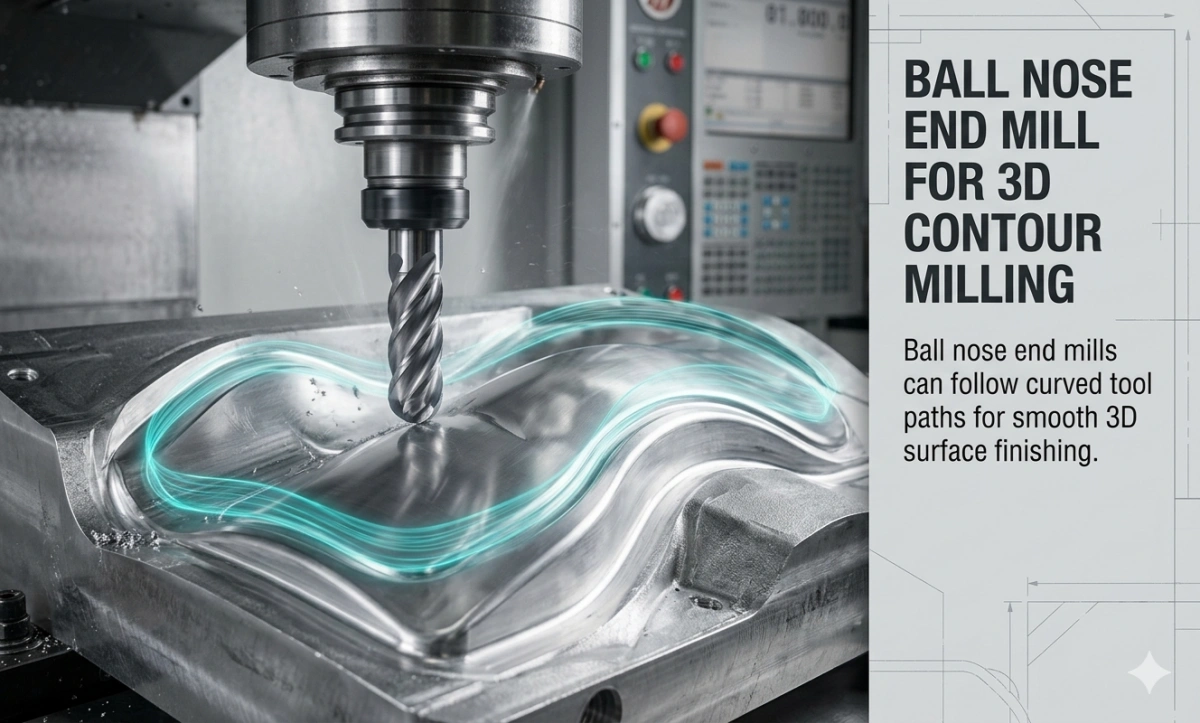
Uno degli usi più comuni di una fresa a testa sferica è la fresatura di contorni 3D.
During 3D contouring, the cutting tool must follow slopes, curve, e superfici a forma libera. A flat end mill may create uneven contact or visible marks on these areas. Al contrario, the rounded cutting end follows the changing surface angle more naturally.
Typical 3D contour applications include:
- Cavità dello stampo
- Superfici curve del prodotto
- Forme scolpite
- Profili CNC complessi
- Prototype parts
- Freeform components
After roughing removes most of the material, the ball nose cutter can complete semi-finishing or final finishing passes. A suitable step-over and stable toolpath help improve the surface before polishing or final treatment.
Fresa a punta sferica per la finitura di stampi e matrici
Mold and die components often contain cavities, raggi, curved walls, e profili dettagliati. Perciò, mold makers commonly use ball nose end mills during the finishing stage.
Primo, a flat or roughing cutter removes most of the stock. Prossimo, the rounded-end cutter machines the remaining curved areas and blended transitions.
Common mold applications include:
- Stampi ad iniezione
- Die-casting molds
- Stampi automobilistici
- Stampi per stampaggio
- Inserti per stampi
- Medical molds
- Precision tooling
Tool stability is especially important during mold finishing. Excessive cutter overhang, poor holder condition, or unsuitable cutting parameters may cause vibration and visible surface marks.
Perciò, select the shortest practical tool length and keep the machine setup rigid.
Fresa a testa sferica per la lavorazione di superfici curve
A ball nose cutter works well on rounded, sloped, and non-flat surfaces because its geometry maintains smoother contact with the workpiece.
This makes it useful for:
- Componenti aerospaziali
- Parti automobilistiche
- Medical implants and instruments
- Decorative products
- Stampi in alluminio
- Precision mechanical components
- Complex prototypes
In queste applicazioni, l’obiettivo non è solo rimuovere materiale. Qualità della superficie, dimensional consistency, and smooth toolpath transitions also matter.
Di conseguenza, machinists often choose a ball nose cutter for the final machining stage rather than heavy stock removal.
Fresa a testa sferica per la lavorazione di grafite ed elettrodi
Graphite and copper electrodes often contain detailed cavities, narrow radii, e forme 3D complesse. Perciò, rounded-end cutters can help machine these profiles accurately.
Per la grafite, wear resistance and dust control are important. The cutter may require a suitable carbide grade, rivestimento, and sharp edge design.
For copper, sharp cutting edges and smooth flutes can help reduce material adhesion and improve the finished surface.
Before selecting the tool, fornire:
- Electrode material and grade
- Drawing or 3D model
- Finitura superficiale richiesta
- Diametro taglierina
- Profondità di lavorazione
- Quantità
These details help determine the suitable geometry, grado di carburo, rivestimento, and tool length.
Ball Nose Milling Strategy for a Better Surface Finish
The cutter alone does not determine the final finish. Toolpath strategy also has a major effect.
Primo, use a small and consistent step-over during finishing. A smaller step-over reduces scallop height, although it also increases machining time.
Prossimo, avoid unnecessary cutter overhang. A shorter and more rigid setup reduces vibration and helps maintain a consistent surface.
Inoltre, consider the effective cutting speed near the center of the ball end. The tool center has a lower cutting speed than the outer cutting edge. Perciò, an appropriate toolpath or slight tool inclination may reduce rubbing near the center.
Finally, match the feed rate, velocità del mandrino, rivestimento, and cutting depth to the workpiece material and machine condition. Trial cuts may be required for demanding surfaces.
Fresa a testa sferica vs fresa a testa piatta
A ball nose end mill and a flat end mill have different cutting geometries and machining purposes.
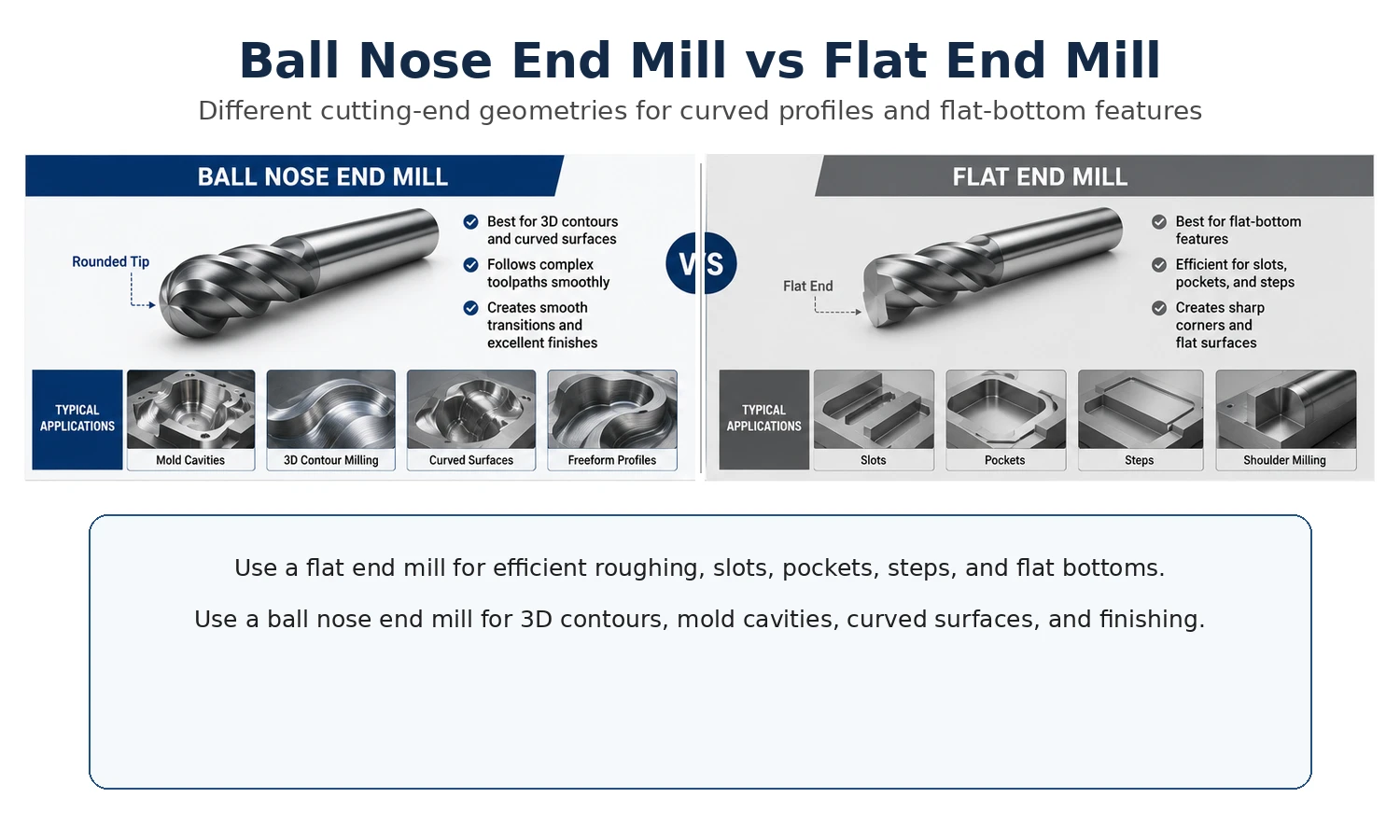
The two tools are often used together. A flat end mill can remove material efficiently during roughing. Dopo di che, a ball nose cutter finishes radii, curved cavities, e profili complessi.
For flat-bottom machining, visualizza il nostro fresa a punta piatta prodotto.
Fresa a punta sferica vs Fresa a punta tonda
Una fresa a testa sferica ha una punta di taglio completamente arrotondata. Perciò, it works well for smooth 3D finishing, profili curvi, e superfici a forma libera.
A bull nose end mill has a flat center with rounded corners. Di conseguenza, fornisce un supporto angolare più forte e funziona bene per la semifinitura, profili a gradini, and flat areas that require a corner radius.
Per un confronto dettagliato, Leggere fresa a testa toro vs fresa a testa sferica.
Come scegliere una fresa a punta sferica
The correct tool depends on the workpiece material, diametro della fresa, profondità di lavorazione, disegno del flauto, rivestimento, e lo stato della macchina.
Materiale del pezzo
When machining aluminum and copper, sharp cutting edges and efficient chip evacuation can help reduce built-up edges.
Acciaio, acciaio inossidabile, and mold materials usually require a suitable carbide grade and heat-resistant coating to improve wear resistance and tool life.
Graphite machining has different requirements. Perciò, tool wear, rivestimento, dust control, and edge sharpness should all be considered.
Cutter Diameter and Tool Length
Choose a diameter that matches the workpiece radius, dimensione del dettaglio, and available machining space.
Inoltre, use the shortest practical flute length and overall length. Excessive overhang reduces rigidity and may cause vibration.
Conte di flauto
Two-flute designs provide more chip space and often suit aluminum, rame, grafite, e materiali più morbidi.
Four-flute designs provide more cutting edges and may improve stability during steel machining and finishing operations.
Coating and Machine Stability
The coating should match the workpiece material, durezza, cutting temperature, and coolant condition.
Tuttavia, even the correct coating cannot compensate for excessive runout, poor holder condition, or an unstable machine setup.
For more detailed selection guidance, Leggere come scegliere una fresa a testa sferica.
Domande frequenti
What are the main uses of a ball nose end mill?
It is mainly used for 3D contour milling, finitura della cavità dello stampo, lavorazione di superfici curve, rifinitura dello stampo, elettrodi di grafite, freeform profiles, and precision CNC finishing.
Una fresa a punta sferica può tagliare superfici piane?
It can machine some flat areas, but it does not efficiently create a fully flat-bottom profile. A flat end mill usually works better for flat-bottom pockets, slot, passi, e spalle.
È una fresa a testa sferica adatta alla lavorazione di stampi?
Sì. Mold makers commonly use ball nose end mills to finish curved cavities, raggi, detailed profiles, and complex three-dimensional surfaces.
What materials can ball nose end mills machine?
Possono lavorare l'acciaio, acciaio inossidabile, alluminio, rame, grafite, ghisa, mold steel, and many alloy materials. Tuttavia, the carbide grade, rivestimento, disegno del flauto, and cutting parameters should match the workpiece.
Can a ball nose end mill machine cast iron?
Sì. A carbide ball nose end mill can machine cast iron, especially on curved surfaces, molds, and 3D profiles. Tuttavia, the carbide grade, rivestimento, disegno del flauto, and cutting parameters should match the specific cast iron grade.
Qual è la differenza tra le frese a testa sferica e a testa toro??
A ball nose end mill has a fully rounded tip for 3D finishing and curved surfaces. A bull nose end mill has a flat center with rounded corners, so it provides stronger edge support for semi-finishing and corner-radius machining.
Send Your Ball Nose End Mill Requirement
In summary, this rounded-end cutter is mainly selected for CNC applications that require smooth 3D contours, finitura dello stampo, superfici curve, elettrodi di grafite, e profili di precisione.
Need a standard or custom carbide cutter for your CNC machining project?
Send your diameter, lunghezza del flauto, lunghezza complessiva, dimensione del gambo, conteggio dei flauti, rivestimento, materiale del pezzo, durezza, disegno, e quantità. Our team will review the application and provide a suitable tool proposal and quotation.
Send your requirements to sales@cutterbest.com.