 Frese di precisione,Utensili da taglio per la lavorazione CNC di ogni materiale

Capire come scegliere una fresa a testa sferica può aiutare a migliorare la finitura superficiale, stabilità della lavorazione, and tool selection accuracy. Tuttavia, the correct cutter depends on more than diameter alone.
This guide explains how to select a ball nose end mill according to the workpiece material, scopo di lavorazione, diametro della fresa, raggio della palla, conteggio dei flauti, coating or edge treatment, portata dell'utensile, stabilità della macchina, e requisiti di finitura superficiale.
For available standard and custom carbide cutters, visualizza il nostro Frese a testa sferica in carburo.
Quick Ball Nose End Mill Selection Guide
La tabella seguente fornisce un punto di partenza pratico. Final tool selection should also consider the actual part geometry, durezza del pezzo, profondità di lavorazione, condizione della macchina, e requisito di finitura.
| Requisito di lavorazione | Focus della selezione |
|---|---|
| Lavorazione CNC generale | Match the cutter series to the workpiece material and hardness |
| Hardened Materials | Select the appropriate hardened or high-hardness series |
| Elettrodi di grafite | Use a dedicated graphite tool with CVD diamond coating |
| Cavità profonde | Confirm neck clearance, portata dell'utensile, and minimum practical overhang |
| Dettagli 3D raffinati | Use a diameter and ball radius that match the feature size |
| 2-Flute or 4-Flute | Choose according to material, spazio per i chip, rigidità, and finishing requirements |
| Finitura superficiale elevata | Control tool reach, esaurire, step-over, e stabilità della macchina |
This table is a starting point rather than a universal specification. The final cutter should match the actual workpiece and machining setup.
Perché è importante scegliere la fresa a punta sferica giusta
A ball nose end mill has a fully rounded cutting end that follows slopes, cavità, raggi, and complex three-dimensional profiles.
Tuttavia, one cutter cannot suit every machining condition. Durezza del pezzo, dimensione della taglierina, configurazione del flauto, rivestimento, portata dell'utensile, and machine stability all affect the final result.
The purpose of tool selection is therefore not simply to choose a diameter. The complete cutter configuration should match the workpiece and machining requirement.
Come scegliere una fresa a punta sferica: 7 Fattori chiave
Prima di ordinare, confirm these seven factors:
- Materiale del pezzo e durezza
- Scopo della lavorazione
- Diametro di taglio, raggio della palla, e la portata dell'utensile
- Conteggio del flauto
- Coating or edge treatment
- Requisito di finitura superficiale
- Machine and tool-holder stability
Each factor affects the others, so they should be evaluated together.
1. Scegli in base al materiale del pezzo
Workpiece material and hardness affect the required carbide grade, cutting-edge design, configurazione del flauto, rivestimento, and overall tool structure.
General and Hardened Materials
For general machining below approximately HRC45, a general-purpose carbide ball nose series may be suitable.
For workpieces around HRC55–70, the high-hardness series uses ultrafine low-cobalt carbide, taglienti rinforzati, a larger core, and multilayer nano-composite coatings. Selected custom designs can be evaluated for materials up to HRC75.
The final choice should still consider the cutter diameter, sovrametallo di lavorazione, condizione della macchina, e finitura richiesta.
Aluminum and Copper
Aluminum and copper require different cutting conditions from hardened steel.
When selecting a cutter for these materials, prioritize suitable edge geometry, evacuazione truciolo, and the correct material-specific tool configuration. Cutter size, profondità di lavorazione, and surface finish requirement should also be considered before confirming the tool.
Elettrodi di grafite
Graphite machining requires a dedicated wear-resistant tool solution. CutterBest’s graphite ball end mill series uses CVD diamond coating.
For dedicated graphite machining tools, vedi il nostro Frese con rivestimento diamantato.
2. Scegli in base allo scopo della lavorazione CNC
The correct cutter also depends on whether the operation involves roughing, semifinitura, o finitura finale.
Roughing and Semi-Finishing
A ball nose cutter is generally not the first choice for heavy stock removal. In molti casi, a flat or roughing end mill removes most of the material first.
A ball nose cutter can then machine curved areas, raggi, pareti della cavità, and transitional surfaces during semi-finishing.
Rifinitura finale
For final finishing, surface quality becomes more important than material-removal rate.
Rigidità dell'utensile, suitable geometry, runout limitato, correct reach, and a stable toolpath all affect the finished surface.
3D Fresatura di contorni
Ball nose end mills are well suited to slopes, curve, superfici a forma libera, and complex 3D profiles because the rounded cutting end follows changing surface angles.
For a detailed applications guide, Leggere A cosa serve una fresa a punta sferica?
3. Scegli per diametro, Raggio della palla, e portata dello strumento
Diameter selection affects rigidity, risoluzione dei dettagli, accessibilità, ed efficienza di lavorazione.
Una fresa più piccola può raggiungere cavità strette, piccoli raggi, e profili dettagliati. A larger cutter generally provides greater rigidity and may machine broader curved surfaces more efficiently.
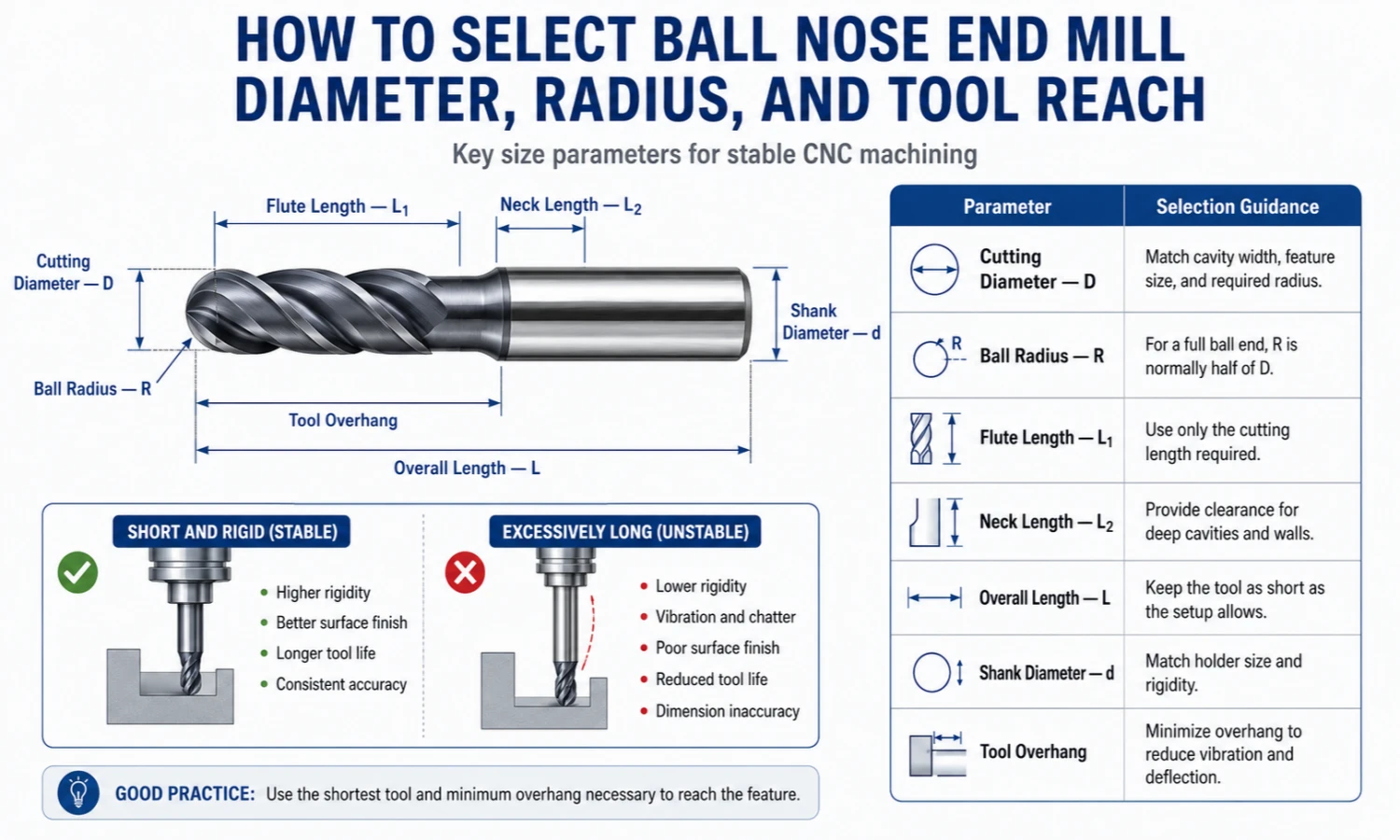
Per un design standard con estremità sferica completa, il raggio della sfera è normalmente la metà del diametro di taglio.
Per esempio:
- 4 mm cutting diameter normally corresponds to R2
- 6 mm cutting diameter normally corresponds to R3
- 10 mm cutting diameter normally corresponds to R5
The main dimensions to confirm are:
| Parametro | Punto di selezione |
|---|---|
| Diametro di taglio: D | Abbina la larghezza della cavità, dimensione della caratteristica, e il raggio richiesto |
| Raggio della palla – R | Per un finale a palla completo, R è normalmente la metà di D |
| Lunghezza del flauto | Use only the cutting length required for the operation |
| Lunghezza del collo | Provide sufficient clearance for deep cavities and walls |
| Lunghezza totale | Keep the tool as short as the setup allows |
| Diametro del gambo | Match the holder and required tool rigidity |
| Sporgenza dell'utensile | Minimize unnecessary overhang |
Diametro di taglio
Choose the diameter according to the part radius, larghezza della cavità, dimensione della caratteristica, spazio di lavorazione disponibile, e l'efficienza di lavorazione richiesta.
An unnecessarily small cutter may reduce rigidity and increase machining time, even if it can physically reach the feature.
Lunghezza del flauto e lunghezza del collo
Use only the flute length required for the cutting area.
Per cavità profonde, neck clearance can be more important than simply increasing flute length. A relieved-neck or long-reach structure may provide access while maintaining greater cutter strength.
For dedicated deep-cavity tools, vedi il nostro Fresa a punta sferica a lunga portata.
Lunghezza totale e sporgenza
Use the shortest practical overall length for the setup.
Excessive overhang can reduce rigidity and increase vibration or cutter deflection. Machine rigidity and workpiece clamping should also support the required reach.
4. Scegli per conteggio flauto
Flute count affects chip space, conteggio all'avanguardia, rigidità, and surface-finish behavior.
CutterBest currently offers both 2-flute and 4-flute ball nose configurations.
2 Frese a punta sferica per flauto
A 2-flute design provides larger chip channels and more chip space.
The suitable application still depends on the cutter diameter, materiale del pezzo, profondità di lavorazione, and chip evacuation requirements.
4 Frese a punta sferica per flauto
A 4-flute design provides more cutting edges and may be selected where additional edge count and cutter stability are useful.
The final configuration should match the material, durezza, dimensione della taglierina, profondità di lavorazione, e requisito di finitura.
Do not choose flute count only by habit. A 2-flute or 4-flute cutter should be selected as part of the complete tool configuration.
5. Choose by Coating and Edge Treatment
Coating should match the workpiece material, durezza, cutter series, e condizioni di lavorazione.
For the confirmed CutterBest ball nose product range:
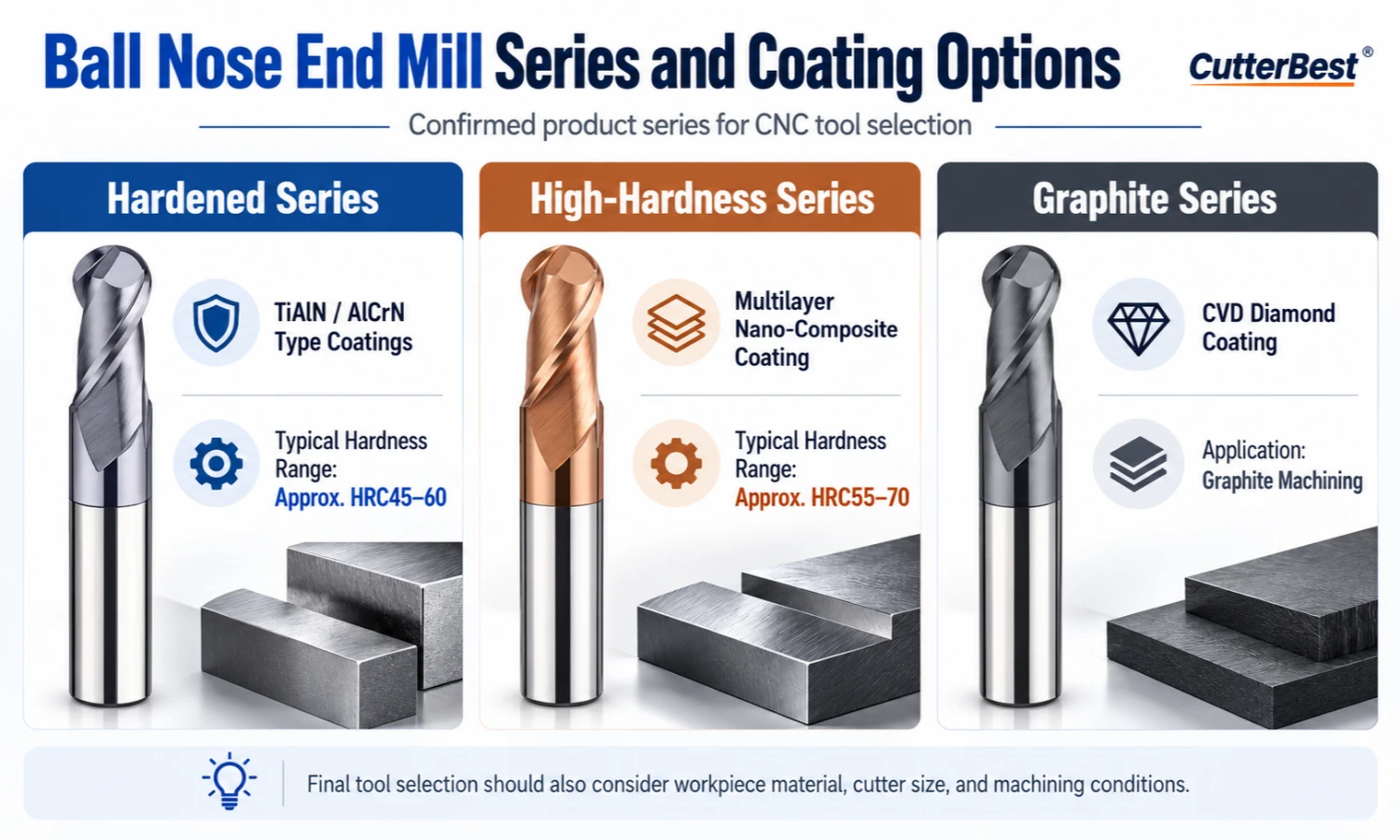
| Product Series | Confirmed Coating / Struttura dello strumento |
|---|---|
| Hardened Series | TiAlN- o rivestimenti tipo AlCrN |
| High-Hardness Series | Multilayer nano-composite coatings with reinforced cutting edges and a larger core |
| Graphite Series | Rivestimento in diamante CVD |
Coating should not be selected separately from the carbide grade, cutting-edge design, configurazione del flauto, e materiale del pezzo.
Per alluminio, rame, and other specialized applications, confirm the appropriate tool configuration according to the actual workpiece and finishing requirement rather than choosing a coating name alone.
6. Scegli in base ai requisiti di finitura superficiale
Surface finish is one of the main reasons machinists use ball nose cutters, but the cutter itself does not determine the final result.
Important factors include:
- Step over programmato
- Direzione del percorso utensile
- Eccentricità dell'utensile
- Sporgenza della taglierina
- Condizioni del portautensili
- Rigidità della macchina
- Bloccaggio del pezzo
A smaller step-over can reduce scallop height, but it also increases the number of tool passes and machining time.
The center of a ball end also has a lower effective cutting speed than the outer cutting edge. Toolpath strategy and machine stability should therefore be considered together with the cutter specification.
7. Controllare la stabilità della macchina e del portautensili
Even a correctly selected cutter may perform poorly in an unstable setup.
Prima della lavorazione, check the tool holder, esaurire, sporgenza della fresa, spindle condition, bloccaggio del pezzo, and overall machine rigidity.
Use the shortest practical tool reach and maintain a clean, accurate holder connection.
Se si verificano vibrazioni, review the complete setup rather than assuming the cutter itself is the only cause.
Ball Nose or Bull Nose End Mill?
A ball nose end mill has a fully rounded cutting end and is commonly used for 3D contours, superfici curve, e cavità dello stampo.
A bull nose end mill has a flat center with rounded corners and serves a different machining purpose.
For the complete comparison, Leggere Fresa a punta toro vs Fresa a punta sferica.
Errori comuni nella scelta di una fresa a punta sferica
Choosing the Wrong Cutter Series
Do not select a cutter based only on diameter. Workpiece material and hardness should match the appropriate general-purpose, temprato, elevata durezza, or specialized product series.
Utilizzo di una sporgenza eccessiva dell'utensile
Excessive overhang reduces rigidity and can increase vibration or cutter deflection. Use the shortest practical reach for the operation.
Ignorare il conteggio del flauto
A 2-flute and a 4-flute cutter have different flute-space and cutting-edge characteristics. Select the flute configuration according to the material, dimensione della taglierina, e requisiti di lavorazione.
Ignoring Ball Radius and Neck Clearance
Cutting diameter alone does not define the complete cutter geometry. Raggio della palla, lunghezza del flauto, liquidazione del collo, diametro del gambo, and overall reach can all affect accessibility and rigidity.
Utilizzo di una fresa a testa sferica per la lavorazione a fondo piatto
A rounded cutting end does not efficiently create flat-bottom slots, tasche, o spalle quadrate.
Per queste operazioni, vedi il nostro Fresa a testa piatta.
When Is a Custom Ball Nose End Mill Needed?
A custom cutter may be appropriate when a standard tool cannot provide the required radius, portata, sdoganamento, rigidità, o geometria.
CutterBest can evaluate non-standard requirements from drawings, informazioni sulle dimensioni, riferimenti agli strumenti esistenti, materiale del pezzo, durezza, e condizioni di lavorazione.
For standard and custom product options, visualizza il nostro Frese a testa sferica in carburo.
Final Ball Nose End Mill Selection Checklist
Prima di ordinare, confermare:
- Materiale del pezzo e durezza
- Operazione di lavorazione
- Cutting diameter and ball radius
- Required flute and neck length
- Tool reach and clearance
- 2-flute or 4-flute configuration
- Suitable coating or cutter series
- Requisito di finitura superficiale
- Machine and holder stability
- Whether a standard or custom cutter is required
This information helps reduce specification errors and makes the quotation process more accurate.
If you are still deciding come scegliere una fresa a testa sferica, start with the workpiece material, scopo di lavorazione, dimensione della taglierina, configurazione del flauto, e la finitura superficiale richiesta.
Domande frequenti
Come scelgo una fresa a testa sferica?
Choose the cutter according to the workpiece material and hardness, scopo di lavorazione, diametro di taglio, raggio della palla, conteggio dei flauti, rivestimento, portata dell'utensile, requisito di finitura superficiale, e stabilità della macchina.
Should I choose a 2-flute or 4-flute ball nose end mill?
The correct flute count depends on the material, diametro della fresa, profondità di lavorazione, evacuazione truciolo, rigidità, e requisito di finitura. CutterBest offers both 2-flute and 4-flute configurations.
How do I select the correct ball radius?
For a standard full ball-end cutter, il raggio della sfera è normalmente la metà del diametro di taglio. The final radius should match the part geometry, cavità, profilo, e la finitura superficiale richiesta.
When should I request a custom ball nose end mill?
Consider a custom tool when a standard cutter cannot provide the required dimensions, raggio, portata, sdoganamento, or other machining-specific geometry.
Invia la tua richiesta di fresa a punta sferica
Need help selecting the correct ball nose end mill for your CNC application?
Visualizza il nostro Frese a testa sferica in carburo for available product series and custom options.
Send your inquiry by email at sales@cutterbest.com, oppure contattaci su Contatti.