 Frese di precisione,Utensili da taglio per la lavorazione CNC di ogni materiale

Introduzione
Cos'è una fresa a punta toro? It is a flat-bottom end mill with a defined radius at the cutting corners. This geometry is also commonly described in tooling catalogs as a fresa per raggio angolare, although naming can vary between manufacturers.
The flat bottom allows the cutter to machine bottom surfaces, while the radiused corners create a rounded bottom-to-wall transition instead of a sharp cutting-corner result.
Bull nose end mills are commonly used for contouring, fresatura di profili, lavorazione della cavità, semifinitura, and other CNC operations where the part geometry allows or requires a corner radius.
Cos'è una fresa a punta di toro?
A bull nose end mill has a flat cutting bottom with radiused corners between the bottom cutting edge and the side cutting edge.
This geometry distinguishes it from two other common end mill profiles. A square or flat end mill has a sharp cutting corner, mentre una fresa a testa sferica ha un'estremità tagliente completamente arrotondata. A bull nose cutter keeps the flat bottom while adding a defined corner radius.
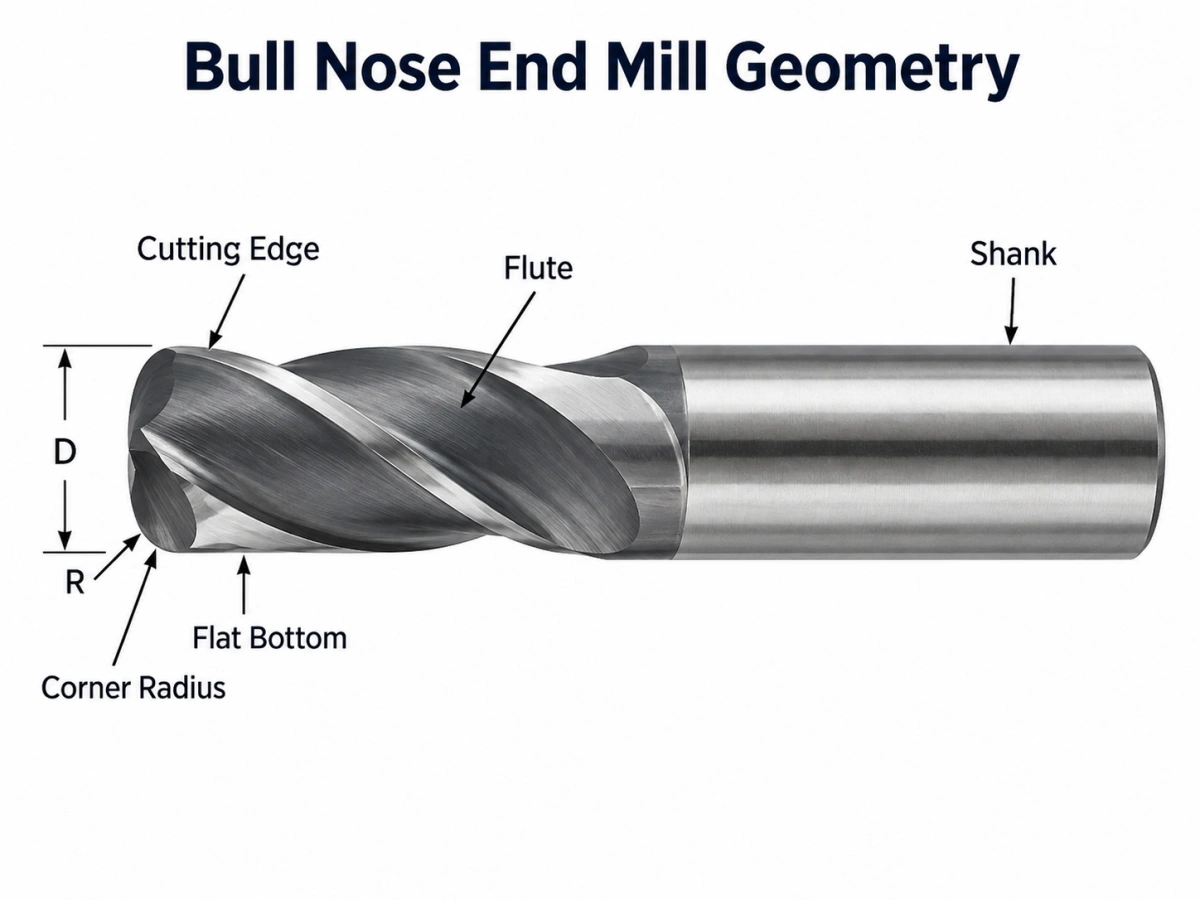 Di conseguenza, the tool is useful when a part requires a flat or stepped feature together with a radiused bottom-to-wall transition.
The exact cutter still needs to match the required part dimensions, corner geometry, portata, e condizioni di lavorazione.
Bull Nose End Mill and Corner Radius End Mill Terminology
The terms fresa a candela a testa tonda E fresa per raggio angolare often describe closely related flat-bottom cutter geometry with radiused cutting corners.
“Corner radius end mill” is a common catalog term because it directly describes the tool geometry. “Bull nose end mill” is also widely used by buyers, macchinisti, e fornitori.
Tuttavia, naming conventions can vary between manufacturers. Some catalogs may use the terms differently or separate product families according to radius size, serie, o applicazione.
Per questo motivo, do not rely on the product name alone. Confirm the actual cutter diameter, raggio d'angolo, geometria del flauto, and other required dimensions before ordering.
For available product configurations, vedi il nostro Fresa a punta di toro.
Why the Corner Radius Matters
The corner radius is located where the flat bottom of the cutter transitions into the side cutting edge.
This radius changes the geometry produced at the bottom-to-wall transition of the machined feature. Instead of leaving the sharp-corner geometry associated with a square-profile cutter, the bull nose geometry creates or follows a radiused transition.
The required radius should therefore match the drawing and finished part geometry.
A larger or smaller radius should not be selected from a general rule alone. The exact R value depends on the required feature, dimensioni della taglierina, requisito di lavorazione, and part design.
What Is a Bull Nose End Mill Used For?
Bull nose end mills are used in CNC milling applications where the part geometry benefits from a flat bottom combined with a corner radius.
Le applicazioni tipiche includono:
- Fresatura di contorni
- Fresatura di profili
- Semifinitura
- Lavorazione di cavità
- Lavorazione di stampi e matrici
- Stepped features with radiused lower corners
- Bottom-to-wall transitions where a corner radius is required
The same cutter type may be used for different workpiece materials, but the final tool configuration should match the material and machining conditions.
Per esempio, grado di carburo, geometria del flauto, rivestimento o trattamento superficiale, dimensioni dell'utensile, and cutting design may vary according to the actual application.
Therefore, the tool name alone does not determine the complete machining setup.
Basic Bull Nose End Mill Selection
Selecting a bull nose end mill starts with the geometry of the part rather than with a general performance rule.
Part and Corner Geometry
Primo, check the drawing.
Confirm whether the feature:
- Requires a corner radius
- Allows a radiused transition
- Requires a flat bottom
- Has enough access for the selected cutter diameter
- Requires a sharp internal corner instead
If the drawing requires a sharp 90-degree cutting-corner result with no specified radius, a bull nose geometry may not be the correct choice for that feature.
Tool Dimensions
The cutter diameter and corner radius must match the feature being machined.
Length of cut, portata dell'utensile, dimensione del gambo, and overall tool geometry also need to suit the part and machine setup.
This page does not list every possible size combination because standard and custom configurations vary. For actual dimensions and available product options, see the Fresa a punta di toro pagina del prodotto.
Workpiece and Machining Requirement
After confirming the basic geometry, the final cutter configuration depends on the workpiece and machining requirement.
Different applications may require different flute geometry, rivestimento o trattamento superficiale, lunghezza dell'utensile, design a taglio centrale, or tolerance requirements.
Per applicazioni non standard, the drawing and machining information provide the best basis for confirming the final tool.
Related End Mill Comparisons
A bull nose end mill is sometimes compared with other cutter profiles, but each comparison has a different selection question.
If you need a sharp-corner comparison, Vedere Fresa a punta tonda vs fresa a testa piatta.
Per la differenza tra una fresa raggiata a fondo piatto e un'estremità tagliente completamente arrotondata, Vedere Fresa a punta toro vs Fresa a punta sferica.
Bull nose / corner radius cutters are also different from corner rounding form cutters. Vedere Fresa per raggio d'angolo e fresa per arrotondamento d'angolo.
Domande frequenti
Cos'è una fresa a punta toro?
A bull nose end mill is a flat-bottom milling cutter with a defined radius at the cutting corners. The corner radius creates a radiused transition between the machined bottom and side wall.
A cosa serve una fresa a punta toro?
Typical uses include contour milling, fresatura di profili, semifinitura, lavorazione della cavità, lavorazione di stampi e matrici, and features that require a radiused bottom-to-wall transition.
The actual application depends on the part geometry and tool configuration.
Una fresa a punta toro è uguale a una fresa a raggio angolare?
The terms are often used for closely related flat-bottom cutters with radiused cutting corners, and “corner radius end mill” is a common catalog description for this geometry.
Tuttavia, terminology can vary between manufacturers, so the actual radius and cutter geometry should always be confirmed.
How do I choose a bull nose end mill?
Start with the part drawing and required corner geometry.
Confirm the cutter diameter, raggio d'angolo, portata richiesta, e altre dimensioni. Then consider the workpiece material and machining requirement when confirming the final flute geometry, rivestimento o trattamento superficiale, and tool design.
For standard dimensions or custom configurations, refer to the Fresa a punta di toro pagina del prodotto.
Una fresa a punta toro è uguale a una fresa per arrotondare gli angoli?
No.
A bull nose or corner radius end mill has a radius on the cutting corners of the tool itself. A corner rounding end mill is a different form cutter used to produce a rounded profile on a workpiece edge.
For the detailed distinction, Vedere Fresa per raggio d'angolo e fresa per arrotondamento d'angolo.
Conclusione
A bull nose end mill combines a flat cutting bottom with radiused cutting corners. It is commonly used when the part requires a flat or stepped feature together with a radiused bottom-to-wall transition.
The correct cutter depends on the drawing, raggio d'angolo, dimensioni dell'utensile, pezzo, and machining requirement rather than on one fixed configuration.
If you need help confirming a bull nose end mill for your part, send your drawing or machining requirements by E-mail oppure contattaci direttamente al Contatti.