 精密フライスカッター,あらゆる材料を加工するCNC用の切削工具

紹介
CNC加工では, ブルノーズ vs フラットエンドミル is a common comparison because tool selection directly affects part accuracy, surface finish, 工具寿命, and production efficiency. Many machinists want to know whether a radius-corner cutter or a sharp-corner cutter is the better choice for a specific job.
Although both tools are widely used, they perform differently in real cutting conditions. A bull nose end mill is generally stronger at the corners and more stable in contouring or semi-finishing work. By contrast, a flat end mill is still the better option when a part requires sharp internal corners, precise shoulders, or square-bottom features.
In other words, the right choice depends on the part geometry, 材料, and machining goal. For contour milling, cavity machining, and stronger corner support, you can view our custom R corner cutter options.
For sharp internal corners, square shoulders, スロッティング, and flat-bottom features, 私たちのこともチェックしてください flat end mill product page.
Quick Answer
This ブルノーズ vs フラットエンドミル comparison helps you choose the right cutter based on corner strength, surface finish, sharp corner requirements, and machining stability.Choose a ブルノーズエンドミル when you need better corner strength, smoother transitions, and more stable cutting in contour milling or semi-finishing.
Choose a flat end mill when the part requires true sharp internal corners, square shoulders, or slotting with a flat-bottom result.
In many real machining jobs, the best solution is not choosing only one tool. その代わり, many machinists use a bull nose end mill for roughing or semi-finishing, then switch to a flat end mill for final sharp details.
What Is the Difference Between a Bull Nose End Mill and a Flat End Mill?
At first glance, these two tools may look similar. しかし, the difference at the cutting corner changes tool life, finish quality, and application range.
If you want a full explanation of bull nose tool geometry and uses, 読む ブルノーズエンドミルとは何ですか.
ブルノーズエンドミル
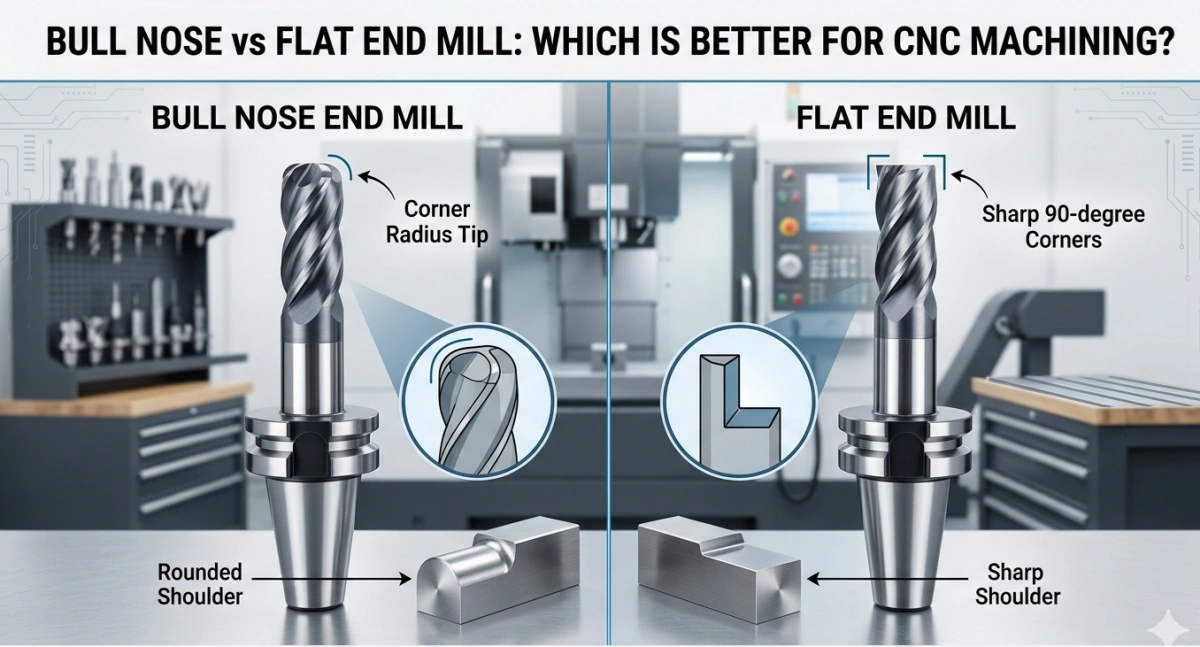
A bull nose end mill has a flat bottom with a rounded corner radius. Because the sharp corner is replaced by a radius, the cutting edge is stronger and less likely to chip. As a result, this tool is often used for contour milling, 中仕上げ, cavity machining, and mold work.
フラットエンドミル
A flat end mill has a flat bottom and a sharp 90-degree corner. It is commonly used for slots, 肩, flat walls, and parts that require a true sharp internal corner. しかし, the sharp edge is usually more vulnerable to wear or chipping in demanding conditions.
Why This Difference Matters
The corner geometry directly affects machining stability. A rounded corner usually supports smoother transitions and better durability, while a sharp corner gives more precise corner definition. したがって, neither tool is universally better. The better choice depends on the part requirement.
性能比較
The difference between a bull nose end mill and a flat end mill is not only about shape. It also affects how the tool performs during actual cutting.
Corner Strength
A bull nose end mill usually offers stronger corners because the radius reduces stress concentration. したがって, it is often the safer choice for harder materials, longer cutting cycles, and unstable conditions.
表面仕上げ
For curved or stepped surfaces, a bull nose end mill often creates smoother transitions. By contrast, a flat end mill may leave more visible marks unless the toolpath and stepover are carefully controlled.
Tool Life
In many applications, a bull nose end mill can deliver longer tool life because its cutting edge is less fragile. A flat end mill can still perform very well, but its sharp corner tends to wear faster when cutting conditions become more demanding.
Accuracy of Sharp Corners
This is where a flat end mill remains essential. If a part requires a true sharp internal corner or square-bottom detail, a bull nose end mill cannot fully replace it.
ブルノーズ vs フラットエンドミル: Which Tool Is Better for Different Applications?
The better tool depends on the job. To make selection easier, here is a simple comparison.
Quick Selection Table
| 機械加工の必要性 | Better Choice |
|---|---|
| Sharp internal corners | Flat end mill |
| Smoother profile transitions | Bull nose end mill |
| Better corner strength | Bull nose end mill |
| Square slots and shoulders | Flat end mill |
| Mold cavities and semi-finishing | Bull nose end mill |
| Reduced corner chipping | Bull nose end mill |
This table is intentionally simple, so it is easier to read on mobile devices.
Bull Nose End Mill Is Better For
- contour milling
- semi-finishing operations
- mold cavity machining
- curved or filleted surfaces
- hardened steel machining
- high-speed cutting where edge strength matters
Flat End Mill Is Better For
- スロット
- 肩
- 鋭い内側の角
- square-bottom features
- wall finishing with crisp corner definition
For square shoulders, スロッティング, 鋭い内側の角, and flat-bottom features, you can view our flat end mill product page.
Best Combined Strategy
In many machining tasks, the most efficient process uses both tools. A bull nose end mill can improve stability and tool life in semi-finishing, while a flat end mill can finish the final sharp details.
Material Removal and Machining Efficiency
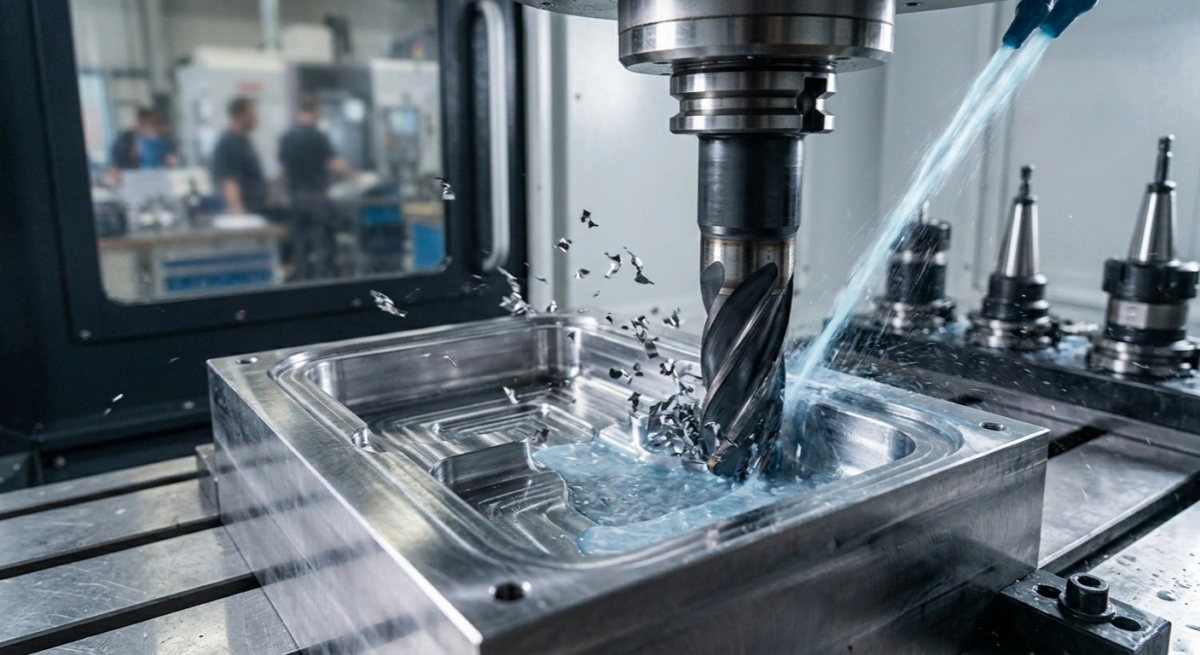
For contouring, cavity work, and semi-finishing, a bull nose end mill often provides a more stable cutting process. 多くの場合, this improves machining confidence and reduces corner failure.
しかし, a flat end mill can still be more efficient for simple slotting, square shoulders, and flat-bottom machining. したがって, material removal efficiency is not only about the tool type. It also depends on the feature being machined.
When vibration control, edge durability, and tool life are important, a bull nose end mill is often the better option. When sharp geometry is the top priority, a flat end mill remains necessary.
How to Choose the Right Tool
When deciding between a bull nose end mill and a flat end mill, focus on three practical points: part geometry, 材料, そして仕上げ要件.
Selection by Part Geometry
If the part has fillets, curved transitions, or cavity features, a bull nose end mill is usually the better choice. If the drawing requires sharp internal corners, a flat end mill is the correct tool.
Selection by Material
For mold steel, 硬化鋼, and other demanding materials, a bull nose end mill often provides better edge durability. For general slotting and simpler features, a flat end mill still works well.
Selection by Finish Requirement
If smoother transitions and lower chipping risk are important, choose a bull nose end mill. If the part must keep a crisp 90-degree inside corner, choose a flat end mill.
Selection by Process Strategy
For many real-world jobs, the best answer is not either-or. その代わり, use a bull nose end mill where durability matters most, then switch to a flat end mill where corner precision matters most.
If you need to compare available sizes, radius options, and flute designs, check our ブルノーズエンドミル.
Bull Nose vs Ball Nose: Should This Page Cover It?
Some users also search for bull nose vs ball nose. しかし, that is a different comparison intent from bull nose vs flat end mill.
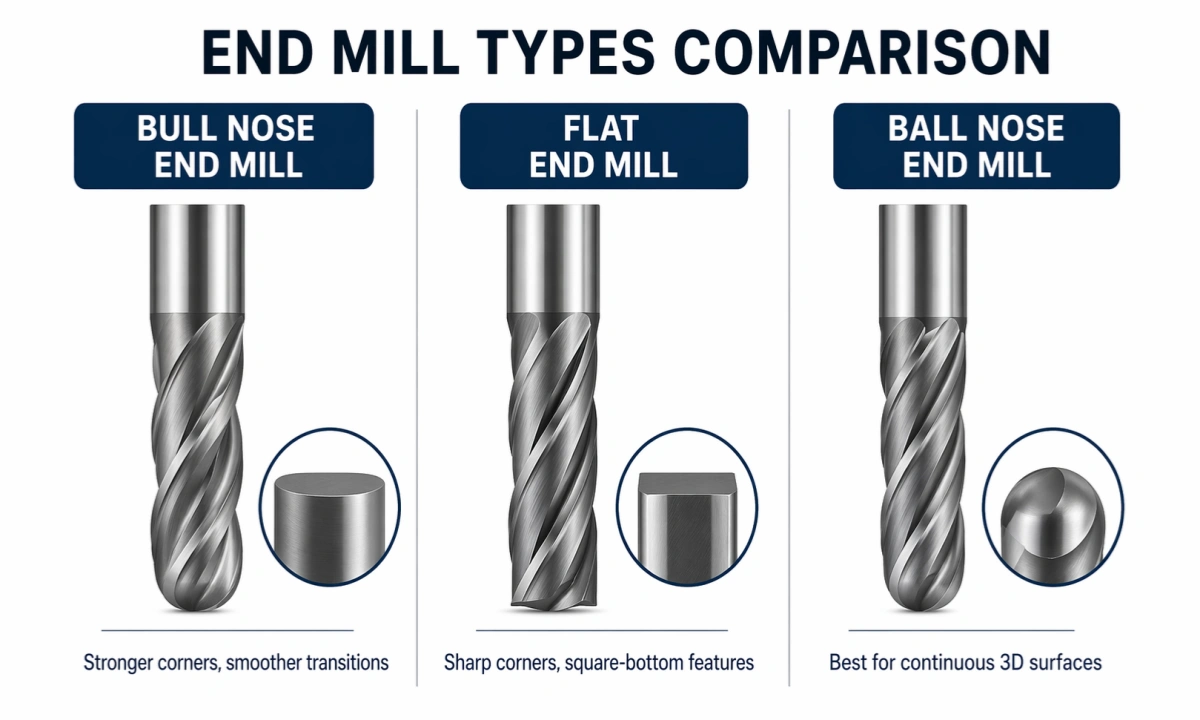
In simple terms, ブルノーズエンドミルは、コーナー半径を備えた平坦な底部を備えています。, while a ball nose end mill has a fully rounded tip. A bull nose tool is often more practical for general profiling and stronger corners. By contrast, a ball nose tool is better for continuous 3D surface machining.
To keep this page focused, this article does not expand that topic too much. If you also need that comparison, 私たちのを読んでください ball nose comparison guide.
FAQ
Can one tool handle all operations?
Not usually. A bull nose end mill works better for contouring, 中仕上げ, より強力なエッジサポート, while a flat end mill is still needed for true sharp internal corners.
Which tool gives better surface finish?
For curved or stepped surfaces, a bull nose end mill usually gives a smoother transition. For flat walls and crisp edges, a flat end mill remains important.
Which tool is better for high-speed machining?
In many high-speed machining applications, a bull nose end mill provides better corner stability and lower chipping risk because of its radius design.
Which tool is better for mold machining?
In many mold and cavity applications, a bull nose end mill is preferred because it supports smoother profiling and better corner durability.
When should I use a bull nose end mill instead of a flat end mill?
Use a bull nose end mill when you need better edge strength, smoother contour transitions, more stable semi-finishing, or less corner chipping.
For a more detailed explanation of tool geometry and applications, 私たちのを読んでください tool geometry and application guide.
結論
In this ブルノーズ vs フラットエンドミル comparison, there is no single cutter that is best for every CNC job. A bull nose end mill is usually stronger, more stable, and better for contouring, 中仕上げ, and mold-related work. A flat end mill, however, remains essential for sharp internal corners, スロット, and square-bottom features.
したがって, the correct choice depends on part geometry, material hardness, finish requirements, and machining strategy. 多くの場合, using both tools together gives the best result.
For contour milling, cavity machining, or harder materials, 私たちのものを見る custom R corner cutter.
For sharp internal corners, square shoulders, スロッティング, and flat-bottom features, check our flat end mill product page.
Need help choosing the right cutter? Send us your tool diameter, corner radius requirement, フルート数, コーティング, ワーク材質, machining application, そして量.
Email us for a custom cutter recommendation