 精密フライスカッター,あらゆる材料を加工するCNC用の切削工具

An end mill flute is the spiral groove on an end mill cutter. It helps form the cutting edge, remove chips, guide coolant, and control cutting performance during CNC milling.
For machinists, engineers, and buyers, flute design is important because it affects chip evacuation, 工具の強度, surface finish, 送り速度, and material suitability. 例えば, a 2 flute end mill usually gives better chip removal in aluminum. 対照的に, a 4 flute end mill often provides better cutting stability in steel.
したがって, understanding end mill flute count and flute design can help you choose the right milling cutter for different materials and machining operations.
What Does Flute Mean on an End Mill?
An end mill flute is the groove that runs along the cutting part of the tool. Most flutes are spiral, but some special tools may use straight flute designs.
Each flute creates space for chips to leave the cutting area. At the same time, the flute shape also affects cutting edge strength and tool rigidity. このため, flute design is not only about chip removal. It also influences the whole cutting process.
In simple terms, the flute has four main functions:
| Function | なぜそれが重要なのか |
| Cutting edge formation | Each flute helps create a cutting edge |
| Chip removal | The groove allows chips to leave the cut |
| Coolant flow | Coolant can reach the cutting zone more easily |
| Tool strength | Flute depth affects the core strength of the tool |
If you are choosing a general CNC milling tool, you can start with our エンドミルカッター page.
Why Is End Mill Flute Count Important?
End mill flute count means how many flutes the cutter has. Common options include 2 フルート, 3 フルート, 4 フルート, そして 6 フルートエンドミル.
The number of flutes affects chip space and tool strength. Fewer flutes usually provide more chip space, so they work well for soft materials and slotting. しかし, more flutes give the tool a stronger core and more cutting edges. 結果として, they can improve stability and surface finish in harder materials.
| フルートカウント | Main Feature | 一般的な使用方法 |
| 2 フルート | Large chip space | アルミニウム, plastic, スロッティング |
| 3 フルート | Balance of chip removal and finish | アルミニウム, non-ferrous metals |
| 4 フルート | Better rigidity and stability | 鋼鉄, ステンレス鋼, general milling |
| 6 フルート | More cutting edges | Finishing and harder materials |
したがって, more flutes are not always better. The best choice depends on the material, 切込み深さ, 機械剛性, and surface finish requirement.
Common End Mill Flute Types
2 フルートエンドミル
あ 2 flute end mill has two cutting flutes and larger chip space. このため, it is often used for aluminum, plastic, 銅, and other soft or non-ferrous materials.
It is also a common choice for slotting because chips need enough room to leave the cutting area. If chip removal is poor, chips may stay in the slot and cause tool wear, poor finish, or tool breakage.
アルミ用, plastics, and slotting applications, you can view our 2 フルートエンドミル page.
3 フルートエンドミル
あ 3 flute end mill offers a balance between chip evacuation, 切削安定性, そして表面仕上げ. It has more cutting edges than a 2 flute tool, but it still keeps enough flute space for aluminum and other non-ferrous materials.
Many manufacturers use this cutter when they need better surface finish than a 2 flute cutter while still keeping good chip evacuation. 加えて, this tool can be useful for high-speed aluminum machining when the machine, ツールホルダー, and cutting parameters are stable.
For more details, 私たちのを読んでください とは何ですか 3 に使用されるフルートエンドミル ガイド.
4 フルートエンドミル
あ 4 flute end mill is one of the most common choices for steel, ステンレス鋼, and general CNC milling. Compared with a 2 flute tool, it has more cutting edges and a stronger core.
結果として, a 4 flute end mill can provide better stability, better tool strength, and a smoother finish in many steel machining operations. しかし, it has less chip space than a 2 flute tool, so it may not be the best choice for deep slotting in aluminum.
For steel, ステンレス鋼, and general CNC milling, you can view our 4 フルートエンドミル.
6 フルートエンドミル
あ 6 flute end mill has more cutting edges and smaller chip space. It is often used for finishing, 側面フライス加工, and machining harder materials when the chip load is controlled properly.
Because 6 flute tools have more contact with the workpiece, they can help improve surface finish. しかし, they need stable machining conditions and proper chip evacuation.
For finishing and stable CNC machining, you can view our 6 フルートエンドミル.
How to Choose End Mill Flute Count by Material
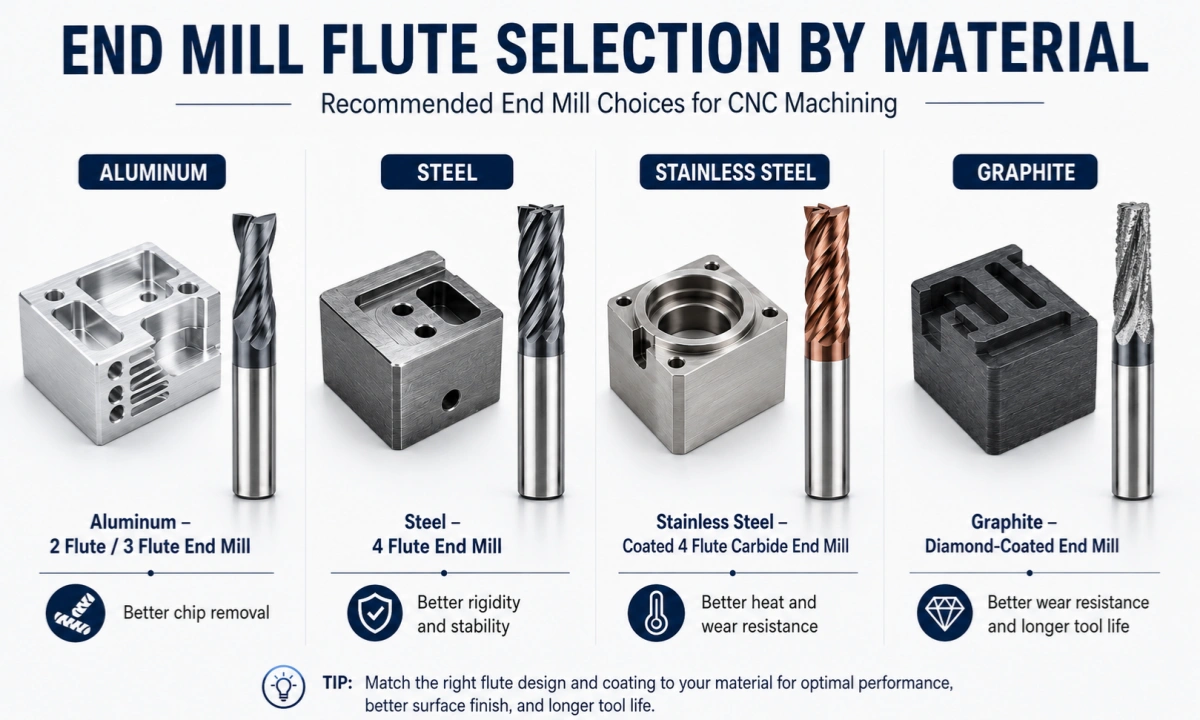
材料が異なれば、フルートの設計も異なります. したがって, material should be one of the first factors you check before choosing an end mill flute count.
| ワーク材質 | Recommended Flute Count | Reason |
|---|---|---|
| アルミニウム | 2 フルートとか 3 フルート | Better chip removal |
| Plastic | 1 フルートとか 2 フルート | Reduces chip clogging |
| 鋼鉄 | 4 フルート | Better rigidity and stability |
| ステンレス鋼 | 4 flute or coated carbide end mill | 優れた耐熱性と耐摩耗性 |
| 硬化鋼 | 4 フルートとか 6 フルート | Stronger cutting edge and better finish |
| 黒鉛 | Diamond-coated end mill | 耐摩耗性の向上 |
End Mill Flute for Aluminum
Aluminum is soft, but it can stick to the cutting edge if chips are not removed quickly. したがって, 2 フルートとか 3 flute end mills are usually better choices.
A larger flute space helps move chips away from the cutting zone. 加えて, polished flutes can reduce built-up edge and improve cutting stability.
End Mill Flute for Steel
Steel needs stronger tool rigidity and better cutting stability. このため, 4 flute end mills are widely used for steel milling.
あ 4 flute design provides a stronger core and more cutting edges. したがって, it can support side milling, プロファイリング, 肩削り加工, and finishing in many steel applications.
End Mill Flute for Stainless Steel
Stainless steel can generate heat and work harden during machining. したがって, the tool should have a sharp cutting edge, good coating, and stable flute design.
多くの場合, a coated 4 flute carbide end mill is a practical choice. しかし, 切断パラメータ, 冷却剤, and machine rigidity also matter.
For high-performance CNC machining, 私たちのものをご覧いただくこともできます 超硬エンドミルカッター.
End Mill Flute for Graphite
Graphite is abrasive, so tool wear is a major concern. この場合, flute count is important, but coating is even more important.
Diamond-coated end mills can improve wear resistance and extend tool life when machining graphite and other abrasive materials.
グラファイト加工用, 私たちのものを見る ダイヤモンドコーティングエンドミル.
How Flute Design Affects Cutting Performance
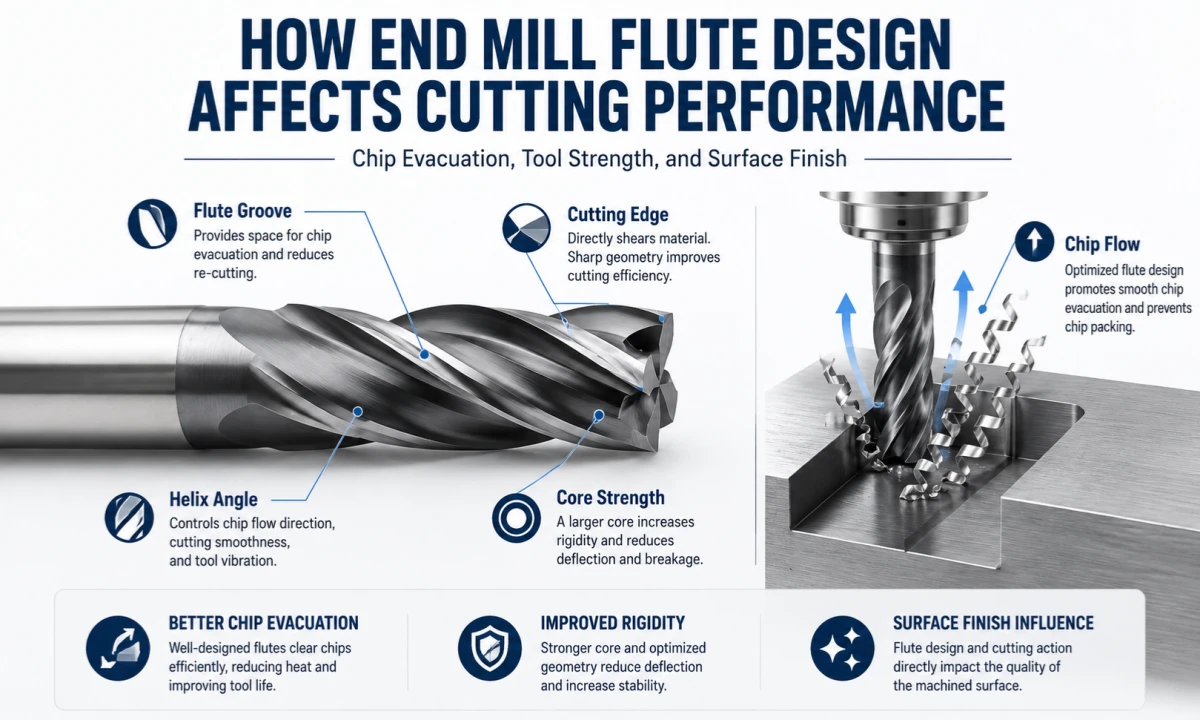
End mill flute design affects more than the number of cutting edges. It also includes flute depth, ねじれ角, core diameter, 刃の長さ, and coating compatibility.
For a broader end mill selection guide, 私たちのを読んでください endmill tool selection guide.
切りくずの排出
Chip evacuation is the ability of the tool to remove chips from the cutting area. If chips cannot leave the cut smoothly, they may cause heat, rubbing, poor surface finish, or tool breakage.
Fewer flutes usually provide more chip space. したがって, 2 フルートと 3 flute end mills are often better for aluminum, plastic, and deep slots.
Tool Strength
Tool strength depends partly on the core diameter of the end mill. A tool with deeper flutes has more chip space, but it may have a smaller core. 結果として, it may be less rigid.
More flutes usually create a stronger core. したがって, 4 フルートと 6 flute end mills are often better for harder materials and stable side milling.
表面仕上げ
More flutes can improve surface finish because more cutting edges contact the workpiece. しかし, the tool also needs correct feed rate, speed, tool runout, and machine stability.
For finishing operations, 4 フルートとか 6 flute end mills are often used. Meanwhile, for roughing or slotting, fewer flutes may work better because they remove chips more easily.
Heat Control
Heat control is important in stainless steel, チタン, and hardened steel. If heat stays near the cutting edge, 工具の摩耗は急速に増加する可能性があります.
A suitable flute design, コーティング, coolant method, and cutting speed can help reduce heat and improve tool life.
End Mill Flute Selection by Machining Operation
The machining operation also affects flute selection. A tool used for slotting may not be the best choice for finishing. したがって, you should match the flute count with the cutting task.
| 機械加工作業 | Recommended Flute Count | Tool Choice |
| Slotting aluminum | 2 フルートとか 3 フルート | Better chip space |
| Slotting steel | 2 フルートとか 4 フルート | Depends on depth and rigidity |
| Side milling steel | 4 フルート | Stronger cutting stability |
| 仕上げ | 4 フルートとか 6 フルート | Better surface finish |
| 荒加工 | ラフィングエンドミル | Faster material removal |
| Graphite machining | Diamond-coated end mill | 耐摩耗性の向上 |
For heavy material removal before finishing, 私たちのものを見る ラフィングエンドミル.
For Slotting
Slotting needs good chip evacuation because the tool cuts inside a narrow groove. したがって, 2 flute tools are often preferred for aluminum and soft materials.
For steel slotting, the best choice depends on slot depth, 冷却剤, と機械剛性.
For Side Milling
Side milling needs tool rigidity and stable cutting. 多くの場合, 4 flute end mills perform well because they provide good strength and cutting balance.
仕上げ用
Finishing needs a smoother surface and stable cutting force. したがって, 4 フルートとか 6 flute end mills are often used when chip removal is not a major problem.
Common Mistakes When Choosing End Mill Flutes
Choosing the wrong flute count can reduce tool life and machining quality. Below are some common mistakes to avoid.
| Mistake | Possible Result | Better Choice |
| Using too many flutes for aluminum slotting | Chip clogging and heat | 使用 2 フルートとか 3 フルート |
| Using too few flutes for steel finishing | Poor finish or vibration | 使用 4 フルートとか 6 フルート |
| Ignoring flute length | Chatter and tool deflection | Use the shortest suitable flute length |
| Choosing only by price | Short tool life | Match tool design to the material |
| Using one tool for all materials | Unstable performance | Select by material and operation |
要するに, the best end mill flute design should match the workpiece material, 切込み深さ, tool path, 機械剛性, and required surface finish.
FAQ About End Mill Flutes
What does flute mean on an end mill?
A flute is the groove on an end mill cutter. It forms the cutting edge, removes chips, and helps coolant reach the cutting area.
Are more flutes better on an end mill?
Not always. More flutes can improve rigidity and surface finish, but they reduce chip space. Fewer flutes usually remove chips better, especially in aluminum and slotting.
とは何ですか 2 に使用されるフルートエンドミル?
Machinists often use a 2 flute end mill for aluminum, plastic, soft materials, and slotting. It has larger chip space, so it can remove chips more easily.
For aluminum machining, 見る 2 フルートエンドミル.
とは何ですか 4 に使用されるフルートエンドミル?
Machinists often use a 4 flute end mill for steel, ステンレス鋼, 側面フライス加工, プロファイリング, and general CNC machining. It offers better rigidity and cutting stability than a 2 flute tool.
鋼加工用, 見る 4 フルートエンドミル.
How many flutes are best for aluminum?
アルミ用, 2 フルートと 3 flute end mills are usually better choices. They provide more chip space and reduce chip clogging during high-speed machining.
How many flutes are best for steel?
For steel, 4 flute end mills are commonly used because they offer better tool strength and cutting stability. 仕上げ用, 6 flute end mills may also be suitable when the machine setup is stable.
How do I choose the right end mill flute count?
First, 素材をチェックする. それから, confirm the machining operation, such as slotting, 側面フライス加工, 荒削り, または仕上げ. Finally, choose the flute count, コーティング, 刃の長さ, and tool size based on the cutting condition.
結論
An end mill flute affects chip removal, cutting edge strength, surface finish, 送り速度, と工具寿命. したがって, choosing the right flute count is important for stable CNC milling.
In general, 2 フルートと 3 flute end mills are better for aluminum and soft materials. 4 flute end mills are suitable for steel and general milling. 6 flute end mills are often used for finishing and harder materials. しかし, the best choice still depends on the material, 切込み深さ, 機械剛性, and surface requirement.
If you need help choosing the right flute design, Cutterbest can support standard and custom end mill cutters with different flute counts, コーティング, 溝の長さ, and tool sizes.
For general CNC milling, 私たちのものを見る 超硬エンドミルカッター.
Aluminum slotting usually needs better chip evacuation, so our 2 フルートエンドミル can be a suitable choice.
When machining steel, 私たちのものを見る 4 フルートエンドミル for better rigidity and cutting stability.
アプリケーションの仕上げ用, our 6 フルートエンドミル can help improve surface finish and tool stability.