 精密フライスカッター,あらゆる材料を加工するCNC用の切削工具

An end mill cutter is a rotating cutting tool used in CNC milling to remove material from the end and side of a workpiece. It can machine slots, ポケット, プロフィール, 側壁, 曲面, and finishing features in materials such as aluminum, 鋼鉄, ステンレス鋼, 銅, とプラスチック.
このガイドの内容, you will learn what an end mill cutter is, how it differs from a drill bit, what it does in CNC milling, common cutter types, basic specifications, and how to choose the right tool for different machining applications.
エンドミルカッターとは?
エンドミルカッターは、CNC機械やフライス盤で使用される回転切削工具です。. It rotates at high speed while the tool or workpiece moves along a controlled path to remove material.
The main difference between an end mill cutter and many other tools is its cutting geometry. Most end mills have cutting edges on the end and along the sides. したがって, they can cut vertically and laterally. This makes them suitable for slotting, 側面フライス加工, プロファイリング, ポケットフライス加工, 輪郭を描く, そして仕上げ.
Manufacturers commonly make end mill cutters from high-speed steel or solid carbide. しかし, many CNC machine shops choose solid carbide tools because they offer better rigidity, higher wear resistance, and more stable cutting performance.
If you need standard or custom tools for production machining, 訪問することもできます エンドミルカッター製品ページ.
Main Parts of an End Mill Cutter
Although end mill cutters come in different shapes and designs, most tools include several basic parts. Understanding these parts helps buyers choose the right cutter for their material, 機械, そして加工目標.
| 一部 | 関数 | なぜそれが重要なのか |
| 刃先 | Remove material from the workpiece | Affect cutting efficiency and surface finish |
| フルート | Help evacuate chips during machining | Influence chip removal, 剛性, 切断安定性 |
| Tool tip | Defines the end geometry of the cutter | Affects slotting, 輪郭を描く, 仕上げ, and corner strength |
| シャンク | Held by the tool holder or spindle | Must match the holder for stable clamping |
| コーティング | Protects the cutting edge during machining | Improves wear resistance, heat resistance, と工具寿命 |
刃先
The cutting edges are the working part of the tool. They remove material during milling and directly affect cutting performance, 正確さ, そして表面仕上げ.
フルート
Flutes are the grooves along the body of the cutter. They help remove chips from the cutting area. 加えて, flute design affects rigidity, 熱制御, 切断安定性.
Tool Tip
The tool tip design depends on the cutter type. Some end mills have flat ends, while others have ball nose, コーナー半径, or tapered geometry. 結果として, different tip designs are used for different machining tasks.
シャンク
The shank is the part held by the tool holder or spindle. Its diameter must match the holder correctly. さもないと, 振動, poor accuracy, or tool runout may occur.
コーティング
Many end mill cutters use coatings such as TiAlN, アルティン, TiSiNの, 錫, DLC, or Nano blue coating. The right coating can improve heat resistance, 摩耗を減らす, 工具寿命を延ばします.
End Mill Cutter vs Drill Bit
Many beginners confuse an end mill cutter with a drill bit. しかし, they are designed for different machining purposes.
A drill bit mainly cuts in the axial direction to create round holes. 対照的に、, an end mill cutter can cut both axially and laterally. したがって, it can machine slots, ポケット, 輪郭, プロフィール, 側壁, および仕上げ面.
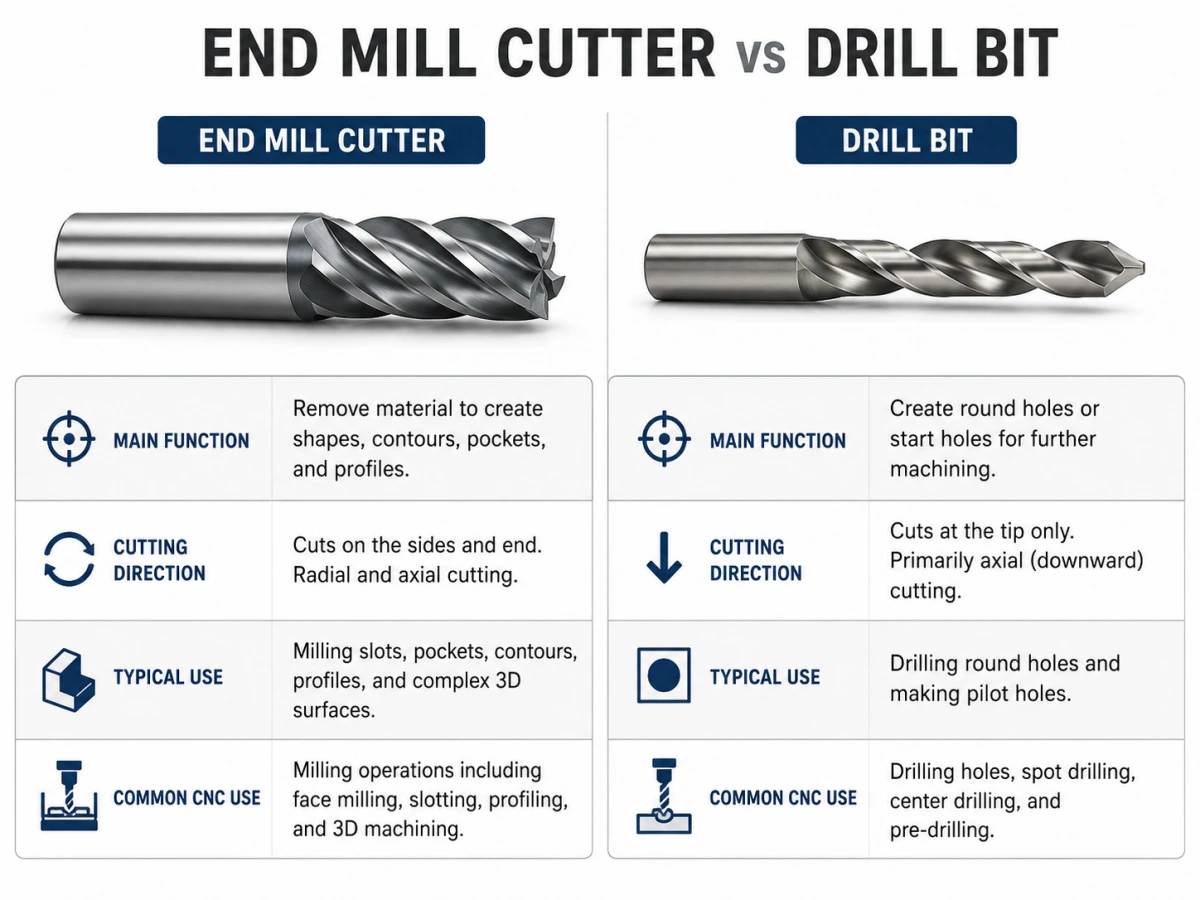
| 特徴 | エンドミルカッター | ドリルビット |
| Main function | フライス加工, スロッティング, プロファイリング, サイドカット | Drilling holes |
| 切断方向 | Axial and lateral | Mainly axial |
| 一般的な使用方法 | スロット, ポケット, 輪郭, 側壁 | Round holes |
| Tool flexibility | より高い | より低い |
| Common CNC use | General milling operations | Hole-making operations |
要するに, both tools remove material, but they are not interchangeable in most machining situations. A center-cutting end mill can plunge in some applications, but it is still not the same as a standard drill bit.
Common Types of End Mill Cutters
There are many types of end mill cutters, and each design has a specific purpose. Choosing the right type helps improve cutting efficiency, 表面品質, と工具寿命.
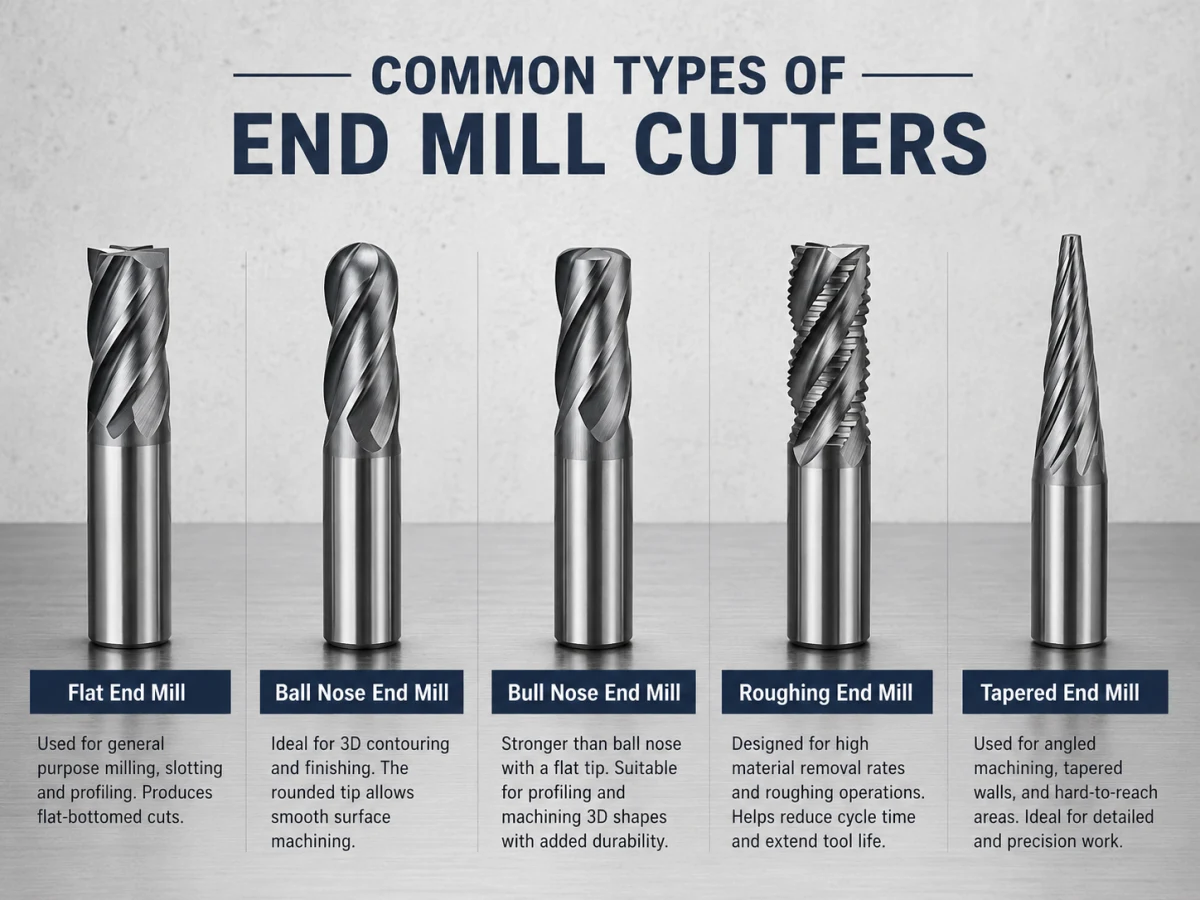
フラットエンドミル
A flat end mill has a flat cutting end. It is widely used for slotting, 側面フライス加工, 肩削り加工, および汎用加工.
ボールエンドミル
A ball nose end mill has a rounded cutting end. It is commonly used for 3D contouring, 金型加工, 曲面, and finishing operations.
For curved surface machining and mold work, 私たちのものをご覧いただくこともできます ボールノーズエンドミル.
ブルノーズエンドミル
ブルノーズエンドミル, also called a corner radius end mill, combines a flat bottom with rounded corners. It improves edge strength and helps create smoother transitions.
For stronger corner geometry, see our ブルノーズエンドミル.
ラフィングエンドミル
A roughing end mill is designed for aggressive material removal. It is often used before finishing to remove large amounts of stock quickly.
For heavy stock removal, あなたは私たちをチェックすることができます ラフィングエンドミル.
テーパーエンドミル
A tapered end mill has a gradually changing diameter. It is used for angled walls, 深い空洞, 金型加工, and special profiles.
For mold cavities and angled machining, 私たちを訪問してください テーパーカッター.
For a more detailed comparison of tool geometries, 私たちのを読んでください end mill cutter types guide.
エンドミルカッターは何に使用されますか?
End mill cutters are used in many CNC milling operations. Because they can cut from the end and the side, they are suitable for both simple and complex machining tasks.
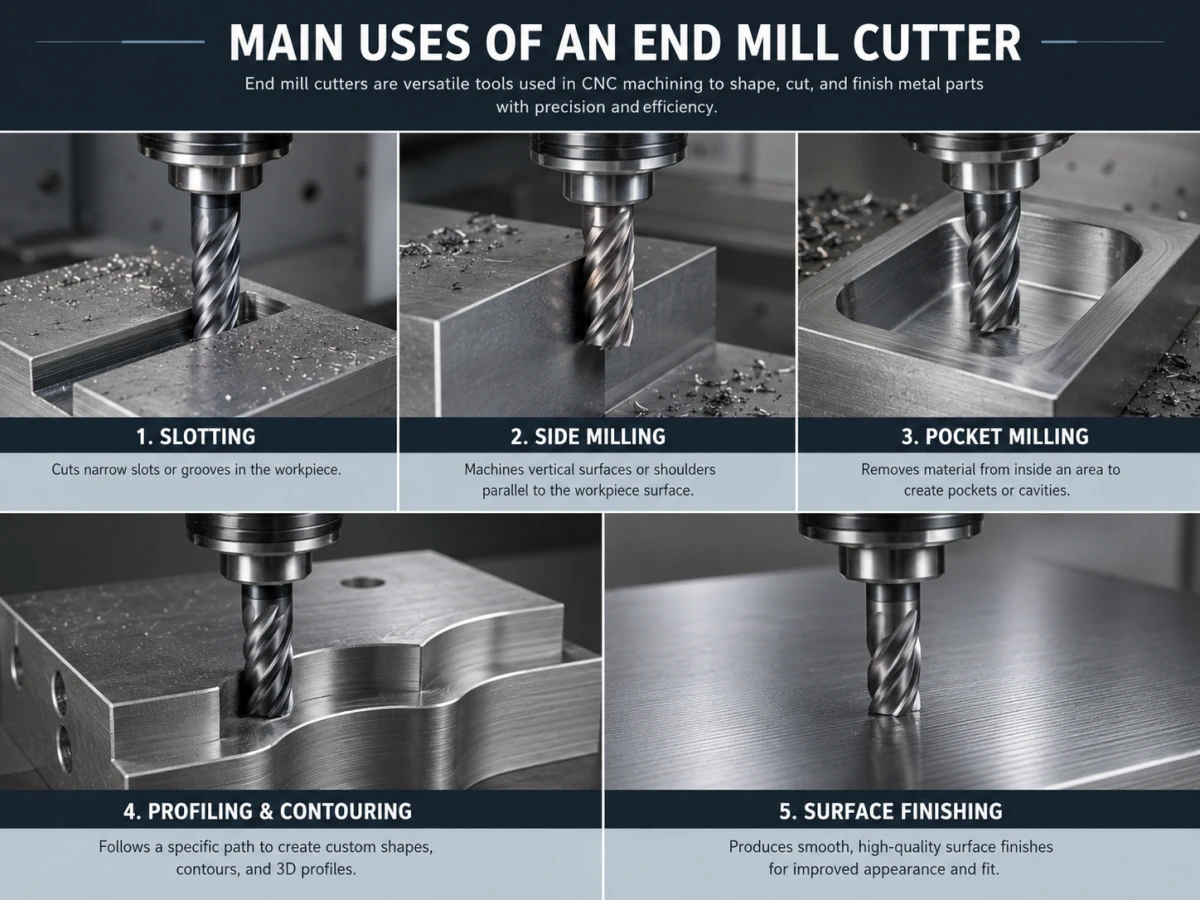
溝 加工
Slotting is one of the most common applications. An end mill cutter can cut straight or curved slots into a workpiece with good accuracy. These slots can create keyways, 溝, ガイドトラック, and assembly features.
For softer materials such as aluminum, chip evacuation is important. したがって, machinists often select 2 flute tools when the workpiece needs better chip removal.
側面フライス加工
Side milling uses the side cutting edges of the tool to remove material from the vertical surface of a workpiece. This operation is useful for machining shoulders, ステップ, そして側壁.
Machine shops commonly use side milling for precision parts, 金型部品, ツーリングパーツ, and general CNC production.
プロファイリングとコンタリング
Machinists also use end mill cutters for profiling and contouring. These operations create complex shapes, curved paths, and external or internal profiles.
Machinists often select ball nose and corner radius tools for this kind of work because these tools can improve surface transitions and finishing quality.
ポケットミーリング
Pocket milling removes material from a closed or recessed area inside a workpiece. This operation is common in parts that need internal cavities, weight reduction, または限られた領域内での正確な材料除去.
Good chip control, stable tool paths, and the correct cutter geometry are important for this process.
表面仕上げ
After rough machining, an end mill cutter can also be used for finishing. The goal is to improve dimensional accuracy and surface smoothness.
Finishing tools are selected according to tolerance, ワーク材質, 機械の安定性, and required surface quality.
段付きフライス加工と肩加工
End mill cutters can machine stepped surfaces, 肩, マルチレベル機能. These features often require sharp transitions, 安定した切断, and accurate dimensions.
結果として, 工具剛性, flute design, and coating selection are important.
End Mill Cutter Uses for Aluminum, 鋼鉄, and Stainless Steel
Different workpiece materials require different cutter designs. したがって, buyers should match the end mill cutter to the material and machining condition.
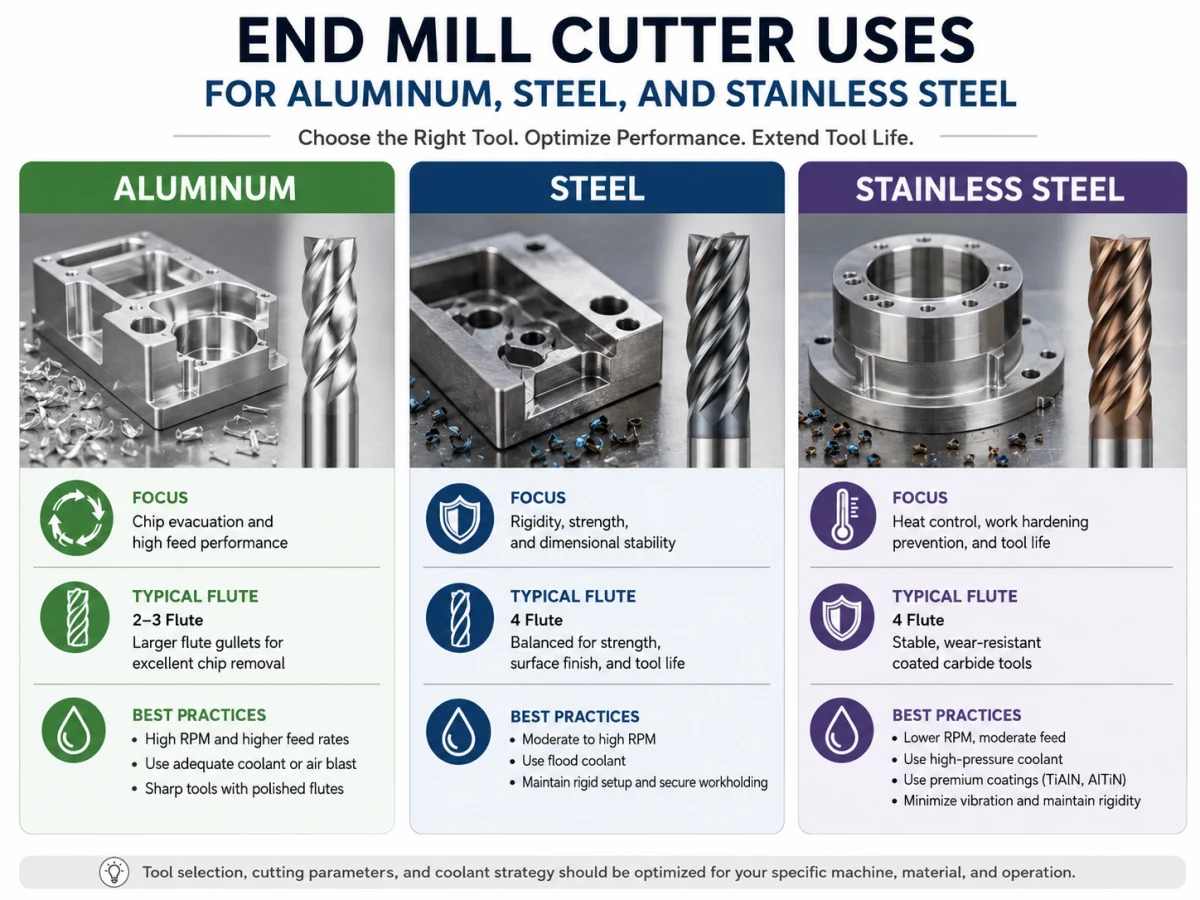
| ワーク材質 | Common Cutter Choice | 主な理由 |
| アルミニウム | 2 フルートとか 3 フルート超硬エンドミル | Better chip evacuation and smooth cutting |
| 鋼鉄 | 4 flute carbide end mill with suitable coating | 剛性と耐摩耗性の向上 |
| ステンレス鋼 | Coated carbide end mill with stable geometry | Better heat control and edge protection |
| 銅と真鍮 | Sharp edge carbide end mill | Clean cutting and reduced burrs |
| プラスチック | Sharp, polished flute cutter | Smooth chip removal and lower melting risk |
アルミ用エンドミルカッター
アルミを加工する場合, end mill cutters are used for slotting, ポケットフライス加工, 側面フライス加工, そして仕上げ. アルミニウムはより大きな切りくずを生成します, そのため、刃数が少なく、切りくず排出が良好な工具が好まれることがよくあります。.
High-helix carbide end mills are also common for aluminum because they help improve cutting smoothness and reduce chip buildup.
アルミニウムおよび非鉄材料用, you can compare flute options on our 2 フルートエンドミル そして 3 フルートエンドミル ページ.
鋼用エンドミルカッター
炭素鋼・合金鋼用, エンドミルカッターは側面フライス加工によく使用されます, 輪郭を描く, ショルダー加工, and semi-finishing. スチールには通常、より優れた剛性とより強い耐摩耗性が必要です.
多くの場合, 4 flute carbide end mills are selected for steel and general-purpose metal machining.
鋼加工用, あなたは私たちを見ることができます 4 フルートエンドミル.
ステンレス鋼用エンドミルカッター
ステンレス鋼は熱を発生し、工具の摩耗を引き起こす傾向があるため、機械加工がより困難です. ステンレス鋼用途の場合, エンドミルカッターは一般的にプロファイリングに使用されます, 仕上げ, 制御されたサイドミーリング加工.
適切なコーティング, フルートの形状, and cutting parameters help maintain cutting stability and reduce edge wear.
How to Choose a Basic End Mill Cutter
Choosing an end mill cutter does not need to be complicated. しかし, buyers should check several factors before ordering.
ワーク材質
The workpiece material is one of the most important factors. アルミニウム, 鋼鉄, ステンレス鋼, 銅, 真鍮, プラスチック, and cast iron may require different flute designs, コーティング, and cutting strategies.
フルートカウント
刃数は切りくず排出に影響します, 剛性, and cutting efficiency. 例えば, machinists often use 2 アルミ用フルートツール, while they commonly choose 4 flute tools for steel and general-purpose machining.
さらに詳しく比較するには, 私たちのを読んでください 2 フルート対 4 フルートエンドミルガイド.
工具材質
Many CNC machine shops choose solid carbide end mill cutters because they provide higher rigidity, より優れた耐摩耗性, and stable performance. Some workshops still use HSS tools for lower-speed or general machining applications.
コーティング
The coating should match the material and machining condition. 例えば, machinists often choose TiAlN and AlTiN coatings for steel, while DLC coating may suit aluminum and non-ferrous materials.
Required Finish
For roughing operations, the main goal is higher material removal. しかし, for finishing work, surface quality and dimensional accuracy become more important.
Basic Specifications to Check Before Buying
ご注文の前に, buyers should confirm several key specifications. This helps avoid tool mismatch and improves machining stability.
カッター径
Cutter diameter affects cutting width, 剛性, and the size of the machined feature.
フルートの長さ
Flute length determines how deep the cutter can machine. しかし, a longer flute may reduce rigidity, so it should match the actual cutting depth.
全長
Overall length affects tool reach and vibration control. A longer tool may be needed for deep cavities, but it should be used carefully to reduce chatter.
シャンク径
Shank diameter must match the holder correctly. Stable clamping helps improve accuracy and tool life.
Corner Geometry
フラット, ボールノーズ, コーナー半径, and tapered geometries are used for different machining goals. したがって, corner geometry should match the part shape and required finish.
Coating Type
被削材の材質に応じてコーティングを選択してください, 切断速度, 冷却水の状態, and tool life requirement.
Why Solid Carbide End Mill Cutters Are Common in CNC Milling
Solid carbide end mill cutters are popular because they offer strong rigidity, high hardness, and good wear resistance. They can support higher cutting speeds and provide more stable performance than many standard tool materials.
In production machining, many shops use carbide tools for steel, ステンレス鋼, 鋳鉄, アルミニウム, およびその他の要求の厳しい材料. 加えて, the right geometry and coating can improve machining consistency.
Industrial buyers, 販売代理店, and machine shops often prefer carbide tools because they help reduce tool changes and support more stable production.
For standard and custom carbide tools, you can visit our carbide end mill cutter pape.
When Do You Need a Custom End Mill Cutter?
A standard cutter can solve many common machining tasks.
しかし, you may need custom tooling when the part has a special profile, deep cavity, unusual material, 厳格な許容範囲, or non-standard size requirement.
Manufacturers can design custom end mill cutters with special diameter, 刃の長さ, 全長, コーナー半径, コーティング, シャンクサイズ, and tool geometry.
For drawing-based or OEM tooling, 私たちを訪問してください custom end mills pape.
FAQ
What is an end mill cutter?
An end mill cutter is a rotary cutting tool used for CNC milling operations such as slotting, 側面フライス加工, プロファイリング, 輪郭を描く, ポケットフライス加工, そして仕上げ.
What is an end mill cutter used for?
It is used to remove material from the end and side of a workpiece. Common applications include slots, ポケット, 側壁, プロフィール, 肩, 曲面, および仕上げ面.
What is the difference between an end mill cutter and a drill bit?
A drill bit mainly cuts holes in the axial direction. An end mill cutter can cut axially and laterally, so it can perform more milling operations such as slotting, プロファイリング, そしてサイドミーリング.
What are the common types of end mill cutters?
Common types include flat end mills, ボールノーズエンドミル, ブルノーズエンドミル, ラフィングエンドミル, tapered end mills, 2 フルートエンドミル, 3 フルートエンドミル, 4 フルートエンドミル, そして 6 フルートエンドミル.
How do I choose a basic end mill cutter?
You should check the workpiece material, フルート数, カッター径, 刃の長さ, 全長, シャンク径, tool material, コーティング, および必要な表面仕上げ.
Are carbide end mill cutters better than HSS end mills?
Carbide end mill cutters usually provide better rigidity, 耐摩耗性, 切断安定性. しかし, the best choice depends on the machine, ワーク材質, 切断速度, and budget.
結論
An end mill cutter is a versatile CNC milling tool used for slotting, 側面フライス加工, ポケットフライス加工, プロファイリング, 輪郭を描く, ショルダー加工, そして仕上げ. Because it can cut from both the end and the side, it is more flexible than many basic cutting tools.
適切なカッターを選択するには, buyers should understand the tool structure, カッタータイプ, フルート数, 材料, コーティング, 直径, 刃の長さ, および機械加工アプリケーション. Once these factors are matched correctly, the cutter can provide better cutting efficiency, longer tool life, より安定した加工結果を実現.
Looking for a reliable end mill cutter manufacturer for aluminum, 鋼鉄, ステンレス鋼, or custom CNC machining?
Explore our エンドミルカッター製品ページ 標準および OEM ソリューション用, または、図面とアプリケーションの要件をお知らせください。.