 Precision Milling Cutters,Cutting Tools for CNC Machining Every Material

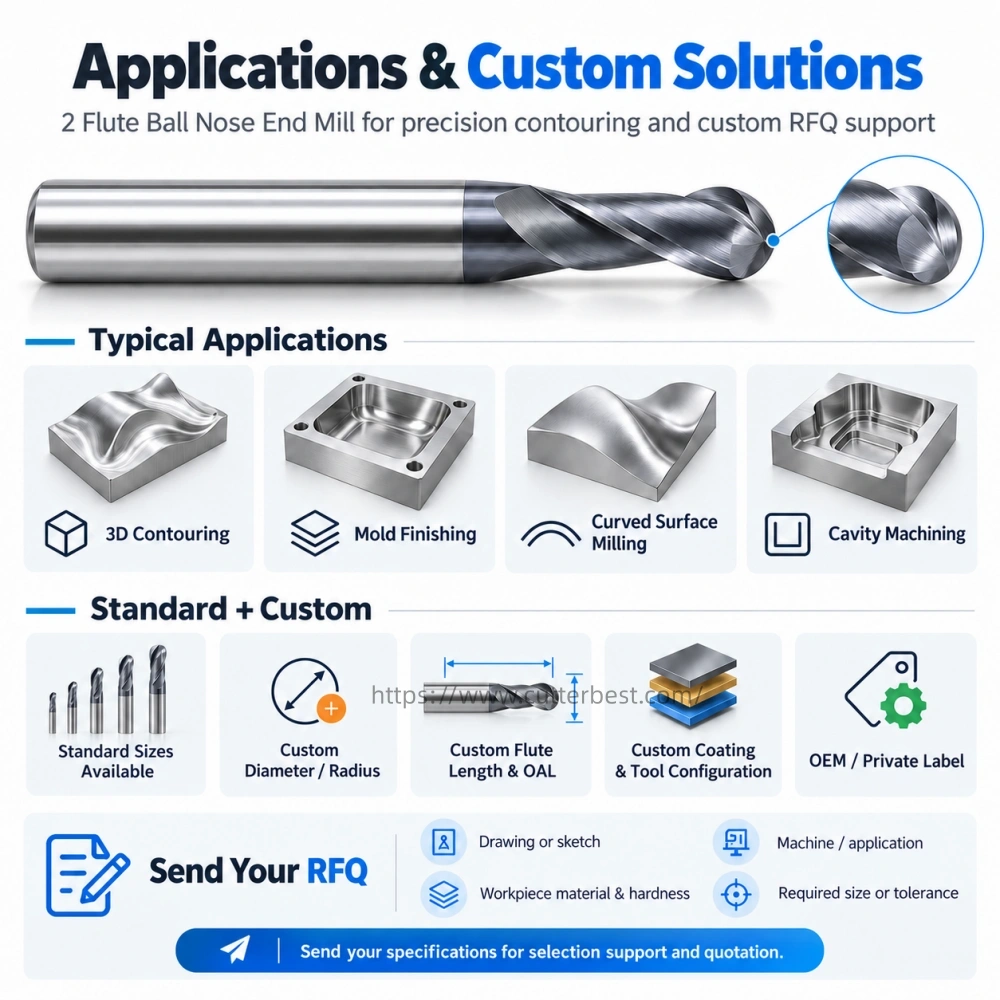
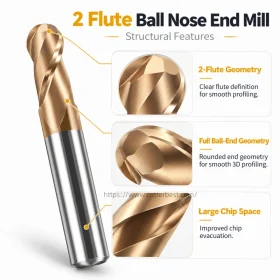
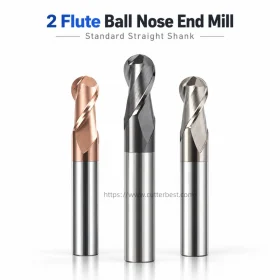
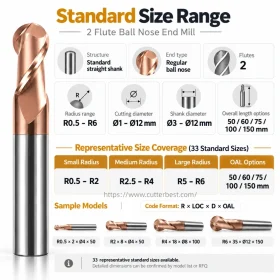
The 2 flute ball nose end mill range from CutterBest combines a standard straight shank, solid carbide construction, two cutting flutes, and a full ball-end profile. The range covers CNC contouring, mold and cavity finishing, curved-surface machining, and other applications that require a rounded cutting profile.
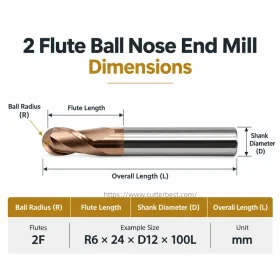
Buyers can select from common combinations of ball radius, cutting diameter, flute length, shank diameter, and overall length. The appropriate carbide grade, coating, and tool configuration depend on the workpiece material, hardness, cutter size, and machining conditions.
CutterBest also reviews non-standard requirements based on dimensions, drawings, or existing tool references. For the broader ball-end product range, see Carbide Ball Nose End Mills.
Specification Options
The following values summarize the currently confirmed standard-size system for straight-shank 2 flute ball nose end mills. They represent common options rather than the complete manufacturing range.
| Specification | Available / Representative Options |
|---|---|
| Ball Radius | R0.5–R6 |
| Cutting Diameter | Ø1–Ø12 mm |
| Flute Length | 2–35 mm |
| Shank Diameter | Ø3–Ø12 mm |
| Overall Length | 50 / 60 / 75 / 100 / 150 mm |
| Flute Configuration | 2 Flutes |
| End Geometry | Full Ball End |
| Coating | Uncoated or application-specific coating options |
| Tolerance | According to drawing or confirmed requirement |
| Custom Dimensions | Non-standard dimensions can be reviewed from drawings or application requirements |
All dimensional values are in millimeters unless otherwise specified.
Applications & Selection
3D Contouring and Curved Surface Milling
The full ball-end profile follows curved and changing surface geometry during CNC toolpaths. Typical applications include 3D contouring, radiused features, curved surfaces, and complex profile milling.
For a broader application guide, see What Is a Ball Nose End Mill Used For?
Mold and Cavity Finishing
Two-flute ball nose end mills can machine mold surfaces, cavities, profiles, and other features that require a rounded cutting path. Select the cutter radius, flute length, and overall length according to the cavity geometry, access space, workpiece material, and finishing requirement.
When a deep cavity requires additional neck clearance rather than a standard straight-shank structure, see Long Reach Ball Nose End Mill.
Material and Hardness Selection
Do not select a 2 flute ball nose end mill by flute count or diameter alone. Match the tool configuration to the workpiece material, hardness, cutter size, machining condition, and required finish.
| Workpiece Condition | Selection Direction |
|---|---|
| Aluminum and Non-Ferrous Materials | Evaluate a sharp cutting configuration with an uncoated or application-specific option |
| General Steel | Match carbide grade and coating to the material and machining operation |
| Stainless Steel | Match the tool configuration to material grade, hardness, and machining conditions |
| Mold and Hardened Steel | Select a suitable higher-hardness configuration according to the actual HRC and application |
| High-Hardness / Quenched Materials | Evaluate a dedicated high-hardness configuration based on the actual material and hardness |
| Titanium and Heat-Resistant Alloys | Review carbide grade, coating, geometry, and machining conditions together |
For detailed guidance on diameter, radius, flute count, coating, reach, and surface-finish requirements, see How to Choose a Ball Nose End Mill.
Key Features
Two-Flute Cutting Geometry
The two-flute design leaves relatively open flute channels around the ball-end cutting section. This flute space supports chip clearance during profiling and three-dimensional milling.
However, flute count alone does not determine the correct tool. Consider cutter diameter, cutting depth, workpiece material, tool reach, machine stability, and finishing requirements together.
Solid Carbide Construction
The standard product family uses solid carbide / tungsten carbide construction. Match the carbide grade to the workpiece material, hardness, cutter dimensions, and machining conditions rather than assigning one carbide grade to every application.
Application-Specific Coating Options
CutterBest offers both uncoated and coated configurations within the product family. Select the coating according to workpiece material, hardness, machining conditions, and customer requirements.
Confirm the final coating during product selection or quotation instead of treating one coating as suitable for every material.
Custom Manufacturing
Custom Dimensions and Tool Configuration
CutterBest can review custom 2 flute ball nose end mills when the standard size range does not match the required part geometry or machining setup.
Custom requirements may include:
- Cutting diameter or ball radius
- Flute length
- Shank diameter
- Overall length
- Coating requirement
- Tolerance requirement
- Drawing-defined geometry
- OEM marking or private-label requirements
For a tapered body or tapered ball-end geometry, see Tapered Ball Nose End Mill.
Information for RFQ
For product review and quotation, provide the information that is already available for the application:
- Cutting diameter or ball radius
- Flute length
- Shank diameter
- Overall length
- Workpiece material
- Workpiece hardness
- Required quantity
- Coating requirement, if specified
- Drawing or existing tool reference, if available
If some dimensions are still open, send the available drawing, current tool information, or machining requirement first. CutterBest can review the remaining details with the application information.
Frequently Asked Questions
Is a 2 flute ball nose end mill the same as a 2 flute ball end mill?
Yes. Industry buyers commonly use “ball nose end mill” and “ball end mill” for the same full-radius cutting-end geometry. On this page, both terms refer to the standard straight-shank, two-flute solid carbide product family.
What standard sizes are available for 2 flute ball nose end mills?
The confirmed standard-size system covers ball radii from R0.5 to R6, with multiple flute-length, shank-diameter, and overall-length combinations. CutterBest can also review dimensions outside these common combinations from a drawing or size requirement.
How do you select the coating for a 2 flute ball nose end mill?
Select the coating according to the workpiece material, hardness, machining conditions, and application requirements. This product family does not use one fixed coating.
Can CutterBest manufacture custom 2 flute ball nose end mills?
Yes. CutterBest can review non-standard dimensions and application-specific configurations from drawings, dimensional requirements, existing tool references, or machining information.
Send Your 2 Flute Ball Nose End Mill Inquiry
Send your 2 flute ball nose end mill inquiry by email at sales@cutterbest.com, or contact us on WhatsApp for product selection and quotation support.