 Precision Milling Cutters,Cutting Tools for CNC Machining Every Material

Understanding how to choose a ball nose end mill can help improve surface finish, tool life, and machining stability.However, the best cutter depends on more than its diameter or price.
This guide explains how to choose a ball nose end mill according to the workpiece material, machining purpose, cutter diameter, ball radius, flute count, coating, tool reach, machine rigidity, and surface finish requirement.
Ball nose cutters mainly suit 3D contour milling, mold finishing, curved surface machining, graphite electrodes, and precision profiles. For standard and custom options, view our carbide ball nose end mills.
Quick Ball Nose End Mill Selection Guide
The table below provides a practical starting point. However, the final specification should also consider the machine condition, cutting depth, part geometry, coolant method, and production requirements.
| Machining Need | Suggested Starting Point |
| Aluminum Machining | 2–3 flutes with sharp edges, polished flutes, or DLC coating |
| Steel Mold Finishing | 4-flute carbide cutter with TiAlN or AlTiN coating |
| Stainless Steel | Rigid carbide geometry with a heat-resistant coating |
| Graphite Electrodes | Sharp cutting edges with a wear-resistant coating |
| Deep Cavities | Relieved neck, suitable neck length, and minimum overhang |
| Fine 3D Details | Smaller diameter with a short, rigid tool reach |
| High Surface Finish | Small step-over, stable toolpath, and limited runout |
This guide provides a starting point rather than a universal specification. A suitable cutter must match the actual workpiece and machining setup.
Why Choosing the Right Ball Nose End Mill Matters
A ball nose end mill has a fully rounded cutting end. Therefore, it can follow slopes, cavities, radii, and complex three-dimensional profiles more smoothly than a flat-bottom cutter.
However, one tool cannot suit every CNC application. An unsuitable flute count may restrict chip evacuation, while the wrong coating may increase heat or material adhesion. In addition, excessive tool length may cause vibration and visible surface marks.
For example, a cutter designed for aluminum may not perform well in hardened steel. Likewise, a long tool with unnecessary overhang may lose rigidity during deep-cavity finishing.
A suitable selection can help:
- Improve surface quality
- Reduce vibration
- Control chip evacuation
- Increase cutting stability
- Extend cutter life
- Reduce secondary polishing
- Lower trial-and-error costs
How to Choose a Ball Nose End Mill: 7 Key Factors
Before ordering, confirm the following seven factors:
- Workpiece material
- Machining purpose
- Cutting diameter and ball radius
- Flute count
- Coating or edge treatment
- Cutting length, neck length, and overall reach
- Surface finish and machine stability
Each factor affects cutter performance and should not be evaluated separately.
1. Choose by Workpiece Material
The workpiece material affects the flute geometry, carbide grade, edge preparation, coating, and cutting conditions.
| Workpiece Material | Recommended Starting Point |
| Aluminum | Sharp cutting edges, polished flutes, 2–3 flutes, or DLC coating |
| Steel | Carbide cutter with TiAlN or AlTiN coating |
| Stainless Steel | Rigid geometry with a heat-resistant coating |
| Graphite | Sharp edges and a wear-resistant coating |
| Copper | Polished flutes and a low-friction cutting surface |
| Cast Iron | Wear-resistant carbide with stable edge strength |
| Hardened Mold Steel | Strong carbide grade with a high-temperature coating |
Best Ball Nose End Mill for Aluminum
For aluminum, a 2-flute or 3-flute cutter with sharp cutting edges and good chip space is a practical starting point.
Polished flutes can help chips move away from the cutting area. Meanwhile, an uncoated or DLC-coated design may reduce friction and built-up edges.
However, the final choice should also consider:
- Cutting diameter
- Machining depth
- Coolant or air-blast method
- Machine rigidity
- Spindle speed
- Surface finish target
Steel and Stainless Steel
Steel and stainless steel generate more cutting heat and usually require stronger cutting edges.
TiAlN, AlTiN, or another suitable heat-resistant coating can improve wear control. In addition, a rigid machine setup and limited tool overhang help maintain a stable finish.
Graphite and Copper Electrodes
Graphite machining requires wear resistance, stable geometry, and effective dust control. By contrast, copper machining benefits from sharp edges and smooth flutes that reduce material adhesion.
Therefore, provide the electrode grade, drawing, machining depth, and surface finish requirement before selecting the cutter.
2. Choose by CNC Machining Purpose
The correct tool also depends on whether the operation involves roughing, semi-finishing, or final finishing.
Roughing and Semi-Finishing
A ball nose cutter is generally not the first choice for heavy stock removal. In many cases, a flat or roughing end mill removes most of the material first.
After that, a stronger ball nose design can perform semi-finishing passes on curved areas, radii, and cavity walls.
Final Finishing
For finishing, surface quality becomes more important than high material-removal rates.
A stable flute design, limited runout, suitable coating, and small step-over can improve the final surface. However, an extremely small step-over also increases machining time.
Therefore, the toolpath should balance surface quality and production efficiency.
3D Contour Milling
During 3D contouring, the cutting edge must follow slopes, curves, and freeform surfaces. The rounded end provides gradual contact as the surface angle changes.
For more application information, read what is a ball nose end mill used for.
3. Choose by Diameter, Ball Radius, and Tool Reach
Diameter selection affects tool strength, detail resolution, surface finish, and machining efficiency.
A smaller cutter can reach narrow cavities, small radii, and detailed profiles. In contrast, a larger cutter provides greater rigidity and may finish broader surfaces more efficiently.
For a standard full ball-end design, the ball radius is normally half of the cutting diameter. For example:
- 4mm cutting diameter normally corresponds to R2
- 6mm cutting diameter normally corresponds to R3
- 10mm cutting diameter normally corresponds to R5
The table below summarizes the main size parameters.
| Parameter | Selection Point |
| Cutting Diameter — D | Match the cavity width, feature size, and required radius |
| Ball Radius — R | For a full ball end, R is normally half of D |
| Flute Length | Use only the cutting length required for the operation |
| Neck Length | Provide enough clearance for deep cavities and walls |
| Overall Length | Keep the tool as short as the setup allows |
| Shank Diameter | Match the holder size and required rigidity |
| Tool Overhang | Minimize overhang to reduce vibration and deflection |
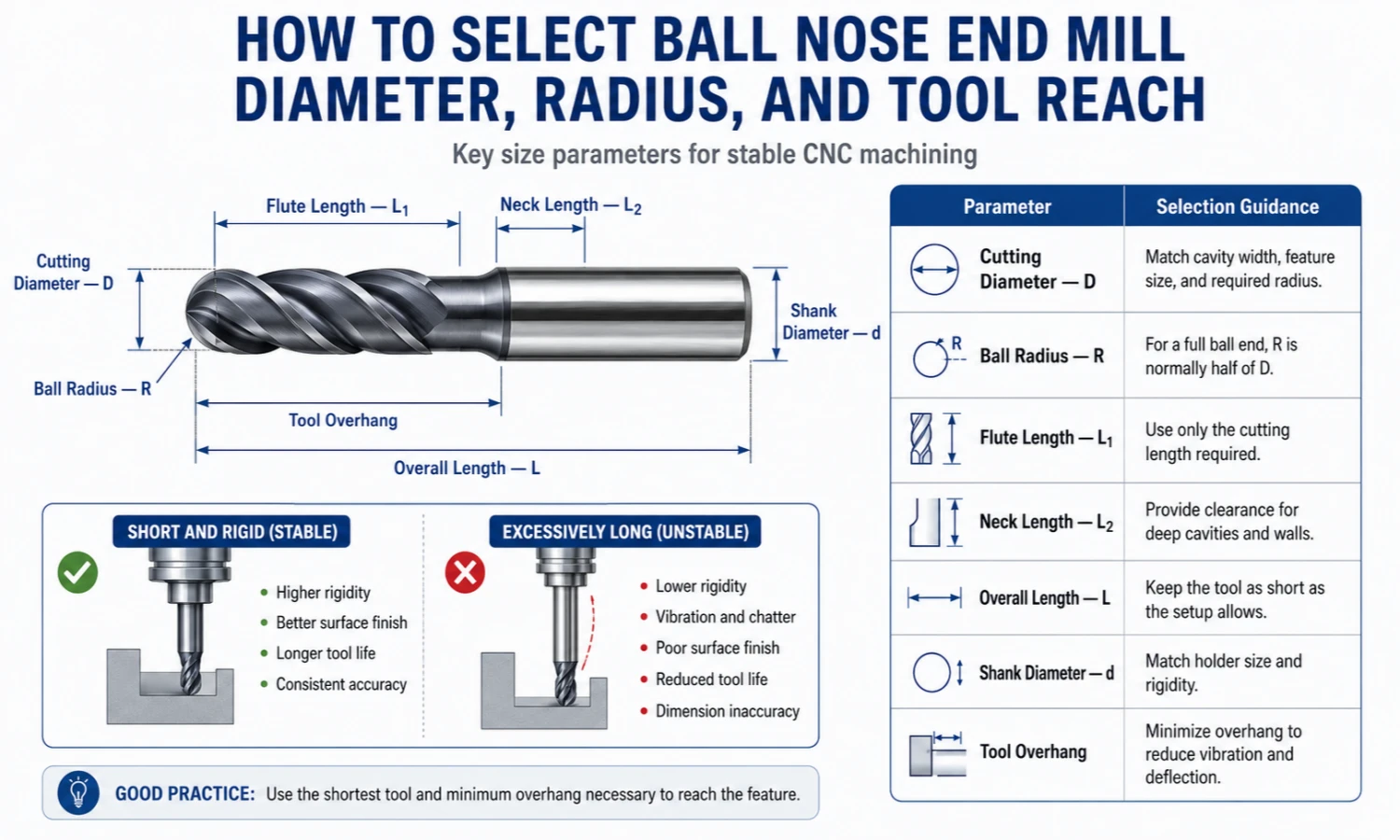
Cutting Diameter
Choose the diameter according to:
- Part radius
- Cavity width
- Detail size
- Surface curvature
- Available machining space
- Required productivity
Do not select a small cutter only because it can reach the feature. An unnecessarily small diameter may reduce rigidity and machining efficiency.
Flute Length and Neck Length
A longer flute can reach deeper cutting areas, but it also reduces tool strength.
For deep cavities, a relieved neck may provide clearance without requiring an excessively long cutting edge. Therefore, confirm both the flute length and neck length before ordering.
Overall Length and Overhang
Use the shortest practical overall length.
Excessive overhang can cause:
- Vibration
- Cutter deflection
- Poor surface finish
- Reduced tool life
- Dimensional variation
- Tool breakage
Machine rigidity and workpiece clamping should also support the selected reach.
4. Choose by Flute Count
Flute count affects chip evacuation, tool strength, feed capability, and surface finish.
| Flute Count | Best Starting Applications | Main Advantage |
| 2 Flutes | Aluminum, copper, graphite, and softer materials | More chip space |
| 3 Flutes | Aluminum and general CNC finishing | Balance of chip space and stability |
| 4 Flutes | Steel, stainless steel, and mold finishing | More cutting edges and greater stability |
| 5–6 Flutes | Selected finishing and hard-material applications | Higher edge count for controlled finishing |
| Custom Flutes | Special materials and custom operations | Geometry designed for the application |
A 2-flute design provides larger chip channels. Therefore, it often suits materials that create long or adhesive chips.
A 4-flute cutter provides more cutting edges. As a result, it may improve stability and surface quality in steel and mold finishing.
However, do not choose flute count only by habit. Cutter diameter, cutting depth, material hardness, machine rigidity, and chip evacuation must also be considered.
For a broader flute comparison, read 2 flute vs 4 flute vs 6 flute end mill.
5. Choose by Coating and Edge Treatment
Coatings can improve heat resistance, wear resistance, oxidation control, and tool life. However, the coating must match the workpiece material and cutting conditions.
| Coating or Treatment | Suitable Starting Applications | Main Benefit |
| TiAlN | Steel and general CNC machining | Wear and heat resistance |
| AlTiN | Harder materials and high-temperature cutting | Strong heat resistance |
| AlCrN | Steel, stainless steel, and stable dry machining | Oxidation and wear control |
| DLC | Aluminum, copper, and non-ferrous materials | Low friction and reduced adhesion |
| Polished Flutes | Aluminum and copper | Better chip flow |
| Uncoated Carbide | Selected aluminum and soft-material applications | Sharp cutting edges |
| Custom Coating | Special materials and production conditions | Application-specific performance |
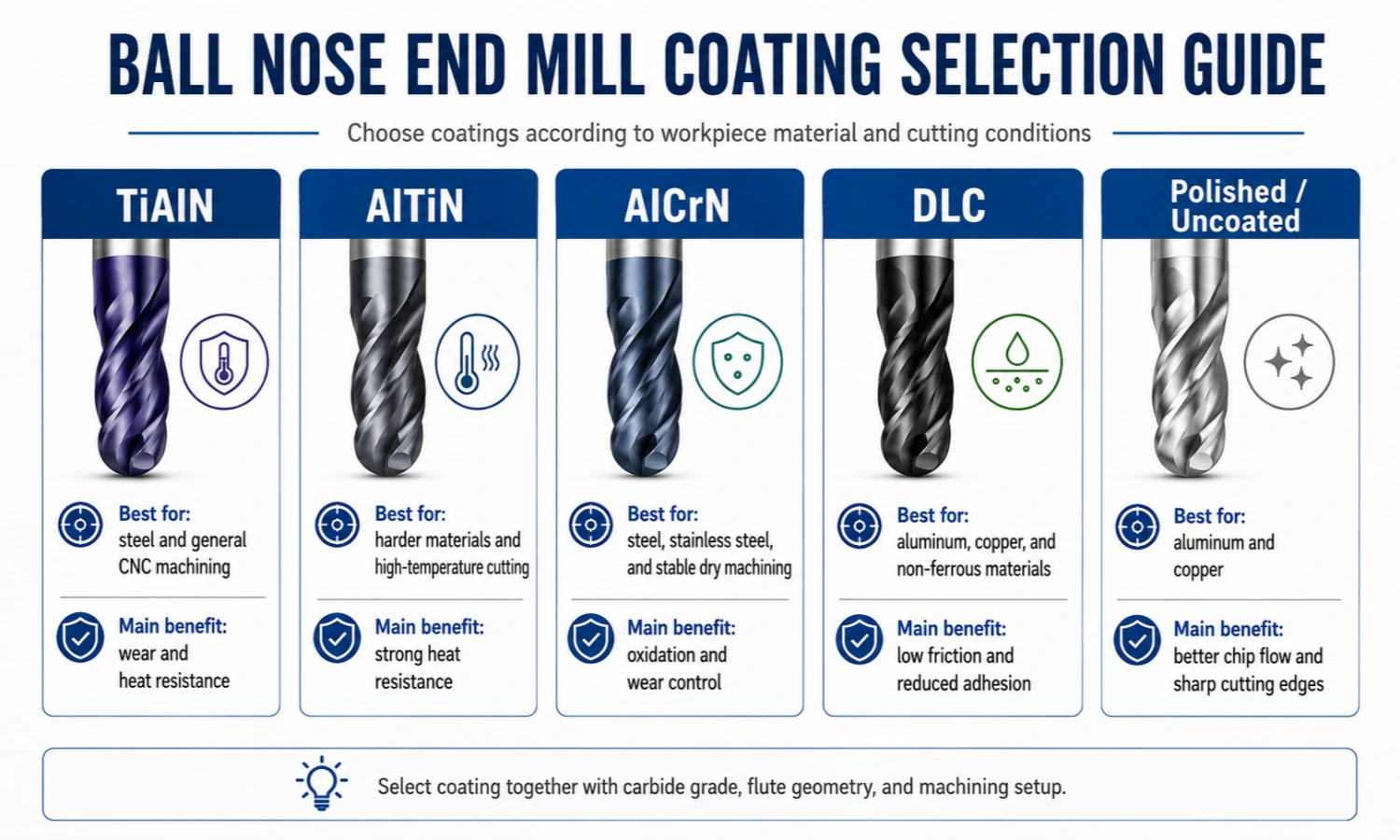
When machining aluminum and copper, polished flutes or DLC can help reduce friction and built-up edges.
Steel, stainless steel, and mold materials usually benefit from TiAlN, AlTiN, or AlCrN coatings because these options can improve heat resistance and wear control.
Graphite machining has different requirements. In this case, the selected coating should reduce abrasive wear while maintaining suitable edge sharpness.
However, coating alone cannot correct an unsuitable cutter geometry. Therefore, consider the carbide grade, flute design, edge preparation, and coating as a complete system.
6. Choose by Surface Finish Requirement
Surface finish is one of the main reasons machinists use a ball nose cutter. However, the cutter alone does not determine the final result.
You should also consider:
- Programmed step-over
- Feed rate
- Spindle speed
- Toolpath direction
- Tool runout
- Tool-holder condition
- Cutter overhang
- Machine rigidity
- Workpiece clamping
A smaller step-over normally reduces scallop height and creates a smoother surface. However, it also increases the number of tool passes and total machining time.
In addition, the center of the ball end has a lower effective cutting speed than the outer cutting edge. A suitable toolpath or slight tool inclination may reduce rubbing near the cutter center.
For precision finishing, runout and machine stability can matter as much as the cutter specification.
7. Check Machine and Tool-Holder Stability
Even a correctly selected cutter may perform poorly in an unstable setup.
Before machining, check:
- Spindle condition
- Tool-holder cleanliness
- Collet condition
- Tool runout
- Cutter overhang
- Workpiece clamping
- Machine rigidity
- Coolant or air-blast direction
Use the shortest practical tool reach and maintain a clean, accurate holder connection.
If vibration occurs, do not immediately assume that the cutter quality is the only cause. Tool length, runout, clamping, cutting parameters, and toolpath strategy should also be reviewed.
Ball Nose End Mill vs Bull Nose End Mill
A ball nose end mill has a fully rounded cutting end. Therefore, it works well for 3D contours, mold cavities, curved surface finishing, and freeform profiles.
A bull nose end mill has a flat center with rounded corners. As a result, it provides stronger edge support for semi-finishing, stepped profiles, and flat areas that require a corner radius.
For a detailed comparison, read bull nose end mill vs ball nose end mill.
Common Mistakes When Choosing a Ball Nose End Mill
Choosing the Wrong Coating
A coating intended for steel may not perform well in aluminum. Some coatings can increase material adhesion or built-up edges in non-ferrous applications.
Therefore, match the coating and flute surface to the workpiece material.
Using Too Much Tool Overhang
Long overhang reduces rigidity and can cause vibration, dimensional variation, poor surface finish, or premature tool wear.
Use a shorter tool or relieved-neck design whenever possible.
Ignoring Flute Count
A 2-flute and a 4-flute cutter do not perform in the same way.
One provides more chip space, while the other provides more cutting edges. Therefore, select the flute count according to the material and operation.
Ignoring Ball Radius and Neck Clearance
Selecting only by cutting diameter can create clearance or surface-finish problems.
Confirm:
- Ball radius
- Flute length
- Neck length
- Shank diameter
- Overall length
- Tool overhang
Using a Ball Nose Cutter for Flat-Bottom Machining
A rounded-end cutter does not efficiently create flat-bottom slots, pockets, or square shoulders.
For these operations, view our flat end mill product.
Selecting Only by Price
A lower tool price does not always mean a lower machining cost.
A poorly matched cutter may increase:
- Tool changes
- Machining time
- Polishing work
- Scrap risk
- Production interruptions
Compare the complete machining result rather than the cutter price alone.
When Should You Request a Custom Ball Nose End Mill?
A standard cutter may not provide the required reach, rigidity, clearance, or surface finish.
Custom production may be suitable when you need:
- Non-standard cutting diameter
- Special ball radius
- Extra-long reach
- Relieved-neck design
- Special shank diameter
- Non-standard flute count
- High-hardness material machining
- Special coating
- Tight dimensional tolerance
- OEM laser marking
- Private-label packaging
For custom evaluation, provide:
- Cutting diameter
- Ball radius
- Flute length
- Neck length
- Overall length
- Shank diameter
- Flute count
- Workpiece material
- Material hardness
- Coating requirement
- Quantity
- Drawing or sample
Already know your required dimensions and coating? View our custom ball nose end mills.
Final Selection Checklist
Before ordering, confirm:
- What material will be machined?
- What is the material hardness?
- Is the operation roughing, semi-finishing, or finishing?
- What cutting diameter and ball radius are required?
- How deep is the cavity?
- What flute length and neck length are required?
- Which flute count suits the material?
- Is a coating necessary?
- What surface finish is required?
- Can the machine and holder support the tool reach?
- Is a standard cutter suitable, or is a custom design required?
This checklist can reduce specification errors and improve quotation accuracy.
FAQ
How do I choose a ball nose end mill?
Choose the cutter according to the workpiece material, cutting diameter, ball radius, flute count, coating, machining depth, tool reach, machine rigidity, and required surface finish.
What flute count is best for a ball nose end mill?
The best flute count depends on the material and application. A 2-flute cutter offers more chip space, while a 4-flute cutter provides more cutting edges and may improve stability during steel machining and finishing.
Which coating is best for ball nose end mills?
TiAlN, AlTiN, or AlCrN may suit steel and high-temperature cutting. DLC or polished flutes often suit aluminum, copper, and other non-ferrous materials. The final selection depends on the exact material and machining conditions.
What diameter should I choose?
Choose a diameter that matches the cavity width, part radius, detail size, and required machining efficiency. Smaller diameters reach narrow areas, while larger diameters provide more rigidity.
How do I select the correct ball radius?
For a standard full ball-end cutter, the ball radius is normally half of the cutting diameter. However, always confirm the required part geometry and drawing before ordering.
Can a ball nose end mill machine aluminum?
Yes. A 2-flute or 3-flute design with sharp edges and polished flutes is a practical starting point. DLC coating may also reduce friction and built-up edges.
Should I choose a ball nose or bull nose end mill?
Choose a ball nose cutter for smooth 3D surfaces, curved profiles, and mold cavities. Choose a bull nose cutter for semi-finishing, stronger corner support, and flat areas with a corner radius.
Send Your Ball Nose End Mill Requirement
Still unsure how to choose a ball nose end mill for your CNC application?
Send your drawing, workpiece material, hardness, required diameter, ball radius, flute length, overall length, shank size, flute count, coating, and quantity. Our team will review the application and provide a suitable tool proposal and quotation.
Send your requirements to sales@cutterbest.com.