 Cortadores de fresagem de precisão,Ferramentas de corte para usinagem CNC de todos os materiais

Em um 2 flauta vs. 4 comparação de fresas de topo de flauta, a principal decisão é como equilibrar a evacuação de cavacos, contagem de ponta, suporte de ferramenta, e o resultado de usinagem necessário.
Uma fresa de dois canais é frequentemente preferida quando a remoção de cavacos é o principal desafio. Exemplos típicos incluem ranhuras de largura total, bolsos fechados, e usinagem de alto volume de cavacos em alumínio ou outros materiais não ferrosos.
Uma fresa de quatro canais é frequentemente selecionada quando os cavacos podem sair da zona de corte de forma confiável e a operação se beneficia de mais contatos de corte, maior suporte central, ou fresamento lateral estável e acabamento.
No entanto, a contagem de flautas não é o único fator de seleção. Diâmetro do cortador, profundidade da flauta, alcance da ferramenta, material da peça, revestimento, noivado, rigidez da máquina, e o fornecimento de refrigerante também afetam o resultado.
Resposta rápida
Use um 2-moinho de extremidade de flauta quando a operação cria um alto volume de cavacos ou restringe o escoamento de cavacos. É uma direção inicial comum para ranhuras de largura total, bolsos fundos, usinagem de alumínio, e outros cortes pesados.
Use um 4-moinho de extremidade de flauta quando o espaço para cavacos é suficiente e o processo se beneficia de mais arestas de corte. É comumente considerado para fresamento lateral, perfil, semi-acabamento, acabamento, e muitas aplicações de aço.
Nenhum dos designs é automaticamente melhor para cada trabalho. A escolha correta depende de onde o cortador está engatado, como os chips saem do corte, e se o espaço do chip, rigidez, produtividade, ou o acabamento é a principal prioridade.
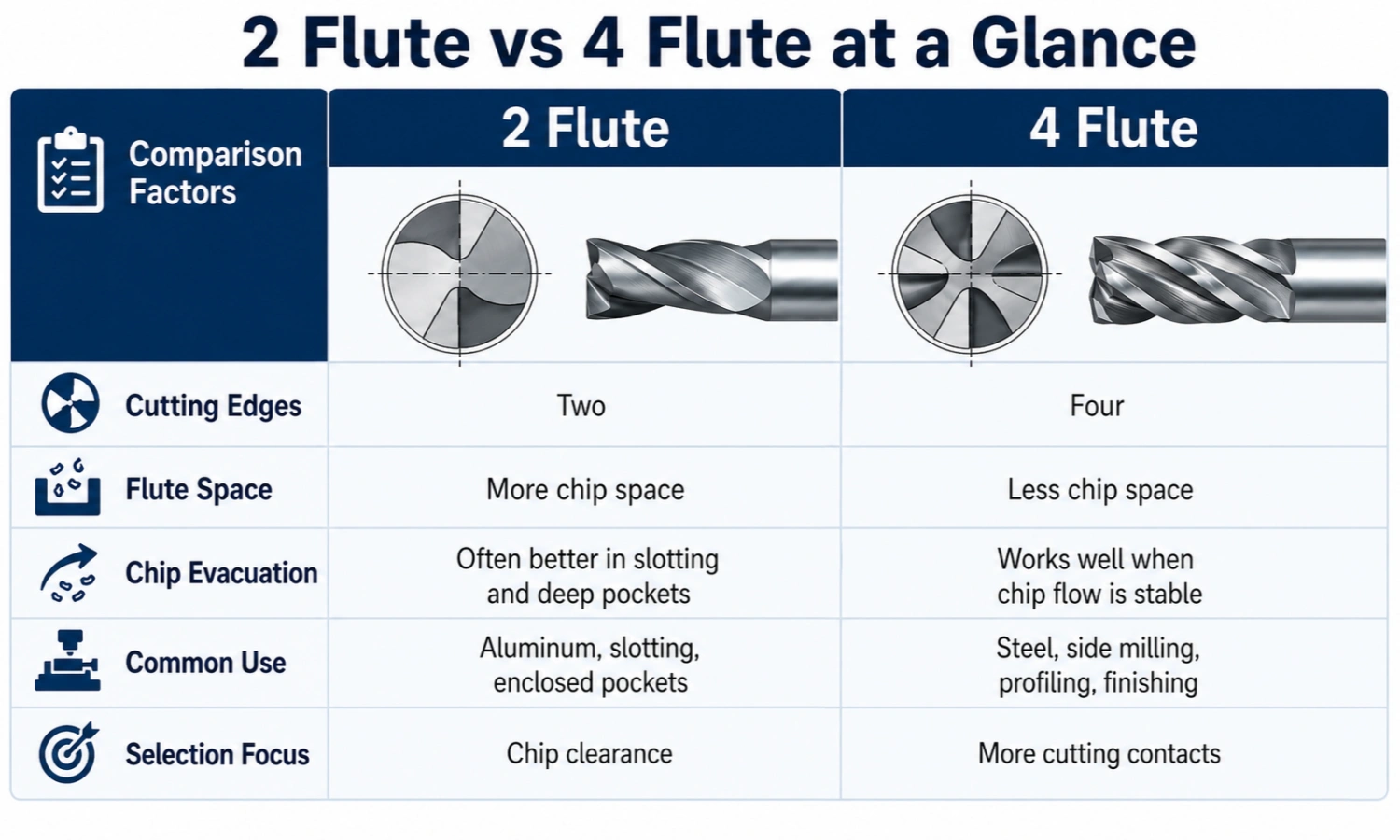
2 Flauta vs. 4 Visão geral da fresa de topo de flauta
| Fator | 2-Direção da Flauta | 4-Direção da Flauta |
|---|---|---|
| Arestas de corte | Duas arestas de corte | Quatro arestas de corte |
| Espaço Flauta | Mais espaço para fichas | Menos espaço entre as arestas de corte |
| Evacuação de chips | Frequentemente útil em cortes fechados ou com muitas lascas | Adequado quando os cavacos podem sair do corte de forma confiável |
| Suporte Principal | Depende da profundidade e geometria da flauta | Muitas vezes permite mais suporte central |
| Slot de largura total | Comum quando o volume do chip é alto | Requer folga adequada de cavacos |
| Fresamento lateral | Adequado quando o escoamento de cavacos continua importante | Frequentemente útil com engate radial mais leve |
| Acabamento de superfície | Pode produzir um bom acabamento em condições estáveis | Mais contatos de corte podem suportar acabamento |
| Direção de Materiais | Comum em cortes de alumínio e não ferrosos | Comum em muitas aplicações de aço e acabamento |
| Foco de seleção principal | Espaço de cavacos e evacuação | Contagem de ponta e suporte de ferramentas |
 Como a contagem de flautas altera o desempenho de corte
Espaço de flauta e evacuação de chips
Uma fresa tem espaço limitado entre suas arestas de corte e o núcleo.
Com duas flautas, uma parte maior do diâmetro da fresa normalmente pode ser alocada para as ranhuras do canal. Portanto, os cavacos têm mais espaço para se formar e se afastar da zona de corte.
Isto pode ser útil durante:
- Slots de largura total
- Fresamento de bolsões profundos ou fechados
- Usinagem de alumínio
- Usinagem de plástico
- Outras operações de alto volume de chips
Uma fresa de quatro canais tem mais arestas de corte dentro do mesmo diâmetro. Como resultado, as ranhuras individuais da flauta são frequentemente menores.
Isso não significa que uma ferramenta de quatro canais não possa evacuar cavacos. Em vez de, isso significa que o aplicativo deve fornecer espaço suficiente, refrigerante, ar, ou movimento do percurso para que os cavacos saiam do corte.
Arestas de corte e capacidade de alimentação
Uma fresa de dois canais tem dois contatos de corte por revolução, enquanto um cortador de quatro canais tem quatro.
Com a mesma velocidade do fuso e carga de cavacos por dente, a ferramenta de quatro canais exigiria um avanço programado mais alto porque mais arestas de corte entram no material durante cada rotação.
No entanto, esse avanço mais alto só é prático quando:
- A evacuação de cavacos permanece estável
- A potência da máquina é suficiente
- O engate da ferramenta é adequado
- O calor de corte é controlado
- A peça de trabalho e o suporte são rígidos
- A geometria da fresa corresponde ao material
Portanto, quatro canais não significam automaticamente usinagem mais rápida. Da mesma maneira, duas flautas não significam automaticamente menor produtividade.
O avanço utilizável depende das condições gerais de usinagem.
Suporte central e rigidez da ferramenta
Um design de quatro canais geralmente permite que mais material permaneça próximo ao núcleo da ferramenta. Isso pode fornecer maior suporte ao núcleo em alguns designs de fresa.
No entanto, a rigidez real também depende:
- Diâmetro do cortador
- Profundidade da flauta
- Comprimento da flauta
- Comprimento total da ferramenta
- Saliência da ferramenta
- Ângulo de hélice
- Classe de metal duro
- Condição do titular
Uma fresa curta de dois canais pode ser mais estável do que uma fresa longa de quatro canais do mesmo diâmetro. Por esta razão, a contagem de canais não deve ser usada como a única medida de rigidez da ferramenta.
Acabamento superficial e estabilidade de corte
Mais arestas de corte podem fornecer contatos de corte mais frequentes. Portanto, uma fresa de quatro canais pode suportar um acabamento consistente durante operações adequadas de fresamento lateral e acabamento.
No entanto, o acabamento superficial também depende:
- Excentricidade da ferramenta
- Qualidade de ponta
- Alimentação por dente
- Engajamento radial
- Deflexão da ferramenta
- Estabilidade da máquina
- Fixação da peça
- Estratégia de percurso
Uma fresa de dois canais bem selecionada ainda pode produzir uma superfície com bom acabamento, especialmente em alumínio e outros materiais não ferrosos.
Para uma explicação mais ampla do espaço da flauta, diâmetro do núcleo, ângulo de hélice, e seleção de contagem de flautas, leia nosso guia de seleção e projeto de canal de fresa de topo.
Quando usar uma fresa de topo de 2 canais
Slot de largura total
A abertura de canais em toda a largura envolve a fresa em todo o seu diâmetro. Consequentemente, a operação produz um alto volume de chips enquanto as paredes dos slots restringem os caminhos de saída de chips disponíveis.
Uma fresa de topo de dois canais é frequentemente considerada porque seus canais mais largos proporcionam mais espaço para cavacos.
O encaixe estável também depende de:
- Profundidade do slot
- Diâmetro do cortador
- Comprimento da flauta
- Saliência da ferramenta
- Fornecimento de ar ou refrigerante
- Rigidez da máquina
- Parâmetros de corte
Uma ranhura rasa e uma ranhura profunda não criam as mesmas condições de corte. Portanto, a ferramenta e a estratégia de corte devem corresponder ao recurso real.
Bolsos profundos ou fechados
Os cavacos podem permanecer dentro de um bolsão profundo ou fechado em vez de sair da zona de corte.
Quando os chips são recortados, o calor de corte e a carga da ferramenta podem aumentar. Marcas de superfície, borda construída, e danos iniciais nas bordas também podem se desenvolver.
Uma fresa de dois canais pode fornecer folga de cavacos útil nessas aplicações. No entanto, profundidade do bolso, método de entrada, engajamento lateral, alcance da ferramenta, e o acesso ao refrigerante ainda deve ser revisado.
Usinagem de Alumínio e Não Ferrosos
Muitas ligas de alumínio produzem cavacos relativamente grandes ou contínuos. Cobre, latão, e plásticos selecionados também podem exigir remoção confiável de cavacos.
Para esses materiais, uma ferramenta de dois canais pode usar:
- Arestas de corte afiadas
- Superfícies de flauta lisas ou polidas
- Espaço adequado para flauta
- Preparação de bordas específica para aplicação
- Ar confiável, névoa, ou entrega de refrigerante
Um design de dois canais não é a única opção para o alumínio. Fresas de três canais e de quatro canais específicas para aplicações também podem funcionar bem em determinadas condições de fresamento lateral ou acabamento.
A seleção deve ser baseada na operação e não apenas no nome do material.
Outras operações pesadas em chips
As ferramentas de dois canais também podem suportar aplicações de desbaste leve e abertura de canais em aços selecionados quando o escoamento de cavacos é difícil.
A questão chave é:
A operação cria mais cavacos do que o espaço disponível do canal pode remover de forma confiável??
Se a resposta for sim, uma contagem de canais mais baixa pode fornecer uma direção inicial útil.
Para exemplos detalhados de aplicações de dois canais, ler que 2 A fresa de topo de flauta é usada para.
Veja nosso padrão e personalizado carboneto sólido 2 moinho de extremidade de flauta opções.
Quando usar uma fresa de topo de 4 canais
Fresamento lateral e perfilamento
Durante o fresamento lateral, apenas parte do diâmetro da fresa pode engatar na peça de trabalho. Os chips geralmente têm mais espaço aberto para deixar do que durante o slot de largura total.
Nesta situação, uma ferramenta de quatro flautas pode fornecer:
- Mais contatos de corte
- Maior suporte central em muitos designs
- Corte radial estável
- Perfil consistente
- Maior produtividade em condições adequadas
No entanto, o engate radial deve permanecer apropriado. O envolvimento lateral pesado ainda pode criar calor, deflexão, e problemas de controle de chip.
Semiacabamento e Acabamento
Fresas de quatro canais são comumente usadas para semiacabamento e acabamento porque a operação geralmente cria um volume de cavaco menor do que o desbaste em largura total.
Mais contatos de corte podem suportar:
- Acabamento de parede consistente
- Fresamento de contorno estável
- Perfil mais suave
- Maior avanço programado sob condições adequadas
Ainda, uma ferramenta de quatro canais não garante uma superfície melhor.
Acabar, alimentação por dente, qualidade de borda, percurso, engate radial, e a rigidez da máquina continuam importantes.
Aplicações em aço e aço inoxidável
As fresas de topo de quatro canais são amplamente utilizadas para muitas operações de usinagem de aço e aço inoxidável.
Nestes materiais, a ferramenta pode se beneficiar:
- Maior suporte central
- Mais arestas de corte
- Revestimento adequado
- Engate radial controlado
- Condições estáveis de máquinas e acessórios
No entanto, a categoria do material por si só não determina a contagem de flautas.
Por exemplo, O canal de largura total em aço ainda pode exigir dois ou três canais quando o escoamento de cavacos é limitado. O aço inoxidável também requer um controle cuidadoso do calor de corte, endurecimento por trabalho, revestimento, e resistência da borda.
Operações com evacuação estável de chips
Uma fresa de quatro canais torna-se mais prática quando os cavacos podem sair da zona de corte sem se acumularem ao redor da ferramenta.
Isto pode ocorrer durante:
- Fresamento lateral
- Perfil superficial
- Acabamento de bolso aberto
- Semiacabamento
- Cortes radiais leves
- Operações com refrigeração eficaz ou fornecimento de ar
Quando o espaço no chip não é mais a principal limitação, contagem de ponta e suporte de ferramentas podem receber maior prioridade.
2 Flauta vs. 4 Flauta por Material da Peça
A tabela a seguir mostra direções iniciais comuns em vez de regras fixas.
| Material | Direção inicial comum | O que pode mudar a escolha |
|---|---|---|
| Alumínio | Duas ou três canais para cortes com muitas lascas | Fresamento lateral, acabamento, grau de liga e refrigerante |
| Cobre | Dois canais para remoção de cavacos | Grau de cobre, controle de rebarbas e acabamento |
| Latão | Duas ou mais flautas podem funcionar | Grau de latão, forma de cavaco e operação de usinagem |
| Plásticos | Uma ou duas flautas são comuns | Tipo de plástico, requisitos de calor e borda de corte |
| Aço | Quatro flautas são comuns | Slot completo, diâmetro da ferramenta, revestimento e profundidade |
| Aço inoxidável | Quatro flautas atendem a muitas operações | Endurecimento por trabalho, noivado, refrigeração e resistência da borda |
| Ferro fundido | Várias contagens de flauta podem funcionar | Abrasividade, corte a seco, poeira e operação |
| Compostos Selecionados | É necessária uma fresa específica para a aplicação | Estrutura material, abrasividade e qualidade da borda |
Esta tabela deve ser usada como guia inicial. A decisão final também deve refletir o diâmetro da ferramenta, profundidade de corte, condição da máquina, e acabamento necessário.
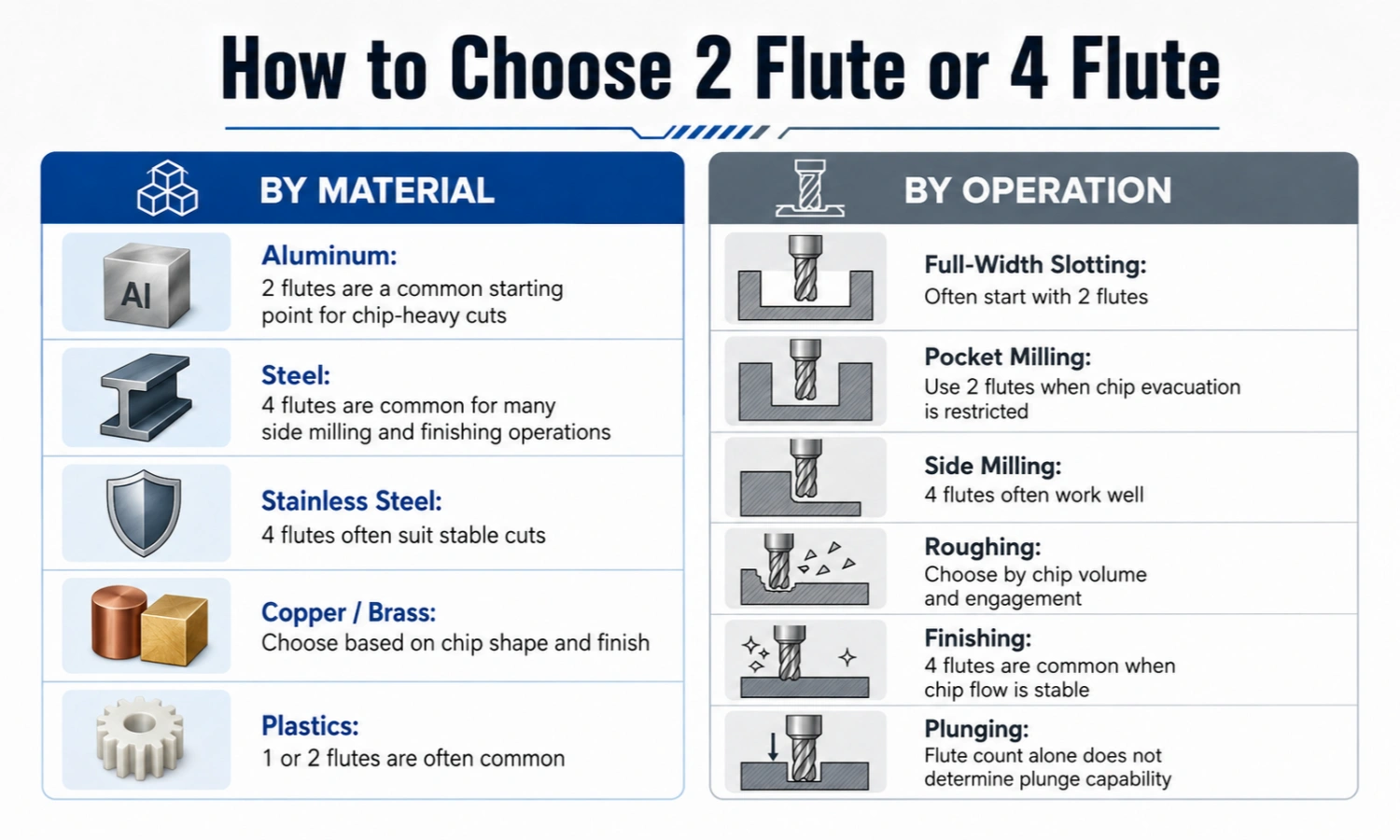
2 Flauta vs. 4 Flauta por operação CNC
Entalhamento
Para ranhuras de largura total, dois canais costumam ser um ponto de partida prático porque a operação produz um alto volume de cavacos e restringe o movimento dos cavacos.
Uma fresa de quatro canais ainda pode executar canais rasos ou controlados quando:
- O slot não é profundo
- A evacuação de cavacos é confiável
- O material produz chips gerenciáveis
- Os parâmetros de corte estão ajustados corretamente
Quanto mais profundo e fechado o slot se torna, o espaço da flauta mais importante geralmente se torna.
Fresamento de Bolso
O fresamento de bolsão inclui o movimento de entrada e o caminho subsequente de remoção de material.
Um cortador de dois canais pode ser adequado para bolsões profundos ou fechados onde o empacotamento de cavacos é uma preocupação. Uma fresa de quatro canais pode ser adequada para engate lateral ou acabamento após a abertura do bolsão principal.
Portanto, um bolsão pode envolver diferentes requisitos de contagem de canais durante diferentes estágios da operação.
Fresamento lateral e perfilamento
Para fresamento lateral, o escoamento de cavacos é muitas vezes menos restrito do que no canal de largura total.
Quatro canais podem suportar mais contatos de corte e perfil estável. No entanto, dois canais ainda podem funcionar bem ao usinar alumínio, plásticos, ou outros materiais que se beneficiem de espaço adicional para cavacos.
A seleção deve refletir o engate radial, acabamento necessário, e rigidez da ferramenta.
Desbaste
O desbaste não significa automaticamente que são necessários dois canais.
O desbaste em toda a largura ou com alto volume de cavacos pode se beneficiar com menos canais. Em contraste, desbaste lateral com engate radial controlado pode usar três, quatro, ou mais arestas de corte.
Fresas de topo dedicadas para desbaste também podem usar quebra-cavacos ou geometria serrilhada. Portanto, eles não devem ser selecionados apenas pela contagem de flautas.
Acabamento
Fresas de quatro canais são comuns no acabamento porque o volume de cavacos geralmente é menor e mais contatos de corte podem melhorar a continuidade da usinagem.
No entanto, a contagem de flautas não pode compensar:
- Excesso excessivo
- Fixação instável
- Alimentação incorreta por dente
- Longo balanço da ferramenta
- Percurso ruim
- Arestas de corte desgastadas
Uma fresa de dois canais também pode produzir um bom acabamento superficial quando combina com o material e as condições de corte..
Mergulho e Rampa
A contagem de canais não determina se uma fresa de topo pode mergulhar.
As fresas de dois e quatro canais podem ser fabricadas com geometria de corte central ou não central. Antes de programar o mergulho direto, rampa, ou entrada helicoidal, confirme se as arestas de corte finais e o design da ferramenta suportam o movimento necessário.
Para orientação detalhada, ler você pode mergulhar com uma fresa de topo.
Lista de verificação de seleção rápida
Antes de escolher entre duas e quatro flautas, confirmar:
- Que material você está usinando?
- A operação é abertura de canais em largura total ou fresamento lateral?
- Quanto volume de chips será produzido?
- A evacuação de cavacos é restrita?
- O bolso é profundo ou fechado?
- O acabamento superficial é mais importante que o espaço da flauta??
- Quanto tempo dura o balanço da ferramenta?
- A configuração da máquina e do acessório é rígida??
- O líquido refrigerante ou o ar podem atingir a zona de corte?
- A operação requer geometria de corte central?
- A fresa foi projetada para desbaste, semi-acabamento, ou acabamento?
Escolha duas canais quando o espaço para cavacos for a principal limitação.
Escolha quatro canais quando o escoamento de cavacos for estável e o processo se beneficiar de mais contatos de corte ou maior suporte do núcleo.
Para uma comparação mais ampla de contagem de flautas, ler comparar 2, 4, e 6 fresas de topo de flauta.
Perguntas frequentes sobre 2 Flauta vs. 4 Fresas de topo de flauta
Qual é a principal diferença entre 2 e 4 Fresas de topo de flauta?
A principal diferença é o equilíbrio entre o espaço da flauta e a contagem de ponta.
Uma fresa de dois canais normalmente oferece mais espaço para cavacos. Uma fresa de quatro canais fornece mais arestas de corte e muitas vezes permite maior suporte do núcleo.
O desempenho real ainda depende da geometria completa da ferramenta e das condições de usinagem.
É 2 Flauta ou 4 Flauta Melhor para Alumínio?
Duas canais são uma escolha comum para ranhuras de alumínio, embolsar, e outros cortes de alto volume de chips.
No entanto, uma fresa de alumínio com quatro canais pode funcionar bem durante o fresamento lateral ou acabamento quando sua geometria fornece folga adequada para cavacos.
A operação é tão importante quanto o material.
Uma fresa de topo de 4 canais é boa para aço?
Sim. Fresas de topo de quatro canais são comumente usadas para fresamento lateral, semi-acabamento, e acabamento em aço.
No entanto, canais em toda a largura ou cortes profundos podem exigir menos canais quando o escoamento de cavacos se torna difícil.
Revestimento, geometria do cortador, rigidez, e as condições de corte também devem corresponder ao tipo de aço.
Uma fresa de topo de 4 canais pode cortar alumínio?
Sim. Uma fresa de quatro canais pode usinar alumínio quando sua geometria de canal, preparação de borda, e as condições de corte são adequadas ao material.
Pode ser útil para fresamento lateral ou acabamento mais leve. Para canais profundos ou remoção pesada de cavacos, menos flautas são geralmente mais fáceis de gerenciar.
Qual contagem de flautas é melhor para ranhuras de largura total?
Duas canais são frequentemente preferidas porque o slot de largura total produz um alto volume de cavacos e limita os caminhos de saída dos cavacos.
No entanto, uma fresa de quatro canais pode trabalhar em canais rasos quando o escoamento de cavacos permanece estável e os parâmetros de corte são adequados.
O que é melhor para fresamento lateral?
Quatro canais são frequentemente úteis para fresamento lateral porque os cavacos têm mais espaço aberto para deixar, enquanto as arestas de corte adicionais podem apoiar a produtividade e o acabamento.
No entanto, duas flautas ainda podem ser preferidas em alumínio, plásticos, ou outras aplicações onde a eliminação de cavacos continua importante.
Uma fresa de topo de 4 canais sempre oferece um acabamento melhor?
Não. Mais arestas de corte podem ajudar em algumas operações de acabamento, mas não garantem uma superfície melhor.
Acabar, qualidade de borda, alimentação por dente, engate radial, deflexão da ferramenta, estabilidade da máquina, e percurso também afetam o resultado.
Uma fresadora de topo de 2 canais pode ser de aço inoxidável?
Alguns cortadores de dois canais podem usinar aço inoxidável, particularmente durante abertura de canais ou operações onde o escoamento de cavacos é restrito.
No entanto, o aço inoxidável também requer uma classe de metal duro adequada, revestimento, resistência da borda, estratégia de refrigeração, e controle do endurecimento por trabalho.
A aplicação exata deve ser revisada.
A contagem de flautas determina a capacidade de mergulho?
Não. A capacidade de mergulho depende da geometria final, especialmente se o cortador tiver bordas de corte central.
Uma ferramenta de dois ou quatro canais pode ser de corte central ou de corte não central.
Sempre confirme a especificação da ferramenta antes da entrada axial.
Guias Relacionados
Para mais informações, ler:
Carboneto sólido 2 moinho de extremidade de flauta
O que é um 2 fresa de topo de flauta usada para?
Você pode mergulhar com uma fresa de topo?
Comparar 2, 4, e 6 fresas de topo de flauta
Projeto e seleção do canal da fresa de topo
Precisa de ajuda para escolher 2 ou 4 Flautas?
Envie-nos o material da sua peça, operação de usinagem, tamanho do cortador, profundidade de corte, alcance da ferramenta, desenho, modelo de referência, e quantidade necessária quando disponível.
Analisaremos as informações e ajudaremos a identificar se o espaço do chip, contagem de ponta, suporte de ferramenta, ou requisitos de superfície devem receber maior prioridade.
E-mail: sales@cutterbest.com