 Cortadores de fresagem de precisão,Ferramentas de corte para usinagem CNC de todos os materiais

Você pode mergulhar com uma fresa de topo? Sim, mas a fresa deve ter geometria de corte central, e o material, profundidade de entrada, evacuação de cavacos, e a configuração da máquina deve ser adequada.
Um projeto de 2 canais geralmente oferece mais espaço para cavacos do que uma fresa de canal mais alto. Portanto, pode suportar entrada de mergulho controlada em alumínio, latão, cobre, plásticos selecionados, e outras aplicações onde o escoamento de cavacos é importante.
No entanto, dois canais não tornam automaticamente uma fresa de topo adequada para entrada vertical. Para bolsos fundos, materiais difíceis, ou configurações instáveis, rampa, entrada helicoidal, ou a pré-perfuração geralmente fornece melhor controle.
O que significa mergulho em fresamento CNC?
Mergulhar significa alimentar uma fresa de topo na direção axial, diretamente em direção à peça de trabalho. Durante este movimento, a fresa deve remover o material próximo ao seu centro enquanto os cavacos saem pelos canais.
Isso difere do fresamento lateral, onde as arestas de corte removem principalmente material da lateral da ferramenta. O mergulho reto cria uma carga axial maior e proporciona menos espaço para os cavacos escaparem da parte inferior do corte.
Como resultado, a geometria da fresa e o método de entrada tornam-se especialmente importantes.
Os métodos típicos de entrada axial incluem:
- Mergulho direto
- Rampando
- Entrada helicoidal
- Pré-perfuração seguida de fresagem
Cada método cria diferentes cargas de corte e condições de fluxo de cavacos.
Você consegue mergulhar com uma fresa de topo com segurança?
Uma fresa de topo pode mergulhar com segurança quando as seguintes condições forem atendidas:
- A ferramenta possui geometria de corte central
- A entrada é rasa e controlada
- Os cavacos podem sair da zona de corte
- O balanço da ferramenta é limitado
- A configuração da máquina e da peça é estável
- O avanço axial corresponde à fresa específica
- O material se adapta à geometria e ao revestimento da ferramenta
A questão mais importante não é simplesmente se a fresa tem dois ou quatro canais..
Em vez de, confirmar:
As arestas de corte finais podem remover material no centro da ferramenta?
Se a resposta for não, o cortador não deve ser alimentado diretamente em material sólido.
Fresas de topo com corte central versus fresas de topo sem corte central
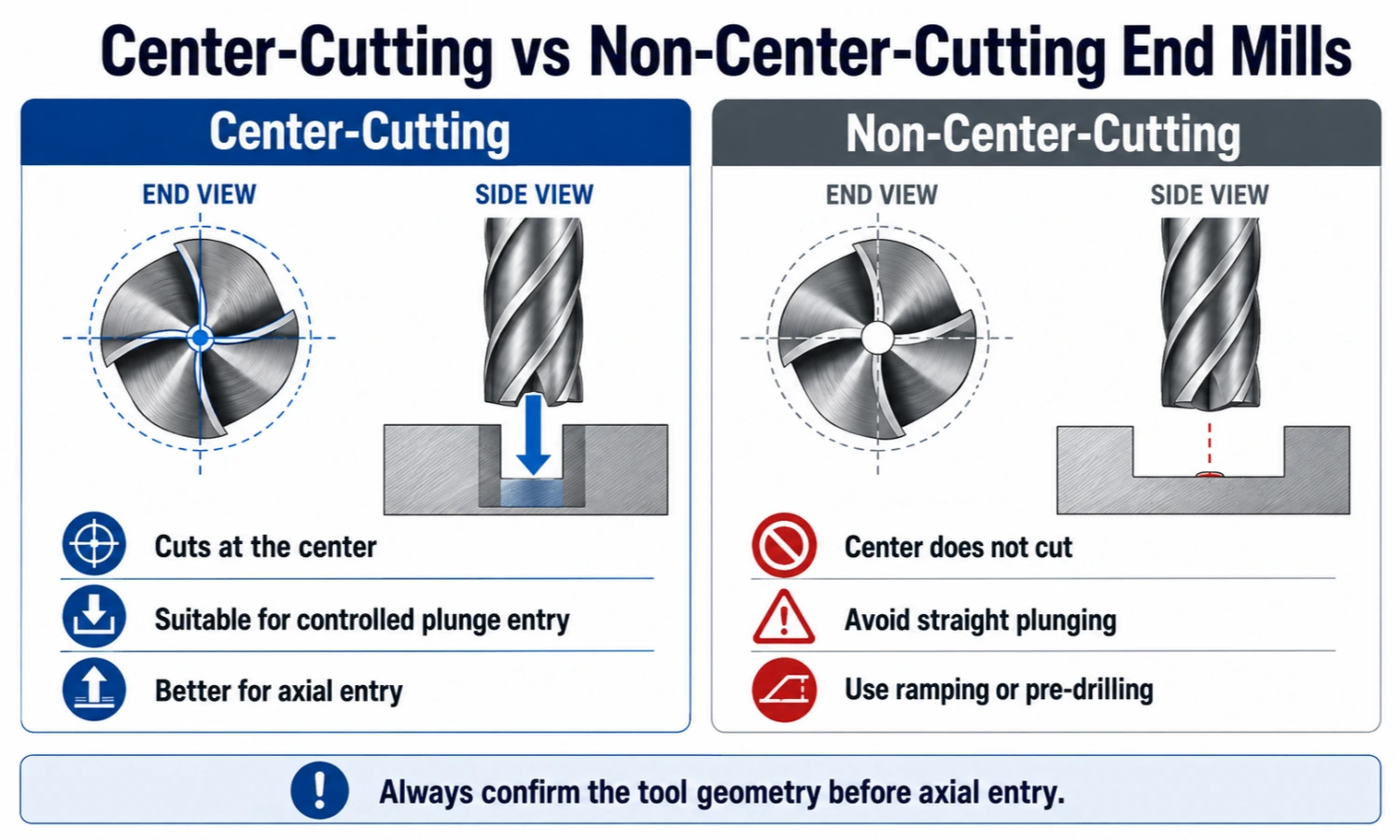
O que é uma fresa de corte central?
Uma fresa de topo com corte central possui arestas de corte que alcançam ou cruzam a área central da ferramenta.
Esta geometria permite que a fresa remova material próximo ao seu centro de rotação. Portanto, pode suportar certas operações de entrada axial, incluindo mergulho reto controlado, rampa, ou entrada helicoidal.
Uma fresa de topo com corte central ainda deve ser usada dentro dos limites de seu projeto específico. Isso não significa que a ferramenta possa ser usada como uma broca para qualquer profundidade, material, ou taxa de alimentação.
Por que uma fresa de topo sem corte central não consegue mergulhar diretamente para baixo
Uma fresa de topo sem corte central não possui uma aresta de corte efetiva no centro da ferramenta.
Se esta ferramenta for alimentada verticalmente em material sólido, o centro pode esfregar em vez de cortar. Isto pode causar:
- Calor excessivo
- Alta carga axial
- Conversa
- Lascas de borda
- Deflexão da ferramenta
- Baixa precisão de entrada
- Falha prematura da ferramenta
Uma ferramenta de corte não central ainda pode realizar fresamento lateral ou inserir um furo existente. No entanto, não deve ser usado para mergulhar diretamente em material sólido.
Como confirmar a geometria do corte central
Não identifique a capacidade de corte central apenas pela contagem de canais.
Em vez de, verificar:
- A especificação do produto
- O desenho da ferramenta
- Uma fotografia nítida da geometria final
- Se as arestas de corte finais alcançam o centro
- As instruções de aplicação do fabricante
- Confirmação do fornecedor da ferramenta
Algumas fresas de topo de dois e quatro canais têm geometria de corte central, enquanto outros não.
Por que um design de 2 flautas pode ajudar na entrada de mergulho
Mais espaço para chips
Uma fresa de topo de 2 canais normalmente possui canais de canais mais largos do que uma fresa com mais canais.
O espaço adicional pode ajudar os cavacos a se afastarem do centro do corte. Isto é importante porque os cavacos têm menos caminhos de saída durante a entrada axial do que durante o fresamento lateral aberto..
Se os cavacos permanecerem abaixo da ferramenta, eles podem ser recortados ou comprimidos contra a peça de trabalho. O calor e a pressão de corte podem então aumentar rapidamente.
Evacuação de cavacos em materiais macios
Alumínio, latão, cobre, e alguns plásticos podem produzir cavacos relativamente grandes ou contínuos.
Uma fresa afiada de 2 canais com espaço adequado pode ajudar a reduzir:
- Embalagem de chips
- Borda construída
- Recorte
- Acúmulo de calor
- Danos de ponta
Ar, névoa, ou refrigerante adequado também pode ajudar a afastar os cavacos da área de corte.
O que a contagem de flautas não pode lhe dizer
A contagem de flautas por si só não confirma:
- Capacidade de corte central
- Uma alimentação de mergulho segura
- Profundidade máxima de entrada
- Adequação para materiais duros
- Método de refrigeração necessário
- Rigidez da ferramenta
- Balanço máximo da ferramenta
O projeto completo da fresa deve ser revisado.
Para mais informações sobre o espaço da flauta, diâmetro do núcleo, comprimento da flauta, e evacuação de cavacos, leia nosso guia de seleção de canal de fresa de topo.
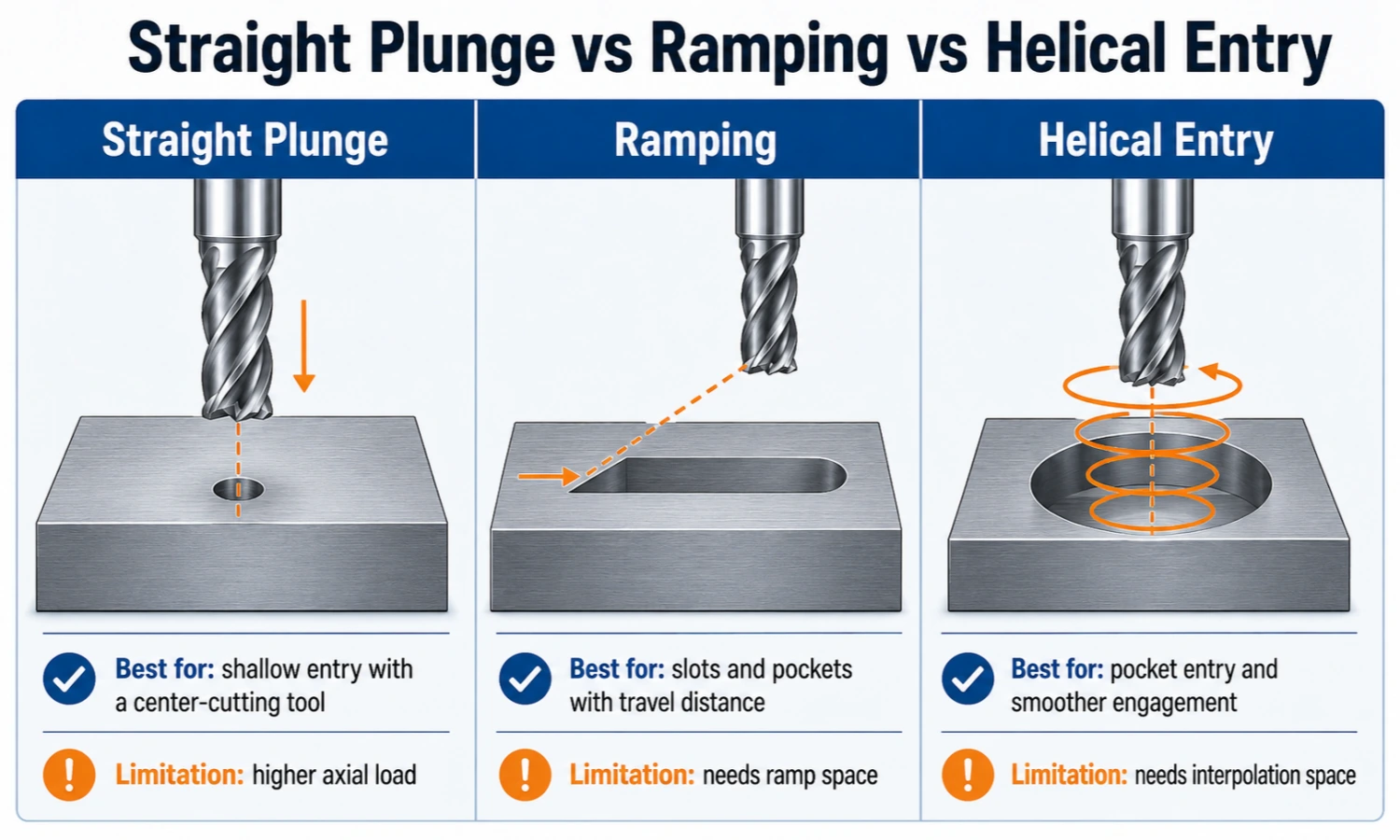
Mergulho Reto vs Rampa vs Entrada Helicoidal
O método de entrada mais seguro depende do recurso, espaço disponível no percurso, material, e design de cortador.
| Método de entrada | Situação adequada | Principal vantagem | Limitação Principal |
|---|---|---|---|
| Mergulho Reto | Entrada rasa com uma ferramenta de corte central | Percurso curto e direto | Maior carga axial e evacuação limitada de cavacos |
| Rampando | Slots e bolsos com distância de viagem disponível | Reduz a carga axial direta | Requer distância de rampa suficiente |
| Entrada helicoidal | Entrada de bolso e aberturas maiores | Engate suave e melhor fluxo de cavacos | Requer espaço de interpolação |
| Pré-perfuração | Entrada axial profunda ou difícil | Remove o material central antes do fresamento | Adiciona outra operação de usinagem |
Quando o mergulho reto é aceitável
O mergulho reto pode ser adequado quando:
- O cortador é de corte central
- A entrada é rasa
- O material é fácil de usinar
- O balanço da ferramenta é curto
- A evacuação de cavacos permanece estável
- O fornecedor da ferramenta permite entrada axial
A entrada direta deve ser controlada em vez de agressiva.
Quando a rampa é a melhor escolha
A rampa combina movimento axial e horizontal.
Porque a fresa se move lateralmente ao entrar no material, a carga de corte é distribuída mais gradualmente do que durante um mergulho reto.
A rampa é frequentemente útil para:
- O slot começa
- Entrada de bolso
- Caminhos de entrada mais longos
- Aplicações onde o mergulho reto cria carga excessiva
O ângulo de rampa e o avanço devem corresponder à fresa e ao material específicos.
Quando usar entrada helicoidal
A entrada helicoidal move a fresa em um caminho circular enquanto avança gradualmente para baixo.
Este método pode melhorar o engate e o escoamento de cavacos porque a fresa não permanece concentrada em um ponto central.
A entrada helicoidal geralmente é adequada para:
- Fresamento de bolso
- Aberturas maiores
- Entrada mais profunda
- Materiais que geram calor durante o mergulho direto
- Aplicativos que exigem entrada mais suave
O bolsão deve fornecer espaço suficiente para o percurso helicoidal.
Quando a pré-perfuração é mais segura
A pré-perfuração remove o material central antes que a fresa de topo entre.
Pode ser útil quando:
- A entrada necessária é profunda
- O material é difícil de usinar
- A fresa de topo selecionada não é adequada para mergulho direto
- A evacuação de cavacos é restrita
- Um furo convencional já faz parte do processo de usinagem
A pré-perfuração adiciona outra ferramenta e operação, mas pode reduzir o risco de danificar a fresa final.
Quando uma fresa de topo de 2 canais pode mergulhar?
Use esta lista de verificação antes de usinar:
- Confirme se o cortador está cortando centralmente
- Verifique se o material corresponde à ferramenta
- Mantenha a primeira entrada superficial e controlada
- Use um avanço axial adequado para a fresa específica
- Certifique-se de que os chips possam sair da parte inferior do corte
- Mantenha o balanço da ferramenta o mais curto possível
- Verifique a condição e o desvio do suporte
- Prenda a peça de trabalho com segurança
- Ar direto, névoa, ou refrigerante em direção à área de entrada
- Pare se a ferramenta esfregar em vez de cortar
Materiais macios e inícios de bolsões rasos são geralmente mais fáceis do que a entrada axial profunda em materiais resistentes ao calor.
No entanto, o resultado real ainda depende do diâmetro da fresa, geometria da borda, classe de metal duro, revestimento, rigidez da máquina, e percurso.
Quando o mergulho reto deve ser evitado?
Ferramenta de corte não central
Não alimente verticalmente uma fresa de topo sem corte central em material sólido.
Use um furo existente, pré-perfuração, rampa, entrada helicoidal, ou outro cortador adequado.
Entrada Axial Profunda
O mergulho profundo torna a evacuação de cavacos mais difícil. Os cavacos podem permanecer abaixo da ferramenta e aumentar o calor ou a pressão de corte.
Rampando, entrada helicoidal, ou a entrada passo a passo pode fornecer melhor controle.
Materiais duros ou resistentes ao calor
Materiais mais duros ou resistentes ao calor podem aumentar a carga axial, aquecer, e estresse de ponta.
Não presuma que mudar de duas flautas para quatro flautas resolverá automaticamente o problema. Revise a série de cortadores, classe de metal duro, revestimento, método de entrada, e condição do líquido refrigerante.
Longo balanço da ferramenta
O balanço longo aumenta o risco de deflexão e trepidação.
Use a ferramenta prática e o comprimento de canal mais curtos. Além disso, melhorar a rigidez do suporte e da peça antes de aumentar a carga axial.
Má evacuação de chips
O mergulho reto deve ser interrompido quando os cavacos permanecerem dentro do bolsão ou começarem a envolver a ferramenta.
Melhorar o fornecimento de ar ou refrigerante, reduzir a profundidade de entrada, ou mude para um método de entrada diferente.
Configuração instável da máquina ou da peça
Um titular instável, pinça gasta, luminária fraca, ou máquina de baixa rigidez pode causar vibração durante a entrada.
Corrija a configuração antes de alterar a contagem de canais ou aumentar o avanço.
Práticas iniciais seguras para entrada em mergulho
A rotação correta, alimentação axial, e a profundidade de entrada dependem da fresa exata e das condições de usinagem. Portanto, um parâmetro fixo não pode ser aplicado a cada fresa de topo de 2 canais.
Use as seguintes práticas iniciais:
- Confirme a geometria de corte central antes de usinar.
- Comece com um avanço axial inferior ao avanço do fresamento lateral.
- Mantenha a entrada inicial superficial.
- Usar ar, névoa, ou refrigerante adequado para limpar cavacos.
- Mantenha a extensão do cortador curta.
- Ouça esfregando, batendo, ou sons de corte instáveis.
- Observe o formato do cavaco e a carga do fuso.
- Inspecione a aresta de corte após o primeiro corte de teste.
- Mude para rampa ou entrada helicoidal quando o mergulho reto estiver instável.
Os cortes de teste devem ser feitos em condições controladas antes da produção total.
Problemas e soluções comuns de corte por imersão
| Problema | Possível causa | Direção de ajuste |
|---|---|---|
| A ferramenta esfrega no centro | Geometria de corte não central | Use uma ferramenta de corte central ou outro método de entrada |
| Pacote de chips dentro do bolso | A entrada é muito profunda ou o escoamento de cavacos é fraco | Reduza a profundidade de entrada e melhore o fornecimento de ar ou líquido refrigerante |
| Conversa durante a entrada | Longa saliência, acabar, ou fixação instável | Reduza o balanço e melhore a rigidez do suporte ou do acessório |
| Borda construída em alumínio | Fraco fluxo de cavacos, bordas opacas, ou condição de superfície inadequada | Use geometria nítida e melhore o escoamento de cavacos |
| Danos iniciais na borda | Avanço axial excessivo ou material inadequado | Reduza o avanço axial ou use rampa |
| Calor excessivo | Longo tempo de contato ou acesso deficiente ao refrigerante | Usar entrada helicoidal, rampa, ou pré-perfuração |
| A ferramenta entra de forma desigual | Geometria final incorreta ou configuração instável | Confirme o corte central e inspecione o desvio |
| Baixa precisão inferior | Desvio da ferramenta ou método de entrada inadequado | Melhore a rigidez e revise a geometria da fresa |
Um problema pode ter mais de uma causa. Portanto, inspecione a configuração completa antes de substituir o cortador.
2 Flauta vs. 4 Flauta para entrada de mergulho
Para entrada de mergulho, a geometria do corte central e o método de entrada são mais importantes do que apenas a contagem de canais.
Uma fresa de 2 canais geralmente oferece mais espaço para cavacos. Isso pode ajudar durante a entrada superficial em alumínio e outros materiais que geram cavacos maiores.
Algumas ferramentas de 4 canais fornecem mais arestas de corte e um núcleo maior. No entanto, os canais menores podem dificultar o escoamento dos cavacos durante a entrada axial reta.
As fresas de topo de 2 e 4 canais podem ser fabricadas com geometria de corte central ou sem corte central. Sempre confirme o produto específico antes de mergulhar.
Para uma comparação mais ampla, ler 2 fresa de topo de flauta vs 4 flauta.
Perguntas frequentes
Todas as fresas de topo de 2 canais podem mergulhar?
Não. Uma fresa de topo de 2 canais deve ter geometria de corte central adequada antes de poder remover material no centro da ferramenta.
A contagem de flautas por si só não confirma a capacidade de mergulho.
Como posso saber se uma fresa de topo é de corte central?
Verifique a especificação do produto, desenho de ferramenta, ou fotografia final. As arestas de corte finais devem alcançar ou cruzar a área central.
Quando a geometria não é clara, peça ao fabricante ou fornecedor para confirmar.
Rampar é mais seguro do que mergulhar em linha reta?
A rampa muitas vezes reduz a carga axial direta porque a ferramenta se move horizontalmente enquanto avança para baixo.
No entanto, o ângulo da rampa, alimentar, geometria do cortador, e a distância de viagem disponível ainda deve ser adequada.
Uma fresa de topo de 2 canais pode mergulhar no alumínio?
Sim, uma fresa de topo com corte central e 2 canais pode realizar entrada de mergulho controlada em alumínio sob condições adequadas.
Arestas de corte afiadas, espaço adequado para flauta, saliência curta, e evacuação confiável de cavacos são especialmente importantes.
Uma fresa de topo pode mergulhar em aço inoxidável?
Algumas fresas de topo com corte central específicas para aplicações podem entrar axialmente em aço inoxidável. No entanto, aquecer, endurecimento por trabalho, controle de cavacos, e o estresse de ponta tornam o mergulho direto mais exigente.
Rampando, entrada helicoidal, ou a pré-perfuração pode fornecer uma abordagem mais segura.
Uma fresa de topo de 4 canais pode mergulhar?
Sim, algumas fresas de topo de 4 canais são de corte central e podem suportar certas operações de entrada axial.
A especificação do produto e o método de entrada recomendado devem ser confirmados primeiro.
Posso usar uma fresa de topo em vez de uma broca?
Uma fresa de topo com corte central pode fazer certas entradas rasas, recursos de fundo plano, e o bolso começa.
No entanto, uma broca é projetada especificamente para fazer furos axiais e geralmente evacua cavacos com mais eficiência em furos convencionais mais profundos.
Use uma fresa de topo quando a operação exigir fresamento após a entrada ou um recurso de fundo plano. Use uma broca adequada para furação profunda normal.
Qual é a diferença entre mergulho e entrada helicoidal?
O mergulho reto alimenta a fresa diretamente para baixo ao longo de seu eixo.
A entrada helicoidal combina movimento circular com avanço axial gradual. Isso reduz a carga central concentrada e normalmente proporciona mais espaço para os cavacos saírem do corte.
Guias Relacionados
Para obter mais informações sobre ferramentas de 2 canais e seleção de contagem de canais, ler:
O que é um 2 fresa de topo de flauta usada para?
2 fresa de topo de flauta vs 4 flauta
2 flauta vs. 4 flauta vs. 6 moinho de extremidade de flauta
Guia de seleção de canal de fresa de topo
Guia de seleção de fresa de topo
Precisa de ajuda para escolher uma fresa de topo com corte central?
Envie-nos o material da sua peça, tamanho de cortador necessário, operação de usinagem, desenho, fotografia de ferramenta, ou problema de corte atual. Podemos revisar as informações disponíveis e ajudar a confirmar uma direção de ferramenta padrão ou personalizada adequada.
Veja nosso padrão e personalizado 2 página de produto da fresa de topo de canal.
Para discutir sua aplicação, envie-nos um e-mail para sales@cutterbest.com.