 Cortadores de fresagem de precisão,Ferramentas de corte para usinagem CNC de todos os materiais

Introdução
UM 4 flute end mill is mainly used for steel, aço inoxidável, liga de aço, acabamento, semi-acabamento, fresagem lateral, and profile milling in CNC machining. With four cutting edges and a stronger core structure, proporciona maior rigidez, corte mais estável, and a smoother surface finish than lower-flute tools in many harder-material applications.
No entanto, it is not the best choice for every material or operation. For aluminum roughing, deep slotting, or heavy chip removal, um 2 flute tool may clear chips more efficiently. Portanto, the right choice depends on the material, profundidade de corte, chip evacuation requirement, e meta de usinagem.
If you need a carbide 4 Fresa de topo de canal para usinagem de aço ou aço inoxidável, você também pode ver nosso 4 moinho de extremidade de flauta product page here.
O que é um 4 Fresa de topo de flauta?
UM 4 flute end mill is a rotary milling cutter with four helical cutting edges. The four-flute design gives the tool a stronger core structure, so it can improve rigidity during CNC machining.
Machinists often use this tool for side milling, fresamento de contorno, usinagem de perfil, acabamento, e semi-acabamento. It works especially well when surface quality, estabilidade de corte, and tool life matter more than maximum chip space. No entanto, for deep slotting in aluminum or other soft materials, um 2 flute tool may be a better choice.
When Should You Use a 4 Fresa de topo de flauta?
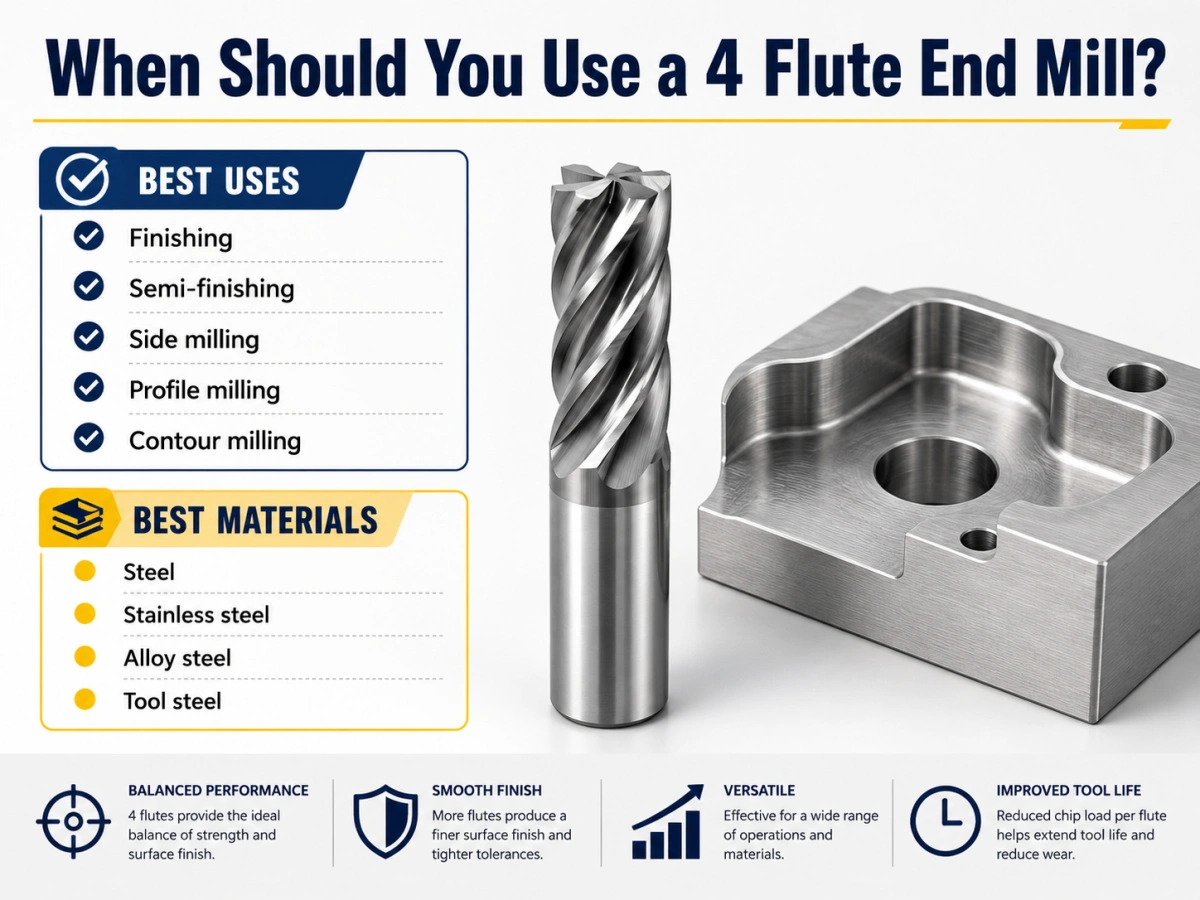
UM 4 flute end mill works best when the operation requires higher rigidity, corte estável, and a cleaner surface finish. Por esta razão, many CNC users choose it for finishing and semi-finishing in steel, aço inoxidável, liga de aço, e outros materiais mais duros.
Em geral, you should consider a 4 fresa de topo de canal quando:
- the workpiece material is steel, aço inoxidável, liga de aço, or tool steel
- the operation requires stable cutting with less vibration
- the goal is better surface finish
- the process involves side milling, fresamento de contorno, ou usinagem de perfil
- the setup needs higher rigidity than a 2 flute tool can provide
- chip evacuation is not the main limitation
Em contraste, for deep slots, heavy aluminum roughing, or very soft materials, a lower flute count tool may remove chips more efficiently.
Best Materials for a 4 Fresa de topo de flauta
Steel and Alloy Steel
UM 4 flute end mill works well for steel and alloy steel because it provides good rigidity and stable cutting performance. Como resultado, machinists often choose it for finishing and semi-finishing operations where dimensional accuracy and surface quality matter.
Aço inoxidável
Stainless steel machining usually requires heat resistance, estabilidade de corte, and careful chip control. Por esta razão, a coated carbide 4 flute end mill can work well in controlled CNC machining when the speed, feed, and coolant match the material.
Aluminum for Light Finishing
UM 4 flute end mill can cut aluminum in some cases, especially for light finishing, contour work, and shallow profiling. No entanto, it is usually not the first choice for deep slotting or heavy roughing because aluminum produces larger chips and needs more chip space.
For a full aluminum-focused explanation, leia nosso are 4 flute end mills good for aluminum guia.
4 Flauta vs. 2 Fresa de topo de flauta
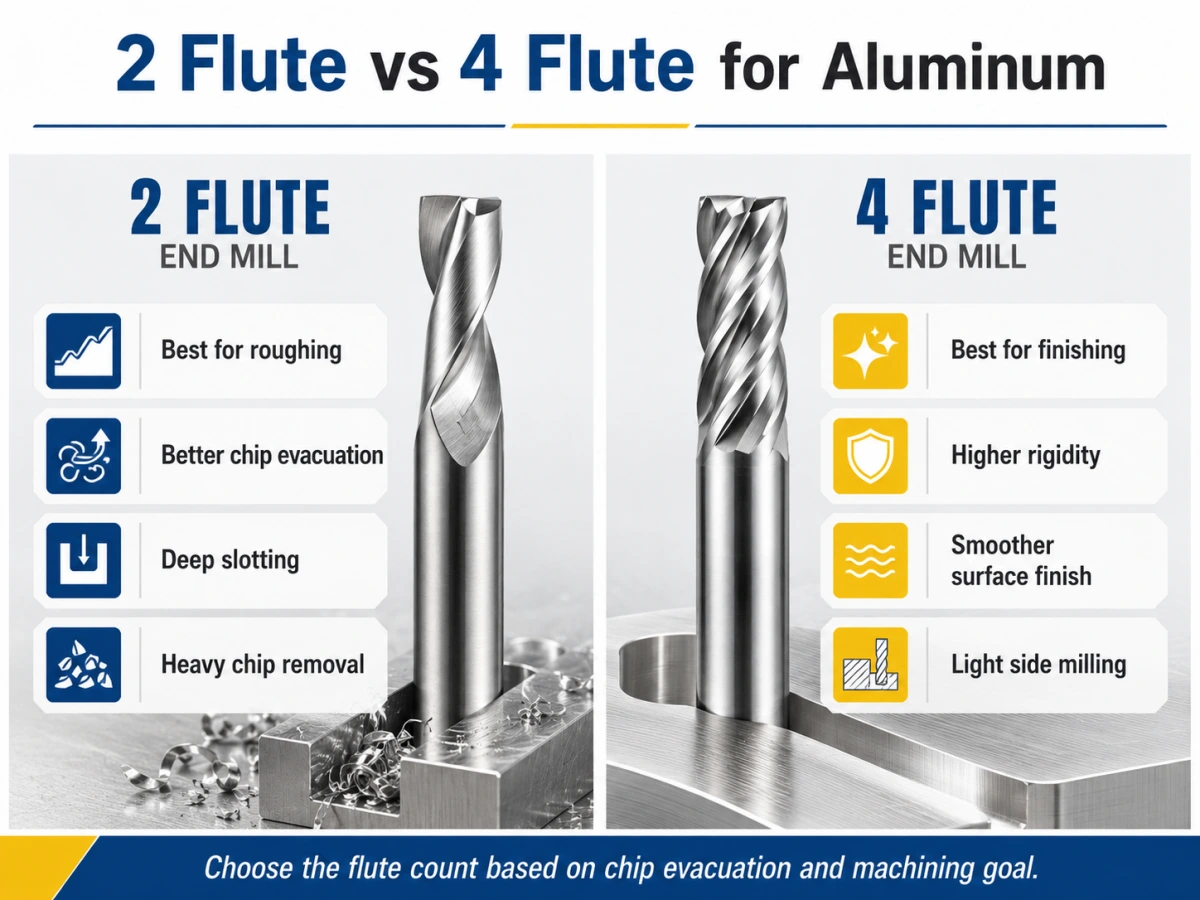
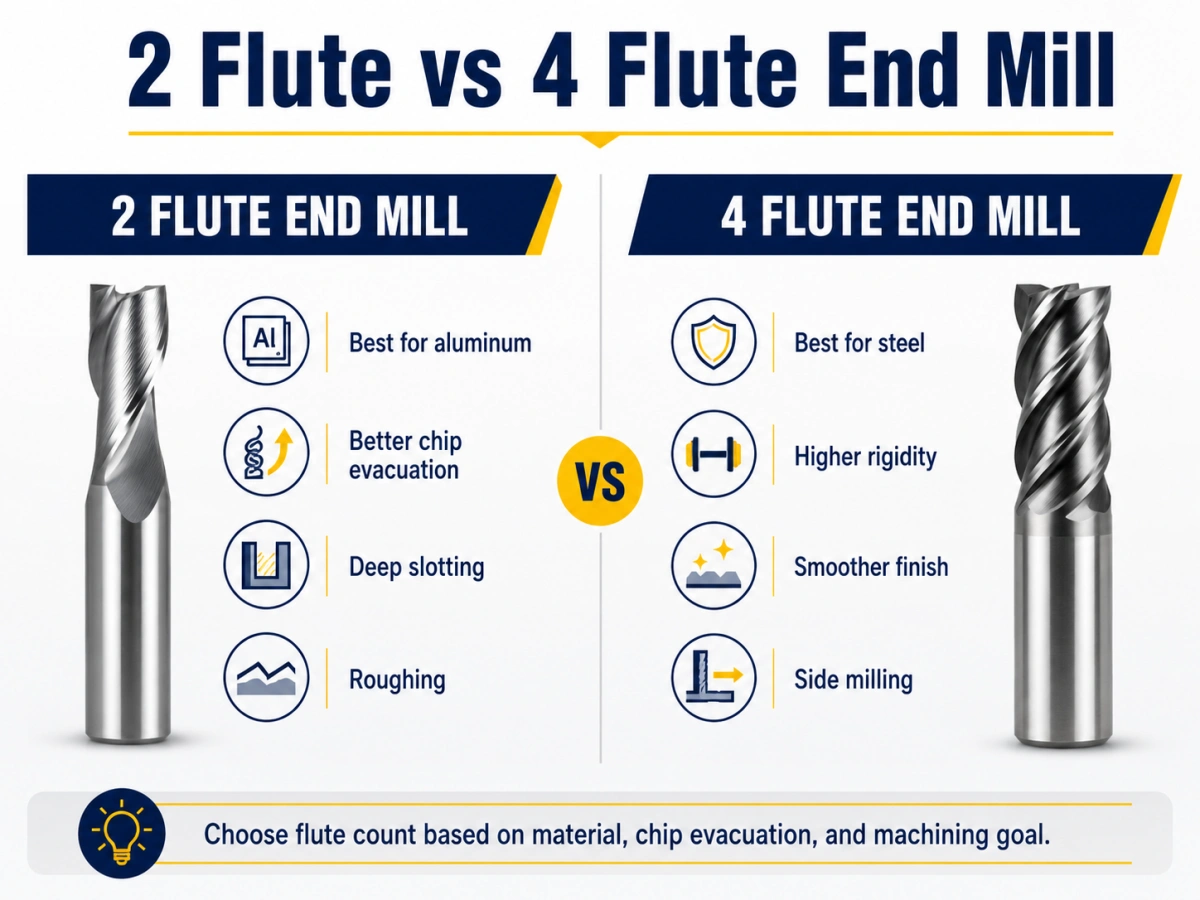
Escolhendo entre um 2 flauta e uma 4 flute end mill depends on the material, profundidade de corte, chip evacuation requirement, e meta de usinagem.
UM 4 flute end mill is usually better for:
- aço e aço inoxidável
- alloy steel and tool steel
- acabamento e semiacabamento
- side milling and profile milling
- higher rigidity
- smoother surface finish
UM 2 flute end mill is usually better for:
- usinagem de alumínio
- latão, cobre, plásticos, and soft materials
- deeper slotting
- roughing in soft materials
- evacuação de cavacos mais rápida
Em outras palavras, um 4 flute end mill is usually the better choice when stability and finish quality matter more than chip space. Em contraste, um 2 flute tool may work better when the material produces larger chips or when the operation needs deeper chip clearance.
For a detailed comparison, leia nosso 2 flauta vs. 4 moinho de extremidade de flauta guia.
Para uma comparação mais ampla por material e operação, você também pode ler nosso 2 flauta vs. 4 flauta vs. 6 moinho de extremidade de flauta guia.
Pode um 4 Flute End Mill Cut Aluminum?
Sim, um 4 flute end mill can cut aluminum, but it usually works better for light finishing, fresamento de contorno, and shallow profiling rather than heavy roughing. Because aluminum produces larger chips, tools with fewer flutes often provide more chip space and better chip evacuation.
Portanto, if the job involves deep slots or aggressive material removal in aluminum, um 2 flute end mill may be the safer option. Enquanto isso, if the operation is light profiling or finishing, um 4 flute design can still work well with proper parameters, suitable coolant, and stable chip control.
For more details, leia nosso 4 flute end mills for aluminum guia.
How to Optimize 4 Flute End Mill Performance
Choose the Right Coating
Different materials require different coating strategies. Para aço, aço inoxidável, and alloy steel, coatings such as AlTiN, TiAlN, or TiSiN can improve wear resistance, resistência ao calor, e vida útil da ferramenta.
Control Tool Overhang
Shorter tool overhang usually improves stability and reduces chatter. Como resultado, a rigid setup can improve surface finish, machining accuracy, and cutting consistency.
Match Speeds and Feeds to the Material
Velocidade de corte, taxa de alimentação, radial engagement, and coolant should match the workpiece material and tool geometry. Além disso, following the tool manufacturer’s recommendations can reduce unnecessary wear, improve surface finish, and extend tool life.
Common Applications in CNC Machining
Because a 4 flute end mill provides a good balance of rigidity and finish quality, CNC users often choose it for many metalworking applications.
Common examples include:
- mold and die machining
- fabricação de peças automotivas
- general machinery components
- precision steel parts
- componentes de aço inoxidável
- tool steel machining
- profile and contour milling work
- finishing and semi-finishing of metal parts
Nessas aplicações, the tool works well when surface quality, estabilidade, and reliable performance matter more than maximum chip space.
Perguntas frequentes
O que é um 4 flute end mill used for?
UM 4 flute end mill is mainly used for steel, aço inoxidável, liga de aço, acabamento, semi-acabamento, fresagem lateral, fresagem de perfil, and CNC metal machining.
É um 4 fresa de topo de flauta boa para aço?
Sim. UM 4 flute end mill works well for steel because it provides higher rigidity, stable cutting performance, and smoother surface finish than lower-flute tools in many finishing operations.
Pode um 4 flute end mill cut stainless steel?
Sim, a coated carbide 4 flute end mill can cut stainless steel when the coating, velocidade, feed, refrigerante, and cutting conditions match the material.
É um 4 flute end mill good for aluminum?
UM 4 flute end mill can work for aluminum finishing and light profiling. No entanto, for deep slotting or heavy roughing, um 2 fresa de topo de canal geralmente é melhor. For more details, leia nosso 4 flute end mills for aluminum guia.
Qual é a diferença entre 2 flauta e 4 fresas de topo de flauta?
UM 2 flute end mill provides more chip space and is often better for aluminum, soft materials, and deeper slotting. UM 4 flute end mill provides higher rigidity and is often better for steel, aço inoxidável, acabamento, and side milling.
Conclusão
UM 4 flute end mill works well for steel, aço inoxidável, liga de aço, acabamento, semi-acabamento, fresagem lateral, e fresamento de perfil. Its main advantages are higher rigidity, smoother surface finish, and more stable cutting performance in CNC machining.
No entanto, it is not the best choice for every job. For aluminum roughing, deep slotting, or heavy chip removal, a lower flute count tool may perform better. Portanto, you should choose the flute count based on material type, profundidade de corte, chip evacuation requirement, e finalidade de usinagem.
Need a 4 Fresa de topo de flauta para aço ou aço inoxidável?
Se você precisar de um 4 fresa de topo de flauta para aço, aço inoxidável, liga de aço, aço para ferramentas, acabamento, semi-acabamento, fresagem lateral, or profile milling, we can help you choose a suitable carbide tool design.
Envie-nos seu material, diâmetro de corte, comprimento da flauta, exigência de revestimento, desenho, ou aplicação de usinagem. Our team can recommend standard or custom carbide end mills for your CNC machining project.
Check our 4 moinho de extremidade de flauta product page here.
Guias relacionados:
São 4 flute end mills good for aluminum?