 Cortadores de fresagem de precisão,Ferramentas de corte para usinagem CNC de todos os materiais

Uma fresa de topo é uma ferramenta de corte rotativa usada em fresamento CNC para remover material da extremidade e da lateral de uma peça de trabalho.. Pode usinar slots, bolsos, perfis, paredes laterais, superfícies curvas, e recursos de acabamento em materiais como alumínio, aço, aço inoxidável, cobre, e plásticos.
Neste guia, você aprenderá o que é uma fresa de topo, como isso difere de uma broca, o que faz no fresamento CNC, tipos de cortadores comuns, especificações básicas, e como escolher a ferramenta certa para diferentes aplicações de usinagem.
O que é uma fresa de topo?
Uma fresa de topo é uma ferramenta de corte rotativa usada em máquinas CNC e fresadoras. Ele gira em alta velocidade enquanto a ferramenta ou peça se move ao longo de um caminho controlado para remover material.
A principal diferença entre uma fresa de topo e muitas outras ferramentas é a sua geometria de corte. A maioria das fresas de topo possui arestas de corte na extremidade e nas laterais. Portanto, eles podem cortar verticalmente e lateralmente. Isso os torna adequados para ranhuras, fresagem lateral, perfil, fresagem de bolso, contorno, e acabamento.
Os fabricantes geralmente fabricam fresas de topo em aço rápido ou metal duro. No entanto, muitas oficinas mecânicas CNC escolhem ferramentas de metal duro porque oferecem melhor rigidez, maior resistência ao desgaste, e desempenho de corte mais estável.
Se você precisar de ferramentas padrão ou personalizadas para usinagem de produção, você também pode visitar nosso página de produto da fresa de topo.
Partes principais de uma fresa de topo
Embora as fresas de topo venham em diferentes formatos e designs, a maioria das ferramentas inclui várias peças básicas. Compreender essas peças ajuda os compradores a escolher a fresa certa para seu material, máquina, e meta de usinagem.
| Papel | Função | Por que é importante |
| Arestas de corte | Remova o material da peça de trabalho | Afeta a eficiência de corte e o acabamento superficial |
| Flautas | Ajude a evacuar cavacos durante a usinagem | Influenciar a remoção de cavacos, rigidez, e estabilidade de corte |
| Dica de ferramenta | Define a geometria final da fresa | Afeta o slot, contorno, acabamento, e força de canto |
| Haste | Segurado pelo porta-ferramenta ou fuso | Deve corresponder ao suporte para fixação estável |
| Revestimento | Protege a aresta de corte durante a usinagem | Melhora a resistência ao desgaste, resistência ao calor, e vida útil da ferramenta |
Arestas de corte
As arestas de corte são a parte funcional da ferramenta. Eles removem material durante o fresamento e afetam diretamente o desempenho de corte, precisão, e acabamento superficial.
Flautas
Flautas são as ranhuras ao longo do corpo do cortador. Eles ajudam a remover cavacos da área de corte. Além disso, o design da flauta afeta a rigidez, controle de calor, e estabilidade de corte.
Dica de ferramenta
O design da ponta da ferramenta depende do tipo de cortador. Algumas fresas de topo têm extremidades planas, enquanto outros têm nariz esférico, raio do canto, ou geometria cônica. Como resultado, diferentes designs de pontas são usados para diferentes tarefas de usinagem.
Haste
A haste é a peça segurada pelo porta-ferramenta ou fuso. Seu diâmetro deve corresponder corretamente ao suporte. De outra forma, vibração, baixa precisão, ou pode ocorrer desgaste da ferramenta.
Revestimento
Muitas fresas de topo usam revestimentos como TiAlN, AlTiN, TiSiN, TiN, DLC, ou revestimento azul Nano. O revestimento certo pode melhorar a resistência ao calor, reduzir o desgaste, e prolongar a vida útil da ferramenta.
Fresa de topo versus broca
Muitos iniciantes confundem uma fresa de topo com uma broca. No entanto, eles são projetados para diferentes fins de usinagem.
Uma broca corta principalmente na direção axial para criar furos redondos. Em contraste, uma fresa de topo pode cortar tanto axial quanto lateralmente. Portanto, pode maquinar slots, bolsos, contornos, perfis, paredes laterais, e superfícies acabadas.
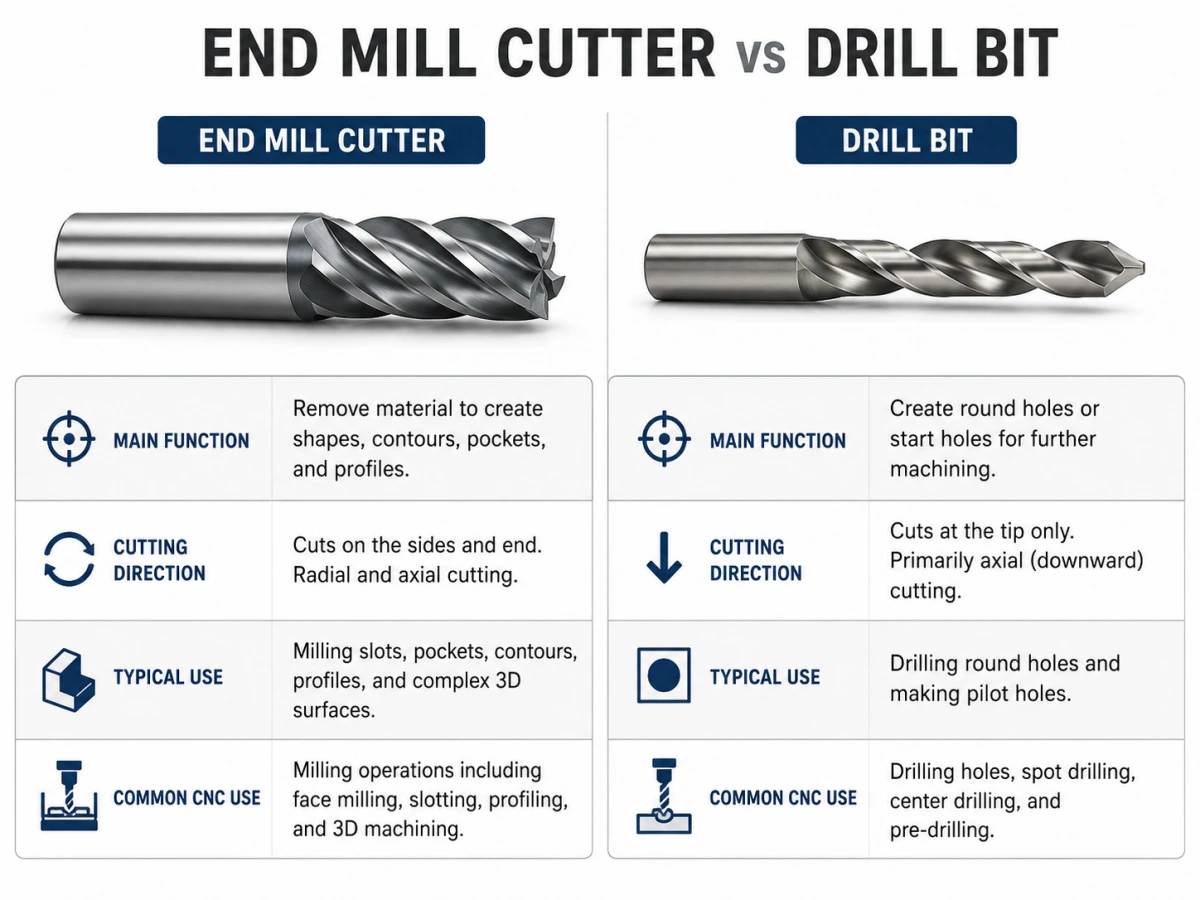
| Recurso | Cortador de moinho de extremidade | Broca |
| Função principal | Fresagem, ranhura, perfil, corte lateral | Furos de perfuração |
| Direção de corte | Axiais e laterais | Principalmente axial |
| Uso típico | Caça-níqueis, bolsos, contornos, paredes laterais | Buracos redondos |
| Flexibilidade da ferramenta | Mais alto | Mais baixo |
| Uso comum de CNC | Operações gerais de fresagem | Operações de furação |
Resumidamente, ambas as ferramentas removem material, mas eles não são intercambiáveis na maioria das situações de usinagem. Uma fresa de topo com corte central pode mergulhar em algumas aplicações, mas ainda não é o mesmo que uma broca padrão.
Tipos comuns de fresas de topo
Existem muitos tipos de fresas de topo, e cada design tem um propósito específico. Escolher o tipo certo ajuda a melhorar a eficiência de corte, qualidade da superfície, e vida útil da ferramenta.
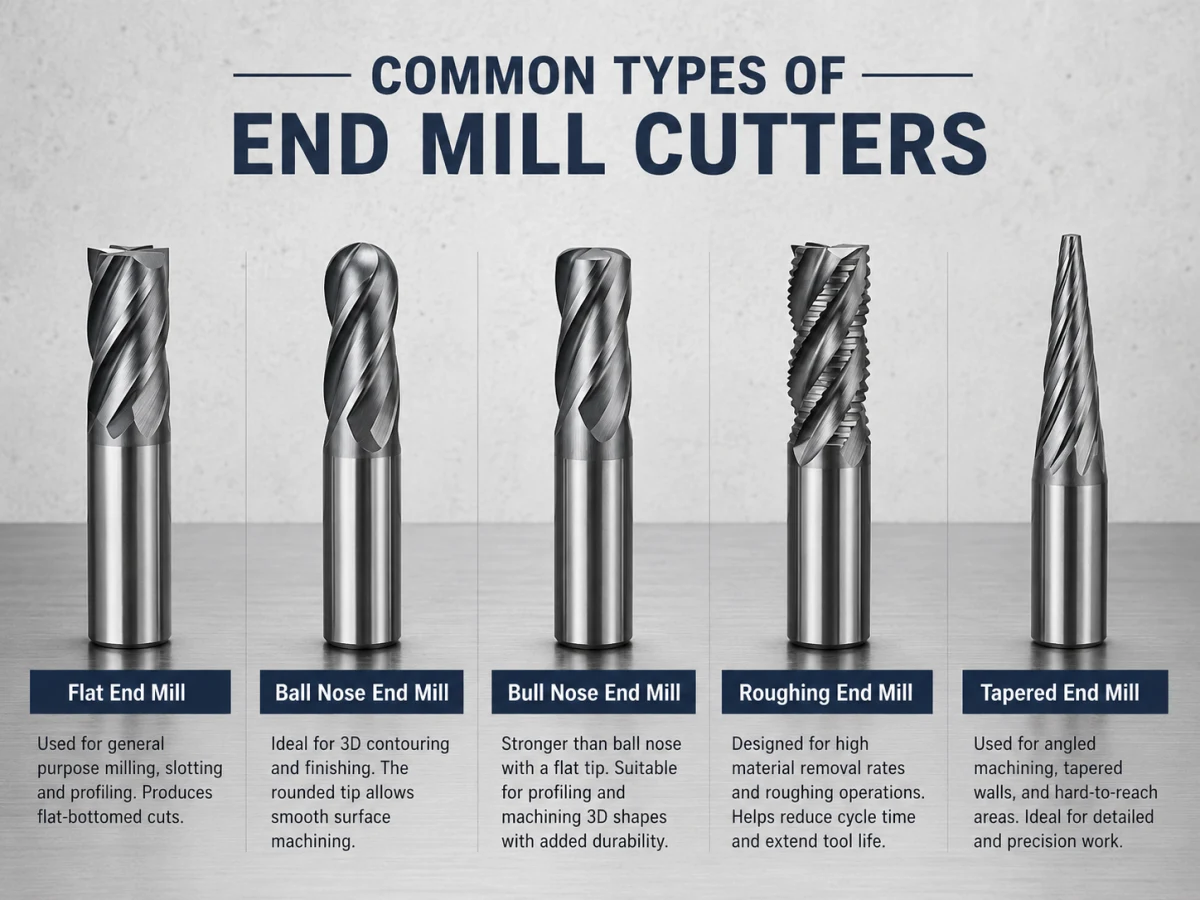
Fresa de topo plano
Uma fresa de topo plano tem uma extremidade de corte plana. É amplamente utilizado para entalhar, fresagem lateral, fresamento de cantos a 90 graus, e usinagem de uso geral.
Fresa de ponta esférica
Uma fresa de topo esférico tem uma extremidade de corte arredondada. É comumente usado para contorno 3D, usinagem de moldes, superfícies curvas, e operações de acabamento.
Para usinagem de superfícies curvas e moldes, você também pode ver nosso fresas de ponta esférica.
Fresa de ponta de touro
Uma fresa de topo de nariz touro, também chamada de fresa de topo com raio de canto, combina um fundo plano com cantos arredondados. Melhora a resistência das bordas e ajuda a criar transições mais suaves.
Para geometria de canto mais forte, veja nosso fresa de topo de nariz de touro.
Fresa de desbaste
Uma fresa de topo para desbaste foi projetada para remoção agressiva de material. É frequentemente usado antes do acabamento para remover rapidamente grandes quantidades de material.
Para remoção pesada de material, você pode verificar nosso fresas de topo para desbaste.
Fresa de topo cônico
Uma fresa de topo cônica tem um diâmetro que muda gradualmente. É usado para paredes angulares, cavidades profundas, usinagem de moldes, e perfis especiais.
Para cavidades de molde e usinagem angular, visite nosso cortador cônico.
Para uma comparação mais detalhada das geometrias das ferramentas, leia nosso guia de tipos de fresas de topo.
Para que é usada uma fresa de topo?
Fresas de topo são usadas em muitas operações de fresamento CNC. Porque eles podem cortar pela ponta e pela lateral, eles são adequados para tarefas de usinagem simples e complexas.
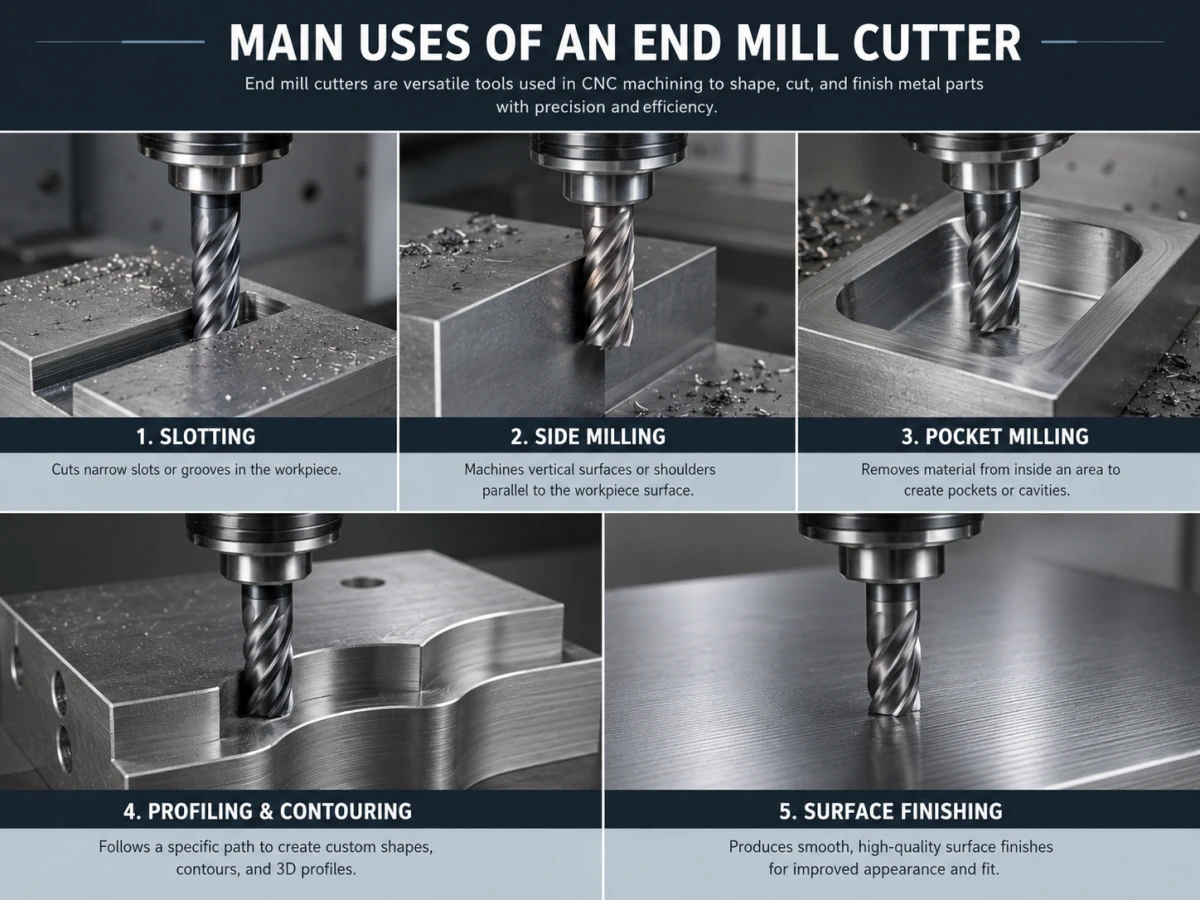
Entalhamento
Slotting é uma das aplicações mais comuns. Uma fresa de topo pode cortar ranhuras retas ou curvas em uma peça de trabalho com boa precisão. Esses slots podem criar rasgos de chaveta, ranhuras, trilhas guia, e recursos de montagem.
Para materiais mais macios, como alumínio, a evacuação de cavacos é importante. Portanto, os maquinistas geralmente selecionam 2 ferramentas de canal quando a peça precisa de melhor remoção de cavacos.
Fresamento lateral
O fresamento lateral utiliza as arestas de corte laterais da ferramenta para remover material da superfície vertical de uma peça de trabalho. Esta operação é útil para usinar cantos, passos, e paredes laterais.
As oficinas mecânicas geralmente usam fresamento lateral para peças de precisão, componentes do molde, peças de ferramentas, e produção CNC em geral.
Perfil e contorno
Os maquinistas também usam fresas de topo para perfilar e contornar. Essas operações criam formas complexas, caminhos curvos, e perfis externos ou internos.
Os maquinistas geralmente selecionam ferramentas de ponta esférica e raio de canto para esse tipo de trabalho porque essas ferramentas podem melhorar as transições de superfície e a qualidade do acabamento.
Fresamento de Bolso
O fresamento de bolsões remove material de uma área fechada ou rebaixada dentro de uma peça de trabalho. Esta operação é comum em peças que necessitam de cavidades internas, redução de peso, ou remoção precisa de material dentro de uma área limitada.
Bom controle de cavacos, caminhos de ferramentas estáveis, e a geometria correta da fresa são importantes para este processo.
Acabamento de Superfície
Após usinagem de desbaste, uma fresa de topo também pode ser usada para acabamento. O objetivo é melhorar a precisão dimensional e a suavidade da superfície.
As ferramentas de acabamento são selecionadas de acordo com a tolerância, material da peça, estabilidade da máquina, e qualidade de superfície necessária.
Fresamento escalonado e usinagem de cantos a 90 graus
Fresas de topo podem usinar superfícies escalonadas, ombros, e recursos de vários níveis. Esses recursos geralmente exigem transições nítidas, corte estável, e dimensões precisas.
Como resultado, rigidez da ferramenta, desenho de flauta, e a seleção do revestimento são importantes.
Usos do cortador de topo para alumínio, Aço, e aço inoxidável
Diferentes materiais de peças exigem diferentes designs de fresa. Portanto, os compradores devem combinar a fresa final com o material e a condição de usinagem.
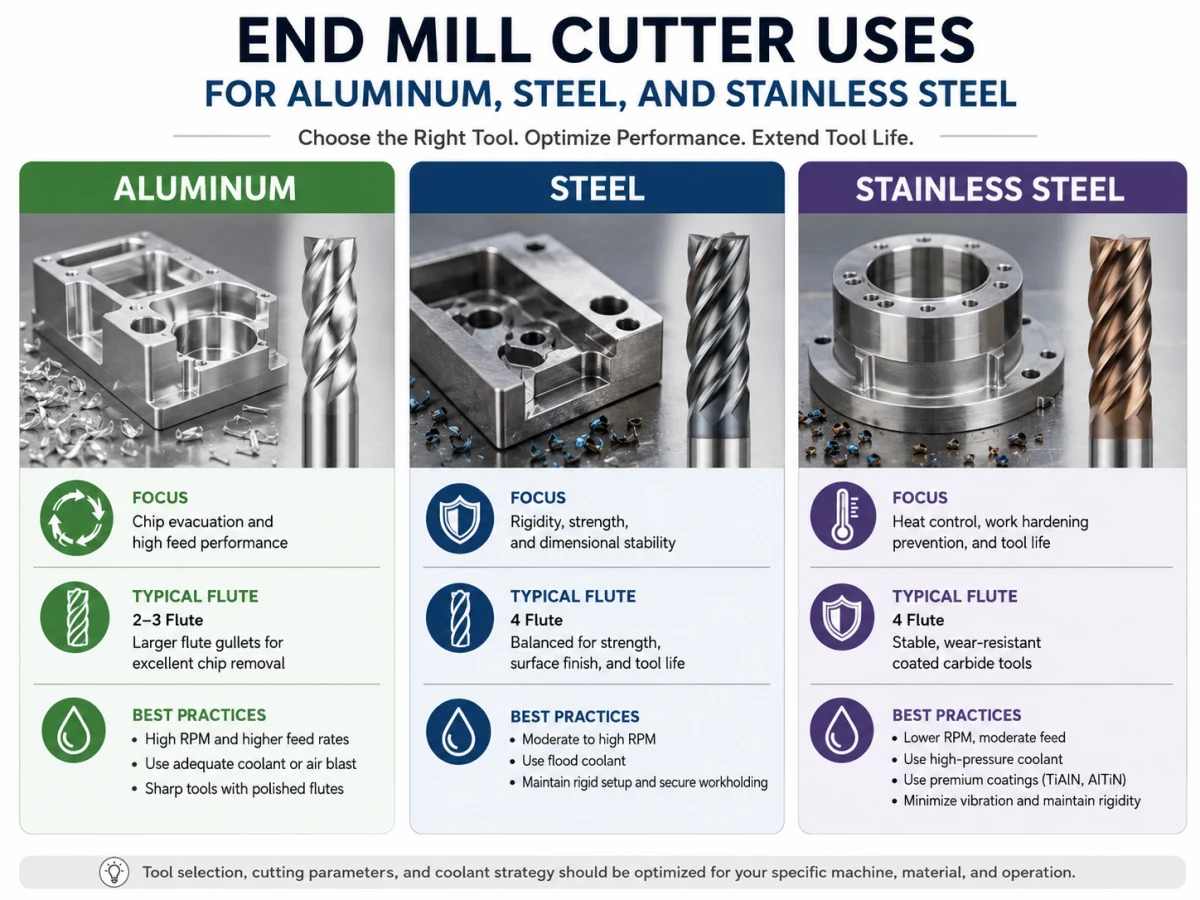
| Material da peça | Escolha comum de cortador | Razão Principal |
| Alumínio | 2 flauta ou 3 fresa de topo de carboneto de flauta | Melhor evacuação de cavacos e corte suave |
| Aço | 4 fresa de topo de metal duro com revestimento adequado | Melhor rigidez e resistência ao desgaste |
| Aço inoxidável | Fresa de topo de metal duro com cobertura e geometria estável | Melhor controle de calor e proteção de bordas |
| Cobre e latão | Fresa de topo de metal duro com aresta afiada | Corte limpo e rebarbas reduzidas |
| Plásticos | Afiado, cortador de flauta polido | Remoção suave de cavacos e menor risco de fusão |
Fresa de topo para alumínio
Ao usinar alumínio, fresas de topo são usadas para ranhurar, fresagem de bolso, fresagem lateral, e acabamento. O alumínio produz cavacos maiores, portanto, ferramentas com menos canais e bom escoamento de cavacos são frequentemente preferidas.
Fresas de topo de metal duro de alta hélice também são comuns para alumínio porque ajudam a melhorar a suavidade do corte e reduzem o acúmulo de cavacos.
Para alumínio e materiais não ferrosos, você pode comparar opções de flauta em nosso 2 moinho de extremidade de flauta e 3 moinho de extremidade de flauta páginas.
Fresa de topo para aço
Para aço carbono e aço liga, fresas de topo são frequentemente usadas para fresamento lateral, contorno, usinagem de ombro, e semi-acabamento. O aço geralmente requer melhor rigidez e maior resistência ao desgaste.
Em muitos casos, 4 fresas de topo de metal duro com canal são selecionadas para usinagem de aço e metal de uso geral.
Para usinagem de aço, você pode ver nosso 4 moinho de extremidade de flauta.
Fresa de topo para aço inoxidável
O aço inoxidável é mais difícil de usinar porque gera calor e tende a causar desgaste da ferramenta. Em aplicações de aço inoxidável, fresas de topo são comumente usadas para perfilar, acabamento, e fresamento lateral controlado.
O revestimento certo, geometria da flauta, e os parâmetros de corte ajudam a manter a estabilidade do corte e reduzem o desgaste da aresta.
Como escolher uma fresa de topo básica
Escolher uma fresa de topo não precisa ser complicado. No entanto, os compradores devem verificar vários fatores antes de fazer o pedido.
Material da peça
O material da peça é um dos fatores mais importantes. Alumínio, aço, aço inoxidável, cobre, latão, plásticos, e ferro fundido podem exigir diferentes designs de canal, revestimentos, e estratégias de corte.
Contagem de Flauta
A contagem de canais afeta o escoamento de cavacos, rigidez, e eficiência de corte. Por exemplo, os maquinistas costumam usar 2 ferramentas de flauta para alumínio, embora eles geralmente escolham 4 ferramentas de canal para aço e usinagem de uso geral.
Para uma comparação mais profunda, leia nosso 2 flauta vs. 4 guia de fresa de topo de flauta.
Material da ferramenta
Muitas oficinas de máquinas CNC escolhem fresas de topo de metal duro porque elas fornecem maior rigidez, melhor resistência ao desgaste, e desempenho estável. Algumas oficinas ainda usam ferramentas HSS para aplicações de usinagem geral ou de baixa velocidade.
Revestimento
O revestimento deve corresponder ao material e às condições de usinagem. Por exemplo, machinists often choose TiAlN and AlTiN coatings for steel, while DLC coating may suit aluminum and non-ferrous materials.
Required Finish
For roughing operations, the main goal is higher material removal. No entanto, for finishing work, surface quality and dimensional accuracy become more important.
Basic Specifications to Check Before Buying
Before placing an order, buyers should confirm several key specifications. This helps avoid tool mismatch and improves machining stability.
Diâmetro do cortador
Cutter diameter affects cutting width, rigidez, and the size of the machined feature.
Comprimento da Flauta
Flute length determines how deep the cutter can machine. No entanto, a longer flute may reduce rigidity, so it should match the actual cutting depth.
Comprimento total
Overall length affects tool reach and vibration control. A longer tool may be needed for deep cavities, but it should be used carefully to reduce chatter.
Diâmetro da haste
O diâmetro da haste deve corresponder corretamente ao suporte. A fixação estável ajuda a melhorar a precisão e a vida útil da ferramenta.
Geometria de Canto
Plano, nariz de bola, raio do canto, e geometrias cônicas são usadas para diferentes objetivos de usinagem. Portanto, a geometria do canto deve corresponder ao formato da peça e ao acabamento necessário.
Tipo de revestimento
O revestimento deve ser selecionado de acordo com o material da peça, velocidade de corte, condição do líquido refrigerante, e requisitos de vida útil da ferramenta.
Por que as fresas de topo de metal duro são comuns no fresamento CNC
As fresas de topo de metal duro são populares porque oferecem forte rigidez, alta dureza, e boa resistência ao desgaste. Eles podem suportar velocidades de corte mais altas e fornecer desempenho mais estável do que muitos materiais de ferramentas padrão.
Na usinagem de produção, muitas lojas usam ferramentas de metal duro para aço, aço inoxidável, ferro fundido, alumínio, e outros materiais exigentes. Além disso, a geometria e o revestimento corretos podem melhorar a consistência da usinagem.
Compradores industriais, distribuidores, e oficinas mecânicas geralmente preferem ferramentas de metal duro porque elas ajudam a reduzir as trocas de ferramentas e suportam uma produção mais estável.
Para ferramentas de metal duro padrão e personalizadas, você pode visitar nosso cortador de topo de metal duro pape.
Quando você precisa de uma fresa de topo personalizada?
Uma fresa padrão pode resolver muitas tarefas comuns de usinagem.
No entanto, você pode precisar de ferramentas personalizadas quando a peça tiver um perfil especial, cavidade profunda, material incomum, tolerância estrita, ou exigência de tamanho não padrão.
Os fabricantes podem projetar fresas de topo personalizadas com diâmetro especial, comprimento da flauta, comprimento total, raio do canto, revestimento, tamanho da haste, e geometria da ferramenta.
Para ferramentas baseadas em desenho ou OEM, visite nosso fresas de topo personalizadas pape.
Perguntas frequentes
O que é uma fresa de topo?
Uma fresa de topo é uma ferramenta de corte rotativa usada para operações de fresamento CNC, como ranhuramento, fresagem lateral, perfil, contorno, fresagem de bolso, e acabamento.
Para que é usada uma fresa de topo?
É usado para remover material da extremidade e da lateral de uma peça de trabalho. Aplicações comuns incluem slots, bolsos, paredes laterais, perfis, ombros, superfícies curvas, e superfícies acabadas.
Qual é a diferença entre uma fresa de topo e uma broca?
Uma broca faz furos principalmente na direção axial. Uma fresa de topo pode cortar axial e lateralmente, para que possa realizar mais operações de fresamento, como abertura de canais, perfil, e fresamento lateral.
Quais são os tipos comuns de fresas de topo?
Os tipos comuns incluem fresas de topo plano, fresas de ponta esférica, fresas de topo de nariz de touro, fresas de topo para desbaste, fresas de topo cônicas, 2 fresas de topo de flauta, 3 fresas de topo de flauta, 4 fresas de topo de flauta, e 6 fresas de topo de flauta.
Como escolho uma fresa de topo básica?
Você deve verificar o material da peça de trabalho, contagem de flauta, diâmetro do cortador, comprimento da flauta, comprimento total, diâmetro da haste, material de ferramenta, revestimento, e acabamento superficial necessário.
As fresas de topo de metal duro são melhores do que as fresas de topo HSS??
Fresas de topo de metal duro geralmente proporcionam melhor rigidez, resistência ao desgaste, e estabilidade de corte. No entanto, a melhor escolha depende da máquina, material da peça, velocidade de corte, e orçamento.
Conclusão
Uma fresa de topo é uma ferramenta de fresagem CNC versátil usada para ranhurar, fresagem lateral, fresagem de bolso, perfil, contorno, usinagem de ombro, e acabamento. Porque pode cortar tanto na extremidade quanto na lateral, é mais flexível do que muitas ferramentas básicas de corte.
Para escolher o cortador certo, os compradores devem compreender a estrutura da ferramenta, tipo de cortador, contagem de flauta, material, revestimento, diâmetro, comprimento da flauta, e aplicação de usinagem. Uma vez que esses fatores sejam combinados corretamente, o cortador pode fornecer melhor eficiência de corte, maior vida útil da ferramenta, e resultados de usinagem mais estáveis.
Procurando um fabricante confiável de fresa de topo para alumínio, aço, aço inoxidável, ou usinagem CNC personalizada?
Explore nosso página de produto da fresa de topo para soluções padrão e OEM, ou entre em contato conosco com seus requisitos de desenho e aplicação.