 Cortadores de fresagem de precisão,Ferramentas de corte para usinagem CNC de todos os materiais

A T slot milling cutter helps CNC users machine T-shaped slots in metal workpieces, machine tables, fixture plates, mold bases, and workholding systems. Its special cutting head forms the wider lower section of a T-slot after the operator creates a pilot slot.
Its special cutting head forms the wider lower section of a T-slot after the operator creates a pilot slot.
Unlike a standard end mill, this cutter can reach under the top surface and create an undercut groove. Portanto, CNC shops often use it for fixture manufacturing, mold production, machine table slotting, and mechanical assembly systems.
For available sizes, revestimentos, and custom options, veja nosso custom solid carbide T slot cutter.
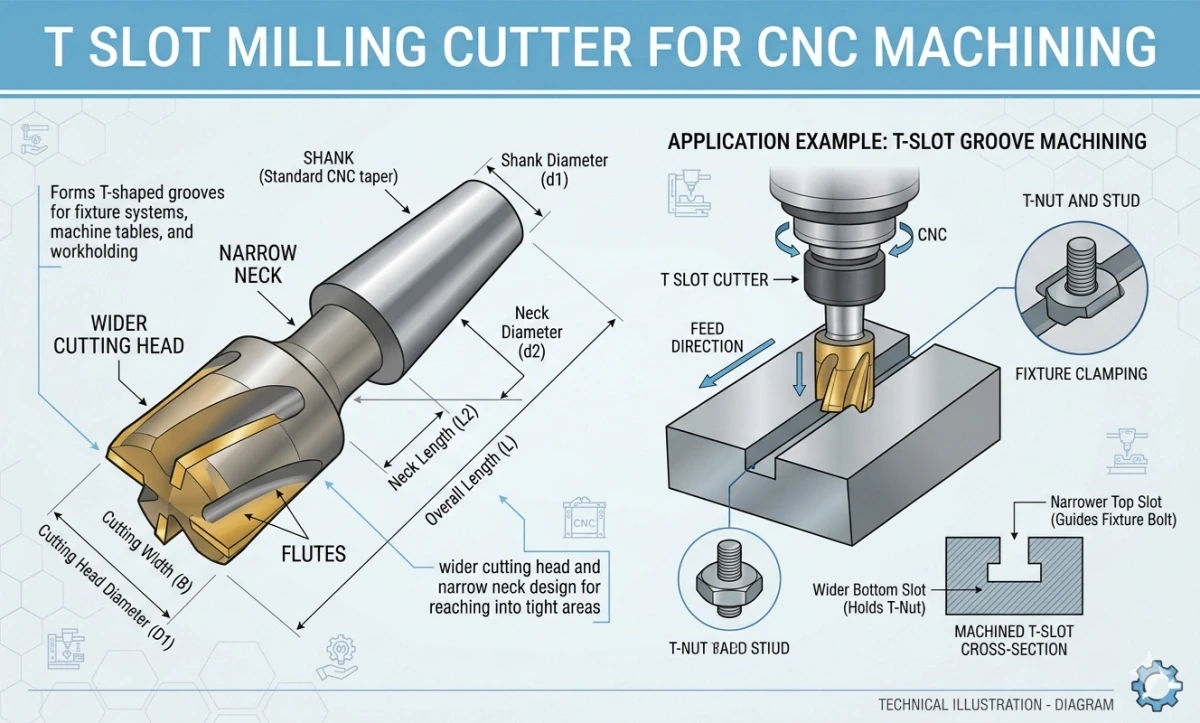
What Is a T Slot Milling Cutter?
A T slot milling cutter, also called a T slot cutter or T-groove milling cutter, machines T-shaped grooves. Its cutting head is wider than its neck, so it can cut the lower part of the slot after the first groove is ready.
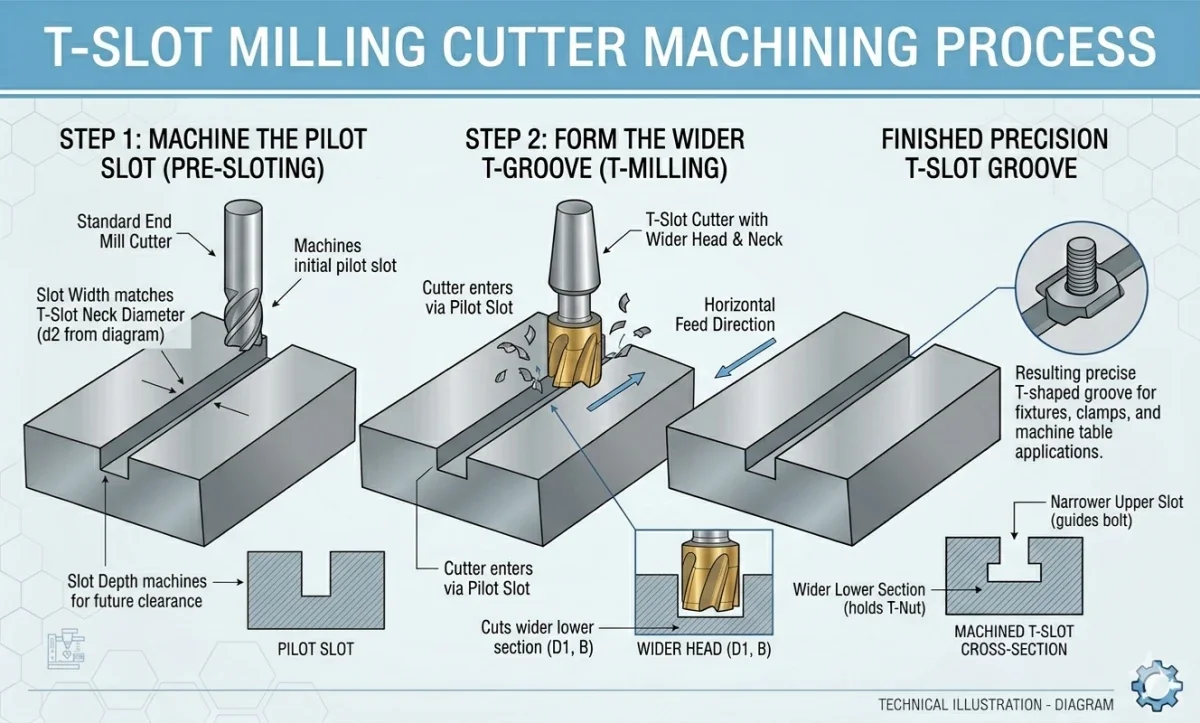
Na maioria dos casos, the machining process starts with a straight pilot slot. Então, the T-slot milling cutter enters that slot and removes material from the lower section. Como resultado, the final groove can hold T-bolts, jogos, clamping systems, or sliding components.
This tool is different from a standard end mill. An end mill can create straight slots and pockets, while a T-slot cutter creates the undercut profile needed for T-shaped grooves.
What Is a T Slot Milling Cutter Used For?
CNC machinists use T slot milling cutters when a part needs a T-shaped groove for fastening, positioning, or assembly. These grooves help secure clamps, jogos, T-bolts, and adjustable components.
Aplicações comuns incluem:
- Machine table T-slots
- Fixture plate machining
- Mold base groove cutting
- Workholding systems
- Automation equipment plates
- Mechanical assembly slots
- Steel and aluminum slot machining
- Custom T-slot profiles
Por exemplo, machine tables often need T-slots for vises and clamps. Mold bases may need grooves for positioning and assembly. Além disso, automation equipment can use T-slots for adjustable mounting systems.
T Slot Milling Operation: How Does It Work?
The T-slot milling process usually includes two steps.
First, the operator machines a straight pilot slot with an end mill or slot milling cutter. This pilot slot gives the T-slot cutter enough space to enter the workpiece.
Próximo, the T-slot milling cutter cuts the wider lower section of the groove. Because the cutting head is wider than the neck, the tool can form the T-shaped profile under the top surface.
Before machining, the operator should check slot width, slot depth, tool clearance, rigidez da máquina, and chip evacuation. Como resultado, the process becomes more stable and the finished slot is more accurate.
Types of T Slot Milling Cutters
Different cutter types suit different materials, machines, and production needs.Therefore, the right choice depends on slot size, material da peça, tool life requirement, and machining condition.
| Tipo de cortador | Melhor para | Principal vantagem |
| HSS T-Slot Cutter | Alumínio, mild steel, ferro fundido | Cost-effective for general T-slot milling |
| Solid Carbide T-Slot Cutter | Aço, aço inoxidável, liga de aço | High rigidity and wear resistance for precision CNC machining |
| Indexable T-Slot Cutter | Larger slots and production machining | Replaceable inserts reduce tool replacement cost |
| Custom T-Slot Cutter | Non-standard slot profiles | Made according to drawing and slot size |
For general machining, HSS cutters can work well on softer materials and mild steel. No entanto, carbide T-slot cutters often perform better in stable CNC machining, harder materials, and longer production runs.
If the slot profile is not standard, a custom T-slot cutter may be a better choice. In that case, the tool should match the drawing, slot width, slot depth, neck clearance, and workpiece material.
T Slot Milling Cutter Sizes and Key Dimensions
T slot milling cutter sizes depend on the required slot profile, pilot slot, undercut dimensions, machine setup, and workpiece material. Portanto, users should confirm the main cutter dimensions before ordering or preparing a custom drawing.
| Key Dimension | What It Controls |
| Head Diameter | Width of the lower undercut section |
| Raio de canto | Corner profile of the machined slot |
| T-Head Thickness | Thickness of the cutting head and undercut clearance area |
| Neck Diameter | Clearance through the pilot slot |
| Neck Length | Tool reach below the workpiece surface |
| Diâmetro da haste | Fit with the tool holder or collet |
| Comprimento total | Tool reach, clearance, and setup rigidity |
A longer neck can reach deeper areas. No entanto, excessive tool overhang may increase vibration and reduce machining accuracy. Portanto, use the shortest practical cutter length whenever possible.
For non-standard T-slots, prepare a drawing that includes the slot profile, material da peça, tolerância, and main cutter dimensions.
How to Choose the Right T Slot Milling Cutter
Choosing the right tool depends on the workpiece material, tamanho do slot, tipo de máquina, e exigência de acabamento superficial. Além disso, you should also consider coating, desenho de flauta, and tool clearance.
Choose by Workpiece Material
Para alumínio e cobre, chip evacuation and low friction matter more. Portanto, polished flutes or DLC coating can help reduce built-up edge.
Para aço e aço inoxidável, tool rigidity and heat resistance are more important. In this case, carbide tools with TiAlN or AlTiN coating are often a better choice.
For cast iron and alloy materials, choose a cutter with stable edge strength and good wear resistance. This helps improve tool life and machining consistency.
Choose by Slot Size
Before ordering, confirm the slot width, slot depth, neck clearance, diâmetro da haste, and tolerance requirement. These details help avoid tool interference and improve machining stability.
If the slot profile is non-standard, you may need a custom T-slot milling cutter. Portanto, it is better to send the drawing before quotation.
Choose by Machine Type
CNC machining centers usually need stable carbide tools and accurate tool holding. Manual milling machines can use HSS or carbide T-slot cutters, depending on the material and cutting condition.
Além disso, deep slots may need a suitable neck length and reduced tool overhang. This helps control vibration and improve the final slot quality.
If you need a non-standard cutter for CNC T-slot milling, we can manufacture a custom solid carbide tool according to your slot profile, material da peça, tolerância, e requisitos de usinagem.
T Slot Milling Cutter vs Slot Milling Cutter
A slot milling cutter cuts straight slots or side grooves. No entanto, a T slot milling cutter creates T-shaped slots and undercut grooves.
| Tipo de ferramenta | Cutting Purpose | Melhor usado para |
|---|---|---|
| Fresa com ranhura em T | Cuts T-shaped slots and undercut grooves | Fixture slots, machine table T-slots, mold base grooves |
| Slot Milling Cutter | Cuts straight slots and side grooves | General groove cutting and slot milling |
| Moinho de Fim | Cuts pockets, perfis, ombros, and flat slots | General CNC milling applications |
If the part only needs a straight slot, a standard slot milling cutter or end mill may be enough. No entanto, if the part needs a wider lower groove for clamping or fastening, a T slot milling cutter is the better choice.
Common Mistakes When Using a T Slot Milling
Even when the cutter type is correct, poor setup can still cause vibration, poor finish, or short tool life. Portanto, users should check several details before machining.
Skipping the Pilot Slot
Do not let a T-slot cutter remove all material at once. Usually, the operator should create a straight pilot slot first. Então, the T-slot cutter can machine the wider lower section more safely.
Choosing the Wrong Neck Clearance
If the neck clearance is too small, the tool may rub against the workpiece. Como resultado, the cut may become unstable. Always check slot width, depth, and clearance before selecting the cutter.
Ignoring Machine Rigidity
T-slot milling creates side cutting forces. Portanto, a stable machine, firm clamping, and proper tool holding can improve accuracy and surface quality.
Perguntas frequentes
O que é uma fresa com ranhura em T?
A T slot milling cutter is a tool for machining T-shaped slots in metal parts, machine tables, fixture plates, mold bases, and workholding systems.
What is a T slot milling cutter used for?
CNC users use it for T-slots, fixture grooves, machine table slots, mold base grooves, and undercut profiles.
What is the difference between a T slot cutter and a T slot milling cutter?
In most CNC machining contexts, both terms refer to the same tool. “T slot cutter” is a shorter product name, while “T slot milling cutter” often appears in technical explanations.
Can a T slot milling cutter cut steel?
Sim. A carbide T-slot milling cutter with a suitable coating can machine steel. No entanto, the tool design, revestimento, taxa de alimentação, and machine rigidity should match the material.
How do I choose the right T-slot cutter size?
Start with the required slot profile and pilot slot dimensions. Then confirm the head diameter, raio do canto, T-head thickness, neck diameter, neck length, diâmetro da haste, tolerância, and available machine clearance.
Conclusão
This cutter machines T-shaped slots for fixture systems, machine tables, mold bases, workholding plates, and mechanical assemblies.
To choose the right cutter, verifique o material da peça de trabalho, tamanho do slot, tipo de máquina, revestimento, and tool clearance. For custom slot profiles or production machining, a custom cutter may provide a better solution.
Need a custom T slot cutter for a non-standard undercut or clearance profile? Envie-nos o seu desenho, material da peça, required tolerance, coating request, e quantidade.