 Cortadores de fresagem de precisão,Ferramentas de corte para usinagem CNC de todos os materiais

Este guia de seleção de fresa de topo explica como escolher uma fresa por operação de usinagem, perfil final, material de ferramenta, contagem de flauta, revestimento, dimensões, e configuração da máquina. Escolher a ferramenta errada pode causar mau escoamento de cavacos, conversa, desgaste rápido das bordas, erros dimensionais, quebra de ferramenta, ou um acabamento superficial inconsistente.
Este guia foi escrito para maquinistas, engenheiros de processo, gerentes de oficina, distribuidores, e compradores que precisam de um ponto de partida prático antes de selecionar ou solicitar uma fresa de topo.
O que é uma fresa final?
Uma fresa de topo é uma ferramenta de corte rotativa usada para ranhurar, embolsar, perfil, fresagem lateral, desbaste, acabamento, e contorno 3D. Ao contrário de uma broca padrão, pode cortar com as bordas de corte finais e externas.
Alguns projetos de corte central suportam rampa, entrada helicoidal, ou mergulho limitado. No entanto, a geometria do centro e o método de entrada devem ser adequados à operação.
Para uma explicação básica, ler o que é uma fresa de topo.
Guia rápido de seleção de fresa
A tabela abaixo fornece instruções práticas para começar. A seleção final da ferramenta ainda deve refletir a classe da peça, diâmetro do cortador, profundidade de corte, condição de titular, rigidez da máquina, e método de remoção de chips.
| Situação de usinagem | Direção inicial da ferramenta | Razão Principal |
|---|---|---|
| Slotting de alumínio ou bolsos profundos | 2–3 flautas, Borda afiada, Flautas Polidas | Mais espaço para cavacos e menor risco de empacotamento de cavacos |
| Fresamento lateral de aço geral | 4 Flautas, Núcleo Forte, Revestimento resistente ao calor | Equilíbrio de rigidez, contagem de bordas, e evacuação de cavacos |
| Fresagem lateral ou acabamento de aço inoxidável | 4–6 Flautas, Geometria de hélice variável ou passo desigual | Ajuda a controlar a vibração, aquecer, e corte instável |
| Desbaste Pesado | Contagem de flauta inferior ou média, Geometria de desbaste ou quebra-cavacos | Mais espaço para cavacos e carga de corte controlada |
| Finalizando com envolvimento leve | Maior contagem de flautas e geometria estável | Mais contatos de corte e melhor consistência da superfície |
| Slots e bolsos de fundo plano | Fresa de topo plano | Produz fundo plano e paredes retas |
| 3D Contornos e cavidades de molde | Fresa de ponta esférica | Extremidade arredondada segue superfícies curvas |
| Semiacabamento e cantos mais fortes | Fresa de ponta arredondada ou raio de canto | O raio fortalece o canto de corte externo |
| Recursos profundos com profundidade de corte limitada | Ferramenta de pescoço longo com comprimento mínimo de canal necessário | Reduz a deflexão em comparação com uma flauta excessivamente longa |
Use esta matriz como o primeiro filtro. Depois disso, confirme o perfil final, material de ferramenta, contagem de flauta, revestimento, dimensões, e configuração da máquina.
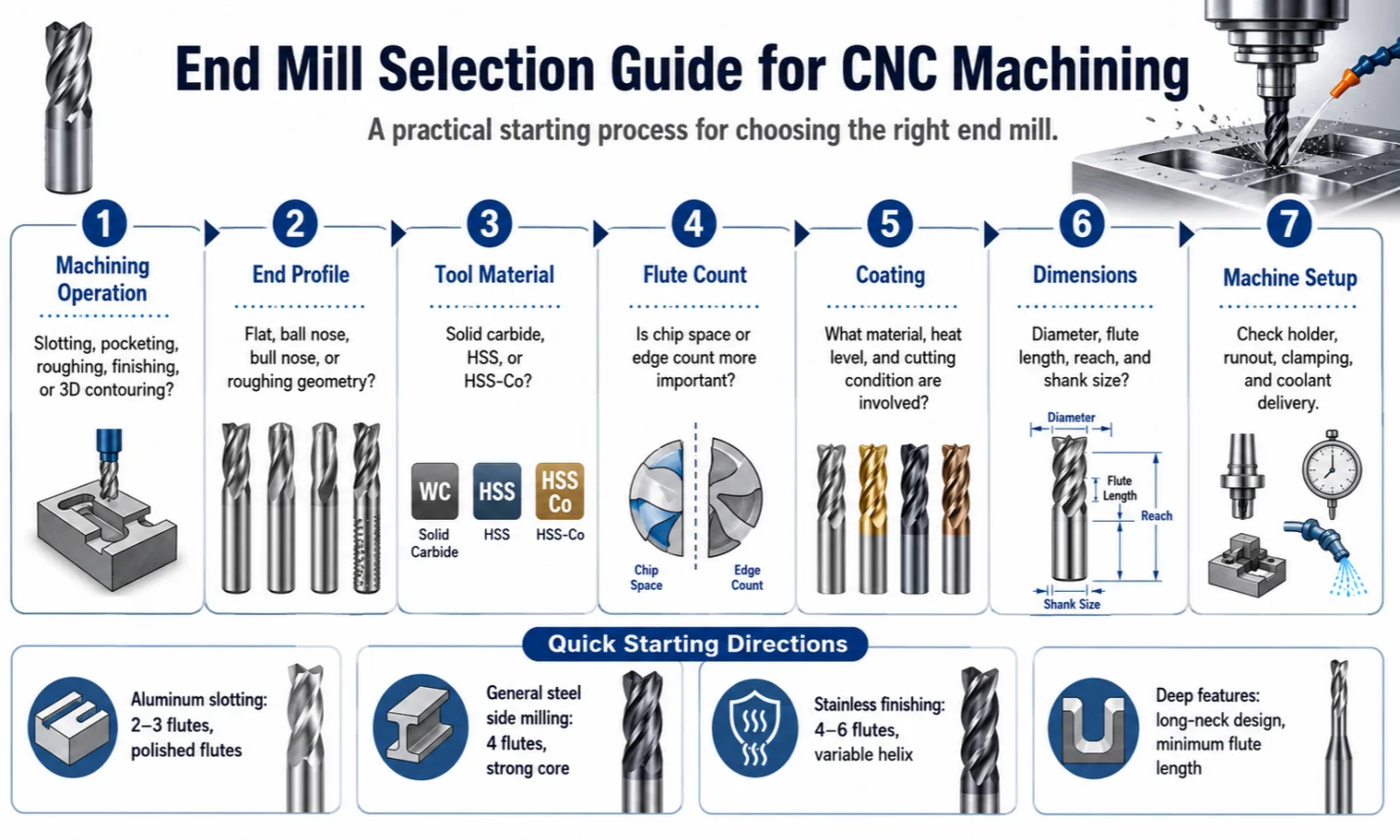
Etapa 1: Escolha uma fresa de topo por operação CNC
A operação de usinagem deve orientar a primeira decisão porque determina a direção de corte, volume de chips, noivado, e superfície necessária.
Entalhamento
A abertura de canais em toda a largura cria um alto volume de cavacos porque a fresa envolve o material em todo o seu diâmetro.
Ao cortar uma ranhura de largura total, priorize o espaço dos chips antes de aumentar a contagem de canais. Comece com menos canais quando os cavacos forem grandes ou a evacuação for difícil.
Uma ferramenta de ranhura adequada normalmente requer:
- Espaço suficiente para flauta
- Evacuação confiável de cavacos
- Um design de corte central quando é necessária entrada direta
- Balanço da ferramenta curto e estável
- Resistência da borda compatível com o material
Para alumínio ou outros materiais que produzem cavacos maiores, 2–3 flautas fornecem um ponto de partida prático. Para aço, a contagem final de canais também depende da profundidade da ranhura, engate radial, diâmetro do cortador, e refrigerante ou fornecimento de ar.
Se os chips permanecerem dentro do slot, não aumente imediatamente o avanço ou altere o revestimento. Primeiro verifique o espaço da flauta, profundidade de corte, direção do ar ou refrigerante, e balanço da ferramenta.
Fresamento de Bolso
O fresamento de bolsão pode combinar rampa, entrada helicoidal, corte lateral, engajamento de canto, e acabamento inferior.
Use uma fresa de topo com corte central quando a entrada programada exigir corte próximo ao centro da ferramenta. No entanto, o corte central não transforma uma fresa de topo em uma broca padrão. A geometria da ferramenta e a estratégia de entrada CAM devem suportar o movimento.
Bolsões profundos também precisam de remoção confiável de cavacos. Lascas presas podem ser recortadas, o que aumenta o calor e pode danificar a aresta de corte.
Quando o bolsão é profundo, mas a profundidade real de corte é curta, escolha uma ferramenta de pescoço longo em vez de uma fresa de topo com um canal desnecessariamente longo.
Fresamento lateral e perfilamento
O fresamento lateral carrega as arestas de corte externas. Como resultado, engate radial, rigidez do cortador, acabar, e a precisão da parede lateral tornam-se importantes.
Use uma fresa de topo plano para paredes e ombros retos. Escolha uma ferramenta bull nose ou raio de canto quando o canto externo precisar de mais força.
Para fresamento lateral de aço em geral, uma ferramenta de 4 canais fornece um equilíbrio prático entre a contagem de arestas, força central, e espaço para chips.
Para engate radial mais leve e acabamento estável, 5–6 canais podem aumentar o número de contatos de corte. No entanto, o escoamento de cavacos deve permanecer estável.
Desbaste
O desbaste produz uma alta carga de corte e volume de cavacos. Portanto, a fresa precisa de espaço suficiente no canal e uma estrutura de borda que possa lidar com o engate.
Para desbaste tradicional, escolha uma contagem de canais baixa ou média quando a remoção de cavacos for difícil. A geometria de desbaste ou quebra-cavacos divide os cavacos em seções menores e pode reduzir a resistência ao corte.
Para percursos de ferramenta dinâmicos ou trocoidais com engate radial mais leve, uma contagem maior de canais pode se tornar prática porque cada canal remove um cavaco menor enquanto a ferramenta segue um caminho de engate controlado.
A estratégia CAM, rigidez da máquina, condição de titular, e a geometria da ferramenta devem funcionar juntas. Uma ferramenta de desbaste de alto desempenho não consegue compensar uma fixação fraca ou balanço excessivo.
Acabamento
O acabamento requer geometria estável, desvio controlado, arestas de corte consistentes, e um perfil de ferramenta que corresponda à superfície necessária.
Quando o engate radial é leve e o escoamento de cavacos permanece estável, mais canais aumentam o número de contatos de corte e podem suportar um acabamento mais suave.
Antes de trocar o cortador, inspecionar:
- Desgaste de ponta
- Precisão do suporte
- Saliência da ferramenta
- Fixação da peça
- Consistência alimentar
- Formato de canto necessário
Uma ferramenta desgastada ou um suporte instável podem produzir um acabamento ruim mesmo quando a contagem de canais está correta.
3D Contorno e Usinagem de Moldes
As fresas de topo esféricas são amplamente utilizadas para superfícies curvas, cavidades de molde, morre, e acabamento 3D. Sua extremidade arredondada acompanha superfícies complexas com mais eficiência do que uma extremidade de corte plana.
As ferramentas Bull Nose são adequadas para semiacabamento e perfilamento quando cantos externos mais fortes são necessários. Seu raio de canto fortalece a aresta de corte, mantendo uma área central mais plana.
Para aço de molde endurecido, combinar a série de ferramentas com a dureza real da peça. Uma ferramenta destinada a materiais até HRC45 pode usar uma classe de metal duro diferente, preparação de borda, e revestimento de um projetado para HRC60 ou HRC65.
Etapa 2: Selecione o perfil final
| Perfil final | Recurso principal | Aplicação Comum |
|---|---|---|
| Fresa de topo plano | Extremidade de corte plana com cantos externos afiados | Caça-níqueis, bolsos, ombros, superfícies planas, e paredes laterais |
| Fresa de ponta esférica | Extremidade de corte totalmente arredondada | 3Contornos D, superfícies curvas, morre, e acabamento da cavidade do molde |
| Fresa de ponta de touro | Extremidade plana com cantos externos arredondados | Perfil, semi-acabamento, usinagem de moldes, e cantos mais fortes |
| Fresa de desbaste | Arestas de corte serrilhadas ou quebra-cavacos | Alta remoção de material e usinagem de desbaste |
| Fresa de topo com corte central | As arestas de corte estendem-se através ou perto do centro | Certas rampas, entrada helicoidal, e operações de entrada de bolso |
Selecione o perfil de acordo com a peça que está sendo usinada.
Uma fresa de topo plano produz recursos de fundo plano e paredes retas. Um cortador de ponta esférica segue superfícies curvas. Uma ferramenta de ponta arredondada fortalece o canto externo e geralmente é adequada para semiacabamento.
Uma fresa de topo com corte central pode suportar movimentos de entrada específicos, mas sua capacidade de mergulho depende da geometria central, diâmetro do cortador, material da peça, e percurso programado.
Para uma comparação mais detalhada, leia nosso Guia de tipos e usos de fresas de topo.
Etapa 3: Escolha Metal Duro ou HSS
O material da ferramenta afeta a rigidez, resistência, resistência ao desgaste, potencial de velocidade de corte, e custo.
Fresas de topo de metal duro
O metal duro sólido proporciona alta rigidez, boa resistência ao desgaste, e desempenho dimensional estável sob condições de usinagem adequadas.
Escolha metal duro quando a aplicação exigir:
- Usinagem CNC em velocidades de corte mais altas
- Precisão dimensional estável
- Aço, aço inoxidável, ferro fundido, ou usinagem de aço de molde
- Ciclos de produção mais longos
- Qualidade de superfície consistente
- Diâmetros de fresa pequenos ou médios com rigidez suficiente da máquina
O carboneto é menos tolerante ao impacto, esgotamento excessivo, fixação instável, e vibração severa. Portanto, a máquina e o suporte devem apoiar a ferramenta.
Para opções de metal duro, veja nosso página de produto da fresa de topo de metal duro.
Fresas de topo HSS e HSS-Co
HSS e cobalto HSS proporcionam maior tenacidade e podem tolerar melhor vibração ou corte interrompido em algumas aplicações.
Escolha HSS ou HSS-Co quando:
- A máquina funciona com uma velocidade de fuso mais baixa
- A configuração tem rigidez limitada
- O corte é interrompido
- É necessário um cortador personalizado maior
- A quantidade do pedido é pequena
- A tenacidade é mais importante do que a velocidade máxima de corte
Para uma máquina de baixa rigidez, HSS-Co pode tolerar melhor vibração e corte interrompido do que metal duro sólido. No entanto, o metal duro geralmente oferece maior rigidez e resistência ao desgaste quando a configuração é estável.
A escolha final deve refletir a máquina, peça de trabalho, tamanho do cortador, operação de corte, quantidade, e meta de custo.
Etapa 4: Escolha a contagem de flautas
A contagem de flautas altera o espaço do chip, força central, capacidade de alimentação, e o número de arestas de corte.
| Contagem de Flauta | Direção Geral de Seleção |
|---|---|
| 2 Flautas | Espaço máximo para chips; útil quando o escoamento de cavacos é a primeira prioridade |
| 3 Flautas | Equilíbrio entre espaço de chips, rigidez, e contagem de ponta |
| 4 Flautas | Direção comum para fresamento de aço em geral e corte lateral |
| 5–6 Flautas | Mais arestas de corte para fresamento lateral estável ou acabamento com engate controlado |
Use 2–3 canais quando o espaço do chip for a principal prioridade. Isso geralmente se aplica a ranhuras de alumínio, bolsos fundos, e operações que produzem chips maiores.
Usar 4 canais como um ponto de partida prático para muitas aplicações gerais de aço e fresamento lateral.
Escolha 5–6 canais quando o engate radial for mais leve, a máquina é rígida, e a evacuação de cavacos já está controlada.
Mais canais não tornam automaticamente uma ferramenta adequada para materiais mais duros. Em ranhuras de largura total, muitas flautas podem prender lascas e causar calor, dano de borda, ou quebra de ferramenta.
Para uma explicação mais profunda, leia nosso guia de seleção de canal de fresa de topo.
Para uma comparação direta, ler 2 flauta vs. 4 flauta vs. 6 moinho de extremidade de flauta.
Etapa 5: Escolha fresas de topo revestidas ou não revestidas
O revestimento afeta o atrito, resistência ao calor, resistência ao desgaste, adesão de materiais, e proteção de última geração.
Use a tabela a seguir como uma direção de seleção em vez de uma regra fixa.
| Direção da peça | Revestimento ou Direção da Superfície | Consideração principal |
|---|---|---|
| Alumínio e Materiais Não Ferrosos | Não revestido, Polido, DLC, ou revestimento de baixa fricção adequado | Reduza a adesão e suporte o fluxo de cavacos |
| Aço Carbono e Liga | TiAlN, AlTiN, ou revestimento resistente ao calor adequado | Resistência ao calor e proteção de bordas |
| Aço inoxidável | AlCrN, TiAlN, AlTiN, ou revestimento específico para aplicação | Aquecer, vestir, e estabilidade de corte |
| Compostos de Grafite e Abrasivos | Ferramentas revestidas de diamante | Resistência ao desgaste abrasivo |
| Aplicações gerais de baixa velocidade | Opções TiN ou Não Revestidas | Lubricidade e proteção geral contra desgaste |
Alumínio e Materiais Não Ferrosos
Para alumínio, comece com uma ponta afiada, flauta polida, e superfície não revestida ou de baixo atrito.
Um revestimento com alta resistência ao calor não é automaticamente adequado para alumínio. Se a superfície aumentar a adesão do material, pode ocorrer aresta postiça e baixo fluxo de cavacos.
Aço
Para aço carbono e liga, TiAlN, AlTiN, TiSiN, ou outro revestimento resistente ao calor adequado pode proteger a ponta.
À medida que a dureza da peça e a temperatura de corte aumentam, classe de metal duro, preparação de borda, e o revestimento tornam-se mais importantes.
Aço inoxidável
Para aço inoxidável, escolha um revestimento e uma geometria que suportem controle de calor e estabilidade de corte.
AlCrN, TiAlN, ou AlTiN pode fornecer instruções iniciais úteis, mas a escolha final deve corresponder ao grau de aço inoxidável, operação, contagem de flauta, condição do líquido refrigerante, e carga de corte.
Ferramentas revestidas de diamante
Fresas de topo com revestimento de diamante combinam com grafite, compósitos, materiais não ferrosos abrasivos, e outras aplicações específicas.
Não use revestimento de diamante como escolha universal para todos os metais. A química da peça e as condições de corte devem ser compatíveis.
O revestimento exato deve corresponder ao grau de metal duro, geometria da ferramenta, classe da peça, operação de corte, e condição do líquido refrigerante.
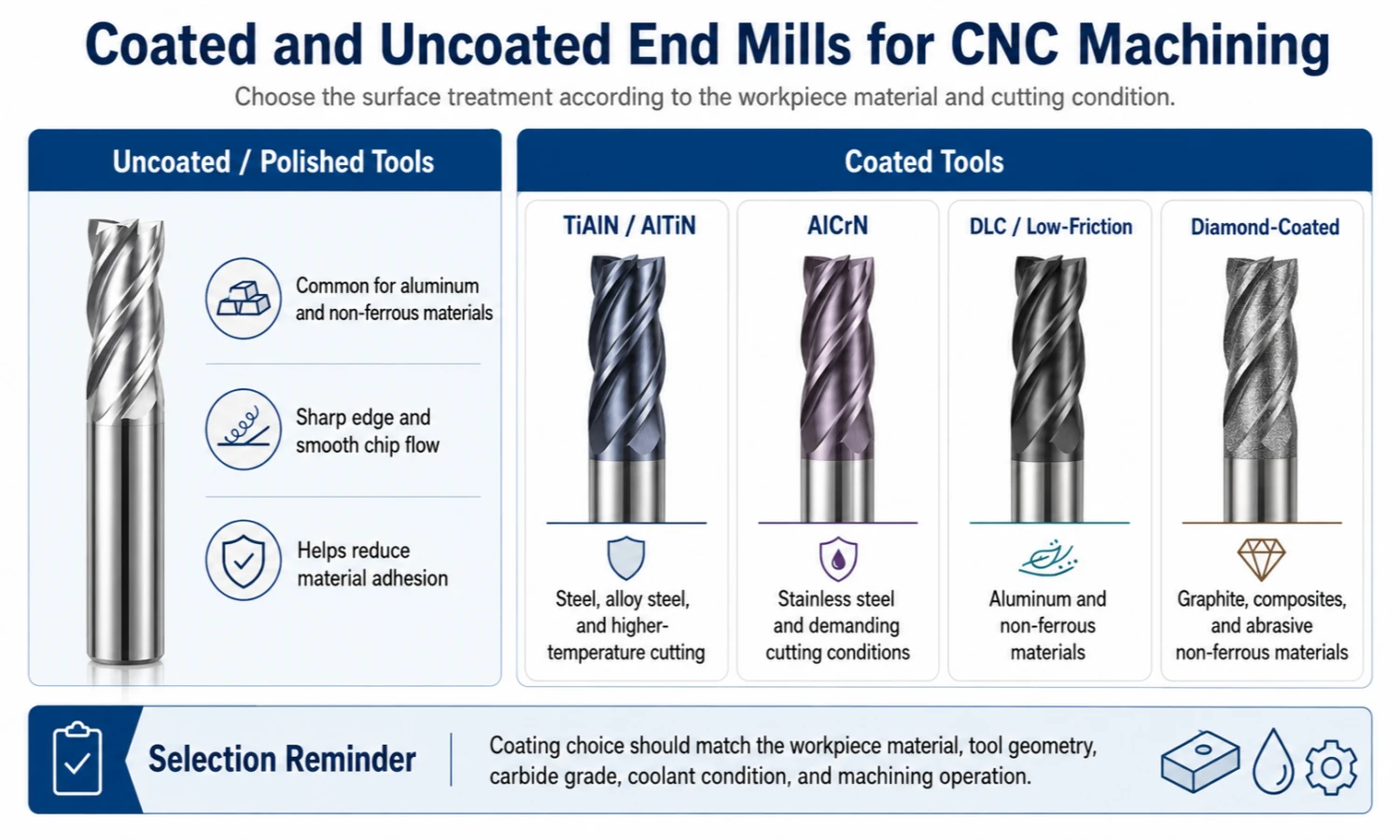
Etapa 6: Confirme dimensões e geometria
O diâmetro da fresa é apenas uma parte da especificação da ferramenta.
Antes de fazer o pedido, confirmar:
- Diâmetro do cortador
- Comprimento da flauta
- Comprimento total
- Diâmetro da haste
- Profundidade de usinagem necessária
- Alcance da ferramenta
- Raio de canto
- Ângulo de hélice
- Contagem de flauta
- Requisito de corte central
- Tolerância dimensional
Use a ferramenta prática mais curta que alcance a área de usinagem.
Se o alcance necessário for longo, mas a profundidade de corte for curta, escolha uma ferramenta de pescoço longo em vez de uma fresa de topo com um canal desnecessariamente longo. Uma seção de corte mais curta pode proporcionar melhor rigidez.
O comprimento excessivo do canal ou o comprimento total aumenta o risco de:
- Conversa
- Deflexão da ferramenta
- Erro dimensional
- Desgaste irregular
- Lascas de canto
- Quebra de ferramenta
Escolha uma fresa de topo personalizada quando as dimensões ou geometria padrão não puderem alcançar o recurso ou atender ao diâmetro necessário, raio do canto, tolerância, revestimento, ou destino do aplicativo.
Etapa 7: Verifique a máquina, Titular, e condições de fixação
A fresa de topo correta ainda pode funcionar mal em uma configuração instável.
Saliência da ferramenta
O balanço longo reduz a rigidez. Mantenha a ferramenta tão próxima do suporte quanto a profundidade de usinagem permitir.
Antes de alterar o revestimento ou a contagem de canais, verifique se o cortador se estende além do necessário.
Desaparecimento do suporte
O desvio pode fazer com que uma aresta de corte carregue mais carga do que as outras. Isso causa desgaste irregular e pode levar a um acabamento superficial ruim, lascar, ou falha prematura.
Inspecione o suporte, pinça, limpeza da haste, e assentamento da ferramenta quando um canal apresenta mais desgaste que os outros.
Rigidez da Máquina
Condição do fuso, precisão do suporte, estrutura da máquina, e fixação da peça afetam o resultado.
Uma ferramenta de metal duro rígido não consegue corrigir o movimento na peça de trabalho ou no suporte.
Entrega de chips e refrigerante
Ar ou líquido refrigerante devem atingir a área de corte.
A entrega deficiente pode deixar chips em bolsos profundos e slots. A ferramenta então recorta esses chips, o que aumenta o calor e danifica a borda.
Fixação da peça
O movimento na peça de trabalho pode parecer um problema de ferramenta.
Antes de trocar o cortador, confirme se o acessório segura a peça com segurança e se o percurso da ferramenta não cria vibração desnecessária.
Como o material da peça afeta a seleção da fresa de topo
O material da peça continua importante, mas deve ser considerado em conjunto com a operação de usinagem.
- O alumínio precisa de arestas vivas e espaço suficiente para cavacos.
- Aço carbono e ligas precisam de arestas de corte mais fortes e resistência ao desgaste.
- O aço inoxidável precisa de corte estável para controlar o calor e o endurecimento por trabalho.
- O ferro fundido precisa de boa resistência à abrasão.
- O molde e o aço para ferramentas requerem uma série de ferramentas que corresponda à dureza real.
- As ligas de titânio exigem controle cuidadoso do calor e engate estável.
Para seleção detalhada baseada em material, ler como escolher uma fresa de topo de metal duro.
Problemas de seleção e configuração de fresa final
| Sintoma | Possível causa | Primeira direção de ajuste |
|---|---|---|
| Pacote de fichas dentro do slot | Muitas flautas, espaço insuficiente para flauta, má evacuação de cavacos | Reduzir a contagem de flautas, melhorar o fornecimento de ar ou refrigerante, e verifique o comprimento da flauta |
| Quebra de ferramenta | Embalagem de chips, saliência excessiva, suporte instável, engajamento pesado | Melhorar a remoção de cavacos, encurtar o alcance, verifique a fixação, e reduzir o envolvimento instável |
| Marcas de conversa | Longa saliência, configuração fraca, forças de corte repetitivas | Encurte a ferramenta, melhorar a fixação, e considere a geometria de hélice variável |
| Mau acabamento superficial | Borda desgastada, acabar, alimentação instável, perfil final inadequado | Inspecione a ferramenta e o suporte, estabilizar o corte, e selecione o perfil correto |
| Desgaste rápido das bordas | Classe de metal duro errada, revestimento, ou condição de corte | Combine a classe e o revestimento com o material, dureza, aquecer, e operação |
| Lascas de canto | Canto agudo sob carga pesada, vibração, corte interrompido | Considere um raio de canto e melhore a estabilidade da configuração |
| Borda construída em alumínio | Alta fricção, borda opaca, superfície áspera da flauta, fluxo de cavacos fraco | Use geometria polida nítida e melhore o escoamento de cavacos |
Um problema de usinagem pode ter diversas causas. Alterar apenas o revestimento ou a contagem de canais pode não resolver.
Comece com a configuração, fluxo de cavacos, condição da ferramenta, e engajamento. Em seguida, avalie se a geometria da ferramenta precisa mudar.
Erros comuns na seleção de fresas de topo
Escolhendo apenas por diâmetro
Duas fresas de topo com o mesmo diâmetro podem ter comprimentos de canal diferentes, contagens de flauta, perfis finais, classes de metal duro, revestimentos, e aplicações.
Sempre revise a especificação completa.
Ignorando a evacuação de chips
A má evacuação de cavacos causa calor, recorte de cavacos, borda construída, conversa, e quebra de ferramenta.
Este problema é especialmente comum durante ranhuras de largura total, embolsando fundo, e usinagem de alumínio.
Usando muita saliência da ferramenta
O alcance excessivo reduz a rigidez.
Use a ferramenta mais curta que atinja com segurança a profundidade de usinagem. Se o recurso for profundo, considere um projeto de pescoço longo com o comprimento de corte mínimo necessário.
Escolhendo mais flautas sem verificar o espaço do chip
Mais arestas de corte melhoram a capacidade de avanço e a consistência da superfície quando o contato é leve e o fluxo de cavacos permanece estável.
Em entalhe profundo, no entanto, contagem excessiva de canais pode prender cavacos e danificar a fresa.
Escolhendo um revestimento apenas pelo nome
Um revestimento mais caro não é automaticamente melhor.
Combine o revestimento com o material, classe de metal duro, geometria, refrigerante, temperatura de corte, e operação.
Usando uma fresa de topo para cada operação
Um cortador de desbaste, ferramenta de acabamento, fresa de topo para entalhar, e o cortador de ponta esférica realizam trabalhos diferentes.
Escolha a fresa de topo de acordo com o recurso e o estágio de usinagem, em vez de usar uma ferramenta geral para cada operação.
Perguntas frequentes
Uma fresa de topo pode fazer um furo?
Algumas fresas de topo com corte central suportam rampa, entrada helicoidal, ou mergulho limitado. No entanto, eles não devem substituir automaticamente uma broca.
Confirme a geometria central, diâmetro do cortador, material da peça, e método de entrada programado antes de usar uma fresa de topo para entrada axial.
Devo escolher metal duro ou HSS para uma máquina de baixa rigidez?
HSS ou HSS-Co podem fornecer mais resistência e tolerância à vibração em uma máquina de velocidade mais baixa ou menos rígida.
O metal duro proporciona maior rigidez e resistência ao desgaste, mas precisa de um suporte estável, desvio controlado, e fixação confiável.
Por que uma fresa de topo quebra durante a abertura de canais?
As causas comuns incluem empacotamento de chips, contagem excessiva de flautas, muita saliência da ferramenta, fixação instável, engajamento pesado, e refrigerante ou fornecimento de ar deficiente.
Verifique o escoamento de cavacos e a estabilidade do setup antes de assumir que a classe de metal duro é o único problema.
Quando devo escolher uma fresa de topo de hélice variável?
Escolha geometria de hélice variável ou de passo desigual quando forças de corte repetitivas criam vibração durante o fresamento lateral, perfil, ou acabamento.
O design pode reduzir a vibração, mas ainda requer um suporte rígido e uma fixação estável da peça.
Quando devo usar uma fresa de topo de pescoço longo em vez de uma fresa de topo de canal longo?
Use uma ferramenta de pescoço longo quando o recurso precisar de alcance adicional, mas apenas uma seção de corte curta.
O comprimento reduzido do canal normalmente fornece mais suporte do que uma aresta de corte desnecessariamente longa.
Quais informações ajudam ao solicitar uma fresa de topo personalizada?
Envie as dimensões da ferramenta disponíveis, desenho, imagem do produto, material da peça, operação de usinagem, recurso necessário, modelo de ferramenta atual, quantidade, e qualquer problema de usinagem existente.
Você não precisa preparar todos os detalhes antes de entrar em contato com o fornecedor. Especificações ausentes podem ser confirmadas durante o processo de cotação.
Precisa de ajuda para selecionar a fresa de topo correta?
A fresa final direita depende da operação de usinagem, material da peça, forma de recurso, dimensões necessárias, configuração da máquina, e alvo de acabamento superficial.
Envie-nos o seu desenho, modelo de ferramenta, dimensões necessárias, imagem do produto, amostra, ou informações de usinagem disponíveis. Com 16 anos de experiência na fabricação de ferramentas de corte, podemos revisar a aplicação e ajudar a confirmar uma direção de ferramenta padrão ou personalizada adequada.
Veja nosso padrão e personalizado página de produto da fresa de topo.
Para discutir sua aplicação, envie-nos um e-mail para sales@cutterbest.com.