 Cortadores de fresagem de precisão,Ferramentas de corte para usinagem CNC de todos os materiais

Fresamento lateral vs fresamento frontal é principalmente uma questão de qual superfície ou recurso você precisa usinar.
O fresamento lateral utiliza principalmente as arestas de corte periféricas da fresa para usinar recursos como paredes verticais, ombros, ranhuras, e slots. Fresamento frontal, por contraste, produz principalmente amplas superfícies planas, com o eixo da fresa geralmente perpendicular à face usinada.
Estas operações resolvem diferentes problemas de usinagem. O fresamento lateral também se sobrepõe ao conceito mais amplo de fresamento periférico, embora a terminologia possa variar de acordo com o tipo de cortador, configuração da máquina, e aplicação.
Fresamento lateral vs fresamento frontal: Comparação Rápida
A tabela abaixo mostra as principais diferenças rapidamente.
| Fator | Fresamento lateral | Fresamento frontal |
|---|---|---|
| Objetivo principal | Recursos laterais da máquina e geometria localizada | Usine superfícies planas largas |
| Superfície ou recurso produzido | Paredes laterais, ombros, ranhuras, slots | Rostos planos, superfícies superiores, superfícies de referência |
| Área de corte principal | Arestas de corte principalmente periféricas | Principalmente arestas de corte na face da fresa |
| Relação do eixo do cortador | A superfície lateral gerada é geralmente paralela ao eixo do cortador | A face usinada é geralmente perpendicular ao eixo da fresa |
| Aplicações típicas | Paredes laterais, ombros, slots, ranhuras, perfis externos | Enfrentando, nivelamento, remoção de material planar, preparação de superfície |
| Tipo de cortador típico | Fresa lateral ou outra fresa periférica adequada | Cortador de fresagem de face |
| Melhor escolha quando | A geometria lateral é o principal requisito | Uma ampla superfície plana é o principal requisito |
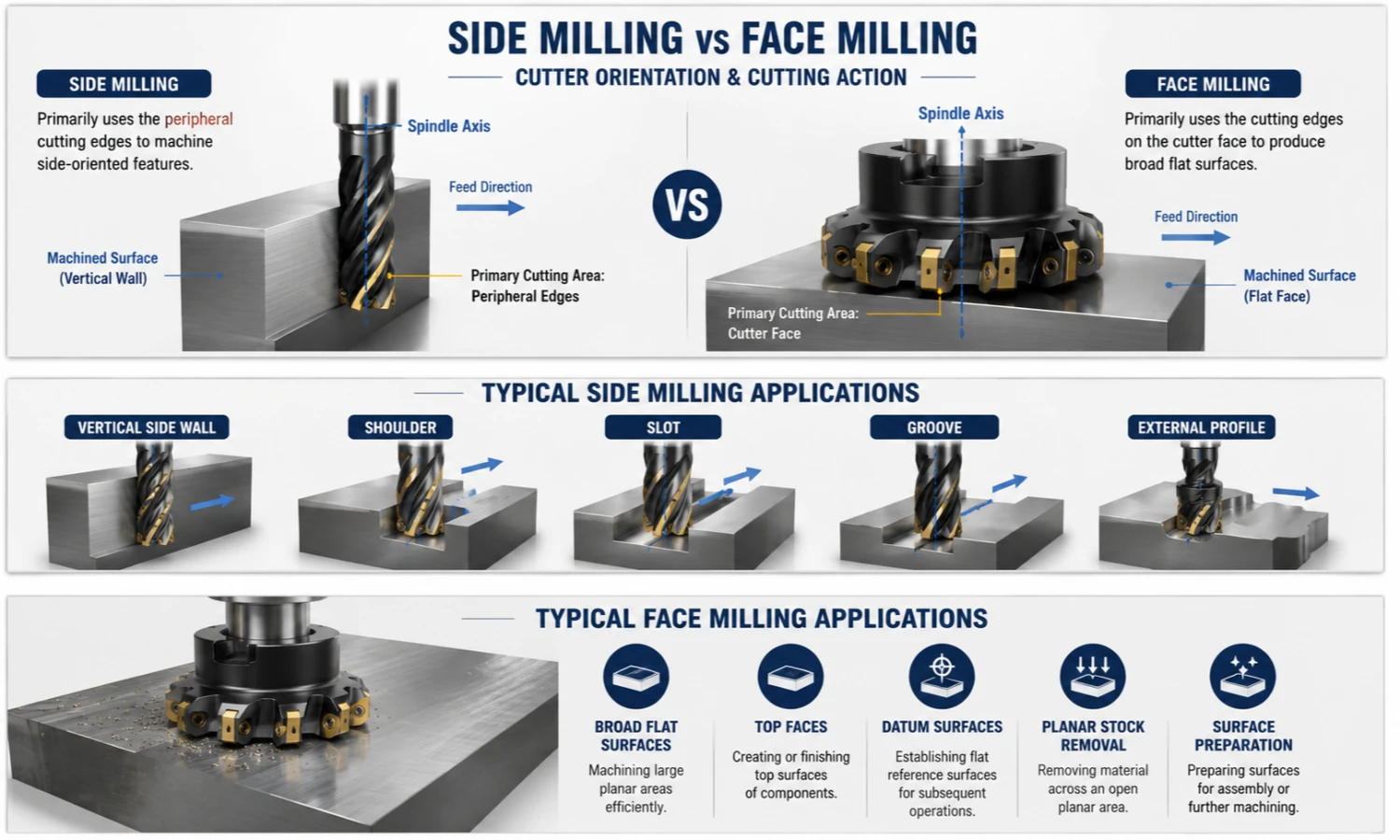
Esta comparação fornece um ponto de partida útil. No entanto, geometria da peça, acesso à ferramenta, rigidez da máquina, fixação de trabalho, e os requisitos de superfície podem afetar a escolha final.
O que é fresamento lateral?
O fresamento lateral é uma operação de fresamento em que as arestas de corte periféricas da fresa realizam a maior parte do trabalho no recurso alvo.. Portanto, é comumente usado quando uma peça requer usinagem ao longo de uma superfície lateral, em vez de através de uma grande face aberta.
O termo muitas vezes se sobrepõe ao fresamento periférico, em que o corte ocorre principalmente ao longo da circunferência da fresa. No entanto, os dois termos nem sempre devem ser tratados como sinônimos exatos porque o design e a aplicação da ferramenta podem afetar a forma como os fabricantes descrevem o processo.
Na prática, fresamento lateral é usado para criar ou finalizar recursos orientados lateralmente.
Aplicações típicas de fresamento lateral
As aplicações comuns de fresamento lateral incluem:
- Superfícies laterais verticais
- Ombros
- Caça-níqueis
- Sulcos
- Perfis externos
- Paredes de bolso acessíveis
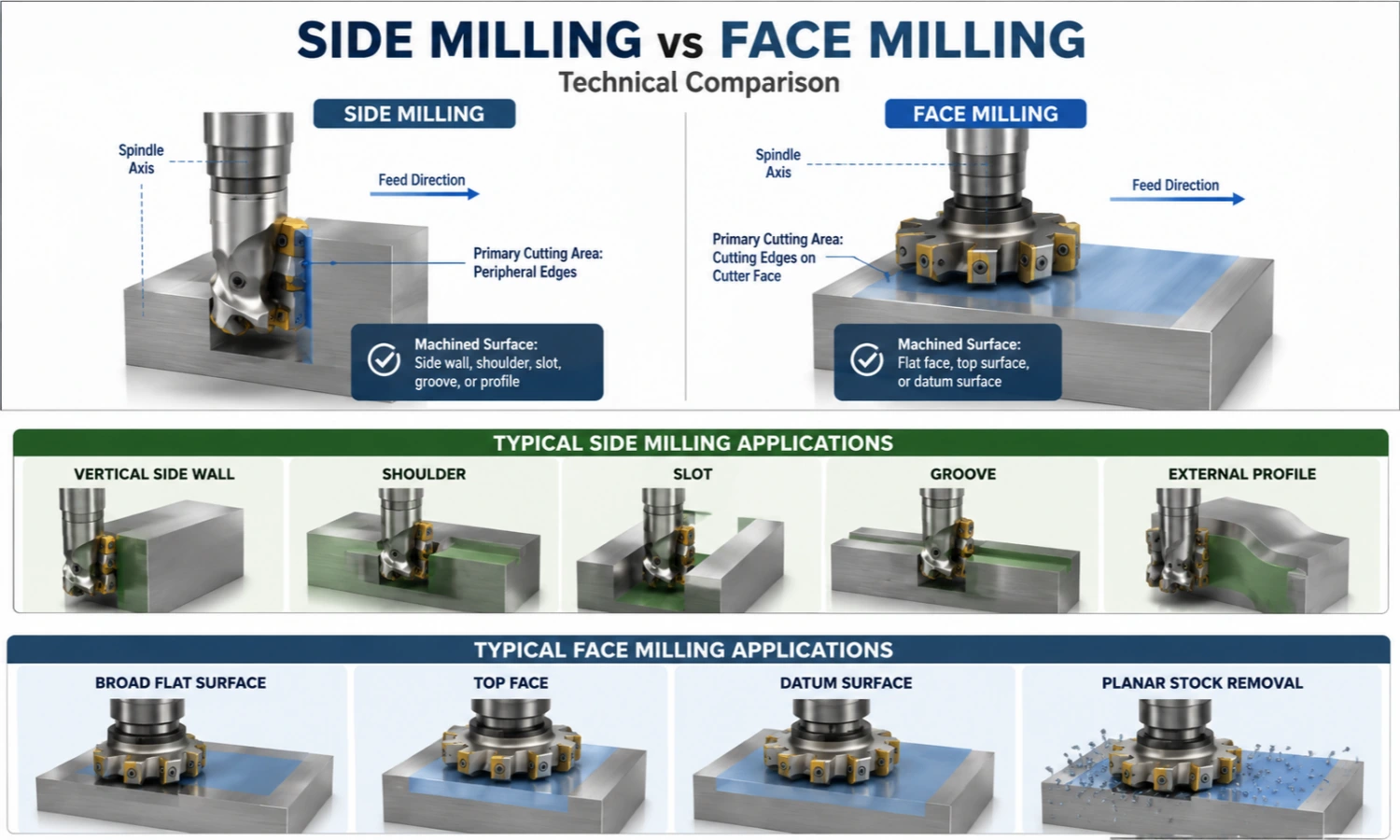
O fresamento lateral é particularmente útil quando o recurso requer geometria lateral controlada.
Para ranhuras, ombros, e outros recursos orientados para o lado, um dedicado Cortador de fresagem lateral pode fornecer uma configuração de ferramenta adequada para a operação.
O que é fresamento frontal?
O fresamento frontal produz principalmente uma superfície plana na face de uma peça de trabalho. Durante a operação, o eixo da fresa é geralmente perpendicular à superfície que está sendo usinada.
Porque o cortador pode cobrir uma área relativamente ampla, os maquinistas costumam usar fresamento de face para nivelar o material, preparando uma cara top, remoção de material de uma superfície plana aberta, ou estabelecer uma superfície de referência para operações posteriores.
No entanto, o fresamento de facear não deve ser avaliado apenas pelo acabamento superficial ou taxa de remoção de material. Diâmetro do cortador, geometria, material da peça, capacidade da máquina, fixação de trabalho, acabar, e as condições de corte podem afetar o resultado.
Aplicações típicas de fresamento frontal
As aplicações típicas incluem:
- Amplas superfícies planas
- Rostos principais
- Superfícies de referência
- Remoção de material planar
- Preparação de superfície
Estas aplicações são normalmente baseadas em uma superfície plana acessível.
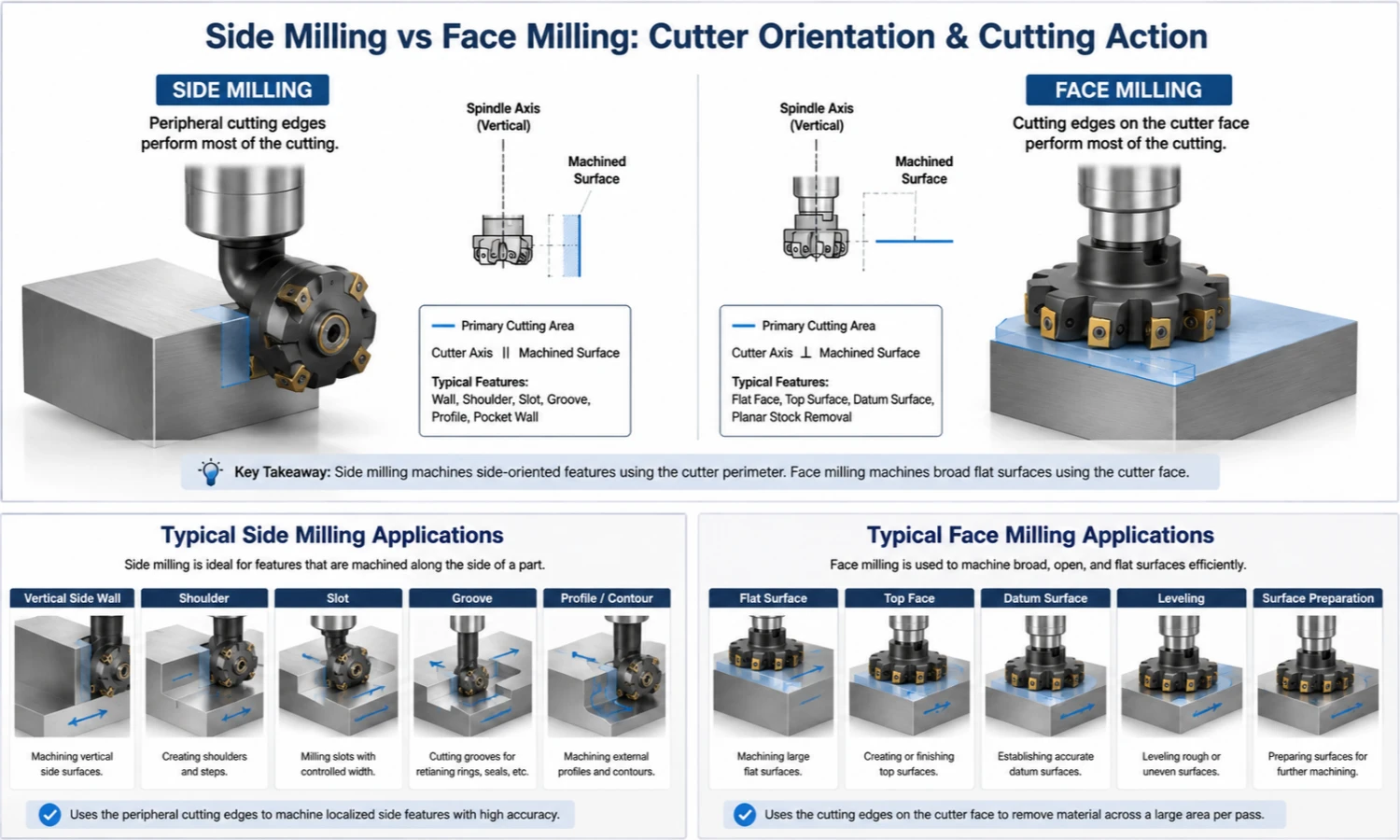
Para usinagem plana aberta, use um Cortador de fresagem de face selecionado para a cobertura de superfície necessária, acesso, e condições de usinagem.
Principais diferenças entre fresamento lateral e fresamento frontal
A comparação rápida mostra o que cada operação faz. Os pontos a seguir explicam por que eles se comportam de maneira diferente na prática.
1. Superfície usinada e geometria da peça
A geometria da peça é geralmente o primeiro fator a verificar.
O fresamento lateral combina com recursos que se estendem ao longo da lateral de uma peça. Estes podem incluir paredes verticais, ombros, ranhuras, slots, e perfis externos.
O fresamento frontal tem uma finalidade diferente. Geralmente é selecionado quando o desenho exige uma superfície plana aberta, face superior, ou dado.
Como resultado, o processo correto geralmente fica mais claro quando você identifica a orientação e o formato do recurso alvo.
2. Engajamento primário de ponta
No fresamento lateral, the peripheral cutting edges perform most of the cutting on the target surface.
In face milling, cutting edges positioned on the face of the cutter primarily generate the planar surface. Depending on the cutter geometry, other parts of the cutting edge may also participate.
Por esta razão, it is more accurate to describe the primary cutting action rather than assume that only one portion of the cutter ever contacts the workpiece.
3. Cutter Orientation and Tool Access
Tool access can change the best machining strategy even when the desired geometry looks simple on a drawing.
A broad, open face usually gives a face mill enough clearance to sweep across the surface. Em contraste, a deep shoulder, narrow groove, pocket wall, or localized side feature may require a cutter that can approach the feature from another direction.
Portanto, faça duas perguntas antes de escolher a operação:
- O cortador pode alcançar fisicamente o recurso?
- A máquina e o acessório podem suportar a direção de corte necessária?
Além disso, se o componente exigir um ombro verdadeiro de 90 graus, a geometria da fresa deve suportar esse recurso. Não se deve presumir automaticamente que uma fresa de facear geral produz todas as condições de canto quadrado.
4. Área de remoção de material e considerações de produtividade
O fresamento frontal geralmente funciona bem quando o material precisa ser removido através de uma ampla, superfície aberta porque um cortador maior pode cobrir mais área por passagem.
Fresamento lateral, por outro lado, concentra o corte ao longo das paredes, ranhuras, slots, ombros, e outros recursos localizados.
Isso não significa que uma operação seja sempre mais produtiva que a outra. A produtividade depende do tamanho do cortador, caminho da ferramenta, capacidade da máquina, rigidez da peça, fixação de trabalho, material, e a quantidade de estoque a ser removido.
Portanto, compare a tarefa de usinagem em vez de procurar um processo universalmente mais rápido.
5. Requisitos de superfície e dimensionais
As prioridades dimensionais também diferem.
Com fresagem lateral, os principais requisitos podem incluir:
- Posição da parede
- Dimensões laterais
- Largura do slot
- Geometria do ombro
- Precisão do perfil
Com fresamento frontal, as prioridades podem mudar para:
- Planicidade
- Qualidade de referência
- Consistência superficial
- Acabamento plano
No entanto, o fresamento frontal não garante automaticamente um melhor acabamento em todos os casos. A qualidade da superfície também depende da geometria da fresa, acabar, condição de ponta, parâmetros de usinagem, condição da máquina, e estabilidade de fixação.
Como escolher entre fresamento lateral e fresamento frontal
Um método prático de seleção começa com o recurso mostrado no desenho e não com a própria fresa.
Escolha fresamento lateral quando…
Considere o fresamento lateral quando a peça exigir:
- Uma parede vertical
- Uma ranhura
- Uma vaga
- Um ombro
- Um perfil lateral
- Usinagem localizada ao longo da lateral de um recurso
Este método é especialmente útil quando a geometria necessária não pode ser alcançada de forma eficiente ao passar uma fresa maior pela face superior.
Escolha o fresamento frontal quando…
O fresamento frontal é geralmente a escolha mais direta quando a tarefa envolve:
- Uma ampla superfície plana
- Nivelando uma face superior irregular
- Estabelecendo uma superfície de referência
- Removendo material em uma área plana
- Preparando uma superfície para usinagem posterior
Nessas situações, a operação corresponde à geometria do recurso e permite que a fresa trabalhe em uma área aberta.
Use ambas as operações quando a peça exigir recursos diferentes
Muitos componentes não requerem uma simples decisão de ou.
Por exemplo, uma peça pode precisar de uma superfície de referência plana junto com um ressalto, parede lateral, ou sulco. Nesta situação, fresamento frontal e fresamento lateral podem se complementar.
Uma sequência de usinagem pode estabelecer uma superfície plana antes de usinar recursos orientados lateralmente. No entanto, a ordem preferida depende da estratégia de referência, configurar, fixação de trabalho, requisitos de tolerância, e estabilidade da peça.
Portanto, fresamento lateral e faceamento são frequentemente operações complementares em vez de operações concorrentes.
Combinando a operação de fresamento com o tipo de fresa correto
Assim que a operação necessária estiver clara, a seleção do cortador fica mais fácil.
| Recurso de peça | Direção de fresagem | Direção típica do cortador |
| Parede, slot, sulco, ombro | Fresamento lateral | Cortador projetado para corte lateral ou periférico |
| Face plana larga ou superfície de referência | Fresamento frontal | Fresa projetada para fresamento frontal |
| Recursos planos e laterais em uma peça | Operações combinadas | Use cada cortador para o recurso pretendido |
Para recursos orientados lateralmente, selecione uma fresa adequada para recursos orientados lateralmente de acordo com a largura necessária, acesso, geometria do recurso, e condições de usinagem.
Para usinagem plana ampla, uma fresa intercambiável para usinagem plana aberta pode ser adequado quando a peça fornece acesso suficiente para a operação.
Em qualquer caso, a escolha final da ferramenta também deve considerar o material da peça, capacidade da máquina, fixação de trabalho, espaço disponível, e requisitos de desenho.
Fatores de seleção que podem mudar a melhor escolha
A geometria da peça fornece o ponto de partida; as condições de configuração determinam se essa escolha inicial é prática.
Não use um cortador para cada recurso. Uma ferramenta que tecnicamente consegue atingir diversas superfícies pode não ser a opção mais adequada para cada uma delas.
Não escolha apenas pela taxa de remoção de material. Uma alta taxa de remoção terá valor limitado se a fresa não conseguir alcançar a peça adequadamente ou controlar a geometria necessária.
Verifique o acesso à ferramenta, fixação de trabalho, e rigidez da máquina. Acesso limitado, longo alcance, ou fixação fraca pode influenciar tanto a operação quanto a escolha da fresa.
Não presuma que o fresamento frontal sempre proporciona o melhor acabamento. O processo selecionado deve primeiro corresponder à superfície alvo. Então a geometria do cortador, condições de corte, estabilidade da máquina, e fixação influenciarão o resultado final.
Fresamento lateral vs fresamento frontal: Qual você deve escolher?
Use o recurso da peça como guia de decisão final:
- Superfície plana ampla ou face de referência → Fresamento de face
- Parede, ombro, slot, sulco, ou perfil lateral → Fresamento lateral
- Recursos planos e verticais → Combine as duas operações quando apropriado
Ao comparar fresamento lateral vs fresamento frontal, a escolha certa depende primeiro da geometria da peça e depois do acesso à ferramenta, fixação de trabalho, capacidade da máquina, e requisitos de superfície.
Se precisar de ajuda para combinar um cortador com seu desenho, material, e requisitos de usinagem, envie os detalhes da inscrição para sales@cutterbest.com para uma recomendação de ferramentas.
Perguntas frequentes
Qual é a principal diferença entre fresamento lateral e faceamento?
A principal diferença é o recurso que está sendo usinado e a ação de corte primária. O fresamento lateral utiliza principalmente arestas de corte periféricas para criar recursos orientados lateralmente, como paredes, ombros, slots, e sulcos. O fresamento frontal cria principalmente superfícies planas amplas, com o eixo da fresa geralmente perpendicular à face usinada.
Como o fresamento lateral está relacionado ao fresamento periférico?
O fresamento lateral se sobrepõe ao conceito mais amplo de fresamento periférico porque ambos dependem principalmente de arestas de corte ao redor da circunferência da fresa. No entanto, a terminologia pode variar de acordo com o tipo de cortador e aplicação. Neste guia, fresamento lateral refere-se principalmente à usinagem de recursos de peças orientadas para o lado.
Como o fresamento lateral está relacionado ao fresamento de topo?
Uma fresa de topo pode realizar corte lateral usando suas arestas periféricas, portanto, o fresamento de topo pode incluir operações de fresamento lateral. No entanto, fresas de topo também podem realizar bolsões, perfil, rampa, e alguns cortes faciais locais. Portanto, o fresamento lateral não deve ser tratado como idêntico a todas as operações de fresamento de topo.
O fresamento lateral e o fresamento frontal podem ser usados na mesma peça??
Sim. Muitas peças contêm recursos planos e orientados lateralmente. O fresamento frontal pode criar uma referência plana ou superfície superior, enquanto o fresamento lateral pode usinar paredes, ombros, ranhuras, ou slots. A sequência exata depende do design da peça, estratégia de dados, configurar, e requisitos de tolerância.
Quando o fresamento de facear é preferido para acabamento superficial?
O fresamento frontal é frequentemente preferido quando o alvo é uma área aberta, ampla superfície plana que requer planicidade consistente ou aparência de superfície. No entanto, o acabamento real também depende da geometria da fresa, acabar, condição de ponta, parâmetros de usinagem, material, condição da máquina, e fixação de trabalho.