 Freze de precizie,Scule de tăiere pentru prelucrarea CNC a fiecărui material

O freză de tăiere este o unealtă de tăiere rotativă utilizată la frezarea CNC pentru a îndepărta materialul de la capătul și partea laterală a piesei de prelucrat. Poate mașina sloturi, buzunare, profiluri, pereții laterali, suprafete curbate, și caracteristici de finisare în materiale precum aluminiul, oţel, oțel inoxidabil, cupru, si materiale plastice.
În acest ghid, veți învăța ce este o freză cu cap, cum diferă de un burghiu, ce face la frezarea CNC, tipuri comune de tăietori, specificatii de baza, și cum să alegeți unealta potrivită pentru diferite aplicații de prelucrare.
Ce este o freză de tăiat?
O freză de tăiere este o unealtă de tăiere rotativă utilizată pe mașinile CNC și mașinile de frezat. Se rotește cu viteză mare în timp ce unealta sau piesa de prelucrat se mișcă pe o cale controlată pentru a îndepărta materialul.
Principala diferență dintre o freză de tăiere și multe alte unelte este geometria sa de tăiere. Most end mills have cutting edges on the end and along the sides. Prin urmare, they can cut vertically and laterally. This makes them suitable for slotting, frezare laterală, profilare, frezarea buzunarului, conturarea, si finisare.
Manufacturers commonly make end mill cutters from high-speed steel or solid carbide. Cu toate acestea, many CNC machine shops choose solid carbide tools because they offer better rigidity, higher wear resistance, and more stable cutting performance.
If you need standard or custom tools for production machining, ne puteti vizita si pagina produsului freza de freza.
Main Parts of an End Mill Cutter
Although end mill cutters come in different shapes and designs, most tools include several basic parts. Understanding these parts helps buyers choose the right cutter for their material, maşină, și obiectivul de prelucrare.
| Part | Funcţie | De ce contează |
| Cutting edges | Remove material from the workpiece | Affect cutting efficiency and surface finish |
| Fluiere | Help evacuate chips during machining | Influence chip removal, rigiditate, și stabilitate de tăiere |
| Tool tip | Defines the end geometry of the cutter | Affects slotting, conturarea, finisare, and corner strength |
| Gambă | Held by the tool holder or spindle | Must match the holder for stable clamping |
| Înveliș | Protects the cutting edge during machining | Improves wear resistance, rezistenta la caldura, și durata de viață a sculei |
Cutting Edges
The cutting edges are the working part of the tool. They remove material during milling and directly affect cutting performance, accuracy, și finisarea suprafeței.
Fluiere
Flutes are the grooves along the body of the cutter. They help remove chips from the cutting area. în plus, flute design affects rigidity, heat control, și stabilitate de tăiere.
Tool Tip
The tool tip design depends on the cutter type. Some end mills have flat ends, while others have ball nose, raza colțului, or tapered geometry. Ca urmare, different tip designs are used for different machining tasks.
Gambă
The shank is the part held by the tool holder or spindle. Its diameter must match the holder correctly. Altfel, vibratie, poor accuracy, or tool runout may occur.
Înveliș
Many end mill cutters use coatings such as TiAlN, Altin, TiSiN, Cositor, DLC, or Nano blue coating. The right coating can improve heat resistance, reduce uzura, and extend tool life.
End Mill Cutter vs Drill Bit
Many beginners confuse an end mill cutter with a drill bit. Cu toate acestea, they are designed for different machining purposes.
A drill bit mainly cuts in the axial direction to create round holes. Prin contrast, an end mill cutter can cut both axially and laterally. Prin urmare, it can machine slots, buzunare, contururi, profiluri, pereții laterali, and finished surfaces.
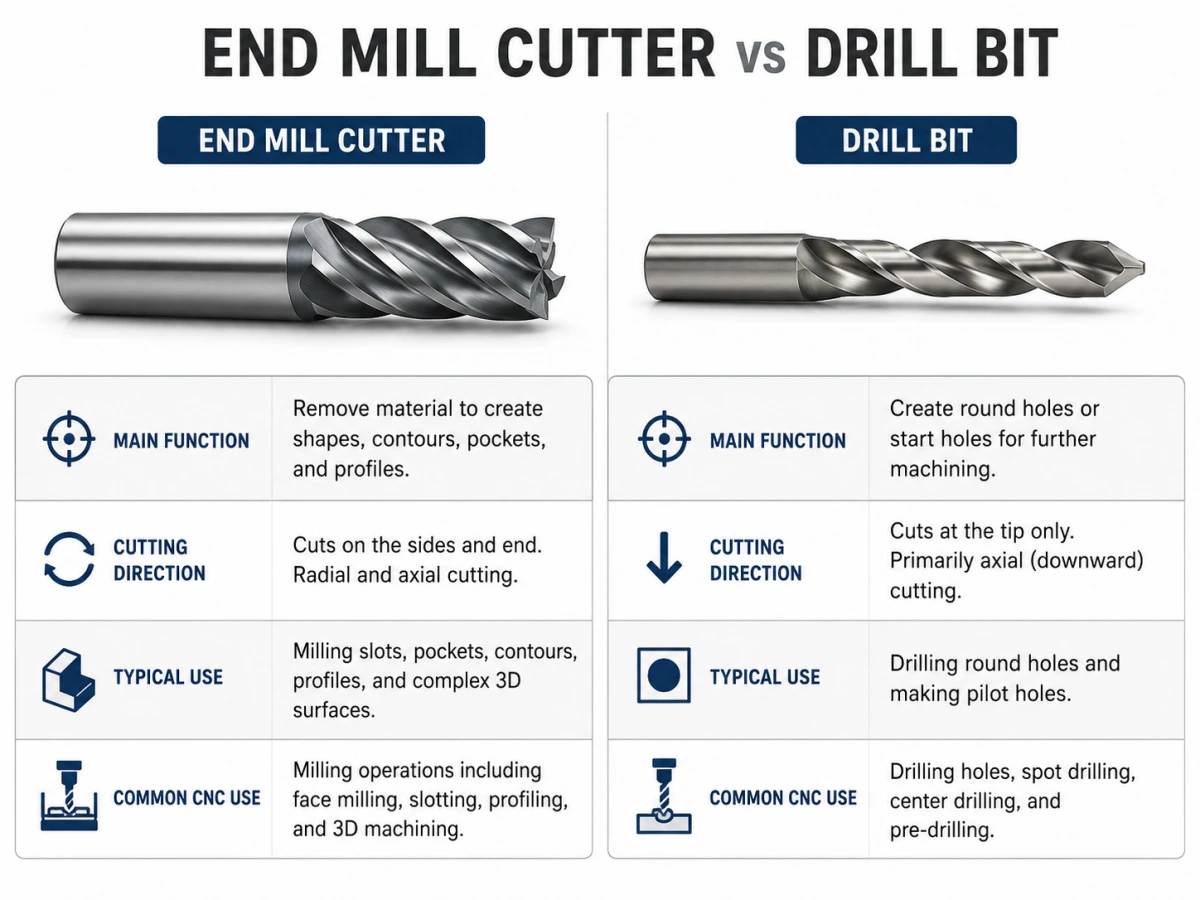
| Caracteristică | Freză de mașină | Burghiu |
| Main function | Milling, sloting, profilare, side cutting | Drilling holes |
| Direcția de tăiere | Axial and lateral | Mainly axial |
| Utilizare tipică | Sloturi, buzunare, contururi, pereții laterali | Round holes |
| Tool flexibility | Superior | Lower |
| Common CNC use | General milling operations | Hole-making operations |
În scurt, both tools remove material, but they are not interchangeable in most machining situations. A center-cutting end mill can plunge in some applications, but it is still not the same as a standard drill bit.
Common Types of End Mill Cutters
There are many types of end mill cutters, and each design has a specific purpose. Choosing the right type helps improve cutting efficiency, calitatea suprafeței, și durata de viață a sculei.
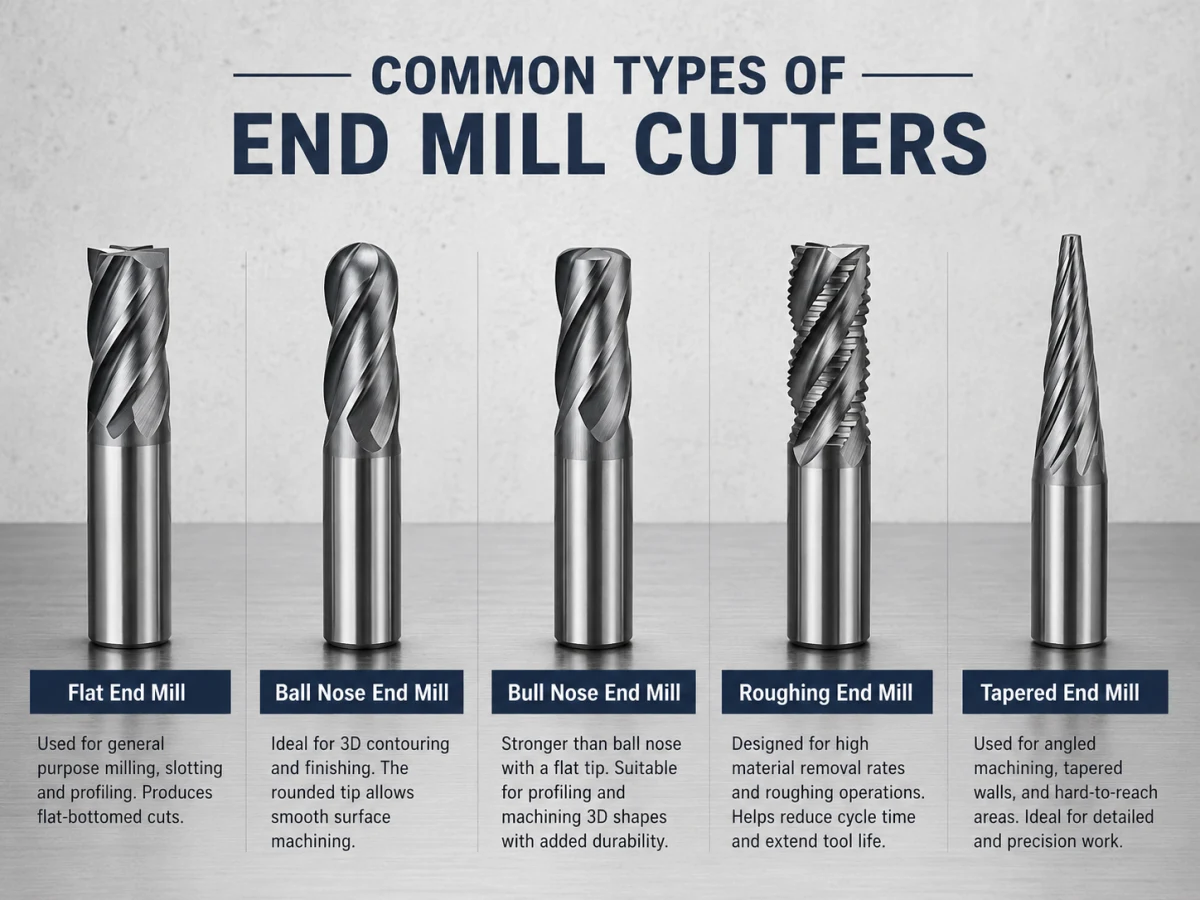
Moara plată
A flat end mill has a flat cutting end. It is widely used for slotting, frezare laterală, frezarea umărului, și prelucrare de uz general.
Moara de capăt cu nas bilă
A ball nose end mill has a rounded cutting end. It is commonly used for 3D contouring, prelucrarea matrițelor, suprafete curbate, și operațiuni de finisare.
For curved surface machining and mold work, de asemenea, puteți vizualiza freze cu cap bilă.
Taur Nose End Mill
A bull nose end mill, also called a corner radius end mill, combines a flat bottom with rounded corners. It improves edge strength and helps create smoother transitions.
For stronger corner geometry, vezi noastre moara cu nas de taur.
Moara de degroșare
A roughing end mill is designed for aggressive material removal. It is often used before finishing to remove large amounts of stock quickly.
For heavy stock removal, ne puteti verifica freze de degroșare.
Freză conică
A tapered end mill has a gradually changing diameter. It is used for angled walls, cavități profunde, prelucrarea matrițelor, and special profiles.
For mold cavities and angled machining, vizitați-ne Tăietor conic.
For a more detailed comparison of tool geometries, citeste-ne end mill cutter types guide.
Pentru ce este folosit un freza de freza?
End mill cutters are used in many CNC milling operations. Because they can cut from the end and the side, they are suitable for both simple and complex machining tasks.
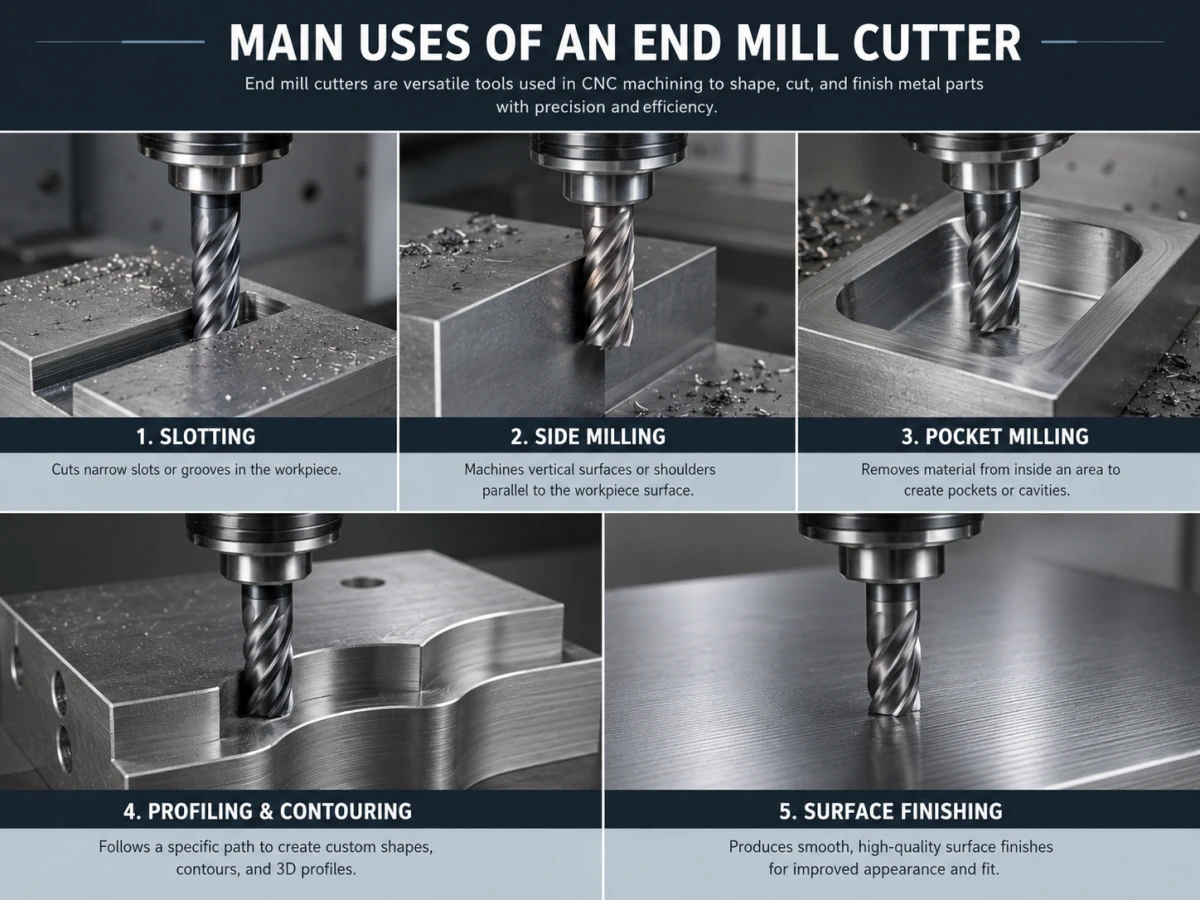
Slotting
Slotting is one of the most common applications. An end mill cutter can cut straight or curved slots into a workpiece with good accuracy. These slots can create keyways, caneluri, piste de ghidare, and assembly features.
For softer materials such as aluminum, chip evacuation is important. Prin urmare, machinists often select 2 flute tools when the workpiece needs better chip removal.
Frezare laterală
Side milling uses the side cutting edges of the tool to remove material from the vertical surface of a workpiece. This operation is useful for machining shoulders, trepte, and side walls.
Machine shops commonly use side milling for precision parts, mold components, tooling parts, and general CNC production.
Profilare și conturare
Machinists also use end mill cutters for profiling and contouring. These operations create complex shapes, curved paths, and external or internal profiles.
Machinists often select ball nose and corner radius tools for this kind of work because these tools can improve surface transitions and finishing quality.
Frezarea buzunarului
Pocket milling removes material from a closed or recessed area inside a workpiece. This operation is common in parts that need internal cavities, weight reduction, sau îndepărtarea precisă a materialului într-o zonă limitată.
Good chip control, stable tool paths, and the correct cutter geometry are important for this process.
Finisarea suprafetei
After rough machining, an end mill cutter can also be used for finishing. The goal is to improve dimensional accuracy and surface smoothness.
Finishing tools are selected according to tolerance, materialul piesei de prelucrat, stabilitatea mașinii, și calitatea suprafeței cerută.
Frezare în trepte și prelucrare cu umăr
End mill cutters can machine stepped surfaces, umerii, și caracteristici pe mai multe niveluri. These features often require sharp transitions, stable cutting, and accurate dimensions.
Ca urmare, rigiditatea sculei, design flaut, and coating selection are important.
End Mill Cutter Uses for Aluminum, Oțel, și oțel inoxidabil
Different workpiece materials require different cutter designs. Prin urmare, buyers should match the end mill cutter to the material and machining condition.
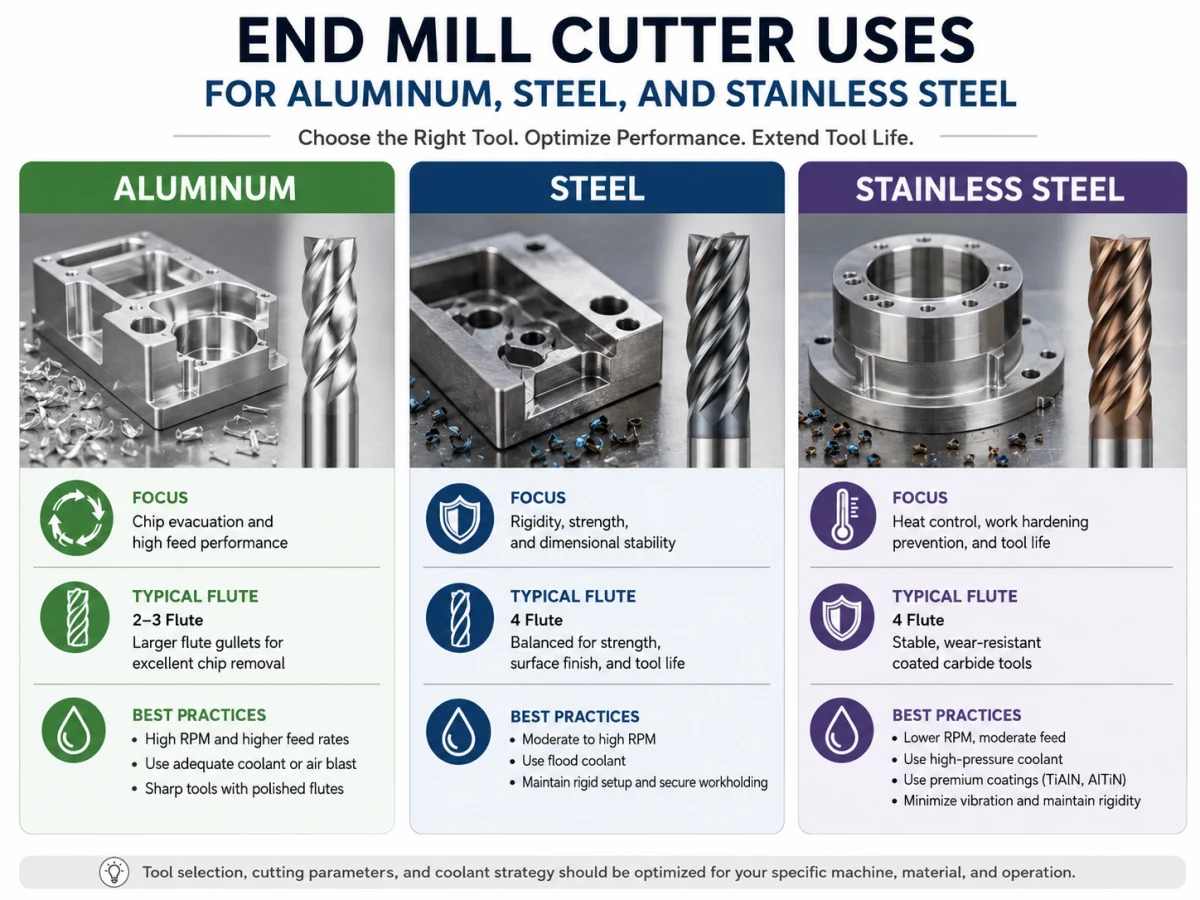
| Materialul piesei de prelucrat | Common Cutter Choice | Motivul principal |
| Aluminiu | 2 flaut sau 3 freză de capăt din carbură de flute | Better chip evacuation and smooth cutting |
| Oțel | 4 flute carbide end mill with suitable coating | Better rigidity and wear resistance |
| Oţel inoxidabil | Coated carbide end mill with stable geometry | Better heat control and edge protection |
| Cupru și alamă | Sharp edge carbide end mill | Clean cutting and reduced burrs |
| Materiale plastice | Sharp, polished flute cutter | Smooth chip removal and lower melting risk |
Freză pentru aluminiu
La prelucrarea aluminiului, end mill cutters are used for slotting, frezarea buzunarului, frezare laterală, si finisare. Aluminiul produce așchii mai mari, astfel încât instrumentele cu mai puține caneluri și o bună evacuare a așchiilor sunt adesea preferate.
Frezele din carbură cu helix înalt sunt, de asemenea, comune pentru aluminiu, deoarece ajută la îmbunătățirea netezimii tăierii și la reducerea acumulării de așchii.
Pentru aluminiu și materiale neferoase, puteți compara opțiunile de flaut pe nostru 2 Freză de capăt pentru caneluri şi 3 Freză de capăt pentru caneluri pagini.
Freză pentru oțel
Pentru oțel carbon și oțel aliat, frezele de freza sunt adesea folosite pentru frezarea laterală, conturarea, prelucrarea umărului, și semifinisare. Oțelul necesită de obicei o rigiditate mai bună și o rezistență mai mare la uzură.
În multe cazuri, 4 Freze din carbură cu caneluri sunt selectate pentru prelucrarea oțelului și a metalelor de uz general.
Pentru prelucrarea oțelului, ne puteti vizualiza 4 Freză de capăt pentru caneluri.
Freză de tăiere pentru oțel inoxidabil
Oțelul inoxidabil este mai dificil de prelucrat deoarece generează căldură și tinde să provoace uzura sculei. În aplicații din oțel inoxidabil, frezele de freza sunt utilizate în mod obișnuit pentru profilare, finisare, și frezare laterală controlată.
Acoperirea potrivită, geometria flautului, iar parametrii de tăiere ajută la menținerea stabilității de tăiere și la reducerea uzurii marginilor.
How to Choose a Basic End Mill Cutter
Choosing an end mill cutter does not need to be complicated. Cu toate acestea, buyers should check several factors before ordering.
Materialul piesei de prelucrat
The workpiece material is one of the most important factors. Aluminiu, oţel, oțel inoxidabil, cupru, alamă, materiale plastice, and cast iron may require different flute designs, acoperiri, and cutting strategies.
Numărul de flaute
Numărul de flaut afectează evacuarea așchiilor, rigiditate, and cutting efficiency. De exemplu, machinists often use 2 flute tools for aluminum, while they commonly choose 4 flute tools for steel and general-purpose machining.
Pentru o comparație mai profundă, citeste-ne 2 flaut vs 4 flute end mill guide.
Material pentru scule
Many CNC machine shops choose solid carbide end mill cutters because they provide higher rigidity, rezistență mai bună la uzură, and stable performance. Some workshops still use HSS tools for lower-speed or general machining applications.
Înveliș
The coating should match the material and machining condition. De exemplu, machinists often choose TiAlN and AlTiN coatings for steel, while DLC coating may suit aluminum and non-ferrous materials.
Required Finish
For roughing operations, the main goal is higher material removal. Cu toate acestea, for finishing work, surface quality and dimensional accuracy become more important.
Basic Specifications to Check Before Buying
Before placing an order, buyers should confirm several key specifications. This helps avoid tool mismatch and improves machining stability.
Diametrul tăietorului
Cutter diameter affects cutting width, rigiditate, and the size of the machined feature.
Lungimea flautului
Flute length determines how deep the cutter can machine. Cu toate acestea, a longer flute may reduce rigidity, so it should match the actual cutting depth.
Lungimea totală
Overall length affects tool reach and vibration control. A longer tool may be needed for deep cavities, but it should be used carefully to reduce chatter.
Diametrul tijei
Shank diameter must match the holder correctly. Stable clamping helps improve accuracy and tool life.
Corner Geometry
Plat, nas de minge, raza colțului, and tapered geometries are used for different machining goals. Prin urmare, corner geometry should match the part shape and required finish.
Coating Type
The coating should be selected according to the workpiece material, viteza de taiere, starea lichidului de răcire, and tool life requirement.
Why Solid Carbide End Mill Cutters Are Common in CNC Milling
Solid carbide end mill cutters are popular because they offer strong rigidity, high hardness, and good wear resistance. They can support higher cutting speeds and provide more stable performance than many standard tool materials.
In production machining, many shops use carbide tools for steel, oțel inoxidabil, fontă, aluminiu, și alte materiale solicitante. în plus, the right geometry and coating can improve machining consistency.
Industrial buyers, distribuitori, and machine shops often prefer carbide tools because they help reduce tool changes and support more stable production.
For standard and custom carbide tools, you can visit our carbide end mill cutter pape.
When Do You Need a Custom End Mill Cutter?
A standard cutter can solve many common machining tasks.
Cu toate acestea, you may need custom tooling when the part has a special profile, deep cavity, unusual material, strict tolerance, or non-standard size requirement.
Manufacturers can design custom end mill cutters with special diameter, lungimea flautului, lungime totală, raza colțului, acoperire, dimensiunea tijei, și geometria sculei.
For drawing-based or OEM tooling, vizitați-ne custom end mills pape.
FAQ
What is an end mill cutter?
An end mill cutter is a rotary cutting tool used for CNC milling operations such as slotting, frezare laterală, profilare, conturarea, frezarea buzunarului, si finisare.
What is an end mill cutter used for?
It is used to remove material from the end and side of a workpiece. Common applications include slots, buzunare, pereții laterali, profiluri, umerii, suprafete curbate, and finished surfaces.
What is the difference between an end mill cutter and a drill bit?
A drill bit mainly cuts holes in the axial direction. An end mill cutter can cut axially and laterally, so it can perform more milling operations such as slotting, profilare, si frezare laterala.
What are the common types of end mill cutters?
Common types include flat end mills, freze cu cap bilă, bull nose end mills, freze de degroșare, tapered end mills, 2 freze cu cap de flaut, 3 freze cu cap de flaut, 4 freze cu cap de flaut, şi 6 freze cu cap de flaut.
How do I choose a basic end mill cutter?
You should check the workpiece material, număr de flaut, diametrul tăietorului, lungimea flautului, lungime totală, diametrul tijei, material pentru scule, acoperire, și finisarea necesară a suprafeței.
Are carbide end mill cutters better than HSS end mills?
Carbide end mill cutters usually provide better rigidity, rezistenta la uzura, și stabilitate de tăiere. Cu toate acestea, the best choice depends on the machine, materialul piesei de prelucrat, viteza de taiere, and budget.
Concluzie
An end mill cutter is a versatile CNC milling tool used for slotting, frezare laterală, frezarea buzunarului, profilare, conturarea, prelucrarea umărului, si finisare. Because it can cut from both the end and the side, it is more flexible than many basic cutting tools.
Pentru a alege cutterul potrivit, cumpărătorii ar trebui să înțeleagă structura instrumentului, tip cutter, număr de flaut, material, acoperire, diametru, lungimea flautului, și aplicație de prelucrare. Odată ce acești factori sunt potriviți corect, freza poate oferi o eficiență de tăiere mai bună, durata de viata mai lunga a sculei, și rezultate de prelucrare mai stabile.
Căutăm un producător de încredere de freze pentru aluminiu, oţel, oțel inoxidabil, sau prelucrare CNC personalizată?
Explorați-ne pagina produsului freza de freza pentru soluții standard și OEM, sau contactați-ne cu cerințele pentru desen și aplicație.