 หัวกัดที่มีความแม่นยํา,เครื่องมือตัดสําหรับเครื่องจักรกลซีเอ็นซีทุกวัสดุ

A flat end mill is a rotating milling cutter with a flat cutting profile and defined outer corners. Its end cutting edges remove material near the tool bottom, while the peripheral flutes cut along the side of the workpiece. This geometry helps create flat surfaces, ผนังตรง, and clear bottom-to-wall transitions.
อย่างไรก็ตาม, the end profile alone does not determine machining performance. การนับขลุ่ย, เส้นผ่านศูนย์กลางหลัก, มุมเกลียว, ความยาวตัด, การเตรียมขอบ, การเคลือบ, and tool overhang all affect how the cutter behaves under load.
Two tools with the same cutting diameter can therefore produce very different results. A low-flute-count design may evacuate aluminum chips efficiently, while a higher-flute-count cutter may provide the rigidity needed for steel machining or finishing.
For available tool materials, ขนาด, การนับขลุ่ย, การเคลือบ, และตัวเลือกที่กำหนดเอง, ตรวจสอบของเรา ดอกเอ็นมิลล์แบบแบน หน้าผลิตภัณฑ์.
Flat End Mill Geometry: The Features That Matter
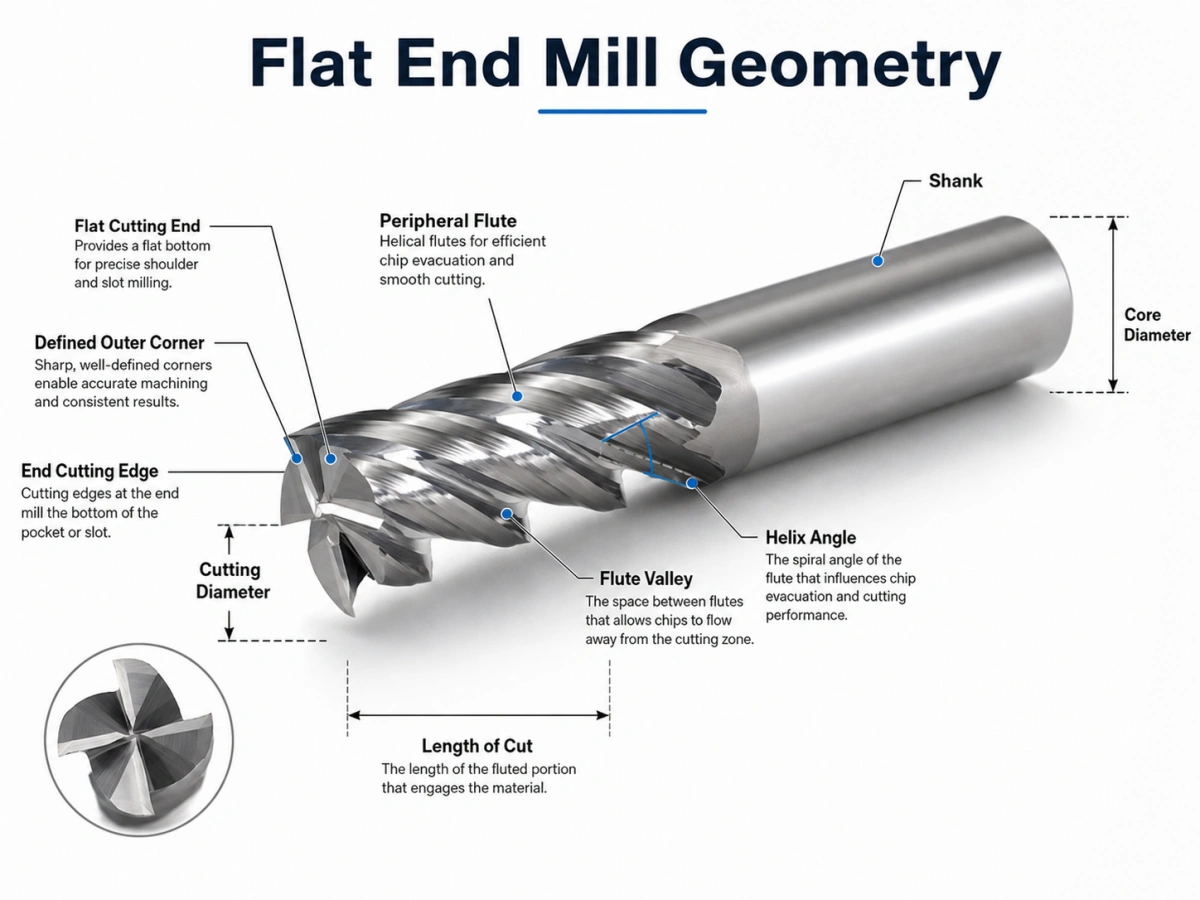
A flat end mill is more than a cutter with a flat bottom. Its performance depends on the relationship between the cutting corners, flute valleys, core, มุมเกลียว, end cutting edges, and peripheral flutes.
Flat Cutting End and Outer Corners
The cutting end has a generally flat profile. Its outer corners connect the end cutting edges with the peripheral cutting edges.
A sharp corner creates a clear transition between the bottom and side wall. อย่างไรก็ตาม, it also concentrates cutting stress. Corner chipping becomes more likely when the setup has excessive runout, ยื่นยาว, การตัดขัดจังหวะ, or aggressive engagement.
When the part drawing allows a corner radius, a bull nose design can strengthen the cutting corner. When the component requires a sharper internal transition, a flat end profile remains the more suitable option.
End and Peripheral Cutting Edges
The end cutting edges remove material near the tool bottom. Their detailed geometry also affects how the cutter enters the workpiece.
Do not assume that every flat end mill can plunge directly into solid material. Some designs support controlled plunging, ลาด, หรือทางเข้าแบบเกลียว. Other tools may require side entry or an existing opening.
Peripheral cutting edges run along the outside diameter. They influence side-wall accuracy, radial cutting action, การสร้างชิป, แรงตัด, และการตกแต่งพื้นผิว.
Flute Valley and Core Diameter
The flute valley provides space for chip flow. ขณะเดียวกัน, the core is the solid material that supports the cutting edges.
This creates a practical trade-off:
- Larger flute valleys improve chip evacuation.
- A larger core increases tool rigidity.
- More cutting edges may improve productivity or surface quality.
- Too many flutes can cause chip packing in deep slots.
A lower flute count is often selected when chip volume is high. A higher flute count is more common when radial engagement is lower and rigidity or finishing performance matters more.
มุมเกลียว
The helix angle controls how gradually the cutting edge enters the material and how cutting forces move through the cutter.
Typical starting points include:
- Around 35°–40° for general machining and stronger cutting edges
- Around 45° for smoother cutting and finishing
- Higher helix angles for improved chip flow, with greater axial force
- Lower helix angles for stronger edges and lower lifting force
These values are not fixed rules. เส้นผ่านศูนย์กลางเครื่องมือ, วัสดุชิ้นงาน, การนับขลุ่ย, การว่าจ้าง, and machine rigidity still determine the final geometry.
Cutting Length and Tool Overhang
Long cutting edges improve reach, but they reduce rigidity. ส่งผลให้, the cutter becomes more sensitive to deflection, วิ่งหมด, และการสั่นสะเทือน.
Use the shortest practical flute length and tool overhang whenever possible. A rigid holder, วิ่งต่ำ, and a strong shank also improve stability.
A short-flute, long-neck design can often reach a deep feature with better rigidity than a fully fluted long cutter.
How Does a Flat End Mill Cut?
The spindle rotates the cutter while the CNC machine controls its movement relative to the workpiece. Each cutting edge enters the material, forms a chip, and leaves the cutting zone.
The end edges act near the tool bottom. ขณะเดียวกัน, the peripheral flutes cut the side of the feature. The actual load distribution depends on axial depth, การสู้รบในแนวรัศมี, entry method, และเส้นทางเครื่องมือ.
Chip Formation and Evacuation
Each cutting edge shears a chip from the workpiece. The flute must then carry the chip away before the next edge reaches the same area.
Poor chip evacuation may cause:
- การตัดชิป
- Excessive heat
- ขอบที่สร้างขึ้น
- ความเสียหายที่ล้ำสมัย
- พื้นผิวไม่ดี
Chip control becomes especially important during deep pocket machining, ช่องเต็มความกว้าง, aluminum machining, and other high-volume cutting operations.
Air blast, สารหล่อเย็น, or another suitable chip-removal method should match the material and machining process. The main objective is simple: chips must leave the cutting zone quickly and consistently.
Practical Geometry Choices by Material
The following tables provide practical starting points. Final selection still depends on the material grade, ความแข็ง, เส้นผ่านศูนย์กลางของเครื่องมือ, สภาพเครื่อง, วิธีหล่อเย็น, และเส้นทางเครื่องมือ.
Typical Geometry by Workpiece Material
| ชิ้นงาน | เรขาคณิตทั่วไป | Main Risk |
| Aluminum and non-ferrous alloys | 2–3 ขลุ่ย, large flute valleys, sharp or polished edges | Chip welding and built-up edge |
| General steel | 4 or more flutes with a stronger core | ความร้อน, สวมใส่, and deflection |
| สแตนเลส | Rigid tool, stable edge, controlled engagement | Heat and work hardening |
| เหล็กหล่อ | Wear-resistant substrate and reinforced edge | Abrasive wear |
| เหล็กชุบแข็ง | Strong core, ระยะยื่นสั้น, reinforced edge | Chipping and rapid wear |
Typical Coating Direction
| ชิ้นงาน | Coating Direction | โฟกัสการเลือก |
| Aluminum and non-ferrous alloys | ไม่เคลือบผิว, เนื้อหาดาวน์โหลด, TiB2, or another suitable option | Low friction and reduced adhesion |
| General steel | TiAlN, อัลทิน, หรือการเคลือบเฉพาะงาน | Heat and wear resistance |
| สแตนเลส | Heat-resistant coating selected by material grade | Stable cutting and heat control |
| เหล็กหล่อ | เคลือบทนต่อการสึกหรอ | Abrasion resistance |
| เหล็กชุบแข็ง | High-temperature coating selected by actual HRC | Edge strength and heat resistance |
สำหรับอะลูมิเนียม, พื้นที่ชิป, ขอบคม, and low material adhesion are usually the main priorities. Two- or three-flute designs often provide more room for chip evacuation.
For general steel, rigidity and heat resistance usually become more important. Four or more flutes may work well when chip load and radial engagement remain under control.
For hardened steel, always provide the actual hardness. HRC 45, HRC 55, และเหล็กแผ่นรีดร้อน 65 require different tool materials, edge preparations, การเคลือบ, และพารามิเตอร์การตัด.
Coating and Edge Preparation
Uncoated or polished tools often suit aluminum, ทองแดง, และวัสดุที่ไม่ใช่เหล็กอื่นๆ. Their sharp, low-friction surfaces help reduce built-up edge.
TiAlN and AlTiN coatings are widely used for steel, สแตนเลส, เหล็กกล้าเครื่องมือ, and other heat-intensive applications. อย่างไรก็ตาม, coating selection must still match the exact workpiece grade and machining conditions.
DLC and similar low-friction coatings are often considered for aluminum and other non-ferrous materials because they can reduce material adhesion.
Edge preparation matters as much as coating. A very sharp edge lowers cutting force but may chip during hard or interrupted cutting. A light hone strengthens the edge, although it also increases cutting force.
Flat End Mill Troubleshooting Guide
| Problem | Likely Cause | Practical Correction |
| พูดพล่อย | ยื่นยาว, weak holding, or high engagement | Shorten overhang and reduce engagement |
| Tapered wall | Tool deflection or excessive cutting load | Use a shorter tool or add a finishing pass |
| การบรรจุชิป | Too many flutes or poor chip removal | Use fewer flutes and improve chip evacuation |
| ขอบที่สร้างขึ้น | Unsuitable edge, การเคลือบ, or chip load | Use a sharper edge and suitable lubrication |
| การบิ่นมุม | วิ่งหนี, impact, or interrupted cutting | Reduce entry shock and check runout |
| Poor finish | พูดพล่อย, recutting, or deflection | Improve rigidity and remove chips effectively |
How to Reduce Chatter and Deflection
Start with the mechanical setup:
- Reduce tool overhang.
- Use the shortest practical cutting length.
- Improve holder and workpiece rigidity.
- Reduce radial or axial engagement.
- Avoid sudden full engagement in internal corners.
- Leave a controlled finishing allowance.
Do not reduce feed to an extremely low value without checking chip load. Feeding too slowly can cause the cutting edge to rub instead of cut. This increases heat and may worsen surface finish.
How to Improve Chip Evacuation
For deep slots and high chip volume:
- Choose fewer flutes or larger flute valleys.
- Direct air or coolant into the cutting zone.
- Prevent chips from being cut again.
- Reduce axial depth when chips cannot escape.
- Consider chipbreaker geometry for long chips.
Flat End Mill vs Square End Mill
In many solid end mill catalogs, “flat end mill” and “square end mill” describe the same general geometry: a flat cutting end with defined outer corners.
The terms emphasize different details:
- “Flat” describes the bottom profile.
- “Square” describes the corner where the end and peripheral cutting edges meet.
Buyers should still confirm the drawing. Some suppliers distinguish between a sharp corner, a small protective chamfer, and a small corner radius.
A square end mill is also different from a square shoulder milling cutter. A square shoulder cutter describes a tool or milling system designed to produce a 90° shoulder. It may use indexable inserts and may not resemble a solid flat end mill.
Flat End Mill vs Bull Nose and Ball Nose Geometry
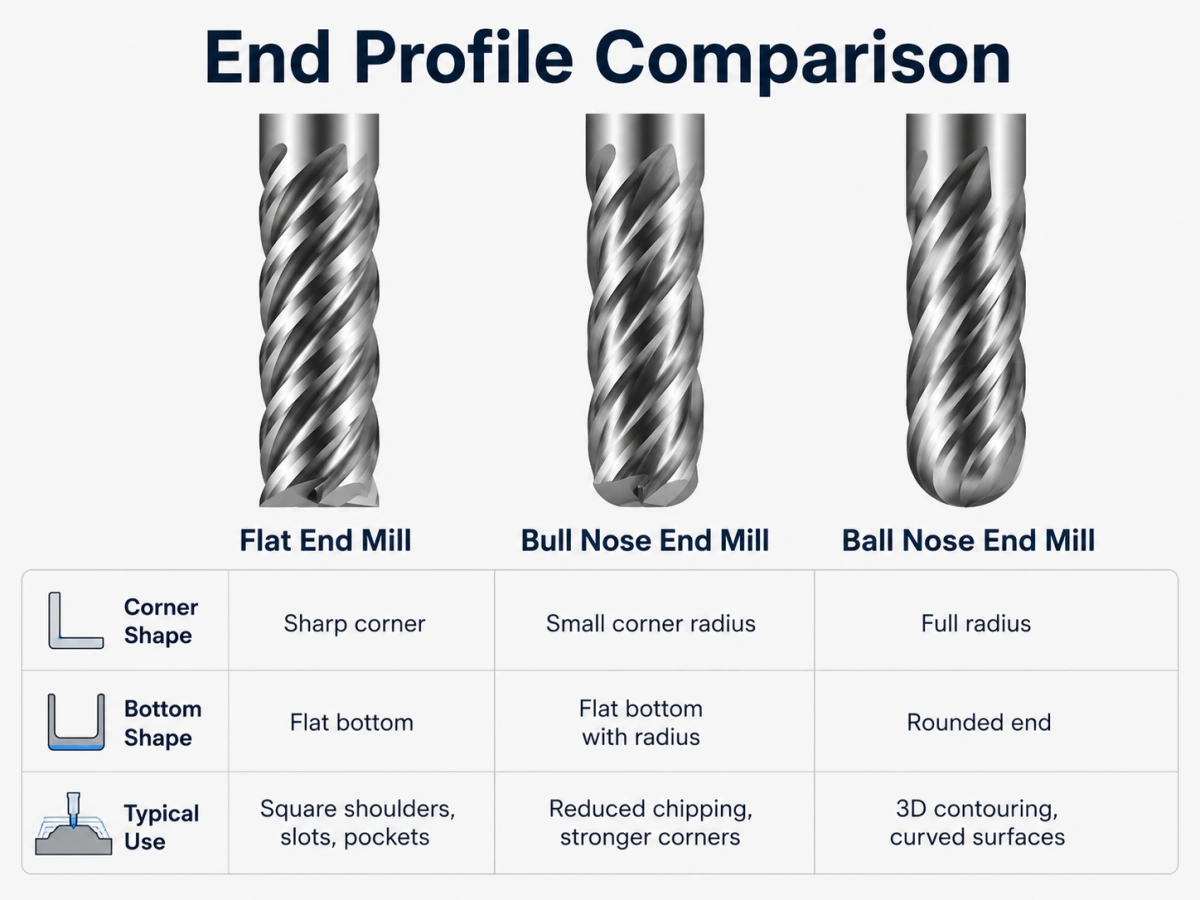
แบน, จมูกวัว, and Ball Nose Comparison
| Tool Profile | เรขาคณิตปลาย | Main Effect |
| ดอกเอ็นมิลล์แบบแบน | Flat end with defined corners | Produces flat bottoms and sharper transitions |
| ดอกเอ็นมิลล์บูลโนส | Flat center with corner radii | Strengthens corners and reduces chipping |
| ดอกเอ็นมิลล์บอลโนส | Fully rounded end | Supports curved and 3D surface machining |
A bull nose end mill strengthens the cutting corner, while a flat profile preserves a sharper internal transition. เพื่อการเปรียบเทียบที่ละเอียดยิ่งขึ้น, อ่าน บูลโนสกับดอกเอ็นมิลล์แบบแบน.
For fully rounded cutting-end geometries, ตรวจสอบของเรา ดอกเอ็นมิลจมูกบอล.
What Information Should You Send to a Tool Supplier?
A professional recommendation requires more than the tool diameter.
Send the following information:
- Workpiece material and exact grade
- ความแข็งของวัสดุ, including HRC when applicable
- เส้นผ่านศูนย์กลางการตัด
- ความยาวขลุ่ย
- ความยาวโดยรวม
- เส้นผ่านศูนย์กลางก้าน
- Required reach or neck length
- การนับขลุ่ย
- Machining operation and entry method
- Coolant or dry-cutting condition
- Required tolerance and surface finish
- ปริมาณการสั่งซื้อ
- การวาดเครื่องมือหรือการวาดชิ้นส่วน
This information helps the supplier evaluate the tool material, เรขาคณิตของขลุ่ย, มุมเกลียว, การเตรียมขอบ, การเคลือบ, and rigidity.
For non-standard dimensions or application-specific tools, ตรวจสอบของเรา ดอกเอ็นมิลล์แบบกำหนดเอง service.
คำถามที่พบบ่อย
What is another name for a flat end mill?
Many suppliers also use the term square end mill. Some catalogs use flat bottom end mill, although the drawing should confirm the actual corner geometry.
Are all flat end mills made of solid carbide?
No. Tool material and construction can be selected according to the workpiece, เครื่องจักร, ปริมาณการผลิต, สภาพการตัด, และความต้องการของลูกค้า.
Can flat end mills have different flute counts?
ใช่. Two, สาม, สี่, six, and custom flute counts are possible. The correct choice depends on chip volume, ความแข็งแกร่ง, การว่าจ้าง, วัสดุ, และข้อกำหนดด้านการตกแต่งพื้นผิว.
Is every flat end mill suitable for direct plunging?
No. Direct plunging depends on the center and end-cutting geometry. Confirm whether the tool supports plunging, ลาด, รายการลาน, ทางเข้าด้านข้าง, or machining from an existing opening.
บทสรุป
A flat end mill is defined by its flat cutting profile and defined outer corners. Its performance depends on the relationship between flute valley, ความแข็งแกร่งหลัก, มุมเกลียว, ความยาวตัด, การเตรียมขอบ, การเคลือบ, และส่วนยื่นของเครื่องมือ.
The machining result also provides useful clues. Chatter points toward instability or excessive engagement. Tapered walls suggest deflection. Chip packing indicates poor evacuation. Corner damage may show that the edge geometry or cutting load does not match the job.
Understanding these signals helps engineers select a more suitable cutter. It also gives purchasing teams the information needed to request an accurate quotation.
Discuss Your Flat End Mill Requirement
Review our standard and custom ดอกเอ็นมิลล์แบบแบน options for different tool materials, ขนาด, การนับขลุ่ย, มุมเกลียว, การเคลือบ, และสภาวะการตัดเฉือน.
Please send your workpiece material, ความแข็ง, ขนาดเครื่องมือ, การทำงานของเครื่องจักร, ปริมาณ, และการวาดภาพถ้ามี.
อีเมล: sales@cutterbest.com