 Präzisions-Fräser,Schneidwerkzeuge für die CNC-Bearbeitung jedes Materials

Einführung
In der CNC-Bearbeitung, bull nose vs ball nose is a common comparison because the right end mill affects surface finish, Standzeit des Werkzeugs, Bearbeitungsstabilität, und Gesamteffizienz. Many machinists want to understand the difference between a bull nose end mill and a ball nose end mill.
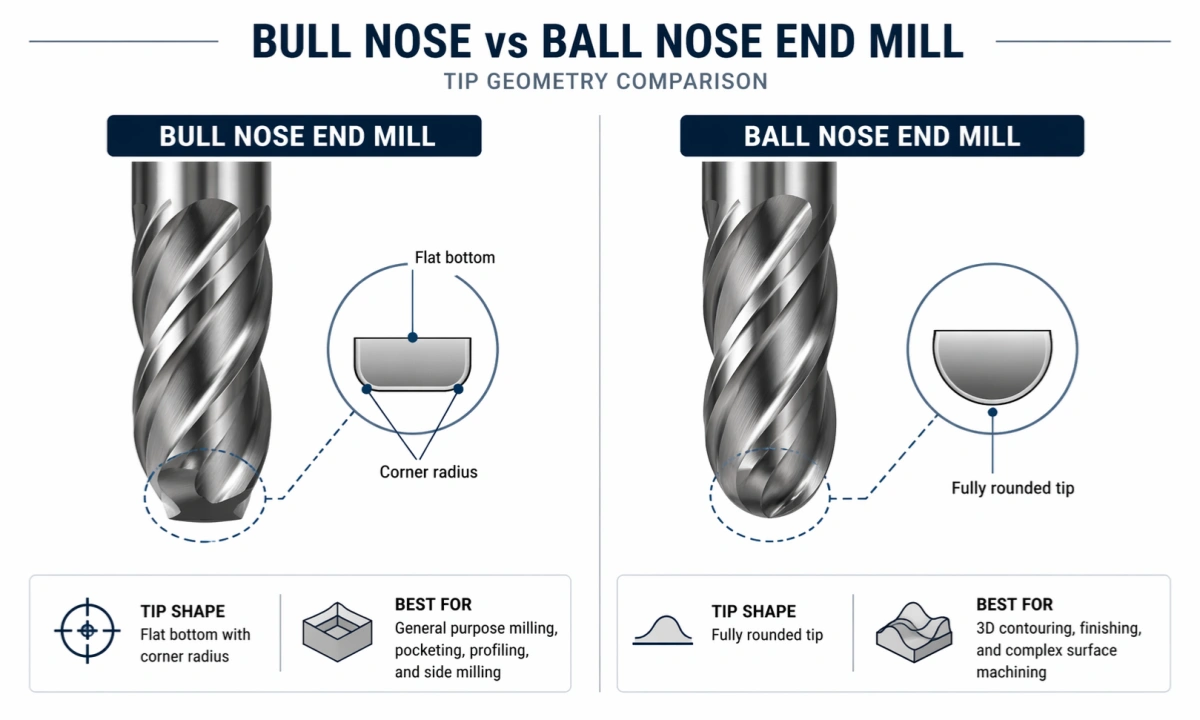
Obwohl diese beiden Fräser beide in der konturbezogenen Bearbeitung eingesetzt werden, Sie sind nicht für genau den gleichen Zweck konzipiert. Ein Bull-Nose-Schaftfräser hat eine flache Unterseite mit einem Eckenradius, während ein Kugelkopffräser eine vollständig abgerundete Spitze hat. Aufgrund dieses Unterschieds, Jedes Werkzeug leistet in bestimmten Bearbeitungssituationen eine bessere Leistung.
In einfachen Worten, Bei stärkeren Ecken wird oft ein Schaftfräser mit abgerundeter Nase bevorzugt, sanftere Übergänge, und eine bessere Kontrolle auf abgestuften oder halbflachen Flächen ist erforderlich. Im Gegensatz dazu, Ein Kugelkopffräser ist normalerweise die bessere Option für kontinuierliche 3D-Oberflächen und komplexe gekrümmte Formen.
If you need stronger corner support, Halbfertigbearbeitung, or stepped profile machining, Sehen Sie sich unsere an custom R corner cutter options.
If your project focuses on 3D contour finishing or curved surface machining, Sie können auch unsere überprüfen Kugelkopffräser.
Schnelle Antwort
This bull nose vs ball nose comparison helps you choose the right cutter based on tip geometry, Eckstärke, 3D Oberflächenbearbeitung, and finish requirements.
Wählen Sie ein Bull-Nase-Schaftfräser wenn Sie eine bessere Eckfestigkeit benötigen, stabilere Konturierung, und sanftere Übergänge auf Profilen oder Stufenflächen.
Wählen Sie einen Kugelkopffräser, wenn Sie kontinuierlichen Kontakt auf 3D-Oberflächen benötigen, geformte Formen, oder komplexe gebogene Teile.
In vielen realen Bearbeitungsaufgaben, Die entscheidende Frage ist nicht, welches Tool allgemein besser ist. Stattdessen, Die bessere Wahl hängt von der Teilegeometrie ab, Bearbeitungsziel, und Finish-Anforderung.
Was ist ein Bull-Nose-Schaftfräser??
Ein Bull-Nose-Schaftfräser ist ein Schaftfräser mit flachem Boden und abgerundetem Eckenradius. In Bezug auf Geometrie und Anwendung liegt er zwischen einem Flachfräser und einem Kugelfräser.
Denn die scharfe Ecke wird durch einen Radius ersetzt, Die Schneidkante wird stärker und splittert weniger leicht ab. Gleichzeitig, Der flache Boden ermöglicht dennoch eine praktische Bearbeitung vieler Profile, Schritte, und halbebene Oberflächen. Infolge, Für das Konturfräsen wird häufig ein Stirnfräser verwendet, Halbfertigbearbeitung, Hohlraumbearbeitung, und Formenbau.
If you want a more complete explanation of tool geometry and common uses, Lesen Sie unsere Werkzeuggeometrie- und Anwendungshandbuch.
Was ist ein Kugelfräser??
Ein Kugelkopffräser hat eine vollständig abgerundete Spitze. Im Gegensatz zu einem Bull-Nose-Schaftfräser, es hat keinen flachen Boden. Diese Geometrie ermöglicht einen gleichmäßigeren Kontakt des Werkzeugs mit gekrümmten und dreidimensionalen Oberflächen.
Aus diesem Grund, Ein Kugelkopffräser wird üblicherweise bei der 3D-Konturbearbeitung verwendet, geformte Oberflächen, Formveredelung, und Freiformgeometrie. Jedoch, weil die Spitze vollständig abgerundet ist, Auf flachen oder gestuften Flächen ist er in der Regel weniger effizient als ein Schaftfräser.
In der Praxis, Ein Kugelkopffräser wird häufig ausgewählt, wenn der Bearbeitungspfad kontinuierliche Kurven anstelle von Merkmalen mit flachem Boden oder halbflachen Merkmalen umfasst.
For 3D contour finishing, Bearbeitung gekrümmter Oberflächen, und Formveredelung, Sie können unsere ansehen Kugelkopffräser.
Der Hauptunterschied zwischen einem Bull Nose-Schaftfräser und einem Kugelkopf-Schaftfräser
Der Hauptunterschied liegt in der Spitzengeometrie, und dieser Unterschied wirkt sich direkt auf das Schneidverhalten aus, Verarbeitungsqualität, und Anwendungsbereich.
Bull-Nose-Schaftfräser-Geometrie
Ein Bull-Nose-Schaftfräser hat:
- ein flacher Boden
- ein Eckradius
- stärkere Kantenunterstützung
- Bessere Kontrolle auf abgestuften oder halbflachen Flächen
Geometrie des Kugelfräsers
Ein Kugelkopffräser hat:
- eine vollständig abgerundete Spitze
- kontinuierlicher gekrümmter Kontakt
- bessere Leistung auf 3D-Oberflächen
- weniger Unterstützung für die Bearbeitung flacher Böden
Warum Geometrie wichtig ist
Ein Bull-Nose-Schaftfräser bietet in der Regel eine bessere Eckenhaltbarkeit und praktischeres Schneiden bei abgestuften oder halbflachen Formen. Ein Kugelkopffräser, Jedoch, ist besser, wenn sich das Werkzeug reibungslos über komplexe gekrümmte Oberflächen bewegen muss. Zusamenfassend, Ein Bull-Nose-Werkzeug ist hinsichtlich Festigkeit und Konturstabilität ausgewogener, Während ein Kugelkopfwerkzeug eher auf die Bearbeitung gekrümmter Oberflächen spezialisiert ist.
Schnelle Vergleichstabelle
| Bearbeitungsbedarf | Bessere Wahl |
|---|---|
| Stärkere Schnittecken | Bull-Nase-Schaftfräser |
| Kontinuierliche 3D-Oberflächen | Kugelkopffräser |
| Vorschlichten und Konturieren | Bull-Nase-Schaftfräser |
| Glatte Freiformoberflächenbearbeitung | Kugelkopffräser |
| Bessere Kontrolle auf ebenen Flächen | Bull-Nase-Schaftfräser |
| Geformte Formdetails | Kugelkopffräser |
Diese Tabelle ist bewusst einfach gehalten, damit sie auf mobilen Geräten gut lesbar bleibt.
Oberflächenbeschaffenheit und Schnittleistung
Bei konturbezogenen Arbeiten können zwar beide Werkzeuge eingesetzt werden, ihr Schneidverhalten ist unterschiedlich.
Oberflächenfinish auf gekrümmten Oberflächen
Ein Kugelkopffräser ist oft die bessere Wahl für kontinuierlich gekrümmte Oberflächen, da sich die abgerundete Spitze reibungsloser über 3D-Konturen bewegt. daher, Es wird häufig bei der Endbearbeitung von Formen eingesetzt, stirbt, und geformte Teile.
Oberflächenfinish auf abgestuften oder halbflachen Flächen
Ein Stirnfräser ist oft praktischer, wenn das Werkstück Übergänge zwischen flachen und gebogenen Abschnitten aufweist. Weil es einen flachen Boden und einen Eckenradius hat, Es kann ein besseres Gleichgewicht zwischen Oberflächenqualität und Schnittstabilität bieten.
Werkzeugstabilität
Ein Bull-Nose-Schaftfräser hat normalerweise stärkere Ecken. Infolge, Unter anspruchsvollen Bedingungen, bei denen es auf die Kantenhaltbarkeit ankommt, ist die Leistung oft besser. Ein Kugelkopffräser kann immer noch eine sehr gute Leistung erbringen, Allerdings ist seine vollständig abgerundete Spitze nicht immer die effizienteste Wahl für jede Geometrie.
Werkzeuglebensdauer
In vielen praktischen Anwendungen, Ein Bull-Nose-Schaftfräser kann eine bessere Kantenunterstützung und ein geringeres lokales Absplitterungsrisiko bieten. Ein Kugelkopffräser, Jedoch, Erbringt oft eine bessere Leistung, wenn die Priorität auf einer glatten Endbearbeitung bei durchgehenden Kurven liegt und nicht auf einer stärkeren Eckenhaltbarkeit.
Welches Tool ist für verschiedene Anwendungen besser??
Die Antwort hängt von der Anwendung ab. Jedes Werkzeug hat klare Stärken bei spezifischen Bearbeitungsaufgaben.
Bull-Nase-Schaftfräser ist besser für
- Konturfräsen
- Halbfertigbearbeitungen
- Hohlraumbearbeitung
- Formbearbeitung mit stärkerer Kantenunterstützung
- abgestufte oder teilweise ebene Flächen
- Arbeiten, bei denen das Abplatzen von Ecken ein Problem darstellt
Der Kugelkopffräser ist besser für
- kontinuierliche 3D-Oberflächenbearbeitung
- geformte Formen
- geschwungene Finishing-Strecken
- Formfinish auf Freiformflächen
- Teile mit komplexer fließender Geometrie
Für die 3D-Konturbearbeitung und die Bearbeitung gekrümmter Oberflächen, Sie können sich auch unsere ansehen Kugelkopffräser.
Beste praktische Wahl
Wenn der Auftrag sowohl halbflache Übergänge als auch gekrümmte Elemente umfasst, Ein Stirnfräser ist oft vielseitiger. Wenn es sich bei dem Auftrag überwiegend um eine 3D-Endbearbeitung mit kontinuierlicher Krümmung handelt, Ein Kugelkopffräser ist normalerweise die bessere Option.
So wählen Sie das richtige Werkzeug aus
Die Wahl zwischen einem Schaftfräser mit Kugelkopf und einem Schaftfräser mit Kugelkopf hängt von der Form des Teils ab, Bearbeitungsziel, und Finish-Anforderung.
Wählen Sie wann einen Bull-Nase-Schaftfräser
- Sie benötigen eine bessere Eckfestigkeit
- Sie bearbeiten Stufenprofile oder halbflache Übergänge
- Sie möchten ein stabileres Vorschlichten oder Konturfräsen
- Sie möchten lokale Kantenabsplitterungen reduzieren
Wählen Sie wann einen Kugelkopffräser
- Sie bearbeiten kontinuierliche 3D-Oberflächen
- Sie benötigen einen sanfteren Kontakt bei gekrümmter Geometrie
- you are finishing sculpted molds or freeform parts
- you want a more natural toolpath on complex contours
Choose Based on the Most Critical Feature
If the part includes both curved and stepped features, choose the tool based on the most critical surface. In many real applications, machinists may use a bull nose end mill for semi-finishing and a ball nose end mill for final 3D finishing. This approach often gives a better balance between efficiency and surface quality.
If you also need to compare bull nose with a sharp-corner flat-bottom tool, Lesen Sie unsere Vergleichsführer für Flachschaftfräser.
Common Search Confusion
Many users compare bull nose, Kugelnase, and flat end mills at the same time. Jedoch, each comparison has a different search intent.
- Bull-Schaft-Schaftfräser vs. Kugel-Schaftfräser focuses on flat bottom with corner radius vs fully rounded tip
- Bull Nose vs. Flachschaftfräser konzentriert sich auf abgerundete Ecken vs. scharfe Ecken
- Was ist ein Bull-Nose-Schaftfräser? konzentriert sich auf die Werkzeugdefinition, verwendet, und Geometrie
To keep the topic clear, this article focuses on the difference between a bull nose end mill and a ball nose end mill. If you need other comparisons, you can read the related guides for flat end mills or general bull nose tool geometry.
Häufig gestellte Fragen
Was ist der Unterschied zwischen einem Schaftfräser mit Kugelkopf und einem Schaftfräser mit Kugelkopf??
Ein Bull-Nose-Schaftfräser hat eine flache Unterseite mit einem Eckenradius, während ein Kugelkopffräser eine vollständig abgerundete Spitze hat. daher, Für stärkere Ecken und halbflache Profile ist das Bullnose-Werkzeug normalerweise besser geeignet, Für durchgehende 3D-Oberflächen ist das Kugelkopfwerkzeug hingegen besser geeignet.
Welches Werkzeug eignet sich besser für die 3D-Oberflächenbearbeitung??
Ein Kugelkopffräser ist normalerweise die bessere Wahl für kontinuierliche 3D-Oberflächen, da seine abgerundete Spitze der gekrümmten Geometrie reibungsloser folgt.
Welches Werkzeug eignet sich besser zum Konturfräsen??
In vielen Konturfräsanwendungen, Ein Bull-Nose-Schaftfräser ist praktischer, da er eine stärkere Kantenunterstützung und eine bessere Kontrolle bei abgestuften oder halbflachen Profilen bietet.
Ist ein Schaftfräser mit Kugelkopf stärker als ein Schaftfräser mit Kugelkopf??
In vielen Anwendungen, Ja. Ein Bull-Nose-Schaftfräser bietet aufgrund seines flachen Bodens und des Eckenradiusdesigns häufig eine stärkere Kantenunterstützung.
Kann ein Werkzeug das andere ersetzen??
Nicht ganz. Diese Tools können sich in einigen Anwendungen überschneiden, Sie sind jedoch für unterschiedliche Oberflächentypen und Endbearbeitungsziele konzipiert.
Wo kann ich die Spezifikationen des Bull-Nose-Schaftfräsers überprüfen??
Sie können unsere ansehen custom R corner cutter options for dimensions, Radiusoptionen, und Bearbeitungsdetails.
Where can I check ball nose end mill specifications?
Sie können unsere ansehen Kugelkopffräser for 3D contouring, Bearbeitung gekrümmter Oberflächen, Formveredelung, and related specifications.
Abschluss
In this bull nose vs ball nose comparison, the two cutters may seem similar, Sie sind jedoch für unterschiedliche Bearbeitungsanforderungen konzipiert. Für stärkere Ecken ist ein Schaftfräser in der Regel besser geeignet, Halbfertigbearbeitung, Konturstabilität, und Stufenprofile. Für glatte 3D-Oberflächen ist ein Kugelfräser in der Regel besser geeignet, geformte Formen, und Freiformbearbeitung.
daher, Die richtige Wahl hängt von der Teilegeometrie ab, Schnittstrategie, und Finish-Anforderung. For stronger edge support, Halbfertigbearbeitung, or stepped profile machining, Ein Stirnfräser ist oft die bessere Option. For continuous 3D contour finishing, Bearbeitung gekrümmter Oberflächen, or mold finishing, Ein Kugelkopffräser ist normalerweise das richtige Werkzeug.
For custom radius options and stepped profile machining, Sehen Sie sich unsere an custom R corner cutter options.
Für die 3D-Konturbearbeitung und die Bearbeitung gekrümmter Oberflächen, Schauen Sie sich unsere an Kugelkopffräser.
Need help choosing the right cutter? Send us your workpiece material, machining surface, tool diameter, radius or ball size, Beschichtungsanforderung, und Bestellmenge.