 Präzisions-Fräser,Schneidwerkzeuge für die CNC-Bearbeitung jedes Materials

Tapered end mills are CNC milling tools used to machine draft angles, konische Seitenwände, Formhohlräume, deep profiles, schmale Rillen, and detailed machined features. Unlike a standard straight end mill, the cutting diameter gradually increases from the tip toward the shank.
Infolge, the tool can follow angled surfaces while providing more support behind the small cutting tip. Jedoch, the correct cutter still depends on the taper angle, Spitzendurchmesser, Endgeometrie, Werkstückmaterial, Schnitttiefe, und Maschinenzustand.
This guide explains what tapered end mills are used for, how different types work, and how to select a suitable tool for mold making, engraving, Profilfräsen, and other CNC applications.
What Is a Tapered End Mill?
A tapered end mill is a milling cutter with a cutting section that gradually becomes larger from the tip toward the shank. The tool may have a flat end, Kugelnase, Eckradius, or custom cutting profile.
Manufacturers often use these tools when a part includes angled walls, draft angles, tapered grooves, tiefe Hohlräume, or small details that cannot be machined efficiently with a straight cutter.
The main dimensions usually include:
| Tool Feature | Description |
| Kegelwinkel | The angle formed by the tapered cutting section |
| Spitzendurchmesser | The smallest cutting diameter near the tool tip |
| Maximum cutter diameter | The largest diameter of the cutting section |
| Flötenlänge | The length of the cutting edges |
| Gesamtlänge | The complete tool length from tip to shank end |
| Schaftdurchmesser | The diameter held by the tool holder |
| End geometry | Flat end, Kugelnase, radius end, or custom form |
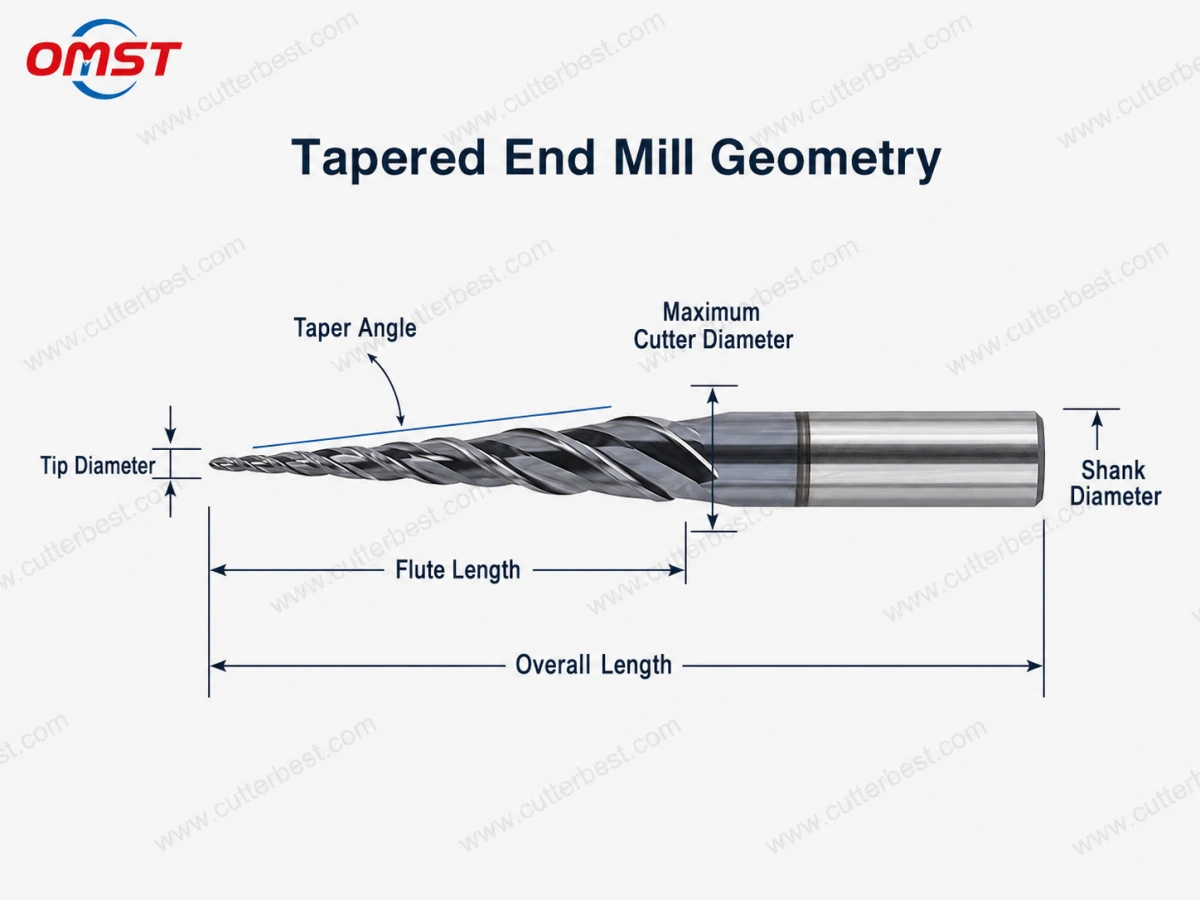
Before ordering a cutter, confirm whether the drawing shows a single-side taper angle or a total included angle. Otherwise, the finished profile may not match the part design.
Wofür werden konische Schaftfräser verwendet??
Tapered end mills are used for CNC operations that require angled surfaces, gradually changing wall profiles, small cutting tips, or improved support during long-reach machining.
Their most common applications include mold making, draft-angle milling, tapered groove cutting, deep-cavity machining, 3D-Konturierung, engraving, and custom profile production.
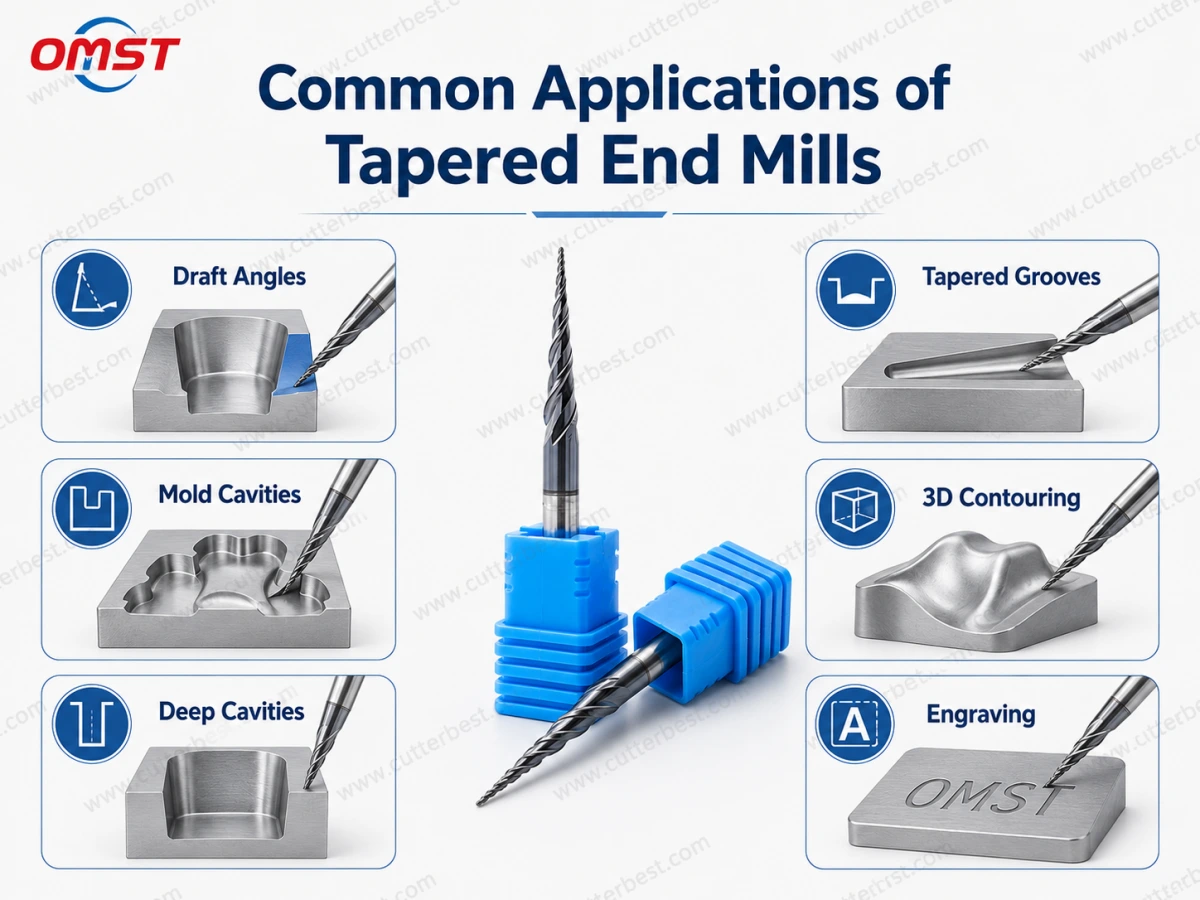
Machining Draft Angles and Tapered Sidewalls
Many molds, stirbt, and machined components include draft angles. These angles help molded parts release more easily and allow designers to create non-vertical walls.
A tapered end mill can machine the required angle directly when the cutter geometry matches the drawing. daher, the tool is often used for:
- Mold draft walls
- Tapered pockets
- Angled sidewalls
- Sloped profiles
- Non-parallel surfaces
Jedoch, the cutter angle must be confirmed carefully. Even a small difference between the tool angle and the drawing can affect the final wall geometry.
Mold and Die Cavity Machining
Mold cavities frequently contain deep areas, schräge Wände, gekrümmte Oberflächen, and detailed transitions. A standard end mill may not reach these features efficiently, especially when the cavity becomes narrow near the bottom.
A tapered cutter can provide a small cutting tip while maintaining a larger cross-section closer to the shank. Folglich, it may offer better rigidity than a straight tool with a similar tip diameter and reach.
Zu den gängigen Formen- und Gesenkanwendungen gehören::
- Injection mold cavities
- Druckgussformen
- Forming dies
- Elektrodenbearbeitung
- Draft-wall finishing
- Detailed cavity profiles
For curved cavities and 3D surfaces, a tapered ball-nose design is often selected.
Deep-Cavity and Long-Reach Machining
Deep cavities require additional tool reach. Trotzdem, increasing the tool length can also increase vibration and deflection.
Because a tapered tool becomes thicker toward the shank, it can provide more support behind the cutting area. This geometry may improve stability during light profiling and finishing operations.
Actual performance still depends on:
- Spitzendurchmesser
- Kegelwinkel
- Flötenlänge
- Werkzeugüberhang
- Tool holder runout
- Steifigkeit der Maschine
- Werkstückmaterial
- Schnittparameter
A tapered design does not replace a proper machining setup. daher, use the shortest practical tool length whenever possible.
Tapered Grooves and Special Profiles
Tapered grooves have non-parallel walls, so they cannot always be produced with a standard straight end mill in one operation.
A taper milling cutter may be used for:
- Tapered slots
- Angled grooves
- V-shaped profiles
- Special form features
- Kundenspezifische CNC-Komponenten
- Non-standard machine parts
When the groove has a special angle or profile, a custom tool may reduce the number of machining steps.
3D Contouring and Curved Surfaces
A tapered ball nose end mill combines a tapered cutting section with a rounded tip. This tool is suitable for curved surfaces, 3D-Konturen, und Formveredelung.
Zu den typischen Anwendungen gehören::
- Endbearbeitung des Formhohlraums
- Curved component surfaces
- 3D profile milling
- Complex die shapes
- Transition surfaces
- Sculptured parts
The ball radius, Kegelwinkel, and tool path must work together. Zusätzlich, a small step-over is normally required when a finer surface finish is needed.
For curved surfaces and 3D profiles that require tapered geometry, siehe unsere Konischer Kugelkopffräser.
Engraving and Fine Detail Machining
Micro tapered end mills are often used for small details, schmale Merkmale, fine engraving, and miniature mold components.
A small tip can enter tight areas. In der Zwischenzeit, the tapered body supports the tool behind the cutting edge.
These tools may be used for:
- Fine lettering
- Small mold details
- Narrow channels
- Decorative profiles
- Precision engraving
- Miniature components
Jedoch, micro cutters are sensitive to runout and excessive cutting load. daher, Werkzeughaltung, Spindelzustand, and cutting parameters must be checked carefully.
Common Tapered End Mill Applications
The following table summarizes several common uses:
| Anwendung | Suitable Cutter Type | Main Selection Point |
| Draft-angle machining | Tapered flat end mill | Match the taper angle to the drawing |
| Endbearbeitung des Formhohlraums | Tapered ball nose end mill | Confirm radius, erreichen, und Oberflächenbedarf |
| Konisches Nutfräsen | Flat-end or custom tapered cutter | Check groove width and wall angle |
| Deep-cavity profiling | Rigid carbide tapered end mill | Minimize overhang and control cutting load |
| Feine Gravur | Micro tapered end mill | Control runout and tip diameter |
| Curved 3D surfaces | Konischer Kugelfräser | Select suitable radius and step-over |
| Custom profiles | Konischer Fräser in individueller Form | Provide a complete drawing and material information |
Why Use a Tapered End Mill?
A tapered end mill is not required for every milling operation. Jedoch, it offers several practical advantages when the workpiece contains angled or difficult-to-reach features.
Improved Rigidity in Long-Reach Applications
A small straight end mill with a long cutting length may deflect under cutting pressure. Im Vergleich, a tapered tool has more material behind the small tip.
Infolge, the increasing cross-section can help improve rigidity during suitable finishing and profile-milling operations.
Trotzdem, rigidity depends on the complete setup. Werkzeugdurchmesser, Hartmetallsorte, Zustand des Halters, Schnitttiefe, and machine stability must also be considered.
Better Access to Angled and Narrow Areas
The small tip can enter narrow areas, while the tapered cutting edges follow an angled wall. daher, one cutter may reach features that would otherwise require several operations or special tool paths.
This is especially useful in mold cavities, detailed parts, and tapered grooves.
Direct Machining of the Required Wall Angle
When the cutter angle matches the part design, the tapered cutting edge can machine the complete wall angle directly.
This may simplify the tool path and improve profile consistency. Jedoch, the angle must be checked before production because drawings may use different angle definitions.
Stable Finishing of Tapered Profiles
A suitable tapered tool can provide stable contact along an angled profile. Zusätzlich, the correct flute design and coating can improve chip evacuation and wear resistance.
For the best result, the cutting parameters should be validated through a controlled test cut before full production.
Common Types of Tapered End Mills
Different end geometries are selected for different workpiece features.
Tapered Flat End Mills
A tapered flat end mill has a flat cutting tip. It is commonly used for:
- Konische Rillen mit flachem Boden
- Angled sidewalls
- Draft profiles
- Mold features
- Tapered slots
This design is suitable when the bottom surface must remain relatively flat.
For this flat-end tapered geometry, siehe unsere Konischer Vierkant-Schaftfräser.
Tapered Ball Nose End Mills
A tapered ball nose end mill has a rounded cutting tip. It is mainly used for:
- Gekrümmte Oberflächen
- 3D-Konturen
- Formhohlräume
- Complex profiles
- Surface finishing
Because the tip is rounded, the tool can follow curved tool paths more smoothly than a flat-end cutter.
Tapered Radius End Mills
A tapered radius end mill includes a corner radius between the tool bottom and side cutting edges.
The radius can strengthen the cutting corner and produce a smooth transition between the bottom and sidewall. daher, this type may be used for semi-finishing, Formprofile, and filleted features.
For tapered cutting geometry with a flat end and R transition, siehe unsere Schaftfräser mit konischem Eckenradius.
Micro Tapered End Mills
Micro tapered cutters have a very small tip diameter. They are used for detailed profiles, schmale Merkmale, engraving, and miniature cavities.
Since the tip is small, runout control is critical. Even limited runout can increase uneven cutting loads and shorten tool life.
Custom Form Tapered Cutters
Some components require a non-standard taper angle, Spitzendurchmesser, Flötenlänge, oder Schnittprofil. In diesen Fällen, the manufacturer can produce a custom cutter according to the drawing.
Cutterbest can review standard and non-standard tapered cutter requirements. Sehen Sie sich unsere an custom tapered cutter product page for available geometry, Beschichtung, and OEM options.
Tapered End Mill vs Straight End Mill
Tapered and straight end mills are used for different machining requirements. A straight end mill maintains a constant cutting diameter, while a tapered cutter gradually increases in diameter toward the shank.
| Auswahlpunkt | Konischer Schaftfräser | Straight End Mill |
| Schnittgeometrie | Tapered cutting section | Constant cutting diameter |
| Main application | Formschrägen, sich verjüngende Wände, und Sonderprofile | Gerade Wände, Taschen, und Spielautomaten |
| Deep reach | Increasing section may improve rigidity | Rigidity depends strongly on diameter and reach |
| Formenbearbeitung | Suitable for draft walls and special cavities | Suitable for general pockets and vertical walls |
| End options | Flat end, Kugelnase, Radius, oder benutzerdefiniert | Flat end, Kugelnase, Radius, and other standard types |
| Hauptabmessungen | Kegelwinkel, Spitzendurchmesser, und erreichen | Cutter diameter and cutting length |
| Anpassung | Often customized for angle and profile | Often selected from standard diameters and lengths |
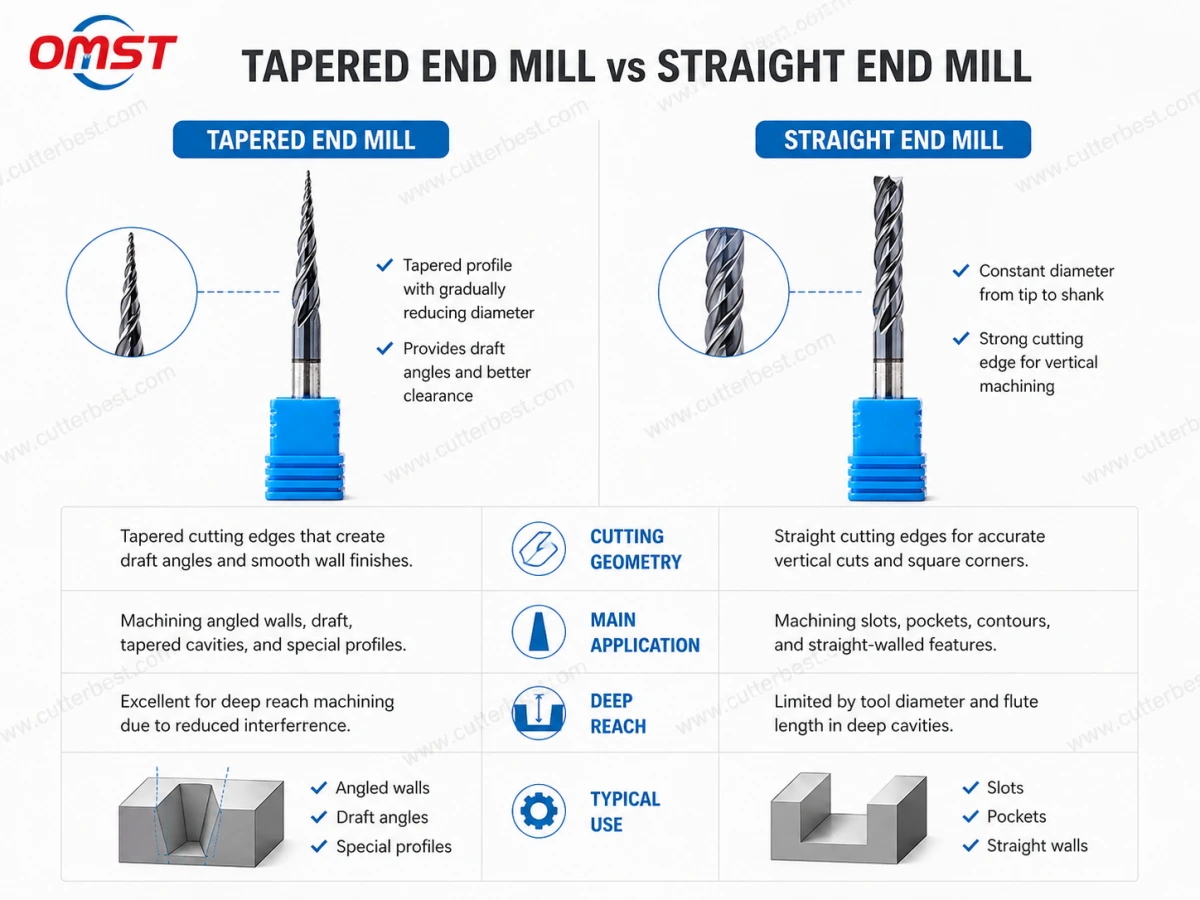
A tapered tool is usually preferred when the wall angle is part of the component design. Im Gegensatz, a straight end mill is normally selected for general slots, Taschen, vertical sidewalls, and standard profile milling.
How to Choose a Tapered End Mill
Selecting a cutter only by the tip diameter is not enough. The complete geometry and machining conditions must be reviewed.
Confirm the Required Taper Angle
Erste, check the drawing and confirm how the angle is specified.
Some drawings show the angle on one side of the tool. Others show the complete included angle. daher, this detail should be confirmed before production.
Also check whether the final wall requires:
- A constant taper
- A draft angle
- A curved transition
- A special profile
- A tolerance on the wall angle
Select the Tip and Maximum Cutter Diameters
The tip diameter affects the smallest feature that the tool can machine.
A smaller tip can enter fine details. Jedoch, it is also more sensitive to vibration, Auslaufen, and excessive cutting load.
The maximum cutter diameter must also fit the cavity opening and part geometry.
Choose the Correct End Geometry
The workpiece shape determines whether a flat end, Kugelnase, radius end, or special profile is required.
| Workpiece Feature | Suggested End Geometry |
| Flat-bottom tapered slot | Tapered flat end |
| Curved mold cavity | Tapered ball nose |
| Filleted transition | Tapered radius end |
| Feine Gravur | Mikrokonischer Fräser |
| Non-standard form | Custom profile cutter |
Check the Flute Length and Tool Reach
Use the shortest flute length and overall length that can safely reach the machining area.
A longer tool increases access. Jedoch, it may also increase vibration and deflection. daher, unnecessary tool extension should be avoided.
The holder should also grip as much of the shank as practical without contacting the workpiece.
Match the Flute Design to the Workpiece Material
Different materials require different cutting-edge and flute designs.
Zum Beispiel, aluminum usually needs sharp edges and sufficient chip space. Im Gegensatz dazu, steel machining often requires stronger cutting edges and suitable wear resistance.
| Werkstückmaterial | General Selection Consideration |
| Aluminum and non-ferrous materials | Sharp edges, polierte Flöten, and good chip evacuation |
| Kohlenstoffstahl | Suitable carbide grade and wear-resistant coating |
| Edelstahl | Sharp geometry, stable holding, and heat-resistant coating |
| Formstahl | Good rigidity, controlled reach, and suitable coating |
| Gusseisen | Wear-resistant geometry and stable cutting conditions |
| Gehärteter Stahl | High-rigidity setup, suitable carbide grade, and controlled parameters |
These recommendations are general. The exact tool should be selected according to material hardness, Maschinenzustand, Kühlmittel, und Schneidvorgang.
Select the Carbide Grade and Coating
The coating should match the workpiece and cutting conditions.
Common options include:
- Uncoated carbide for sharp cutting and some non-ferrous applications
- TiAlN or AlTiN for suitable steel and higher-temperature operations
- TiSiN for selected hard-material applications
- DLC for aluminum and other non-ferrous materials
- Polished flutes for improved chip flow
Jedoch, no coating is ideal for every job. Before selecting one, consider cutting speed, Kühlmittel, Werkstückhärte, Werkzeugdurchmesser, and machining time.
Review Machine Rigidity and Tool Holding
Even the correct cutter may perform poorly if the machine or holder is unstable.
Überprüfen:
- Zustand der Spindel
- Tool-holder runout
- Tool extension
- Werkstückspannung
- Coolant or air supply
- Vorschubgeschwindigkeit
- Spindelgeschwindigkeit
- Axial and radial cutting depth
For micro tools, runout should be controlled as closely as the equipment allows.
How to Use Tapered End Mills More Effectively
Correct operation is especially important when the cutter has a small tip or extended reach.
Minimize Tool Runout
Runout causes one cutting edge to remove more material than the others. Folglich, the load becomes uneven and the small tip may wear or break early.
Use a clean, accurate holder and inspect the spindle and collet regularly.
Use the Shortest Practical Tool Extension
Ein übermäßiger Überhang verringert die Steifigkeit. daher, mount the tool with the shortest extension that still provides safe access to the workpiece.
Jedoch, make sure the holder does not contact the part or fixture.
Avoid Excessive Cutting Loads
Do not apply cutting parameters based only on the shank diameter. The small tip and local cutting diameter must also be considered.
Start with conservative parameters when machining a new material or profile. Dann, adjust the process after checking cutting sound, Spanbildung, Werkzeugverschleiß, und Oberflächenqualität.
Maintain Effective Chip Evacuation
Chips can collect inside deep cavities. If they are recut, surface quality may decline and cutting heat may increase.
Luft, Kühlmittel, or another suitable chip-removal method should be directed toward the cutting zone when practical.
Inspect the Tool and Finished Surface
Regular inspection can identify problems before tool failure occurs.
Suchen:
- Edge wear
- Chipping
- Built-up material
- Uneven flute wear
- Vibration marks
- Schlechte Oberflächenbeschaffenheit
- Profile or dimensional changes
If these signs appear, review runout, Werkzeugerweiterung, Schnittlast, Beschichtung, und Spanabfuhr.
What Information Is Needed for a Custom Tapered End Mill?
Provide the main machining details before requesting a custom tool:
- Werkstückmaterial und Härte
- Taper angle and angle definition
- Tip diameter and maximum cutter diameter
- Flötenlänge, Gesamtlänge, and shank diameter
- End geometry and coating requirement
- Zeichnung, Menge, und Bearbeitungsanwendung
For non-standard cutter geometry, Sehen Sie sich unsere an custom tapered cutter Produktseite:
For other custom cutting tools, Sehen Sie sich unsere an kundenspezifische Schaftfräser.
Häufig gestellte Fragen
What Is a Tapered End Mill Used For?
A tapered end mill is used to machine draft angles, sich verjüngende Wände, tiefe Formhohlräume, schmale Rillen, 3D-Konturen, engraving details, und nicht standardmäßige Profile.
The exact application depends on the taper angle, Spitzendurchmesser, Endgeometrie, Schnittlänge, und Werkstückmaterial.
Are Tapered End Mills Stronger Than Straight End Mills?
A tapered cutting section has more material behind the small tip. daher, it may provide better rigidity than a straight tool with a similar tip diameter and reach.
Jedoch, actual strength still depends on the carbide grade, Werkzeuglänge, tip size, Halterschlag, Schnittparameter, und Werkstückmaterial.
What Is the Difference Between a Tapered Flat End and a Tapered Ball Nose End Mill?
Machinists use a tapered flat end mill for flat-bottom features, tapered grooves, and angled sidewalls.
A tapered ball nose end mill has a rounded tip and is more suitable for curved surfaces, Formhohlräume, 3D-Konturen, und Endbearbeitungsarbeiten.
Can Tapered End Mills Machine Hardened Steel?
Tapered end mills can machine hardened steel when the carbide grade, Beschichtung, Werkzeuggeometrie, Steifigkeit der Maschine, and cutting parameters are suitable.
Vor der Produktion, confirm the material hardness and perform a controlled test cut.
How Is the Taper Angle Specified?
A drawing may specify the taper as either a single-side angle or a total included angle. Because drawing standards and customer descriptions can differ, confirm the angle definition before manufacturing the tool.
Can You Customize Tapered End Mills?
Ja. Wir können den Konuswinkel anpassen, Spitzendurchmesser, maximaler Schnittdurchmesser, Endgeometrie, Flötenlänge, Gesamtlänge, Schaftdurchmesser, Hartmetallsorte, Beschichtung, Lasermarkierung, and packaging according to the application.
Can You Order a Sample Before Production?
We can usually evaluate a sample order based on the cutter geometry, Werkstückmaterial, Beschichtung, manufacturing difficulty, und benötigte Menge.
Please provide a complete drawing before we confirm the tool design and quotation.
Abschluss
Tapered end mills are used for draft angles, konische Seitenwände, Formhohlräume, deep profiles, tapered grooves, 3D-Konturen, engraving, and other detailed CNC applications.
Flat-end tools are suitable for flat-bottom and angled-wall features. Ball-nose designs are better for curved surfaces and mold finishing. In der Zwischenzeit, micro tapered cutters are useful for narrow areas and fine details.
To select the correct tool, confirm the taper angle, Spitzendurchmesser, maximaler Fräserdurchmesser, Endgeometrie, Schnittlänge, Werkstückmaterial, Maschinenzustand, und erforderliche Oberflächenbeschaffenheit.
Für custom tapered cutter Anforderungen, you can send the drawing, Werkstückmaterial, erforderliche Abmessungen, Bearbeitungsanwendung, and order quantity to Cutterbest for review. We can recommend or customize a suitable carbide tapered cutter for sample testing or production machining.